

30 Minute Workout 4 Days a Week: Strength and Fitness Plan

8 Week Strength Training Program for Muscle Growth

4 Week Dumbbell Program: Strength and Muscle Building Plan

45 Minute Kettlebell Strength Training Program: Full-Body Power
3 Day Full Body Barbell Workout: for Strength Muscle & total Power
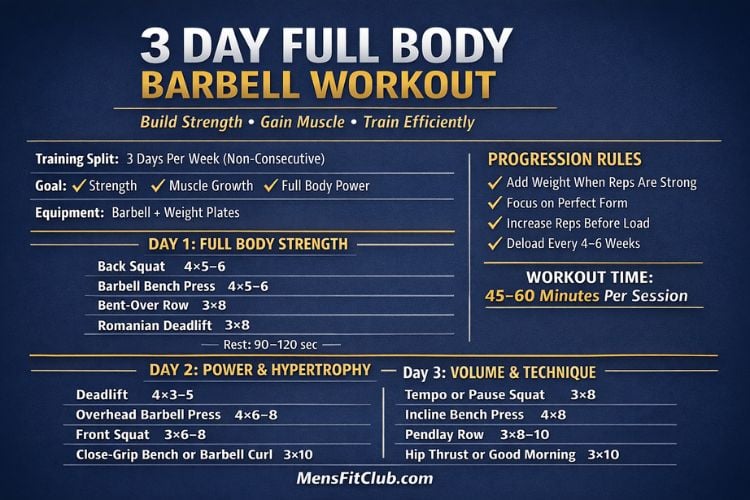
A 3 day full body barbell workout is one of the most effective training structures for building strength, muscle mass, and functional power while keeping workouts efficient and sustainable. Whether your goal is hypertrophy, fat loss, or raw strength, barbell training delivers unmatched results by allowing progressive overload with compound movements that activate the entire body.
Unlike split routines that isolate muscle groups across many days, a full body barbell program trains all major muscle groups multiple times per week. This frequency stimulates greater muscle growth, improves movement patterns, and enhances recovery when programmed correctly. Training three days per week also provides ample rest days, making this approach ideal for beginners, intermediate lifters, and even advanced athletes who value performance and longevity.
This guide breaks down everything you need to know about a 3 day full body barbell workout, including benefits, exercise selection, weekly structure, progression strategies, and a complete workout plan you can follow immediately.
Why Choose a 3 Day Full Body Barbell Workout?
A three-day training schedule strikes the perfect balance between intensity and recovery. Barbell movements demand high neural output and total-body coordination, which makes recovery just as important as training volume.
Training full body three times per week allows you to stimulate muscle protein synthesis frequently while avoiding overuse injuries. This structure also keeps workouts focused on high-value lifts instead of excessive accessory work.
Key Benefits of Full Body Barbell Training
A full body barbell routine improves overall strength by prioritizing compound lifts like squats, deadlifts, presses, and rows. These movements recruit multiple muscle groups simultaneously, leading to greater hormonal responses and improved athletic performance.
Another major benefit is efficiency. Instead of spending six days per week in the gym, you can build impressive strength and size with just three well-planned sessions. This makes the program ideal for busy professionals, athletes, or anyone who wants maximum results with minimal time investment.
Who Is This 3 Day Barbell Workout Program Best For?
A 3 day full body barbell workout is versatile and adaptable, making it suitable for a wide range of lifters.
Beginners benefit from practicing fundamental barbell lifts multiple times per week, accelerating skill development and strength gains. Intermediate lifters can use structured progression to break plateaus and improve overall performance. Advanced lifters can scale intensity and volume to maintain strength while managing recovery.
This routine also works well for those focused on fat loss, as heavy compound lifts burn more calories and preserve lean muscle mass during calorie deficits.
Core Principles of a 3 Day Full Body Barbell Workout Program
Before jumping into the workouts, it’s important to understand the principles that make this routine effective.
Progressive Overload
Progressive overload is the foundation of strength and muscle growth. Each week, you should aim to increase weight, reps, or overall training volume. Small, consistent improvements lead to long-term results.
Compound Movement Focus
Barbell workouts prioritize compound lifts that involve multiple joints and muscle groups. These exercises deliver the highest return on investment for strength, muscle growth, and functional fitness.
Balanced Volume and Recovery
Because the entire body is trained each session, volume must be carefully managed. The goal is to train hard while leaving enough recovery capacity to perform well in the next workout.
Weekly 3 Day Barbell Workout Training Schedule
This program follows a simple three-day structure, typically performed on non-consecutive days.
A common schedule includes training on Monday, Wednesday, and Friday, allowing rest days between sessions. This spacing supports muscle recovery, nervous system adaptation, and consistent performance.
Each workout emphasizes different movement patterns and intensity levels to prevent burnout while maintaining progression.
Warm-Up Guidelines for 3 Day Barbell Workout Training
Proper warm-up is essential before heavy barbell lifting. A well-structured warm-up prepares your joints, muscles, and nervous system for the workload ahead.
Start with five to ten minutes of light cardio or dynamic movement such as rowing, cycling, or brisk walking. Follow this with dynamic mobility drills for hips, shoulders, and thoracic spine.
Finish your warm-up with lighter sets of your main lift, gradually increasing weight until you reach your working sets.
Day 1: Full Body Strength Focus
Day one emphasizes foundational strength with moderate to heavy loads and controlled volume.
Barbell Back Squat 3 Day Workout
The barbell back squat is one of the most effective lower-body exercises for building strength and muscle. It targets the quads, glutes, hamstrings, and core while reinforcing proper movement mechanics.
Perform four sets of five to six reps using a challenging but manageable weight. Rest two to three minutes between sets.
Barbell Bench Press
The bench press develops upper-body pushing strength, targeting the chest, shoulders, and triceps. Focus on controlled reps and proper bar path.
Complete four sets of five to six reps with two minutes of rest between sets.
Barbell Bent-Over Row 3 Day Workout
Rows balance pressing movements and strengthen the upper back, lats, and core. Maintain a neutral spine and pull the bar toward your lower ribs.
Perform three sets of eight reps with controlled tempo.
Barbell Romanian Deadlift
The Romanian deadlift emphasizes posterior chain development, targeting the hamstrings and glutes while reinforcing hip hinge mechanics.
Complete three sets of eight reps with moderate weight.
Day 2: Power and Hypertrophy Emphasis
Day two introduces slightly higher reps and explosive intent to stimulate muscle growth and power output.
Conventional Deadlift 3 Day Barbell Workout
The deadlift is a total-body strength builder that targets the posterior chain, core, and grip strength. Keep reps lower to maintain proper technique.
Perform three to four sets of three to five reps with full recovery between sets.
Overhead Barbell Press
The overhead press builds shoulder strength, upper-body stability, and core engagement. Stand tall and brace your core throughout the lift.
Complete four sets of six to eight reps.
Barbell Front Squat 3 Day Workout
Front squats place greater emphasis on the quads and core while reducing lower-back strain. Maintain an upright torso and controlled descent.
Perform three sets of six to eight reps.
Barbell Curl or Close-Grip Bench Press
Finish the workout with an accessory movement to target the arms. Choose barbell curls for biceps or close-grip bench press for triceps.
Complete three sets of ten reps.
Day 3: Volume and Technique Focus Barbell Workout
Day three prioritizes volume, tempo control, and technical refinement to reinforce movement patterns.
Pause Back Squat or Tempo Squat
Pause or tempo squats increase time under tension and improve control. Use lighter weight than day one.
Perform three sets of eight reps with a brief pause at the bottom.
Incline Barbell Bench Press
Incline bench shifts emphasis to the upper chest and shoulders while maintaining pressing strength.
Complete three to four sets of eight reps.
Pendlay Row or Barbell Row
Pendlay rows improve explosive pulling strength and reinforce proper spinal alignment.
Perform three sets of eight to ten reps.
Barbell Hip Thrust or Good Morning
Choose a posterior chain movement that complements your deadlift. Focus on glute activation and controlled tempo.
Complete three sets of ten reps.
Rest Periods and Training Intensity
Rest periods vary depending on the exercise and training goal. Heavy compound lifts require longer rest intervals of two to three minutes, while accessory movements can use shorter rest periods of 60 to 90 seconds.
Training intensity should feel challenging but sustainable. Avoid training to failure on every set, as recovery is critical when training full body multiple times per week.
Progression Strategy for Long-Term Results
To continue making progress, track your workouts and aim for gradual improvements. Increase weight by small increments when all sets and reps are completed with proper form.
You can also progress by adding reps, increasing total sets, or improving technique and tempo control. Deload every four to six weeks if performance begins to stall.
Nutrition to Support Barbell Training
Nutrition plays a major role in recovery and performance. Consume adequate protein to support muscle repair and growth, aiming for consistent intake throughout the day.
Carbohydrates fuel intense barbell sessions and replenish glycogen stores. Healthy fats support hormone production and joint health. Stay hydrated and prioritize nutrient-dense foods.
Common Mistakes to Avoid
One common mistake is using too much weight too soon. Proper form and consistency matter more than lifting heavy every session.
Skipping warm-ups or neglecting recovery can also hinder progress. Full body barbell training is demanding, and recovery strategies like sleep, mobility work, and rest days are essential.
How Long Should You Follow This Program?
This 3 day full body barbell workout can be followed for eight to twelve weeks with proper progression. After that, you can adjust volume, swap variations, or transition into a more specialized program.
Many lifters find long-term success cycling back to full body training multiple times per year due to its efficiency and effectiveness.
Why This 3 Day Full Body Barbell Workout Works
A 3 day full body barbell workout delivers a powerful combination of strength, muscle growth, and functional fitness. By focusing on compound movements, balanced volume, and progressive overload, this program helps you build a strong, athletic physique without excessive time commitment.
Whether you train at home or in a commercial gym, this routine provides a sustainable path to long-term results. Stay consistent, prioritize recovery, and commit to steady progression — your strength and physique will follow.
Looking to expand your training knowledge alongside this 3 Day Full Body Barbell Workout? Check out our other strength-building and barbell-focused guides like the 20-Minute Full Body Barbell Workout Power Strength Routine for a time-efficient routine that still hits major muscle groups effectively, perfect for busy days. Dive deeper into foundational lifts with our Barbell Program To Build Strength and Muscle Efficiently article for detailed explanations of essential barbell exercises and how to structure your weekly training. If you’re interested in higher-impact conditioning with barbells, our 45 Minute Full Body Barbell Workout to Build Muscle and Burn Fat gives another excellent variation that blends strength with metabolic conditioning. For a variation that focuses on overall strength and muscle growth in a slightly different format, explore the 30-Minute Full Body Barbell Workout: To Build Lean Muscle guide. Finally, complement your barbell training with insights from our Best Barbell Workouts to Boost Strength article, which rounds up some of the most effective barbell routines to increase power and performance.


Most Recommended

Subscribe to our Newsletter
Stay up to date on the latest men’s health, fitness and lifestyle trends and tips.
About Us
Men’s Fit Club was started with the goal of empowering men to get the most out of their lives. This meant going beyond exercise and diet tips to really address the broad range of issues that men face on a daily basis – topics like recreation, finding love, sexual health and even sound fashion advice.
Quick Links
© COPYRIGHT MEN'S FIT CLUB 2026. All Rights Reserved