

4 Week At Home Workout Plan for Strength Muscle and Fat Loss

6 Day Strength Training Program for Maximum Muscle and Power

4 Week Beginner Workout Routine: Your Path to Getting Fit

Strength Training Program for Over 50: Build Muscle & Stay Strong
3-Day Powerlifting Split: Build Maximum Strength (Full Program)
Powerlifting is one of the most effective training styles for building raw strength, muscle mass, and functional performance. Unlike bodybuilding programs that focus on aesthetics, powerlifting training prioritizes performance—specifically improving your one-rep max (1RM) on the squat, bench press, and deadlift. A structured 3 day powerlifting workout split is ideal for beginners, intermediate lifters, and busy athletes who want serious strength gains without training every day.
This guide will walk you through a complete 3 day powerlifting program, including weekly structure, exercise selection, sets and reps, progressive overload strategies, recovery tips, and nutrition guidelines. Whether your goal is to increase strength, compete in powerlifting, or build a strong foundation for athletic performance, this program delivers results.
What Is a 3 Day Powerlifting Workout Split?
A 3 day powerlifting split divides training into three focused sessions per week, typically emphasizing one main lift per day—squat, bench press, and deadlift—along with supporting accessory exercises. This structure allows lifters to maximize strength gains while maintaining recovery and preventing overtraining.
The simplicity of a 3 day split makes it perfect for lifters who want consistent progress without spending five or six days per week in the gym. It also allows ample recovery time between heavy training sessions, which is critical for nervous system recovery and muscle repair.
Benefits of a 3 Day Powerlifting Split Program
A properly designed 3 day powerlifting program offers numerous benefits for both beginners and experienced lifters. First, it improves maximal strength by focusing on compound lifts that engage multiple muscle groups. Second, it builds lean muscle mass through progressive overload and volume work. Third, it enhances athletic performance by increasing force production, coordination, and stability.
Another major benefit is sustainability. Training three days per week reduces burnout, decreases injury risk, and fits easily into busy schedules. Many elite powerlifters and strength athletes have built impressive totals using three weekly training sessions.
Weekly Training Schedule for 3 Day Powerlifting Split
The most common weekly structure is:
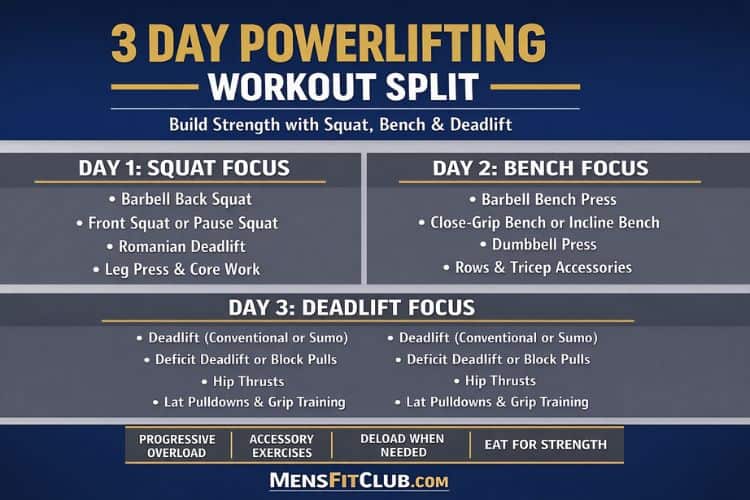
- Day 1: Squat Focus (Lower Body Strength)
- Day 2: Bench Press Focus (Upper Body Strength)
- Day 3: Deadlift Focus (Posterior Chain Strength)
Training days can be scheduled as Monday, Wednesday, and Friday or Tuesday, Thursday, and Saturday, depending on your availability. Rest days between sessions allow muscles and the central nervous system to recover fully.
Day 1 – Squat Focus Workout
Main Lift – Barbell Back Squat
The squat is the foundation of lower body strength and one of the most important powerlifting movements. It targets the quadriceps, glutes, hamstrings, core, and lower back. On squat day, the goal is to train heavy while maintaining perfect technique.
A typical working scheme includes multiple sets of low reps, such as 4 to 6 sets of 3 to 5 reps at 75–85% of your one-rep max. Beginners can start lighter and focus on form before increasing intensity.
Secondary Lift – Front Squat or Pause Squat 3 Day Powerlifting Split
Front squats and pause squats help improve squat mechanics, strengthen the quads, and reinforce proper positioning. These variations build strength in the bottom position and improve carryover to the competition squat.
Accessory Exercises
Accessory movements on squat day focus on lower body hypertrophy and stability. Exercises like Romanian deadlifts, leg presses, lunges, and hamstring curls strengthen supporting muscles and prevent imbalances. Core exercises such as hanging leg raises or planks are also essential for squat stability.
Day 2 – Bench Press Focus Workout 3 Day Powerlifting Split
Main Lift – Barbell Bench Press
The bench press is the primary upper body strength movement in powerlifting. It targets the chest, shoulders, and triceps. On bench day, lifters typically perform multiple sets of low to moderate reps with progressive loading.
A common approach is 5 sets of 3 to 5 reps at 75–85% of 1RM. Technique is crucial, so lifters should focus on controlled descent, strong leg drive, and consistent bar path.
Secondary Lift – Close-Grip Bench or Incline Bench
Close-grip bench presses emphasize the triceps, while incline bench presses target the upper chest and shoulders. These variations improve lockout strength and overall pressing power.
Accessory Exercises 3 Day Powerlifting Split
Accessory exercises for bench day include dumbbell presses, overhead presses, lateral raises, triceps extensions, and rows. Upper back work is essential for bench stability, so exercises like barbell rows, pull-ups, and face pulls should be included.
Day 3 – Deadlift Focus Workout Powerlifting Split
Main Lift – Conventional or Sumo Deadlift
The deadlift is the ultimate test of posterior chain strength, engaging the glutes, hamstrings, lower back, traps, and grip. Lifters can choose conventional or sumo deadlift based on body mechanics and competition goals.
A typical scheme includes 3 to 5 sets of 2 to 5 reps at 75–90% of 1RM. Deadlifts are highly taxing, so volume is often lower than squats and bench presses.
Secondary Lift – Deficit Deadlift or Block Pulls
Deficit deadlifts improve off-the-floor strength, while block pulls target lockout strength. These variations help lifters overcome sticking points and improve overall deadlift performance.
Accessory Exercises
Accessory exercises for deadlift day focus on the posterior chain and upper back. Romanian deadlifts, hip thrusts, glute bridges, back extensions, and lat pulldowns are excellent choices. Grip training, such as farmer’s carries or heavy holds, is also beneficial.
Sets, Reps, and Intensity Guidelines
Powerlifting training revolves around manipulating volume and intensity to drive strength gains. Beginners typically benefit from higher volume and moderate intensity, while intermediate and advanced lifters require heavier loads and structured periodization.
For main lifts, working in the 3–5 rep range at 75–85% of 1RM is ideal for building strength. Accessory exercises can be performed in higher rep ranges, such as 8–15 reps, to promote muscle growth and joint health.
Progressive Overload for Powerlifting
Progressive overload is the key to continuous strength gains. Lifters can increase weight, sets, reps, or training frequency over time. A simple progression method is adding 2.5 to 5 pounds to the main lifts each week as long as all reps are completed with good form.
Another effective strategy is wave loading or block periodization, where training cycles alternate between volume-focused and intensity-focused phases. This prevents plateaus and reduces injury risk.
Deload Weeks and Recovery
Recovery is essential in powerlifting because heavy training places significant stress on the nervous system and muscles. Every 4 to 8 weeks, lifters should incorporate a deload week by reducing volume and intensity by 30–50%.
Adequate sleep, hydration, and mobility work also play a critical role in recovery. Foam rolling, stretching, and light cardio can improve blood flow and reduce soreness.
Nutrition for Powerlifting Strength Gains
Nutrition is a cornerstone of powerlifting performance. Lifters aiming to gain strength should consume a calorie surplus with sufficient protein, carbohydrates, and healthy fats. Protein intake of 0.7 to 1 gram per pound of body weight supports muscle growth and recovery.
Carbohydrates fuel heavy training sessions, while fats support hormone production. Supplements such as creatine monohydrate, caffeine, and protein powder can further enhance performance.
Who Should Use a 3 Day Powerlifting Split?
A 3 day powerlifting split is suitable for beginners, intermediate lifters, and even advanced athletes who need a minimalist but effective program. Beginners benefit from the structured approach and manageable volume, while intermediate lifters can use the program as a base for more advanced periodization.
Busy professionals, athletes, and parents also find this split ideal because it delivers maximum results with minimal time commitment.
Common Mistakes in Powerlifting Training
One common mistake is neglecting technique. Poor form can lead to injuries and stalled progress. Another mistake is overtraining by adding too much volume or intensity too quickly. Lifters should prioritize consistency and gradual progression.
Ignoring accessory exercises is another error. Supporting muscles play a crucial role in improving the main lifts and preventing imbalances.
Sample 3 Day Powerlifting Workout Plan
Day 1 – Squat Focus
- Back Squat
- Front Squat or Pause Squat
- Romanian Deadlift
- Leg Press
- Core Work
Day 2 – Bench Focus
- Bench Press
- Close-Grip Bench or Incline Bench
- Dumbbell Press
- Barbell Rows
- Triceps and Shoulder Accessories
Day 3 – Deadlift Focus
- Deadlift
- Deficit Deadlift or Block Pulls
- Hip Thrusts
- Lat Pulldowns or Pull-Ups
- Grip Training
How Long to Run a 3 Day Powerlifting Program
Most lifters can follow a 3 day powerlifting split for 8 to 16 weeks before needing major changes. Over time, adjustments to volume, intensity, and exercise selection keep progress moving. Tracking lifts and maintaining a training log is highly recommended to monitor progress.
Powerlifting vs Bodybuilding Training
Powerlifting focuses on maximal strength, while bodybuilding focuses on muscle size and aesthetics. However, powerlifting training still builds significant muscle mass due to heavy compound lifts and progressive overload. Many lifters combine powerlifting principles with hypertrophy work to achieve both strength and physique goals.
The 3 Day Powerlifting Workout Split
A 3 day powerlifting workout split is one of the most effective and sustainable ways to build strength, muscle, and performance. By focusing on the squat, bench press, and deadlift while incorporating smart accessory work and progressive overload, lifters can achieve consistent gains without overtraining.
Whether you are a beginner looking to build a strong foundation or an experienced lifter chasing new personal records, this program provides a proven blueprint for success. Stay consistent, prioritize recovery, and fuel your body properly to unlock your full strength potential.
3 day powerlifting workout split with other structured strength programs can accelerate your progress. For example, you can explore our complete 5 Day Powerlifting Workout Routine for Strength and Muscle Building to increase training frequency and volume, or follow the 45-Minute Powerlifting Workout Plan if you prefer time-efficient heavy lifting sessions. Adding accessory training from our Best Dumbbell Workouts for Men guide can help improve hypertrophy and fix muscle imbalances, while kettlebell programming from the 30-Minute Kettlebell Workout for Total-Body Strength is perfect for building explosive power and conditioning. Finally, beginners can build a strong foundation by following the Full Body Dumbbell Workout Plan for Beginners to master fundamental movement patterns before progressing to heavier powerlifting cycles.


Most Recommended

Subscribe to our Newsletter
Stay up to date on the latest men’s health, fitness and lifestyle trends and tips.
About Us
Men’s Fit Club was started with the goal of empowering men to get the most out of their lives. This meant going beyond exercise and diet tips to really address the broad range of issues that men face on a daily basis – topics like recreation, finding love, sexual health and even sound fashion advice.
Quick Links
© COPYRIGHT MEN'S FIT CLUB 2026. All Rights Reserved