

30-Minute Lower Body Dumbbell Workout for Strength


30 Minute Lower Body Strength Workout (Build Muscle & Power)

5 Shoulder Workouts with Dumbbells: Guide to Stronger Shoulders
30-Minute Dumbbell Workout for Building Muscle (Home or Gym)
Building muscle doesn’t require hours in the gym or access to complicated machines. With the right structure, intensity, and progression, a 30-minute dumbbell workout to build muscle can deliver serious hypertrophy results. Whether you train at home or in a gym, dumbbells allow for natural movement patterns, unilateral loading, and constant muscle tension—three key drivers of muscle growth.
This guide breaks down exactly how to build muscle in just 30 minutes using dumbbells, why this approach works, and how to optimize every set for maximum gains. You’ll also get a complete workout structure, programming tips, and recovery strategies so you can turn short workouts into long-term muscle growth.
Why a 30-Minute Dumbbell Workout Is Enough to Build Muscle
Many lifters assume muscle growth requires long training sessions. In reality, muscle hypertrophy is driven by training quality, not duration. A focused 30-minute dumbbell workout can be just as effective as a 60-minute session when volume, intensity, and rest are properly managed.
Dumbbells are especially effective because they increase stabilizer muscle activation and force each side of the body to work independently. This improves muscle balance, coordination, and overall strength while reducing injury risk.
A short, well-designed dumbbell workout also keeps cortisol levels lower, improves workout consistency, and allows you to train more frequently—three underrated factors for sustainable muscle growth.
How Muscle Building Works (And How Dumbbells Support It)
Muscle growth occurs through three primary mechanisms: mechanical tension, metabolic stress, and muscle damage. A properly structured dumbbell workout hits all three.
Mechanical tension comes from lifting challenging loads through a full range of motion. Dumbbells allow for deeper stretches and more natural movement paths than barbells or machines.
Metabolic stress is created by higher reps, shorter rest periods, and continuous tension. Supersets and circuits with dumbbells are excellent for building this muscle-building burn.
Muscle damage happens when muscles are exposed to new or challenging stimuli. Dumbbells enable unilateral and rotational movements that introduce fresh stress, helping break plateaus.
When these three factors are combined in a 30-minute format, you get a powerful hypertrophy stimulus without wasted time.
Who Is This 30-Minute Dumbbell Muscle Building Workout For
This workout style is ideal for a wide range of lifters:
- Busy professionals with limited training time
- Home gym athletes using adjustable dumbbells
- Beginners building a muscle foundation
- Intermediate lifters looking to maintain or grow lean mass
- Anyone wanting efficient, joint-friendly training
If your goal is building muscle efficiently, this approach fits seamlessly into almost any schedule.
Equipment Needed for a 30-Minute Dumbbell Muscle Building Workout
You only need a minimal setup to build muscle effectively:
- One or two pairs of dumbbells
- Flat floor space (bench optional but not required)
- Timer or stopwatch
Choose weights that challenge you in the 8–12 rep range for most exercises. If you’re training at home with lighter dumbbells, slower tempo and higher reps can still create enough tension for growth.
Warm-Up: Preparing Your Body for Muscle Growth (5 Minutes)
Before lifting, a proper warm-up improves performance and reduces injury risk. Focus on mobility, blood flow, and activation rather than fatigue.
Spend 30–45 seconds on each movement:
- Arm circles and shoulder rolls
- Bodyweight squats
- Hip hinges
- Push-ups or incline push-ups
- Light dumbbell rows
Your goal is to feel warm, mobile, and ready—not tired.
The Best 30-Minute Dumbbell Workout to Build Muscle
This workout uses compound movements, supersets, and controlled rest to maximize muscle activation in minimal time. Perform each superset for 3 rounds before moving to the next.
Workout Structure Overview
- Total time: 30 minutes
- Format: Full-body hypertrophy
- Rest: 30–45 seconds between exercises, 60 seconds between rounds
- Tempo: Controlled (2–3 seconds lowering phase)
Superset 1: Upper Body Push and Pull
Dumbbell Floor Press Muscle Building Workout
This exercise targets the chest, shoulders, and triceps while limiting shoulder strain. Pressing from the floor increases tension at the top of the movement.
Perform 8–12 reps with controlled form, focusing on squeezing the chest at lockout.
Bent-Over Dumbbell Row
Rows build thickness in the upper back, lats, and rear delts. Maintain a neutral spine and pull the elbows toward your hips.
Perform 10–12 reps, emphasizing a strong contraction at the top.
This push-pull pairing creates balance, improves posture, and maximizes upper-body muscle recruitment.
Superset 2: Lower Body Strength and Size
Dumbbell Goblet Squat Muscle Building Workout
Goblet squats load the quads, glutes, and core while improving squat mechanics. Hold the dumbbell close to your chest and sit deep into the hips.
Perform 10–15 reps, maintaining constant tension throughout the movement.
Dumbbell Romanian Deadlift
This hinge movement builds the hamstrings, glutes, and lower back. Push the hips back, keep a slight bend in the knees, and stretch the hamstrings fully.
Perform 8–12 reps with a slow, controlled descent.
This lower-body superset stimulates large muscle groups, driving both hypertrophy and calorie burn.
Superset 3: Shoulders and Arms for Hypertrophy
Dumbbell Shoulder Press Muscle Building Workout
The shoulder press develops the deltoids and triceps while challenging core stability. Press the weights overhead in a smooth, controlled motion.
Perform 8–12 reps, stopping just short of lockout to maintain tension.
Alternating Dumbbell Curl
Biceps play a key role in upper-body aesthetics and strength. Use a slow tempo and full range of motion.
Perform 10–12 reps per arm, focusing on form rather than momentum.
This superset adds direct arm volume, essential for balanced muscle growth.
Superset 4: Posterior Chain and Core
Dumbbell Reverse Lunge
Reverse lunges reduce knee stress while building glutes, quads, and balance. Step back under control and drive through the front heel.
Perform 8–10 reps per leg.
Dumbbell Renegade Row
This advanced core movement targets abs, lats, shoulders, and arms. Keep hips square and avoid excessive rotation.
Perform 6–10 reps per side, prioritizing control and stability.
This final superset reinforces total-body strength and core engagement.
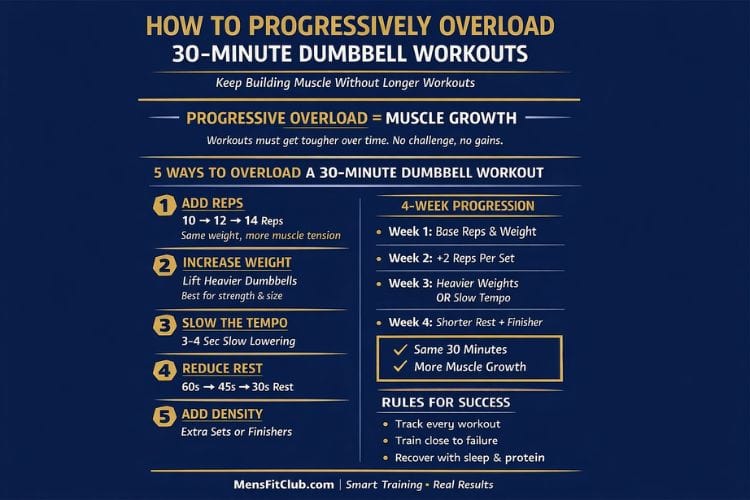
How to Progress This 30-Minute Dumbbell Workout
Progressive overload is essential for muscle growth. Even with short workouts, you must gradually increase training stress.
You can progress by:
- Increasing dumbbell weight
- Adding 1–2 reps per set
- Slowing down the tempo
- Reducing rest time slightly
- Adding an extra round to one superset
Track your workouts and aim for small improvements each week. Consistency beats intensity spikes.
Weekly Training Schedule for Best Results
To maximize muscle growth, perform this workout 3–4 times per week with at least one rest day between sessions.
A simple weekly split could look like:
- Monday: Dumbbell muscle workout
- Tuesday: Rest or light cardio
- Wednesday: Dumbbell muscle workout
- Friday: Dumbbell muscle workout
This frequency provides enough stimulus while allowing proper recovery.
Nutrition Tips to Support Muscle Growth
Training stimulates muscle growth, but nutrition makes it happen. Focus on fueling your body properly.
Prioritize:
- Adequate protein intake (roughly 0.7–1g per pound of lean body mass)
- Complex carbohydrates for workout energy
- Healthy fats for hormone support
- Hydration to optimize performance
Eating a balanced meal with protein and carbs within a few hours of training supports recovery and growth.
Common Mistakes That Limit Dumbbell Muscle Gains
Avoid these errors to get the most from your 30-minute workouts.
Rushing through reps reduces tension and muscle activation. Focus on control.
Using weights that are too light limits hypertrophy. The last few reps should feel challenging.
Skipping progression leads to plateaus. Always aim to improve something over time.
Neglecting recovery increases fatigue and injury risk. Sleep and rest days matter.
Why Dumbbell Training Is Ideal for Long-Term Muscle Growth
Dumbbells promote joint-friendly movement, correct imbalances, and allow endless exercise variety. They’re scalable for beginners yet challenging enough for advanced lifters.
A consistent 30-minute dumbbell workout to build muscle is sustainable, efficient, and adaptable to any environment. Over time, these short sessions compound into impressive strength and physique improvements.
Build Muscle Without Wasting Time
You don’t need marathon workouts to build muscle. With focused effort, smart programming, and progressive overload, a 30-minute dumbbell workout can deliver powerful hypertrophy results.
Stay consistent, train with intent, fuel your body properly, and trust the process. Muscle growth isn’t about doing more—it’s about doing what works, consistently.
If you’re ready to build strength, size, and confidence without spending hours in the gym, this approach is exactly what you need.
When it comes to maximizing muscle growth in minimal time, incorporating a variety of effective dumbbell routines can take your results to the next level. For a more detailed structured plan that progressively challenges your muscles over time, check out this 4-Week Dumbbell Workout Plan tailored for strength and muscle development. If you’re new to resistance training or prefer a beginner-friendly approach, the Full Body Dumbbell Workout Plan for Beginners offers foundational movements to build strength and confidence. To mix up your training and keep your workouts fresh, the 30-Minute Full Body Dumbbell Superset Workout delivers high-intensity supersets that boost muscle engagement and conditioning. For those looking to explore efficient workouts beyond dumbbells, the 30-Minute Full Body Workout for Maximum Results blends bodyweight and weighted movements for overall fitness gains. And if you have a bit more time and want a deeper strength session, the Best 60-Minute Dumbbell Strength Training Plan for Muscle Growth provides an extended workout option to further build lean muscle mass.


Most Recommended

Subscribe to our Newsletter
Stay up to date on the latest men’s health, fitness and lifestyle trends and tips.
About Us
Men’s Fit Club was started with the goal of empowering men to get the most out of their lives. This meant going beyond exercise and diet tips to really address the broad range of issues that men face on a daily basis – topics like recreation, finding love, sexual health and even sound fashion advice.
Quick Links
© COPYRIGHT MEN'S FIT CLUB 2026. All Rights Reserved