

30-Minute Lower Body Dumbbell Workout for Strength


30 Minute Lower Body Strength Workout (Build Muscle & Power)

5 Shoulder Workouts with Dumbbells: Guide to Stronger Shoulders
30-Minute Full Body Dumbbell Complex: Build Strength & Muscle
If you’re short on time but serious about building real, functional strength, a 30-minute full body dumbbell complex for strength is one of the most efficient training methods you can use. Dumbbell complexes combine multiple compound exercises performed back-to-back without setting the weights down, forcing your muscles, lungs, and nervous system to work together as a unit. The result is a workout that builds strength, improves work capacity, and delivers a serious metabolic punch—all in half an hour.
Unlike traditional strength training, where you rest between sets and isolate muscle groups, a dumbbell complex challenges your entire body continuously. Every rep flows into the next movement, creating constant tension and reinforcing full-body coordination. This style of training is ideal for busy professionals, athletes, and anyone looking to maximize results with minimal equipment.
What Is a Dumbbell Complex?
A dumbbell complex is a sequence of exercises performed consecutively using the same pair of dumbbells. You complete all prescribed repetitions of one movement before immediately transitioning to the next—without resting and without putting the dumbbells down.
The defining features of a dumbbell complex include:
- Continuous movement with no rest between exercises
- The same load used for the entire sequence
- Compound lifts that engage multiple muscle groups
- High muscular tension and elevated heart rate
Because rest is removed, even moderate dumbbell loads feel heavy very quickly. This makes complexes incredibly effective for developing strength endurance, muscular coordination, and total-body power.
Why Choose a 30-Minute Full Body Dumbbell Complex for Strength?
Traditional strength programs often require long sessions and heavy barbells. While those methods are effective, they’re not always practical. A 30-minute dumbbell complex delivers many of the same benefits with less time and less equipment.
Efficient Strength Development
Complexes force your muscles to work under fatigue. This increases time under tension, recruits more muscle fibers, and reinforces movement efficiency—all essential for strength gains.
Full-Body Activation
Every major muscle group is involved: legs, glutes, core, back, chest, shoulders, and arms. Instead of training muscles in isolation, you build strength as an integrated system.
Improved Work Capacity
By maintaining continuous effort, dumbbell complexes train your body to produce force while fatigued. This improves athletic performance and real-world strength.
Minimal Equipment, Maximum Results
All you need is one pair of dumbbells and a small training space. This makes complexes ideal for home workouts, hotel gyms, or crowded commercial gyms.
Who Should Use Dumbbell Complex Training?
A full body dumbbell complex for strength is suitable for a wide range of lifters.
Beginners
Beginners benefit from learning fundamental movement patterns—hinge, squat, push, pull—within one structured workout. Starting with light weights builds confidence and coordination.
Intermediate Lifters
Intermediate trainees can use complexes to break plateaus, improve conditioning, and add variety without sacrificing strength.
Advanced Lifters
Advanced athletes use complexes to maintain strength during deload weeks, travel periods, or as metabolic finishers after heavy lifting.
How to Structure a 30-Minute Dumbbell Complex Workout
To get the most from a dumbbell complex, structure matters. The goal is to balance intensity, volume, and recovery within a tight time frame.
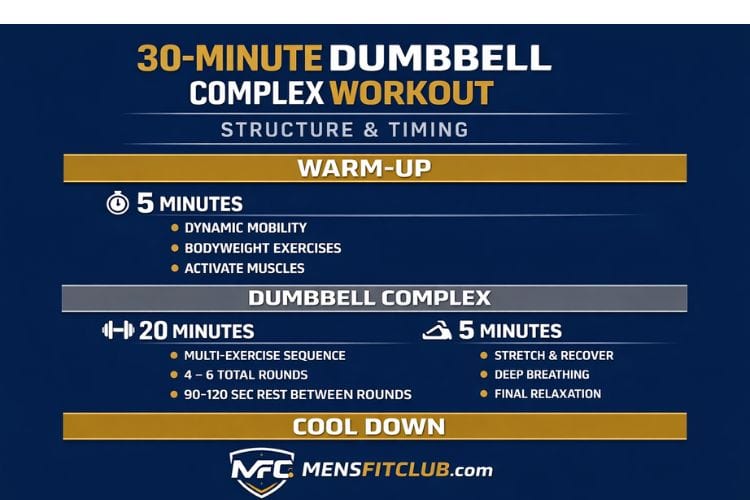
Time Breakdown
- 5 minutes: Dynamic warm-up
- 20 minutes: Dumbbell complex training
- 5 minutes: Cool-down and mobility
This structure ensures you’re warmed up, fully productive during the workout, and properly recovered afterward.
Warm-Up for Dumbbell Complex Training
A proper warm-up prepares your joints, activates key muscles, and reduces injury risk.
Focus on dynamic movements such as:
- Bodyweight squats
- Hip hinges
- Arm circles and shoulder rolls
- Walking lunges with rotation
- Light dumbbell presses or rows
Keep the warm-up short and purposeful. You should feel warm, mobile, and ready to move—not fatigued.
The 30-Minute Full Body Dumbbell Complex for Strength
This workout uses one pair of dumbbells and targets the entire body through compound movements.
How It Works
- Perform all exercises in order
- Do not set the dumbbells down during the complex
- Rest only after completing the full sequence
- Complete 4–6 total rounds
Choose a weight you can control for the weakest exercise in the complex.
Primary Dumbbell Strength Complex
Exercise Sequence (Perform in Order):
Dumbbell Romanian Deadlift
This movement targets the posterior chain—glutes, hamstrings, and lower back—while reinforcing proper hip hinge mechanics.
Dumbbell Bent-Over Row
Rows strengthen the upper back, lats, and arms while improving posture and pulling strength.
Dumbbell Clean
The clean builds explosive power and teaches efficient force transfer from lower body to upper body.
Dumbbell Front Squat
Front squats heavily engage the quads, glutes, and core, reinforcing upright posture and leg strength.
Dumbbell Push Press
This hybrid lift develops shoulder strength, triceps power, and leg drive.
Dumbbell Reverse Lunge
Lunges improve unilateral strength, balance, and joint stability.
Repetition Scheme:
- 6–8 reps per exercise
Rest:
- 90–120 seconds between rounds
Rounds:
- 4–6 total
Why This Dumbbell Complex Builds Strength
Each exercise in the complex serves a specific purpose. The Romanian deadlift and squat provide heavy lower-body loading. Rows and presses balance push-pull strength. Cleans and push presses introduce power and speed. Lunges address imbalances and reinforce stability.
Together, these movements create a powerful full-body stimulus that challenges strength, coordination, and conditioning simultaneously.
Progression Strategies for Dumbbell Complex Training
To continue building strength, progression is essential.
Increase Load
Gradually increase the weight of your dumbbells while maintaining perfect form throughout the entire complex.
Increase Rounds
Adding an extra round increases total volume and time under tension.
Reduce Rest
Shortening rest periods increases density and work capacity without changing weight.
Slow the Tempo
Slower eccentrics increase muscle tension and strengthen connective tissue.
Common Mistakes to Avoid
Choosing Weights That Are Too Heavy
If your form breaks down early in the complex, the load is too heavy. Strength is built through quality movement.
Rushing Transitions
Smooth transitions maintain tension and reduce injury risk. Move with control.
Skipping Warm-Ups
Complexes are demanding. A proper warm-up is non-negotiable.
Dumbbell Complex vs Traditional Strength Training
Both methods have value, but dumbbell complexes offer unique advantages.
Traditional strength training focuses on maximal loads with long rest periods. Dumbbell complexes prioritize continuous effort, movement efficiency, and integrated strength. For many people, combining both approaches delivers the best results.
Weekly Programming Ideas
A 30-minute full body dumbbell complex can be used in multiple ways.
- 2–3 times per week as a primary strength workout
- 1–2 times per week as a conditioning-focused strength session
- Travel or deload weeks when gym access is limited
Pair complexes with mobility work and recovery days to maintain balance.
Nutrition Tips to Support Strength Gains
Strength training demands proper fuel.
- Prioritize protein intake to support muscle repair
- Eat complex carbohydrates to fuel high-intensity sessions
- Stay hydrated to maintain performance
- Avoid training complexes completely fasted if strength is the goal
Recovery and Mobility After Dumbbell Complexes
Because complexes tax the nervous system, recovery matters.
Post-workout, focus on:
- Light stretching for hips, hamstrings, and shoulders
- Deep breathing to lower heart rate
- Adequate sleep and nutrition
Mobility work on rest days helps maintain joint health and movement quality.
Benefits Beyond Strength
A full body dumbbell complex improves more than just raw strength.
- Enhanced cardiovascular conditioning
- Increased muscular endurance
- Improved coordination and balance
- Higher calorie burn in less time
These benefits make complexes one of the most versatile tools in strength training.
The 30-Minute Full Body Dumbbell Complex for Strength
If your goal is to build strength efficiently without sacrificing conditioning or time, a 30-minute full body dumbbell complex is hard to beat. This training method forces your entire body to work as one cohesive system, building strength that transfers directly to real-world performance.
Whether you’re training at home, in a gym, or on the road, dumbbell complexes provide a powerful, minimalist approach to strength training. Commit to consistent effort, progressive overload, and quality movement, and you’ll see measurable gains in strength, endurance, and overall fitness—without ever needing more than one pair of dumbbells.
To help you get even stronger with dumbbells, we’ve pulled together expert guidance and workout routines from across MensFitClub.com that perfectly complement this 30-minute full body dumbbell complex. If you’re new to complexes or want more variety, check out our in-depth guide to the Dumbbell Complex: The Ultimate Full-Body Workout to learn foundational moves and benefits. For additional full-body training ideas, explore the Best Dumbbell Workouts for Men that cover strength, hypertrophy, and muscle balance. If you’re aiming for long-term strength gains, our 4-Week Dumbbell Workout Plan for Strength and Fat Loss provides progressive programming you can cycle after this complex. Looking for at-home options? Try our At-Home Dumbbell Workout Building Strength and Muscle routines tailored to limited space and equipment. Finally, for a different format that still challenges your muscles and conditioning, the 15-Minute Full Body Dumbbell Workouts Quick & Intense Training is a great supplemental option.


Most Recommended

Subscribe to our Newsletter
Stay up to date on the latest men’s health, fitness and lifestyle trends and tips.
About Us
Men’s Fit Club was started with the goal of empowering men to get the most out of their lives. This meant going beyond exercise and diet tips to really address the broad range of issues that men face on a daily basis – topics like recreation, finding love, sexual health and even sound fashion advice.
Quick Links
© COPYRIGHT MEN'S FIT CLUB 2026. All Rights Reserved