

4 Days a Week Weight Training Plan for Strength & Muscle Growth

The Ultimate 4-Day Barbell-Only Strength Training Program

4 Day Per Week Full Body Workout: For Mass and Strength

30 Minute Full Body Strength Training With Dumbbells Only
4 Day Weight Lifting Routine for Strength And Muscle Growth
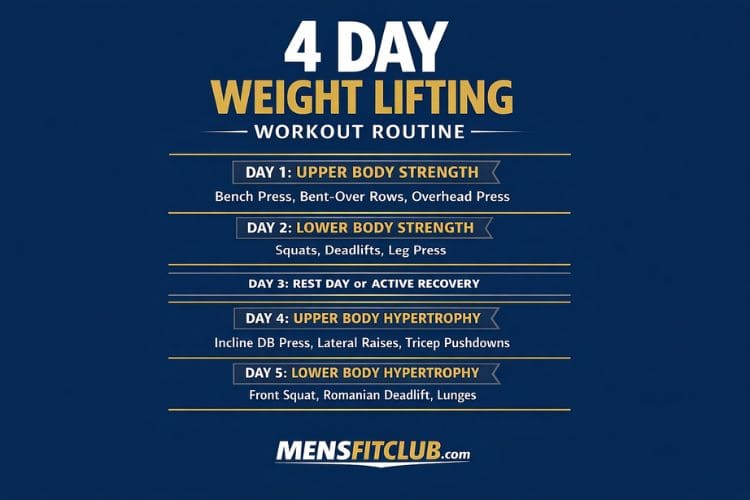
A 4 day weight lifting workout routine is one of the most effective training splits for building muscle, increasing strength, and improving overall fitness. It provides enough weekly training volume to stimulate hypertrophy while allowing adequate recovery between sessions. Whether your goal is bulking, cutting, or recomposition, a properly structured four-day lifting plan can deliver consistent progress when combined with progressive overload and proper nutrition.
This guide will break down a complete 4 day weight lifting workout routine, including training structure, exercise selection, sets and reps, recovery strategies, and progression tips. This routine is ideal for intermediate lifters but can also be adapted for beginners or advanced athletes.
Why Choose a 4 Day Weight Lifting Workout Routine
A four-day training split strikes the perfect balance between intensity and recovery. Unlike full-body workouts, it allows you to focus on specific muscle groups with higher volume. Unlike five- or six-day splits, it prevents overtraining and excessive fatigue.
Training four days per week allows you to hit each muscle group at least once or twice, depending on the split. This frequency is ideal for hypertrophy because muscles require repeated stimulation while also needing rest to grow.
A 4 day routine also fits easily into most schedules. You can train Monday through Thursday with a weekend rest, or use an upper/lower split across the week with rest days in between.
Best Training Split for a 4 Day Weight Lifting Routine
There are several ways to structure a four-day workout split, but one of the most effective is the Upper/Lower split. This method trains the upper body on two days and the lower body on two days, maximizing muscle activation and recovery.
Another popular option is a Push/Pull/Legs + Full Body format, but the upper/lower split tends to be more balanced and beginner-friendly.
In this guide, we will use an Upper/Lower Upper/Lower split, which is ideal for building strength and muscle.
4 Day Weight Lifting Workout Routine Overview
Day 1: Upper Body Strength
Day 2: Lower Body Strength
Day 3: Rest or Active Recovery
Day 4: Upper Body Hypertrophy
Day 5: Lower Body Hypertrophy
Day 6–7: Rest or Light Activity
This structure prioritizes heavy compound lifts early in the week and higher-volume muscle-building work later.
Day 1: Upper Body Strength Workout
The goal of Day 1 is to build maximal strength in the chest, back, shoulders, and arms. Focus on heavy weights with lower reps.
Bench Press
The bench press is the cornerstone of upper body strength. It targets the chest, triceps, and shoulders. Perform 4 sets of 4 to 6 reps with heavy weight.
Barbell Bent-Over Row
This exercise develops the upper back, lats, and biceps. Use a controlled tempo and maintain a neutral spine. Perform 4 sets of 5 to 8 reps.
Overhead Shoulder Press
The overhead press builds strong shoulders and triceps. Use a barbell or dumbbells. Perform 3 sets of 5 to 7 reps.
Pull-Ups or Lat Pulldowns
Vertical pulling strengthens the lats and upper back. Perform 3 sets of 6 to 10 reps.
Barbell Curl
This targets the biceps and forearms. Perform 3 sets of 8 to 12 reps.
Triceps Dips or Skull Crushers
Triceps are essential for pressing strength. Perform 3 sets of 8 to 12 reps.
Day 2: Lower Body Strength Workout
Lower body strength workouts emphasize compound lifts for maximal power and muscle recruitment.
Back Squat
The squat is the king of lower body exercises, targeting quads, glutes, and core. Perform 4 sets of 3 to 6 reps with heavy weight.
Deadlift
Deadlifts develop the posterior chain, including hamstrings, glutes, and back. Perform 3 sets of 3 to 5 reps.
Leg Press
Leg presses allow high-load quad training without spinal stress. Perform 3 sets of 8 to 10 reps.
Standing Calf Raise
Strong calves improve athletic performance and aesthetics. Perform 4 sets of 10 to 15 reps.
Hanging Leg Raises
Core strength supports heavy lifting. Perform 3 sets of 10 to 15 reps.
Day 3: Rest or Active Recovery
Recovery is essential for muscle growth. Use this day for light cardio, mobility work, or stretching. Avoid heavy lifting to allow your nervous system and muscles to recover.
Day 4: Upper Body Hypertrophy Weight Lifting Routine
Day 4 focuses on higher volume to stimulate muscle growth. Use moderate weights and shorter rest periods.
Incline Dumbbell Bench Press
Incline presses target the upper chest. Perform 4 sets of 8 to 12 reps.
Seated Cable Row
This builds mid-back thickness and posture. Perform 4 sets of 8 to 12 reps.
Dumbbell Shoulder Lateral Raises
Lateral raises isolate the side delts for width. Perform 3 sets of 12 to 15 reps.
Face Pulls
Face pulls strengthen rear delts and improve shoulder health. Perform 3 sets of 12 to 15 reps.
Hammer Curls
Hammer curls build biceps and forearms. Perform 3 sets of 10 to 12 reps.
Cable Triceps Pushdowns
This isolates the triceps and increases arm size. Perform 3 sets of 10 to 12 reps.
Day 5: Lower Body Hypertrophy Workout 4 Day Weight Lifting Routine
This session emphasizes volume and time under tension for muscle growth.
Front Squat or Goblet Squat
Front squats shift emphasis to the quads. Perform 4 sets of 6 to 10 reps.
Romanian Deadlift
RDLs target hamstrings and glutes. Perform 4 sets of 8 to 12 reps.
Leg Curl Machine
Hamstring curls isolate the posterior chain. Perform 3 sets of 10 to 15 reps.
Walking Lunges
Lunges improve balance and unilateral strength. Perform 3 sets of 10 to 12 reps per leg.
Seated Calf Raises
Seated raises target the soleus muscle. Perform 4 sets of 12 to 20 reps.
Warm-Up and Cool-Down Guidelines
A proper warm-up increases blood flow and reduces injury risk. Begin each session with 5 to 10 minutes of light cardio followed by dynamic stretches for the muscles you will train.
Cooling down after training helps reduce soreness and improve recovery. Light stretching and foam rolling can help maintain mobility and flexibility.
Progressive Overload for a 4 Day Weight Lifting Routine
Progressive overload is the key to long-term muscle and strength gains. This means gradually increasing the demands placed on your muscles over time.
You can achieve progressive overload by increasing weight, increasing reps, increasing sets, slowing down tempo, or reducing rest time. Track your workouts and aim to improve something each week, even if it is a small increment.
Rest Periods and Training Intensity
Rest periods depend on your goal. Strength-focused sets, rest 2 to 3 minutes between sets. For hypertrophy training, rest 60 to 90 seconds. For isolation exercises, 30 to 60 seconds is sufficient.
Training intensity should be challenging but manageable. Aim to finish most sets with 1 to 3 reps left in reserve to maximize growth while avoiding overtraining.
Nutrition for a 4 Day Weight Lifting Routine Program
Training alone will not build muscle without proper nutrition. To gain muscle, you must eat in a calorie surplus with sufficient protein intake. Aim for 0.7 to 1 gram of protein per pound of body weight.
Carbohydrates fuel workouts and support recovery, while healthy fats support hormone production. Hydration is also essential for performance and recovery.
Common 4 Day Weight Lifting Routine Mistakes to Avoid
Many lifters fail to see results because they lack consistency, train with poor form, or neglect recovery. Avoid skipping workouts, ego lifting, or ignoring sleep. Sleep is one of the most powerful tools for muscle growth, as most recovery occurs during deep sleep cycles.
Who Should Follow This 4 Day Weight Lifting Routine
This routine is ideal for intermediate lifters who have mastered basic form and want to increase training volume. Beginners can use lighter weights and reduce volume, while advanced lifters can add intensity techniques such as drop sets, supersets, and tempo training.
How Long to Follow This 4 Day Weight Lifting Routine
Follow this routine for 8 to 12 weeks before making major changes. After this period, you can adjust exercises, volume, or split structure to prevent plateaus.
Benefits of a 4 Day Weight Lifting Routine
A four-day routine allows balanced muscle growth, increased strength, improved recovery, and better adherence. It also fits well with busy schedules and reduces the risk of burnout compared to higher-frequency programs.
The 4 Day Weight Lifting Workout Routine
A 4 day weight lifting workout routine is one of the most effective training plans for building strength, gaining muscle, and improving overall fitness. By combining heavy compound lifts with hypertrophy-focused accessory work, you can stimulate maximum muscle growth while maintaining recovery.
Consistency, progressive overload, proper nutrition, and quality sleep will determine your results. Stick to the plan, track your progress, and adjust as needed to keep making gains. With dedication and smart programming, this four-day routine can transform your physique and performance.
If you’re following this 4 day weight lifting workout routine, you may also benefit from exploring other structured training programs and strength guides on MensFitClub. For example, the 3 Day Full Body Workout Guide is a great option for beginners looking for a balanced weekly routine, while the 5 Day Powerlifting Workout Routine provides a more advanced split for maximizing strength gains. You can also enhance your results with a 45 Minute Full Body Strength Training Workout for time-efficient muscle building, learn foundational movements in The Best Strength Training Exercises Guide, or explore overall program design with the Full Body Workout Plan Guide to improve consistency and long-term progress.


Most Recommended

Subscribe to our Newsletter
Stay up to date on the latest men’s health, fitness and lifestyle trends and tips.
About Us
Men’s Fit Club was started with the goal of empowering men to get the most out of their lives. This meant going beyond exercise and diet tips to really address the broad range of issues that men face on a daily basis – topics like recreation, finding love, sexual health and even sound fashion advice.
Quick Links
© COPYRIGHT MEN'S FIT CLUB 2026. All Rights Reserved