

Jump Rope Cardio Workout: The Full-Body Fat-Burning Routine


Full Body Evening Cardio Workout: Burn Fat De-Stress Before Bed

4 Day Compound Workout Routine: Build Strength & Athletic Power
45-Minute Weight Workout: Build Muscle & Burn Fat Efficiently
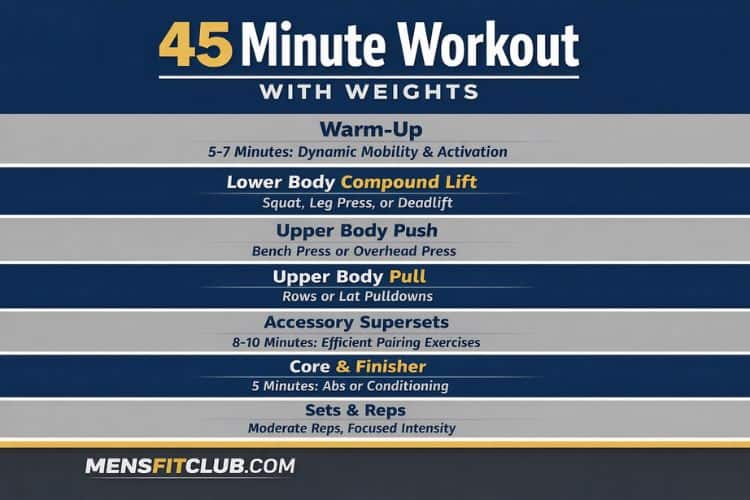
A 45 minute workout with weights is one of the most effective ways to build muscle, burn fat, and improve total-body strength without spending hours in the gym. This time frame is long enough to train every major muscle group with proper intensity, yet short enough to stay focused, efficient, and consistent. Whether your goal is hypertrophy, strength, or overall fitness, a well-structured 45 minute weight workout delivers serious results.
Unlike random gym sessions, a programmed 45 minute weight training workout balances compound lifts, accessory movements, rest periods, and progression strategies. The key is not just what exercises you do—but how you organize them. In this guide, you’ll learn exactly how to structure a full-body workout with weights that maximizes muscle activation, boosts calorie burn, and supports long-term progress.
Why a 45 Minute Workout With Weights Is So Effective
A 45 minute training session hits the sweet spot between volume and intensity. Shorter workouts may lack enough total work for hypertrophy, while longer sessions often lead to fatigue, poor exercise quality, and diminishing returns. When designed correctly, 45 minutes of weight training allows you to lift heavy, move efficiently, and recover properly between sessions.
One of the biggest advantages of a 45 minute workout with weights is hormonal response. Compound lifts performed at moderate to heavy loads stimulate testosterone and growth hormone production, which supports muscle growth and fat loss. Pairing these lifts with smart accessory work increases time under tension without excessive fatigue.
Additionally, this workout length fits easily into most schedules. Consistency is the foundation of results, and a plan you can realistically follow week after week will always outperform an extreme routine you can’t sustain.
Who Should Follow a 45 Minute Weight Training Workout?
A 45 minute workout with weights is ideal for beginners, intermediate lifters, and advanced trainees alike. Beginners benefit from learning fundamental movement patterns without overwhelming volume. Intermediate lifters can push progressive overload while maintaining recovery. Advanced lifters can use density, tempo, and supersets to keep sessions challenging and efficient.
This workout style is also perfect if you train three to five days per week. It provides enough stimulus to build muscle while allowing adequate recovery between sessions. If your goal is fat loss, muscle definition, or strength maintenance, a 45 minute session is more than enough when intensity is high.
How to Structure a 45 Minute Workout With Weights
The most effective 45 minute weight workout follows a simple but proven structure: warm-up, primary compound lifts, secondary assistance exercises, and a brief finisher or core segment. Each section has a purpose and should not be skipped.
Warm-Up (5–7 Minutes)
A proper warm-up prepares your joints, muscles, and nervous system for lifting. Focus on dynamic movements rather than static stretching. Light cardio followed by mobility drills for hips, shoulders, and thoracic spine works best.
Activating key muscle groups—such as glutes, upper back, and core—improves lifting performance and reduces injury risk. A warm-up should leave you energized, not fatigued.
Full-Body 45 Minute Workout With Weights
This 45 minute workout with weights targets the entire body using compound lifts and strategic accessory movements. It can be performed in a commercial gym or a well-equipped home gym.
Lower Body Compound Lift (10 Minutes)
Start with a major lower-body movement such as a barbell squat, goblet squat, or leg press. This exercise recruits the largest muscle groups in the body, elevates heart rate, and sets the tone for the rest of the workout.
Perform multiple working sets with moderate to heavy weight. Focus on controlled tempo, proper depth, and strong bracing. Rest periods should be long enough to maintain performance but short enough to keep intensity high.
Upper Body Push Exercise (7–8 Minutes)
Next, move to an upper-body pushing movement like the bench press, dumbbell press, or overhead press. These exercises target the chest, shoulders, and triceps while also engaging stabilizing muscles.
Use a weight that allows you to complete full reps with good form. The goal is mechanical tension, not rushing through the movement. This portion of the workout builds pressing strength and upper-body mass.
Upper Body Pull Exercise (7–8 Minutes)
Balance your pressing work with a pulling movement such as rows or pull-downs. Pulling exercises strengthen the upper back, improve posture, and support shoulder health.
Focus on squeezing the shoulder blades together and controlling the eccentric phase of each rep. Strong pulling muscles are essential for long-term progress and injury prevention.
Accessory Supersets for Efficiency (8–10 Minutes)
Accessory exercises add volume and address muscle groups that compound lifts may not fully target. Supersets are ideal for a 45 minute workout with weights because they save time while increasing training density.
Pair a lower-body accessory with an upper-body movement or alternate push and pull patterns. This approach maintains intensity without excessive fatigue.
Accessory work improves muscle balance, enhances aesthetics, and strengthens weak points that can limit progress on compound lifts.
Core and Conditioning Finisher (5 Minutes)
Finish your workout with focused core training or a short conditioning circuit. Core exercises improve stability, transfer power between the upper and lower body, and protect the spine during heavy lifts.
A brief finisher increases calorie burn and leaves you with a strong training effect without turning the workout into excessive cardio. Keep this section short and intense.
Sets, Reps, and Rest for a 45 Minute Weight Workout
Programming variables matter just as much as exercise selection. For most people, moderate rep ranges work best in a 45 minute workout with weights.
Compound lifts are typically performed for lower to moderate reps, while accessory exercises use moderate to higher reps. Rest periods should balance recovery and intensity. Longer rest is appropriate for heavy lifts, while shorter rest works well for accessories and supersets.
Training density—how much work you perform in a given time—is a key driver of progress in 45 minute sessions. Staying focused and limiting distractions is essential.
Progressive Overload in a 45 Minute Workout With Weights Plan
Progressive overload is the foundation of muscle growth and strength gains. In a 45 minute workout with weights, progression can take many forms beyond simply adding weight.
You can increase reps, improve form, reduce rest time, or add an extra set over time. Tracking workouts helps ensure you’re moving forward rather than repeating the same session week after week.
Even small improvements compound over time. Consistency and gradual progression are more important than chasing maximum weight every session.
Fat Loss Benefits of a 45 Minute Workout With Weights
Weight training is one of the most effective tools for fat loss because it preserves lean muscle mass while increasing metabolic rate. A 45 minute weight workout burns calories during the session and elevates energy expenditure afterward through excess post-exercise oxygen consumption.
When paired with proper nutrition, this training style supports sustainable fat loss without sacrificing strength. Unlike excessive cardio, weight training shapes the body while improving performance and confidence.
Muscle-Building Benefits of Training for 45 Minutes
Muscle growth depends on mechanical tension, volume, and recovery. A 45 minute workout with weights provides enough stimulus to grow muscle when exercises are chosen wisely and intensity is high.
Shorter, focused sessions often produce better hypertrophy than longer, unfocused workouts. By prioritizing compound movements and quality reps, you maximize muscle activation without unnecessary fatigue.
Common 45 Minute Workout With Weights Mistakes to Avoid
One common mistake is rushing through exercises to “beat the clock.” Speed should never come at the expense of form. Another mistake is performing too many isolation exercises while neglecting compound lifts.
Skipping warm-ups, resting too long, or training without a plan can also reduce the effectiveness of a 45 minute weight training workout. Structure and intent are what separate productive sessions from wasted time.
How Often Should You Do a 45 Minute Workout With Weights?
Most people see excellent results training three to five times per week. This frequency allows enough stimulus for progress while supporting recovery.
You can rotate workout variations or adjust emphasis based on your goals. Full-body sessions work well three days per week, while upper-lower or push-pull splits fit nicely into four or five days.
Nutrition and Recovery for Best Results
Training is only one piece of the equation. To maximize the benefits of a 45 minute workout with weights, you need adequate protein, balanced carbohydrates, and sufficient calories for your goal.
Sleep, hydration, and stress management play a major role in recovery and performance. Without proper recovery, even the best workout program will stall.
The 45 Minute Workout With Weights
A 45 minute workout with weights is one of the most practical and effective ways to train. It builds strength, increases muscle mass, supports fat loss, and fits into almost any schedule. When structured correctly, it delivers professional-level results without unnecessary complexity.
By focusing on compound movements, smart accessory work, progressive overload, and consistent effort, you can transform your body in just 45 minutes per session. Train with purpose, stay consistent, and let the results speak for themselves.
To maximize results from this 45 minute workout with weights, it helps to combine structured training with proven programs and complementary routines. If your goal is total-body strength and efficiency, our 60-minute full body weight lifting workout offers a higher-volume progression option for advanced lifters, while the 45 minute full body weight lifting circuit is ideal for boosting intensity and calorie burn. Beginners can build a strong foundation by following the 30 minute beginner weightlifting workout routine, which focuses on proper form and movement patterns. For those looking to train multiple days per week, the 5 Day Weight Lifting Routine for Maximum Muscle Growth provides balanced volume and recovery, and pairing this plan with our 40 minute weight lifting workout helps maintain consistency while preventing plateaus.


Most Recommended

Subscribe to our Newsletter
Stay up to date on the latest men’s health, fitness and lifestyle trends and tips.
About Us
Men’s Fit Club was started with the goal of empowering men to get the most out of their lives. This meant going beyond exercise and diet tips to really address the broad range of issues that men face on a daily basis – topics like recreation, finding love, sexual health and even sound fashion advice.
Quick Links
© COPYRIGHT MEN'S FIT CLUB 2026. All Rights Reserved