

20 Minute EMOM Workout: A Guide To Full-Body Strength

30 Minute HIIT Workout with Kettlebell: Burn Fat & Build Strength


30 Minute AMRAP Workout For Full Body Conditioning
Best Chest Workout: Your Hypertrophy Blueprint to Build Muscle
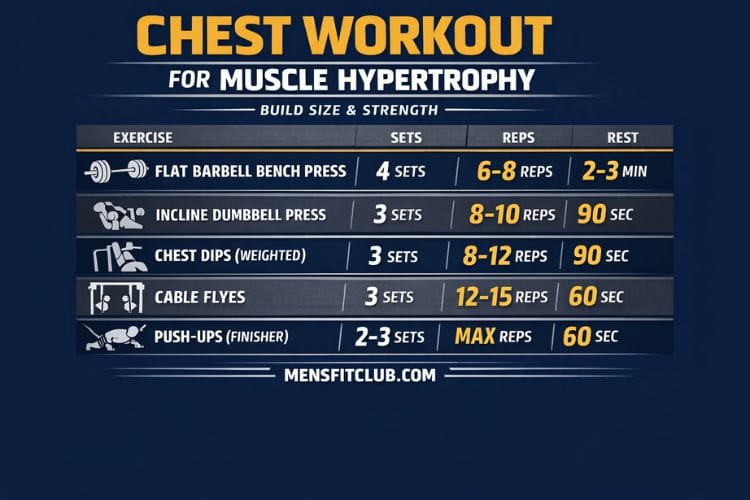
Building a bigger, stronger chest isn’t about randomly bench pressing every workout—it’s about strategic training for muscle hypertrophy. Hypertrophy-focused chest workouts emphasize mechanical tension, sufficient volume, progressive overload, and optimal recovery. When these variables align, your chest muscles are forced to adapt by growing thicker, fuller, and stronger.
This in-depth guide breaks down exactly how to train your chest for maximum muscle hypertrophy, whether you’re a beginner looking to add size or an intermediate lifter trying to break through a plateau. You’ll learn the anatomy of the chest, hypertrophy training principles, exercise selection, programming strategies, and a complete hypertrophy-focused chest workout you can use immediately.
Understanding Chest Muscle Hypertrophy
Muscle hypertrophy refers to the increase in muscle fiber size as a response to resistance training. For the chest, this primarily involves the pectoralis major, which is responsible for pushing movements and upper-body pressing strength.
Chest Muscle Anatomy Explained
The chest is made up of two main muscles:
- Pectoralis Major – The large, fan-shaped muscle responsible for pressing, pushing, and horizontal adduction
- Pectoralis Minor – A smaller stabilizing muscle beneath the pec major
The pectoralis major itself has multiple regions:
- Upper chest (clavicular head) – Emphasized during incline pressing
- Mid chest (sternal head) – Targeted during flat pressing movements
- Lower chest (costal fibers) – Activated more during decline and dip movements
A proper hypertrophy program must target all regions of the chest through varied angles and exercises.
Key Training Principles for Chest Hypertrophy
Before diving into exercises, it’s essential to understand the principles that drive muscle growth.
Training Volume for Muscle Growth
Volume is one of the most critical factors for hypertrophy. For chest growth, most lifters respond best to:
- 10–20 working sets per week
- Spread across 1–3 sessions
- Using a variety of rep ranges and movements
Too little volume limits growth, while excessive volume can impair recovery and stall progress.
Progressive Overload Is Non-Negotiable
Your chest muscles grow when they’re exposed to increasing demands over time. Progressive overload can be achieved by:
- Increasing weight
- Adding reps
- Adding sets
- Improving tempo or time under tension
If your numbers never increase, your chest won’t either.
Optimal Rep Ranges for Hypertrophy
For chest hypertrophy, the most effective rep ranges are:
- 6–10 reps for heavy compound movements
- 10–15 reps for accessory and isolation exercises
- 15–20 reps occasionally for metabolic stress and pump work
Using multiple rep ranges ensures full muscle fiber recruitment.
Best Chest Exercises for Muscle Hypertrophy
A hypertrophy-focused chest workout should include compound lifts for mass and isolation movements for shape and detail.
Compound Chest Exercises for Size
Compound movements allow you to lift heavier loads, generating maximum mechanical tension.
Barbell Bench Press
The cornerstone of chest mass. It primarily targets the mid-chest while engaging shoulders and triceps.
Incline Dumbbell Press
Excellent for upper-chest hypertrophy and improved muscle balance.
Weighted Dips
A powerful lower-chest builder that also enhances pressing strength.
Decline Press Variations
Useful for emphasizing the lower chest and handling heavier loads safely.
Isolation Chest Exercises for Hypertrophy
Isolation movements increase time under tension and improve muscle definition.
Cable Flyes
Maintain constant tension throughout the movement, ideal for hypertrophy.
Dumbbell Flyes
Excellent for stretching the chest under load, stimulating muscle growth.
Pec Deck Machine
Provides controlled resistance and is joint-friendly for higher reps.
Complete Chest Workout for Muscle Hypertrophy
This hypertrophy-optimized chest workout is designed to maximize growth using proven volume, intensity, and exercise selection.
Chest Hypertrophy Workout (60 Minutes)
Flat Barbell Bench Press
4 sets × 6–8 reps
Rest: 2–3 minutes
Focus on controlled negatives and explosive presses.
Incline Dumbbell Press
3 sets × 8–10 reps
Rest: 90 seconds
Emphasize full range of motion and upper-chest contraction.
Chest Dips (Weighted if Possible)
3 sets × 8–12 reps
Rest: 90 seconds
Lean forward to maximize chest activation.
Cable Flyes (Mid to High)
3 sets × 12–15 reps
Rest: 60 seconds
Slow tempo, squeeze hard at peak contraction.
Push-Ups (Finisher)
2–3 sets × max reps
Rest: 60 seconds
Great for metabolic stress and final chest pump.
This structure balances mechanical tension, volume, and metabolic stress, the three pillars of hypertrophy.
How Often Should You Train Chest for Hypertrophy?
Training frequency depends on experience level and recovery ability.
Chest Training Frequency Guidelines
- Beginners: 1–2 sessions per week
- Intermediate lifters: 2 sessions per week
- Advanced lifters: 2–3 sessions per week with split volume
Splitting volume across sessions often leads to better muscle protein synthesis and improved recovery.
Rest Periods and Tempo for Maximum Chest Growth
Rest and tempo play a crucial role in hypertrophy training.
Ideal Rest Periods
- Heavy compound lifts: 2–3 minutes
- Isolation exercises: 60–90 seconds
Adequate rest allows for higher training intensity and better performance.
Time Under Tension
Slowing down the eccentric (lowering) portion of each rep increases muscle damage and growth stimulus. Aim for:
- 2–3 seconds lowering
- 1 second controlled press
- Hard contraction at the top
Nutrition and Recovery for Chest Hypertrophy
Your training is only as effective as your recovery.
Protein Intake for Muscle Growth
To support chest hypertrophy, aim for:
- 0.7–1 gram of protein per pound of bodyweight
- Spread evenly across meals
Protein provides the building blocks necessary for muscle repair and growth.
Calories Matter
Muscle growth requires a caloric surplus. Even the best chest workout won’t build size if you’re under-eating.
Sleep and Recovery
Aim for 7–9 hours of quality sleep per night. Growth happens during recovery, not during your workout.
Common Chest Training Mistakes That Kill Hypertrophy
Avoid these errors if you want consistent chest growth:
- Ego lifting with poor form
- Neglecting incline and isolation movements
- Training chest too infrequently
- Ignoring progressive overload
- Skipping warm-ups and mobility work
Correcting these mistakes can unlock new gains almost immediately.
Chest Hypertrophy Tips for Long-Term Progress
- Rotate exercises every 6–8 weeks
- Track workouts and progression
- Prioritize mind-muscle connection
- Use deload weeks when progress stalls
- Focus on quality reps, not just weight
Consistency over time is what transforms an average chest into a powerful, well-developed one.
Build a Bigger Chest with Smart Hypertrophy Training
Chest hypertrophy isn’t about training harder—it’s about training smarter. By understanding chest anatomy, applying hypertrophy principles, using effective exercises, and maintaining proper nutrition and recovery, you create the perfect environment for muscle growth.
Stick to a structured chest workout for muscle hypertrophy, progressively challenge your muscles, and stay patient. Over weeks and months, those small improvements add up to noticeable size, strength, and confidence—exactly what chest hypertrophy training is all about.
For more on building a bigger, stronger chest and maximizing muscle hypertrophy, be sure to explore our related training resources at MensFitClub. If you want an efficient routine that focuses on strength and size, check out the 35-Minute Chest Workout Plan at the Gym for time-efficient gains and hypertrophy-focused exercise combinations. Looking to vary your stimulus, our Best Chest Workout Routine to Build Mass and Strength Fast breaks down essential compound and isolation movements for full chest development. To deepen your understanding of the movements driving hypertrophy, our Barbell Bench Press Guide to Building Chest Strength offers detailed technique and tips for maximizing your bench press performance. For foundational chest exercises and variations, the Best Chest Workout Exercises page provides a range of drills that hit all regions of the pecs.


Most Recommended

Subscribe to our Newsletter
Stay up to date on the latest men’s health, fitness and lifestyle trends and tips.
About Us
Men’s Fit Club was started with the goal of empowering men to get the most out of their lives. This meant going beyond exercise and diet tips to really address the broad range of issues that men face on a daily basis – topics like recreation, finding love, sexual health and even sound fashion advice.
Quick Links
© COPYRIGHT MEN'S FIT CLUB 2026. All Rights Reserved