

30-Minute Lower Body Dumbbell Workout for Strength


30 Minute Lower Body Strength Workout (Build Muscle & Power)

5 Shoulder Workouts with Dumbbells: Guide to Stronger Shoulders
How to Build Leg Muscle With Only Dumbbells: A Complete Guide
Building strong, muscular legs doesn’t require fancy machines or a fully stocked gym. With nothing more than a pair of dumbbells, you can develop powerful quads, hamstrings, glutes, and calves—whether you train at home, in a minimalist gym, or while traveling. Dumbbells provide versatility, constant tension, unilateral loading, and joint-friendly movement patterns that are ideal for long-term muscle growth. This complete guide explains how to build leg muscles with just dumbbells, covering training principles, exercise selection, workout structure, progression strategies, and recovery—all optimized for hypertrophy and strength.
Why Dumbbells Are Enough Build Leg Muscle Growth
Many lifters assume barbells are mandatory for leg development, but dumbbells can be just as effective when used correctly.
Dumbbells allow a greater range of motion, improve balance, correct muscle imbalances, and reduce joint stress. Because each leg works independently, stabilizer muscles are forced to engage, increasing total muscle activation.
They’re also ideal for controlled tempos, extended time under tension, and unilateral movements—three key drivers of hypertrophy.
Key Principles for Building Leg Muscles With Dumbbells
Progressive Overload Still Applies
Muscle growth occurs when you progressively challenge your muscles over time. With dumbbells, progression can come from:
- Increasing weight
- Adding reps or sets
- Slowing tempo
- Increasing range of motion
- Reducing rest periods
Train Through Full Range of Motion
Deep squats, long lunges, and controlled hinges place more mechanical tension on the muscle fibers, especially the glutes and hamstrings.
Emphasize Unilateral Training
Single-leg exercises increase intensity without requiring heavy weights. Bulgarian split squats, single-leg RDLs, and step-ups are especially effective.
Volume and Frequency Matter
For hypertrophy, aim for:
- 10–20 total sets per week per muscle group
- 2–3 leg-focused sessions per week
- Moderate to high reps (8–20 range)
Build Dumbbell Leg Muscles Anatomy Overview
Understanding which muscles you’re targeting helps you program more effectively.
Quadriceps
Located on the front of the thigh, the quads extend the knee. Dumbbell squats, lunges, and step-ups heavily target this group.
Hamstrings
These muscles run along the back of the thigh and are responsible for hip extension and knee flexion. Romanian deadlifts and split squats emphasize hamstrings.
Glutes
The glutes are the largest and strongest muscles in the lower body. They respond well to deep squats, lunges, hip hinges, and single-leg work.
Calves
Calves often get neglected, but they’re critical for aesthetics and performance. Standing and seated calf raises with dumbbells are highly effective.
Best Dumbbell Exercises to Build Leg Muscles
Dumbbell Squats
Dumbbell squats provide quad and glute development with less spinal loading than barbell squats.
Hold the dumbbells at your sides or in a goblet position. Squat as deep as your mobility allows while maintaining a neutral spine.
Muscles worked: Quads, glutes, adductors, core
Dumbbell Goblet Squats
Goblet squats increase anterior loading, forcing better posture and deeper range of motion.
They’re ideal for beginners and advanced lifters alike, especially when combined with slow eccentrics and pauses.
Muscles worked: Quads, glutes, core
Dumbbell Lunges Build Leg Muscles
Lunges are one of the most effective unilateral leg exercises.
You can perform:
- Forward lunges
- Reverse lunges
- Walking lunges
- Static split lunges
Each variation slightly shifts emphasis between quads and glutes.
Muscles worked: Quads, glutes, hamstrings
Bulgarian Split Squats
This is arguably the best dumbbell leg exercise for muscle growth.
With one foot elevated behind you, the front leg bears most of the load. Even light dumbbells feel heavy due to increased mechanical tension.
Muscles worked: Quads, glutes, hamstrings
Dumbbell Romanian Deadlifts Build Leg Muscles
RDLs are essential for hamstring and glute development.
Focus on hinging at the hips, keeping the dumbbells close to your legs, and stretching the hamstrings at the bottom.
Muscles worked: Hamstrings, glutes, lower back
Dumbbell Step-Ups
Step-ups are excellent for quad and glute hypertrophy and carryover to athletic performance.
Use a box or bench around knee height and drive through the heel of the working leg.
Muscles worked: Quads, glutes, calves
Dumbbell Sumo Squats Build Leg Muscles
The wide stance increases inner thigh and glute activation.
Hold one heavy dumbbell with both hands and sit deep into the squat.
Muscles worked: Glutes, adductors, quads
Dumbbell Calf Raises
Calves respond well to high volume and slow tempo.
Hold dumbbells at your sides and raise your heels slowly, pausing at the top.
Muscles worked: Gastrocnemius, soleus
How to Structure a Dumbbell Leg Workout to Build Muscle Growth
Example Dumbbell Leg Workout (Hypertrophy Focus)
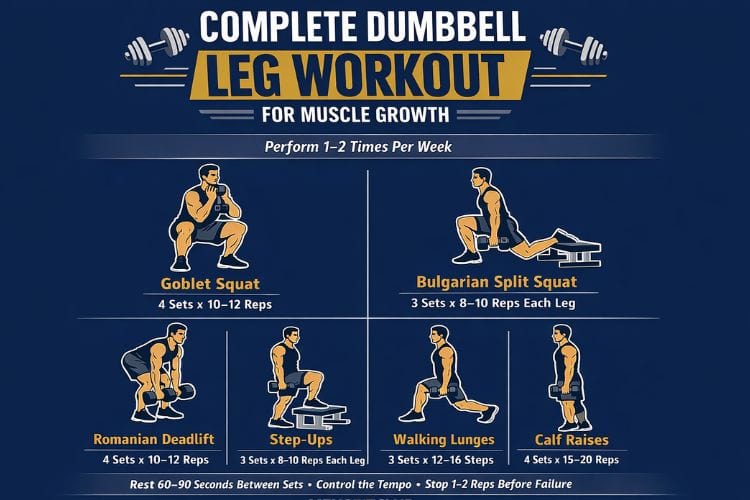
Perform this workout 1–2 times per week.
Workout Structure:
- Rest 60–90 seconds between sets
- Use controlled tempo
- Stop 1–2 reps short of failure on most sets
Workout:
- Dumbbell Goblet Squat – 4 sets x 10–12 reps
- Bulgarian Split Squat – 3 sets x 8–10 reps per leg
- Dumbbell Romanian Deadlift – 4 sets x 10–12 reps
- Walking Dumbbell Lunges – 3 sets x 12–16 steps
- Dumbbell Step-Ups – 3 sets x 8–10 reps per leg
- Dumbbell Standing Calf Raises – 4 sets x 15–20 reps
This combination hits all major leg muscles with sufficient volume for hypertrophy.
Advanced Techniques to Build Leg Muscles With Light Dumbbells
Tempo Training
Slowing down the eccentric (lowering phase) increases time under tension.
Example:
- 3–4 seconds lowering
- 1-second pause
- Explosive upward movement
Paused Reps
Pausing at the bottom of squats or lunges removes momentum and increases muscle recruitment.
Mechanical Drop Sets to Build Dumbbell Leg Muscles
Move from a harder variation to an easier one without rest.
Example:
- Bulgarian split squat → regular split squat → bodyweight squat
Extended Sets
After reaching failure, reduce weight or switch to bodyweight to continue the set.
How Often Should You Train Legs With Dumbbells?
For optimal muscle growth:
- Beginners: 2 leg sessions per week
- Intermediate: 2–3 leg-focused sessions per week
- Advanced: 3 sessions with varied intensity and volume
You can also integrate leg work into full-body or upper/lower splits.
Nutrition Tips to Support Building Dumbbell Leg Muscles
Training is only half the equation.
Eat Enough Calories
Muscle growth requires a slight caloric surplus. If you’re constantly sore but not growing, you may be under-eating.
Prioritize Protein
Aim for:
- 0.7–1 gram of protein per pound of bodyweight daily
High-quality protein supports muscle repair and growth.
Carbohydrates Fuel Leg Training
Leg workouts are demanding. Adequate carbs improve performance, volume, and recovery.
Recovery and Mobility for Leg Growth
Sleep
Aim for 7–9 hours of sleep per night. Growth hormone and testosterone production peak during deep sleep.
Active Recovery
Light walking, cycling, or mobility work improves blood flow and reduces soreness.
Stretching
Post-workout stretching improves flexibility and may enhance recovery over time.
Common Mistakes When Training Legs With Dumbbells
Using Too Much Weight
Poor form reduces muscle activation and increases injury risk. Prioritize technique over load.
Skipping Unilateral Work
Single-leg exercises are essential when training with dumbbells.
Neglecting Calves
Calves need direct volume and frequent training to grow.
Not Progressing
If your workouts look the same every week, results will stall. Track reps, sets, and tempo.
Can You Build Big Legs With Just Dumbbells?
Yes—absolutely.
When programmed correctly, dumbbell leg training can:
- Build muscular quads, glutes, and hamstrings
- Improve symmetry and balance
- Reduce joint stress
- Be sustained long-term without burnout
Many lifters underestimate how challenging dumbbell leg workouts can be until they apply proper volume, tempo, and unilateral loading.
Dumbbells Are a Powerful Tool for Leg Growth
You don’t need barbells or machines to build impressive leg muscles. With smart exercise selection, progressive overload, and consistent effort, dumbbells can deliver exceptional lower-body hypertrophy.
Focus on deep ranges of motion, unilateral movements, and steady progression. Combine your training with solid nutrition and recovery, and your legs will grow stronger, more muscular, and more defined—using nothing but dumbbells.
If you want long-term results, simplicity and consistency will always outperform complexity.
For more ways to maximize your lower-body strength and growth, check out our detailed Leg Workout With Dumbbells Men Should Try guide that breaks down essential movements and benefits. If you’re looking to build a full leg training routine, our Best Leg Workout Program: A Comprehensive Guide offers structured programming and progression tips. To perfect your form and technique on foundational exercises, be sure to explore our in-depth Dumbbell Squats for Men: Build Stronger Legs at Home or the Gym tutorial. For those working out from home, our At Home Dumbbell Workout Building Strength and Muscle includes a lower body section that complements this leg muscle guide. Finally, expand your overall dumbbell training with our Best Dumbbell Workouts For Men resource that covers full-body dumbbell routines and adaptations.


Most Recommended

Subscribe to our Newsletter
Stay up to date on the latest men’s health, fitness and lifestyle trends and tips.
About Us
Men’s Fit Club was started with the goal of empowering men to get the most out of their lives. This meant going beyond exercise and diet tips to really address the broad range of issues that men face on a daily basis – topics like recreation, finding love, sexual health and even sound fashion advice.
Quick Links
© COPYRIGHT MEN'S FIT CLUB 2026. All Rights Reserved