

30-Minute Lower Body Dumbbell Workout for Strength


30 Minute Lower Body Strength Workout (Build Muscle & Power)

5 Shoulder Workouts with Dumbbells: Guide to Stronger Shoulders
Progressive Workout Plan With Barbell: A Muscle-Building Guide
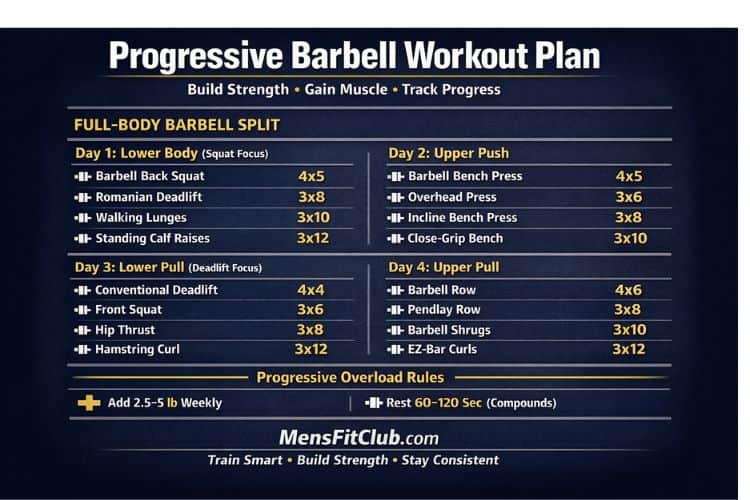
Building real strength and muscle isn’t about random workouts or constantly changing exercises. It’s about following a structured system that allows your body to adapt, grow stronger, and build lean muscle over time. A progressive workout plan with a barbell is one of the most effective, time-tested methods for achieving long-term results in strength, size, and performance.
Barbell training allows for precise load increases, full-body muscle engagement, and measurable progress. When combined with progressive overload principles, it becomes a powerful tool for transforming your physique. Whether your goal is muscle gain, strength development, or athletic performance, a barbell-based progressive workout plan provides clarity, structure, and results.
This guide will walk you through everything you need to know—from the science of progressive overload to a complete barbell workout plan—so you can train with purpose and confidence.
What Is a Progressive Workout Plan?
A progressive workout plan is a training system where you gradually increase the demands placed on your muscles over time. The goal is simple: force your body to adapt by consistently challenging it beyond its current capabilities.
Progression can come in many forms, including adding weight to the bar, increasing repetitions, improving lifting tempo, or enhancing overall workout volume. Among all training tools, barbells are uniquely suited for progression because they allow small, measurable increases in resistance.
A progressive barbell workout plan focuses on compound lifts that work multiple muscle groups simultaneously, ensuring efficient muscle activation and steady strength gains.
Why Barbell Training Is Ideal for Progressive Overload
Barbells are unmatched when it comes to progressive overload. Unlike machines or fixed dumbbells, barbells offer unlimited loading potential and promote balanced muscle development through natural movement patterns.
Barbell exercises engage stabilizer muscles, improve neuromuscular coordination, and allow lifters to track progress precisely. Incremental increases of as little as 2.5 pounds can make a significant difference over time, especially for intermediate and advanced lifters.
Additionally, barbell movements such as squats, deadlifts, bench presses, and overhead presses stimulate the greatest hormonal responses, supporting muscle growth and strength adaptation.
The Science Behind Progressive Barbell Training
Progressive overload works by stimulating muscle fibers through mechanical tension, metabolic stress, and muscle damage. When muscles are exposed to increasing resistance, microscopic tears occur in the muscle tissue. During recovery, these fibers rebuild stronger and thicker.
Barbell training maximizes mechanical tension, the primary driver of strength and hypertrophy. Heavy compound lifts activate a high number of motor units, forcing the nervous system to adapt and improve efficiency.
Over time, this results in increased muscle size, improved force production, and enhanced overall performance.
Key Principles of a Progressive Barbell Workout Plan
Progressive Overload Must Be Gradual
One of the most common mistakes in barbell training is increasing weight too quickly. Progress should be slow and controlled to avoid plateaus and injuries. Adding small amounts of weight consistently leads to sustainable strength gains.
Focus on Compound Movements
Compound barbell lifts form the foundation of any progressive workout plan. These exercises recruit multiple joints and muscle groups, allowing you to lift heavier loads and stimulate more muscle growth.
Recovery Is Non-Negotiable
Progress doesn’t happen during workouts—it happens during recovery. Adequate sleep, proper nutrition, and rest days are essential for muscle repair and strength adaptation.
Consistency Beats Intensity
Training consistently with proper form and progressive increases will outperform sporadic high-intensity workouts every time. A structured plan executed over weeks and months produces the best results.
Benefits of a Progressive Barbell Workout Plan
A progressive barbell workout plan delivers both physical and mental benefits. Physically, it builds lean muscle mass, increases bone density, enhances joint strength, and improves overall body composition.
Mentally, tracking progress and hitting new personal records builds confidence and discipline. Barbell training also encourages goal-setting and long-term commitment, which translates into better adherence and motivation.
For men especially, progressive barbell training supports testosterone production, functional strength, and athletic longevity.
Who Should Follow a Progressive Barbell Workout Plan?
A progressive workout plan with a barbell is suitable for beginners, intermediates, and advanced lifters alike. Beginners benefit from learning fundamental movement patterns and building a strength base. Intermediate lifters use progression to break plateaus and refine technique. Advanced lifters rely on structured progression to continue improving despite slower gains.
As long as exercises are scaled appropriately, barbell training can be adapted to all fitness levels.
Weekly Structure for a Progressive Barbell Workout Plan
A well-designed weekly structure balances training volume, intensity, and recovery. A four-day split is ideal for most lifters, allowing sufficient frequency without overtraining.
Training days are organized around major movement patterns, ensuring balanced muscle development and optimal recovery between sessions.
Day 1: Lower Body Strength (Squat Focus)
The first day emphasizes barbell squats and supporting lower-body movements. Squats are the cornerstone of barbell training, targeting the quads, glutes, hamstrings, and core.
Back squats should be performed with progressive loading, focusing on depth, control, and proper bracing. Accessory lifts support strength development and improve muscular balance.
Day 2: Upper Body Push (Bench & Overhead Press)
Upper-body push day centers around the barbell bench press and overhead press. These lifts develop the chest, shoulders, and triceps while strengthening the upper-body stabilizers.
Progression on pressing movements should be conservative, as these muscle groups recover more slowly than lower-body muscles.
Day 3: Rest or Active Recovery
Rest days are essential in a progressive workout plan. Light mobility work, walking, or stretching promotes blood flow and aids recovery without interfering with strength gains.
Skipping rest days often leads to stalled progress and increased injury risk.
Day 4: Lower Body Pull (Deadlift Focus)
Deadlift day targets the posterior chain, including the glutes, hamstrings, lower back, and upper back. Deadlifts are one of the most neurologically demanding barbell lifts and should be trained with precision.
Progression on deadlifts may occur weekly or bi-weekly, depending on recovery capacity.
Day 5: Upper Body Pull (Row & Back Focus)
Upper-body pull day strengthens the lats, traps, rhomboids, and biceps. Barbell rows are a key component, improving posture, grip strength, and pulling power.
Balanced pulling volume helps prevent shoulder issues and supports pressing strength.
Progressive Barbell Workout Plan (Sample Sets & Reps)
The following structure supports progressive overload while managing fatigue effectively.
Main Lifts
Main compound lifts are performed in the 3–6 rep range, allowing heavy loading and strength progression. Weight increases are added once all sets are completed with proper form.
Secondary Lifts
Secondary barbell lifts are performed in the 6–10 rep range, supporting hypertrophy and technical refinement.
Accessory Work
Accessory exercises use moderate loads and higher reps to target weak points and improve muscular balance.
How to Progress Your Barbell Workouts
Progression doesn’t always mean adding weight every session. Smart progression includes increasing reps, improving tempo, reducing rest time, or enhancing technique.
A common method is double progression, where you increase reps within a target range before adding weight. For example, once you can perform all sets at the top of the rep range, you increase the load slightly.
Tracking workouts in a training log is essential for long-term success.
Common Mistakes to Avoid in Progressive Barbell Training
One of the biggest mistakes is sacrificing form for heavier weight. Poor technique increases injury risk and limits long-term progress.
Another mistake is neglecting warm-ups and mobility work. Preparing joints and muscles properly improves performance and reduces strain.
Finally, many lifters underestimate the importance of recovery. Training hard without adequate rest stalls progress and leads to burnout.
Nutrition for a Progressive Barbell Workout Plan
Proper nutrition fuels progressive training. A calorie surplus supports muscle growth, while sufficient protein intake aids recovery and repair.
Complex carbohydrates provide energy for heavy lifting sessions, while healthy fats support hormone production. Hydration also plays a key role in strength performance.
Without proper nutrition, even the best workout plan will fail to deliver optimal results.
How Long Should You Follow a Progressive Barbell Workout Plan?
A progressive barbell workout plan should be followed for at least 8–12 weeks to allow meaningful adaptation. Long-term progression can continue for years with proper programming adjustments.
Deload weeks—periods of reduced intensity—help manage fatigue and prepare the body for continued progress.
Progressive Barbell Training for Long-Term Results
Consistency, patience, and intelligent progression are the pillars of long-term success. Barbell training rewards those who commit to the process and focus on steady improvement rather than quick fixes.
By mastering fundamental lifts, tracking progress, and prioritizing recovery, you can build a strong, muscular, and resilient body.
Why a Progressive Barbell Workout Training Plan Works
A progressive workout plan with a barbell is one of the most effective and efficient ways to build strength and muscle. It combines measurable progression, functional movement patterns, and proven training principles into one powerful system.
Whether you’re training at home or in the gym, barbells provide the structure and scalability needed for continuous improvement. When paired with proper nutrition and recovery, progressive barbell training delivers results that last.
If your goal is to build muscle, increase strength, and develop a powerful physique, a progressive barbell workout plan is not just an option—it’s a necessity.


Most Recommended

Subscribe to our Newsletter
Stay up to date on the latest men’s health, fitness and lifestyle trends and tips.
About Us
Men’s Fit Club was started with the goal of empowering men to get the most out of their lives. This meant going beyond exercise and diet tips to really address the broad range of issues that men face on a daily basis – topics like recreation, finding love, sexual health and even sound fashion advice.
Quick Links
© COPYRIGHT MEN'S FIT CLUB 2026. All Rights Reserved