

30-Minute Lower Body Dumbbell Workout for Strength


30 Minute Lower Body Strength Workout (Build Muscle & Power)

5 Shoulder Workouts with Dumbbells: Guide to Stronger Shoulders
The Ultimate 60-Minute Calisthenics Workout for Full Body Fitness
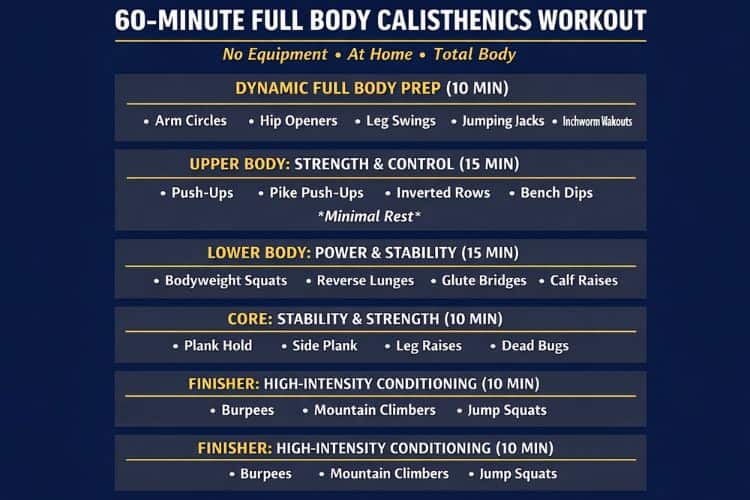
A 60-minute full body calisthenics workout is one of the most effective ways to build strength, burn fat, and improve athletic performance without stepping foot in a gym. By using only your bodyweight, you can challenge every major muscle group, increase cardiovascular endurance, and develop real-world functional strength. Whether your goal is muscle definition, fat loss, or total-body conditioning, calisthenics delivers results when programmed correctly.
This complete 60-minute calisthenics workout is designed for men who want a challenging, structured, and scalable routine that can be done anywhere. With smart exercise sequencing, progressive intensity, and minimal rest, this workout helps maximize time under tension, metabolic stress, and muscular endurance—all without equipment.
Why a 60-Minute Calisthenics Workout Works So Well
Calisthenics training emphasizes compound movements, body control, and coordinated muscle engagement. Unlike machine-based workouts, calisthenics forces your stabilizing muscles to work harder, leading to better balance, mobility, and overall strength.
A full 60-minute session allows enough time to train the upper body, lower body, core, and conditioning systems thoroughly. This duration is ideal for intermediate to advanced athletes, while beginners can modify exercises to match their fitness level.
Key Benefits of Full Body Calisthenics Training
A structured calisthenics workout improves muscular endurance, joint health, coordination, and cardiovascular fitness simultaneously. Because you are moving your own body through space, you develop strength that directly transfers to real-life movement patterns. Additionally, calisthenics workouts burn a high number of calories, making them highly effective for fat loss and body recomposition.
How This 60-Minute Full Body Calisthenics Workout Is Structured
This workout is divided into five phases to ensure optimal performance and recovery throughout the session. Each phase builds upon the last, creating a balanced and challenging full-body experience.
Workout Breakdown Overview
- Dynamic Warm-Up: 10 minutes
- Upper Body Strength Circuit: 15 minutes
- Lower Body Strength Circuit: 15 minutes
- Core & Stability Training: 10 minutes
- Conditioning Finisher: 10 minutes
Minimal rest is encouraged to keep the heart rate elevated while maintaining proper form.
Dynamic Warm-Up (10 Minutes)
A proper warm-up is essential for injury prevention and performance. The goal is to increase blood flow, mobilize joints, and activate the muscles you’ll be using during the workout.
Dynamic Warm-Up Exercises
Start with arm circles, shoulder rolls, and torso twists to loosen the upper body. Follow with leg swings, hip circles, and ankle rotations to prepare the lower body. Finish the warm-up with light full-body movements such as jumping jacks, high knees, and inchworms.
This phase should gradually elevate your heart rate and leave you feeling loose, mobile, and ready to train.
Upper Body Calisthenics Strength Circuit (15 Minutes)
Upper body calisthenics exercises focus on pushing and pulling patterns that develop the chest, shoulders, back, arms, and core. This circuit uses compound movements that engage multiple muscle groups at once.
Push-Ups and Variations
Push-ups form the foundation of calisthenics upper body training. Standard push-ups primarily target the chest, shoulders, triceps, and core. To increase difficulty, slow down the tempo or elevate your feet. Beginners can modify by dropping to their knees or performing incline push-ups.
Pike Push-Ups for Shoulder Strength
Pike push-ups shift the emphasis to the shoulders and upper chest while heavily engaging the core. This movement helps build the pressing strength necessary for advanced calisthenics skills like handstand push-ups.
Inverted Rows or Towel Rows
If a bar or sturdy surface is available, inverted rows are excellent for developing back and biceps strength. If not, towel rows using a door anchor can be a great alternative. These pulling movements balance pushing exercises and improve posture.
Circuit Execution
Perform each exercise for controlled repetitions or timed intervals, resting only briefly between movements. Repeat the circuit multiple times within the 15-minute window.
Lower Body Calisthenics Strength Circuit (15 Minutes)
Lower body training is crucial for building total-body strength, power, and endurance. Calisthenics leg exercises challenge not only the muscles but also balance and coordination.
Bodyweight Squats Full Body Calisthenics Workout
Bodyweight squats target the quadriceps, glutes, and hamstrings while strengthening the hips and knees. Focus on depth, control, and proper alignment to maximize muscle activation.
Reverse Lunges Full Body Calisthenics Workout
Reverse lunges are easier on the knees than forward lunges and place greater emphasis on the glutes and hamstrings. This movement also improves unilateral strength and balance.
Glute Bridges
Glute bridges activate the posterior chain and help counteract prolonged sitting. Strong glutes enhance performance in nearly every athletic movement and protect the lower back.
Calf Raises
Calf raises strengthen the lower legs and improve ankle stability. Perform them slowly and deliberately to maximize time under tension.
Circuit Execution
Move through each lower body exercise consecutively with minimal rest. Aim for steady breathing and controlled movement to maintain form under fatigue.
Core & Stability Training (10 Minutes)
A strong core is the foundation of all calisthenics movements. Core training in this workout focuses on stability, anti-rotation, and total abdominal engagement.
Plank Variations Full Body Calisthenics Workout
Planks build deep core strength and improve posture. Standard planks engage the abs, shoulders, and glutes, while side planks add an oblique challenge.
Hanging or Lying Leg Raises
Leg raises emphasize the lower abdominal muscles and hip flexors. Focus on controlled movement rather than momentum to get the most benefit.
Dead Bugs and Bird Dogs
These stability exercises reinforce proper spinal alignment and improve coordination between the upper and lower body.
Core Circuit Execution
Rotate through core exercises with short rest periods, maintaining tension throughout each movement.
Conditioning Finisher (10 Minutes)
The final phase of the workout pushes cardiovascular fitness and calorie burn to the next level. This finisher is designed to elevate heart rate while reinforcing total-body coordination.
Burpees Full Body Calisthenics Workout
Burpees are one of the most effective full-body conditioning exercises. They combine strength, power, and cardio into a single movement.
Mountain Climbers
Mountain climbers challenge the core while keeping the heart rate high. Maintain a strong plank position throughout the movement.
Jump Squats Full Body Calisthenics Workout
Jump squats develop explosive lower body power and increase metabolic demand. Land softly to protect your joints.
Finisher Format
Perform each exercise in intervals, rotating continuously for the full 10 minutes. Push yourself while maintaining safe and controlled movement patterns.
Cool Down and Mobility (5 Minutes)
Although often overlooked, cooling down is essential for recovery and long-term progress. Gentle stretching helps reduce muscle soreness and restore range of motion.
Focus on stretching the hips, hamstrings, chest, shoulders, and back. Deep breathing during the cool down promotes relaxation and recovery.
How to Progress This 60-Minute Full Body Calisthenics Workout
Progressive overload is key to continuous improvement. You can increase difficulty by adding repetitions, extending time under tension, reducing rest periods, or advancing to more challenging exercise variations.
Tracking your workouts allows you to measure progress and stay motivated. Over time, you’ll notice improved endurance, strength, and overall athleticism.
Who Should Do This Full Body Calisthenics Workout?
This workout is ideal for men who want a challenging, efficient, and equipment-free training plan. It suits those training at home, outdoors, or while traveling. Beginners can scale movements, while advanced athletes can push intensity with harder variations and faster pacing.
Build Strength Anywhere With Full Body Calisthenics Workout
A 60-minute full body calisthenics workout delivers everything you need to build muscle, burn fat, and improve conditioning without equipment. By combining strength training, core work, and high-intensity conditioning, this routine provides a complete training solution for men at any fitness level.
Consistency, proper form, and progressive challenge are the keys to success. Stick with this workout, adjust intensity as needed, and you’ll build a strong, lean, and athletic physique—anytime, anywhere.


Most Recommended

Subscribe to our Newsletter
Stay up to date on the latest men’s health, fitness and lifestyle trends and tips.
About Us
Men’s Fit Club was started with the goal of empowering men to get the most out of their lives. This meant going beyond exercise and diet tips to really address the broad range of issues that men face on a daily basis – topics like recreation, finding love, sexual health and even sound fashion advice.
Quick Links
© COPYRIGHT MEN'S FIT CLUB 2026. All Rights Reserved