

High-Protein Slow-Cooker Meals for Muscle Gain
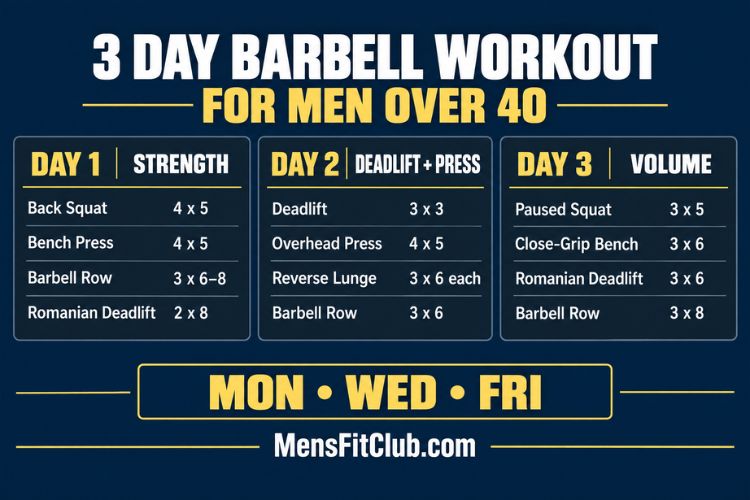
3 Day Barbell Strength Workout Program for Men Over 40

Ground Beef Sweet Potato and Cottage Cheese Bowl
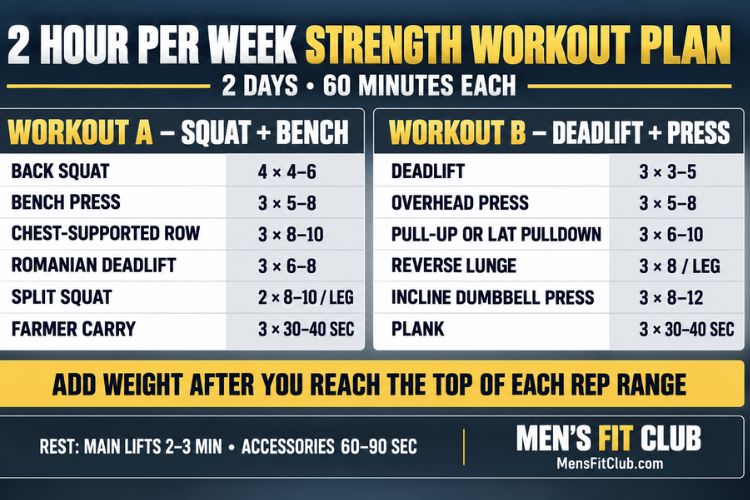
2 Hour Per Week Strength Workout Plan Your Ultimate Guide
2 Hour Per Week Strength Workout Plan Your Ultimate Guide
Finding time to train can feel harder than the workout itself. Work, family, commuting, and everyday responsibilities often make a five-day gym schedule unrealistic. The good news is that you do not need to live in the weight room to become stronger. A carefully designed 2 hour per week strength workout plan can train every major muscle group, provide enough weekly volume for progress, and fit into a demanding schedule.
This plan divides two weekly hours into two focused 60-minute full-body workouts. Each session uses compound exercises, efficient exercise pairings, sensible rest periods, and progressive overload. It is ideal for busy men who want to build strength, maintain or gain muscle, improve everyday performance, and stop wasting time on complicated routines. Train consistently, keep an accurate log, and make your working sets count.
Can You Build Strength Training Only 2 Hours Workout Plan Per Week?
Yes. Two productive hours can be enough to produce meaningful strength and muscle gains, especially for beginners, returning lifters, and recreational trainees. Results depend less on collecting gym hours and more on what you accomplish during them. A program must challenge the main movement patterns, apply progressive overload, and leave enough recovery time between sessions.
Two full-body workouts work well because each major muscle group receives two weekly training exposures. That frequency gives you regular practice on important lifts without requiring daily gym visits. It also provides several recovery days, which can be useful for men balancing training with stressful schedules, physical jobs, sports, or family life.
The plan still requires effort. The final repetitions of a working set should feel challenging while your technique remains controlled. You also need adequate protein, sleep, and consistency. Two hours of deliberate strength training can outperform a longer routine filled with missed sessions, unnecessary exercises, and unfocused effort.
Why This 2-Day Strength Workout Plan Works
The routine is built around six essential patterns: squat, hinge, horizontal push, vertical push, horizontal pull, and vertical pull. Loaded carries and direct core work add trunk stability, grip strength, and practical conditioning. Together, these movements cover the legs, glutes, hamstrings, chest, back, shoulders, arms, and core.
Compound lifts provide a high return on time because they train several muscle groups simultaneously. A squat develops the legs and challenges the trunk. A bench press trains the chest, shoulders, and triceps. A row builds the upper back and biceps. Prioritizing these movements allows you to complete useful weekly volume without turning each workout into a marathon.
The sessions also alternate emphasis. Workout A gives the squat and bench press priority, while Workout B emphasizes the deadlift and overhead press. This distributes fatigue and helps you practice the main lifts when you are fresh. Accessories fill important gaps without distracting from the exercises that drive most of your progress.
Weekly Schedule for the 2 Hour Strength Workout Plan
Train on two nonconsecutive days. Monday and Thursday, Tuesday and Friday, or Wednesday and Saturday all work well. Leave at least two days between sessions when possible. Your exact days matter less than maintaining a repeatable schedule.
| Day | Training | Duration |
|---|---|---|
| Monday | Full Body Workout A | 60 minutes |
| Tuesday | Rest or easy walking | Optional |
| Wednesday | Rest or mobility | Optional |
| Thursday | Full Body Workout B | 60 minutes |
| Friday–Sunday | Recovery and normal activity | Optional |
Easy walking, mobility work, or low-intensity cardio on rest days is fine, but it does not count against the two-hour strength budget. Avoid exhausting intervals or high-volume leg work immediately before either lifting session.
Workout A: Squat and Bench Press Strength 2 Hour Workout Plan
Workout A develops lower-body pushing strength, horizontal pressing power, back strength, and trunk stability. Set up your equipment before starting and use a timer to keep rest periods honest.
Minutes 0–8: Dynamic Warm-Up
Begin with two minutes of brisk walking, cycling, or rowing. Then complete two rounds of eight bodyweight squats, eight hip hinges, six reverse lunges per side, ten band pull-aparts, and six incline push-ups. Finish with two or three gradually heavier warm-up sets for the squat. Warm-up sets prepare you for the working weight and should never create fatigue.
Minutes 8–25: Back Squat
Perform 4 sets of 4–6 repetitions and rest two to three minutes between sets. Choose a weight that leaves approximately two good repetitions in reserve on the first set. Brace before every repetition, keep your whole foot planted, and use the deepest range you can control without losing spinal or knee position.
If barbell squats are unavailable or uncomfortable, use a goblet squat, front squat, hack squat, or leg press. The goal is a stable knee-dominant movement that can be progressed over time.
Minutes 25–40: Bench Press and Row Superset
Perform 3 sets of 5–8 bench presses and 3 sets of 8–10 chest-supported rows. Complete the bench press, rest about 45 seconds, complete the row, and then rest 75–90 seconds before repeating. Pairing opposing movements saves time while maintaining balanced shoulder development.
Use a dumbbell bench press or controlled push-up if you train at home. For the row, use dumbbells, a cable station, a machine, or a resistance band. Keep the pressing repetitions smooth and pull your shoulder blades back during each row.
Minutes 40–53: Romanian Deadlift and Split Squat
Perform 3 sets of 6–8 Romanian deadlifts and 2 sets of 8–10 split squats per leg. Alternate the exercises with 45–60 seconds between movements. Push your hips back during the Romanian deadlift and stop when your hamstrings are fully loaded without rounding your back. During split squats, keep your front foot planted and lower under control.
Minutes 53–60: Carry and Cooldown
Complete 3 farmer carries of 30–40 seconds, resting only long enough to reset your grip. Use dumbbells or kettlebells that challenge your hands while allowing tall posture. Finish with relaxed breathing and brief hip or chest mobility if time remains.
Workout B: Deadlift and Overhead Press Strength
Workout B prioritizes the hip hinge, vertical press, vertical pull, and single-leg strength. It complements Workout A and ensures balanced total-body development.
Minutes 0–8: Dynamic Warm-Up
Perform two minutes of easy cardio followed by two rounds of eight glute bridges, eight unweighted good mornings, six lateral lunges per side, ten arm circles in each direction, and eight scapular pull-downs or band pull-aparts. Complete several progressive deadlift warm-up sets before the first work set.
Minutes 8–24: Deadlift
Perform 3 sets of 3–5 repetitions with two to three minutes of rest. Deadlifts create more fatigue than most exercises, so quality matters more than extra volume. Reset your brace before every repetition, keep the load close to your body, and finish by standing tall rather than leaning backward.
A trap-bar deadlift is an excellent alternative and may be easier for beginners to learn. Dumbbell deadlifts, kettlebell deadlifts, or heavy hip thrusts can fill the same hinge slot when equipment is limited.
Minutes 24–39: Overhead Press and Pull-Up Superset
Perform 3 sets of 5–8 overhead presses and 3 sets of 6–10 pull-ups or lat pulldowns. Rest 45 seconds between exercises and 75–90 seconds after each pair. Keep your ribs down while pressing and avoid turning the movement into a standing incline press. Use an assistance band or machine if you cannot yet complete controlled pull-ups.
Minutes 39–52: Reverse Lunge and Incline Dumbbell Press
Perform 3 sets of 8 reverse lunges per leg and 3 sets of 8–12 incline dumbbell presses. Alternate exercises with 45–60 seconds of rest. Reverse lunges develop unilateral leg strength and may feel friendlier to the knees than forward lunges. The incline press adds chest and shoulder volume without requiring maximal loads.
Minutes 52–60: Core Training and Cooldown
Perform 3 rounds of 8–12 ab-wheel rollouts or 30–40-second front planks. Rest 30–45 seconds. Keep your ribs and pelvis stacked instead of letting your lower back sag. Use the remaining time for easy breathing and gentle mobility.
Sets, Reps, Effort, and Rest Periods
Most primary lifts use 3–4 sets of 3–8 repetitions because moderately heavy loads build strength efficiently. Secondary movements use 6–12 repetitions to add muscle-building volume with less joint stress. Carries and planks are measured by time.
Work mostly at a rate of perceived exertion of 7–8 out of 10, meaning you finish a set with roughly two or three repetitions in reserve. You do not need to reach muscular failure to grow stronger. Repeatedly grinding through ugly repetitions adds fatigue, slows the session, and can undermine technique.
Rest two to three minutes after heavy squats and deadlifts. Use roughly 60–90 seconds for accessory exercises and supersets. If performance drops sharply, extend the rest slightly. If you are fully recovered long before the next set, shorten it. A visible timer prevents three-minute rests from quietly becoming six.
How to Progress the 2 Hour Strength Workout Plan Each Week
Use double progression. Begin at the lower end of each repetition range with a manageable weight. Keep that load until you reach the top of the range on every prescribed set with clean technique and one or two repetitions still available. At the next workout, increase upper-body lifts by approximately 2.5–5 pounds and lower-body lifts by approximately 5–10 pounds. Then return to the lower end of the range.
For example, if your squat prescription is 4 sets of 4–6, you might begin with four sets of four. Over several weeks, build toward four sets of six. Once all four sets reach six strong repetitions, add a small amount of weight and begin again at four repetitions.
Record the exercise, load, sets, repetitions, and perceived effort after every session. Without a log, it is easy to repeat the same work and assume you are progressing. Small improvements count: one additional repetition, slightly better technique, a small weight increase, or the same performance with less effort.
After five to eight demanding weeks, consider a deload if joints ache, motivation falls, or performance declines for multiple sessions. Reduce working weight by about 10–15 percent and complete one fewer set per exercise for one week. Resume normal training feeling refreshed.
Beginner and Home 2 Hour Strength Workout Plan Modifications
Beginners should spend the first two weeks learning technique. Use lighter loads, stop each set well before failure, and perform three work sets instead of four on squats. A qualified trainer can help with unfamiliar barbell movements. Pain is not a normal requirement; replace any exercise that causes sharp or worsening discomfort.
At home, substitute goblet squats for back squats, dumbbell Romanian deadlifts for barbell hinges, floor presses for bench presses, and one-arm dumbbell rows for cable or machine rows. Use standing dumbbell presses, band-assisted pulldowns, split squats, loaded backpack carries, and planks. When weights are limited, add repetitions, slow the lowering phase, pause in difficult positions, or progress to unilateral variations.
The exercise names can change while the movement patterns remain. Retaining a squat, hinge, push, pull, single-leg movement, and core exercise is more important than owning a particular piece of equipment.
Nutrition and Recovery for Better 2 Hour Strength Workout Plan
Training provides the stimulus, while food and sleep support adaptation. Eat enough calories for your goal and include protein in several meals across the day. A practical daily protein target for healthy, active adults is about 0.7–1.0 gram per pound of body weight, although individual needs vary. Build meals around quality protein, produce, carbohydrates, and healthy fats.
Carbohydrates before training can support performance, especially after a long workday. Stay hydrated, aim for seven to nine hours of sleep, and keep rest-day activity easy. Supplements cannot compensate for inconsistent training or poor nutrition. Anyone with a medical condition or medication concerns should consult a qualified healthcare professional before changing training, diet, or supplements.
Common Mistakes That Waste Your 2 Hour Strength Workout Plan
Avoid changing exercises constantly. Strength is a skill, and repeating key lifts allows technique and loading to improve. Keep the core program stable for at least eight weeks unless discomfort or equipment limitations require a substitution.
Do not let isolation exercises replace squats, hinges, presses, and pulls. Curls or lateral raises can be added only when the planned work is complete. Likewise, do not rush heavy sets to turn the workout into conditioning. Give squats and deadlifts full rest, begin with manageable loads, and build momentum rather than chasing maximum effort in week one.
Frequently Asked Questions About 2 Hour Strength Workout Plan
Is two days a week enough to build muscle?
Two full-body sessions can build muscle when they provide challenging weekly sets, progressive overload, sufficient protein, and recovery. Advanced bodybuilders may benefit from more volume, but many busy men can make excellent progress on two well-designed days.
Can I lose fat with this workout plan?
Yes, strength training helps preserve muscle during fat loss, but calorie intake largely determines whether body weight decreases. Combine the plan with a sustainable calorie deficit and regular walking rather than cutting recovery so aggressively that lifting performance collapses.
How long should I follow the program?
Follow it for at least eight to twelve weeks. Continue longer if your lifts improve and you enjoy the structure. There is no need to replace an effective plan simply because the calendar changes.
What if I miss one workout?
Complete the missed session on the next available day, then return to the normal rotation. Do not squeeze both workouts together or perform twice the volume in one session. Long-term consistency matters more than a perfect week.
MensFitClub Strength Training Resources
Continue building your program with MensFitClub’s Full Body Strength Training Workout Plan, review the broader Strength Training Program For Men, or use the Full Body Barbell Strength Workout when you want a barbell-focused session. Men training at home can explore the Home Dumbbell Workout Program, while anyone needing another time-efficient option can try this 45 Minute Full Body Strength Workout.
The 2 Hour Per Week Strength Workout Plan
A busy schedule does not require abandoning strength training. Two focused 60-minute sessions can cover every major movement pattern, provide enough practice for steady progress, and leave ample time for recovery. The key is to protect those appointments, prioritize compound lifts, track performance, and increase demands gradually.
Run the plan for eight to twelve weeks before judging it. Arrive prepared, train with purpose, and resist the urge to add complexity. When two weekly hours are organized around high-quality work, they can become some of the most productive hours in your schedule.


Most Recommended

Subscribe to our Newsletter
Stay up to date on the latest men’s health, fitness and lifestyle trends and tips.
About Us
Men’s Fit Club was started with the goal of empowering men to get the most out of their lives. This meant going beyond exercise and diet tips to really address the broad range of issues that men face on a daily basis – topics like recreation, finding love, sexual health and even sound fashion advice.
Quick Links
© COPYRIGHT MEN'S FIT CLUB 2026. All Rights Reserved