

4-Week Gym Workout Plan for Rapid Muscle Growth

5 Day Strength Training Weight Program (Building Muscle & Power)

4 Week Ab Workout Plan for Men: Build a Stronger Core in 28 Days

Best Full Body Strength Training Routine for Men: To Build Muscle
Powerlifting Workout Plan for Beginners: A Guide to Strength
Powerlifting is one of the most effective and rewarding ways to build raw strength, muscle mass, and confidence in the gym. Unlike bodybuilding or functional training, powerlifting focuses on three main lifts—the squat, bench press, and deadlift. For beginners, starting a powerlifting workout plan can feel intimidating, but with the right plan, technique, and progression strategy, anyone can build a strong foundation and achieve impressive strength gains.
This beginner powerlifting workout plan is designed to help you learn proper technique, build strength safely, and progressively overload your muscles for long-term results. Whether your goal is to compete, gain muscle, or simply get stronger, this guide will give you everything you need to start powerlifting the right way.
What Is Powerlifting Workout Plan & Why Should Beginners Try It?
Powerlifting is a strength sport that measures maximal strength in three compound lifts: the squat, bench press, and deadlift. Unlike Olympic lifting, powerlifting emphasizes controlled, heavy lifts with minimal technical complexity, making it accessible for beginners.
For beginners, powerlifting offers multiple benefits. It builds functional strength that carries over into daily life and other sports. It increases muscle mass through progressive overload, and it improves bone density, posture, and metabolic health. Powerlifting also teaches discipline and goal setting, as strength gains are measurable and motivating.
Starting with a structured powerlifting plan ensures you build strength safely, avoid injuries, and make consistent progress.
Key Principles of a Beginner Powerlifting Workout Plan
Before diving into the workout plan, it’s important to understand the core principles that make powerlifting effective. These principles will guide your training and help you maximize results.
Progressive Overload
Progressive overload is the foundation of powerlifting. It means gradually increasing weight, reps, or sets over time. Beginners should aim to add small amounts of weight each week while maintaining proper form.
Compound Lifts First
Powerlifting programs prioritize compound movements that work multiple muscle groups. Squats, bench presses, and deadlifts should be performed at the beginning of each workout when energy levels are highest.
Proper Recovery
Beginners often underestimate recovery. Powerlifting is demanding on the nervous system, so adequate sleep, nutrition, and rest days are essential for growth.
Technique Over Weight
For beginners, perfecting technique is more important than lifting heavy weights. Good form prevents injuries and ensures long-term progress.
Beginner Powerlifting Workout Plan Overview
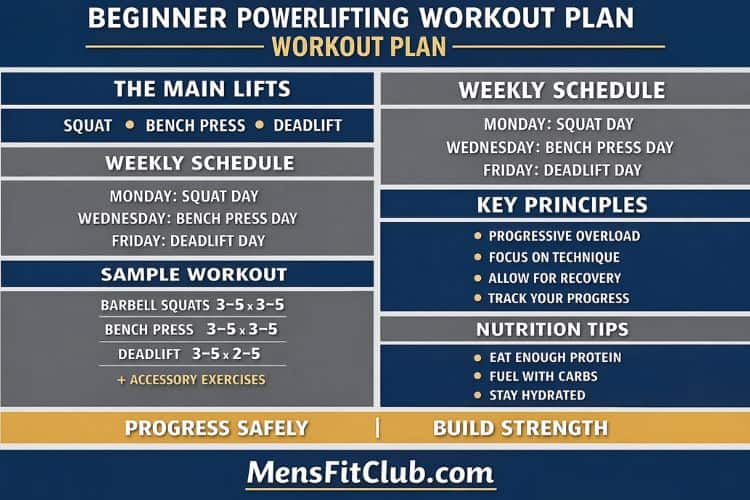
This beginner powerlifting workout plan follows a 3-day full-body split, ideal for beginners who want to build strength without overtraining.
Weekly Schedule Example:
- Day 1: Squat Focus
- Day 2: Bench Press Focus
- Day 3: Deadlift Focus
This structure allows enough recovery while hitting each lift multiple times per week.
Day 1: Squat-Focused Beginner Powerlifting Workout Plan
The squat is the king of lower body exercises and a cornerstone of powerlifting. It builds quads, glutes, hamstrings, and core strength.
Barbell Back Squat
Perform 3–5 sets of 3–5 reps. Use a weight that feels challenging but allows perfect form. Rest 2–4 minutes between sets. Focus on depth, bracing your core, and driving through your heels.
Paused Squat
Paused squats help beginners develop strength at the bottom of the movement. Perform 3 sets of 5 reps, pausing for 2 seconds at the bottom.
Romanian Deadlift Beginner Powerlifting Workout Plan
This movement targets the posterior chain. Perform 3 sets of 8–10 reps with controlled tempo to build hamstrings and glutes.
Core Work
Finish with planks or hanging leg raises for 3 sets of 20–30 seconds or 10–15 reps.
Day 2: Bench Press-Focused Beginner Powerlifting Workout Plan
The bench press develops chest, shoulders, and triceps and is one of the most technical powerlifting lifts.
Barbell Bench Press
Perform 3–5 sets of 3–5 reps. Focus on bar path, tightness, and leg drive. Rest 2–4 minutes between sets.
Close-Grip Bench Press
Close-grip bench press targets the triceps and improves lockout strength. Perform 3 sets of 6–8 reps.
Dumbbell Bench Press Beginner Powerlifting Workout Plan
Dumbbells help build stability and muscle balance. Perform 3 sets of 8–10 reps.
Row Variation
Add barbell rows or seated cable rows for 3 sets of 8–12 reps to balance pushing with pulling.
Day 3: Deadlift-Focused Beginner Powerlifting Workout Plan
The deadlift is the ultimate full-body strength movement, engaging nearly every muscle group.
Conventional Deadlift
Perform 3–5 sets of 2–5 reps. Keep your back neutral, drive through the legs, and lock out with the hips. Rest 3–5 minutes between heavy sets.
Deficit Deadlift or Block Pull
These variations help improve weak points. Perform 3 sets of 4–6 reps.
Pull-Ups or Lat Pulldowns
Perform 3 sets of 8–12 reps to strengthen the lats, which play a major role in deadlift stability.
Hamstring and Core Work
Finish with glute-ham raises or leg curls and weighted planks.
Accessory Exercises for Beginners Powerlifting Workout Plan
Accessory exercises are essential for building muscle, improving weak points, and preventing injuries. Beginners should focus on simple movements that support the big three lifts.
Accessory exercises include lunges, leg presses, dumbbell shoulder presses, face pulls, triceps extensions, and bicep curls. These movements improve muscular balance and help stabilize joints.
Keep accessory volume moderate—3 to 4 exercises per workout with 2 to 4 sets each.
How to Progress on a Beginner Powerlifting Workout Plan
Progression is the key to success in powerlifting. Beginners typically progress faster than advanced lifters, so structured progression is crucial.
Linear Progression
Add 2.5–5 pounds to your lifts each week as long as you complete all sets and reps with good form. If you fail, repeat the same weight the next week.
Deload Weeks
Every 4–6 weeks, reduce weights by 10–20% to allow recovery and prevent burnout.
Tracking Workouts
Log every workout. Tracking weights, reps, and sets helps identify progress and weaknesses.
Proper Technique Tips for Beginners Powerlifting Workout Plan
Technique is everything in powerlifting. Beginners should prioritize form before weight.
For squats, keep your chest up, brace your core, and squat to at least parallel. Bench press, keep your shoulder blades retracted, use leg drive, and control the bar. For deadlifts, maintain a neutral spine, engage your lats, and push the floor away with your legs.
Recording your lifts or working with a coach can dramatically improve technique.
Beginner Powerlifting Workout Plan Nutrition Guide
Nutrition plays a massive role in powerlifting progress. Beginners need adequate calories and protein to recover and build muscle.
Aim for a slight calorie surplus if muscle gain is the goal. Protein intake should be around 0.7–1 gram per pound of body weight. Carbohydrates fuel heavy lifting sessions, while healthy fats support hormone production.
Hydration is also critical, as dehydration can significantly reduce strength performance.
Recovery and Rest for Beginner Powerlifting Workout Plan
Recovery is just as important as training. Beginners should aim for 7–9 hours of sleep per night. Active recovery, stretching, and mobility work help prevent injuries.
Rest days are essential. Avoid training heavy every day, as the nervous system needs time to recover from heavy compound lifts.
Common Mistakes Beginners Make in Powerlifting
Many beginners make mistakes that slow progress or lead to injuries. One common mistake is adding weight too quickly and sacrificing form. Another is neglecting accessory work and mobility training.
Beginners also often underestimate recovery and nutrition. Without proper sleep and food, strength gains will stall.
Consistency is more important than perfection. Stick to the program, progress gradually, and stay patient.
Beginner Powerlifting Program Sample Weekly Schedule
Here is an example weekly structure for beginners:
Monday: Squat Day
Wednesday: Bench Press Day
Friday: Deadlift Day
Each workout lasts 60–90 minutes and includes the main lift, variations, and accessory exercises.
Benefits of Powerlifting for Beginners
Powerlifting offers long-term benefits beyond the gym. It improves physical strength, mental resilience, confidence, and discipline. It also enhances body composition, increases muscle mass, and boosts metabolism.
For beginners, powerlifting provides clear goals and measurable progress, making it one of the most motivating training styles.
How Long Does It Take to See Results?
Beginners can see noticeable strength gains within the first 4–8 weeks. Muscle growth typically becomes visible after 8–12 weeks, depending on nutrition and consistency.
Powerlifting is a long-term journey. The longer you train, the stronger you become.
Should Beginners Compete in Powerlifting?
Competition is optional. Many beginners train powerlifting purely for strength and fitness. However, competing can be motivating and rewarding.
If you choose to compete, focus on technique, consistency, and building a strong base before attempting maximal lifts.
Powerlifting vs Bodybuilding for Beginners
Powerlifting focuses on maximal strength, while bodybuilding focuses on aesthetics and hypertrophy. Beginners can benefit from combining both approaches.
Powerlifting builds a strong foundation, while accessory hypertrophy work improves muscle size and appearance.
Beginner Powerlifting Safety Tips
Safety should always come first. Warm up properly before heavy lifts. Use proper equipment like lifting belts, knee sleeves, and wrist wraps when necessary. Never skip warm-up sets.
If you feel pain (not muscle soreness), stop and assess your form or seek professional guidance.
Start Your Powerlifting Journey Today
Powerlifting is one of the most effective training methods for building strength, muscle, and confidence. This beginner powerlifting workout plan provides a structured approach to learning the big lifts, progressing safely, and achieving consistent results.
By focusing on proper technique, progressive overload, recovery, and nutrition, beginners can transform their strength levels in just a few months. Stay consistent, track your progress, and enjoy the journey of becoming stronger.
If you’re just getting started with powerlifting, it’s important to combine structured strength training with supportive workout programs and foundational fitness routines. You can enhance your strength gains by pairing this beginner powerlifting plan with a comprehensive Full body Workout Plan to improve overall muscle balance and conditioning. Beginners can also benefit from mastering foundational movements through a Bodyweight Workout Plan before progressing to heavy barbell lifts. Incorporating accessory training such as kettlebell routines can further strengthen the posterior chain and core—check out this kettlebell workout program for added strength and conditioning. For time-efficient training days, you can rotate powerlifting sessions with a 30-Minute Full Body Kettlebell Workout or follow a structured 45-Minute Powerlifting Workout Plan to build both muscle and maximal strength.


Most Recommended

Subscribe to our Newsletter
Stay up to date on the latest men’s health, fitness and lifestyle trends and tips.
About Us
Men’s Fit Club was started with the goal of empowering men to get the most out of their lives. This meant going beyond exercise and diet tips to really address the broad range of issues that men face on a daily basis – topics like recreation, finding love, sexual health and even sound fashion advice.
Quick Links
© COPYRIGHT MEN'S FIT CLUB 2026. All Rights Reserved