

4 Days a Week Weight Training Plan for Strength & Muscle Growth

The Ultimate 4-Day Barbell-Only Strength Training Program

4 Day Per Week Full Body Workout: For Mass and Strength

30 Minute Full Body Strength Training With Dumbbells Only
Strongman Functional Training: Build Real-World Strength & Power
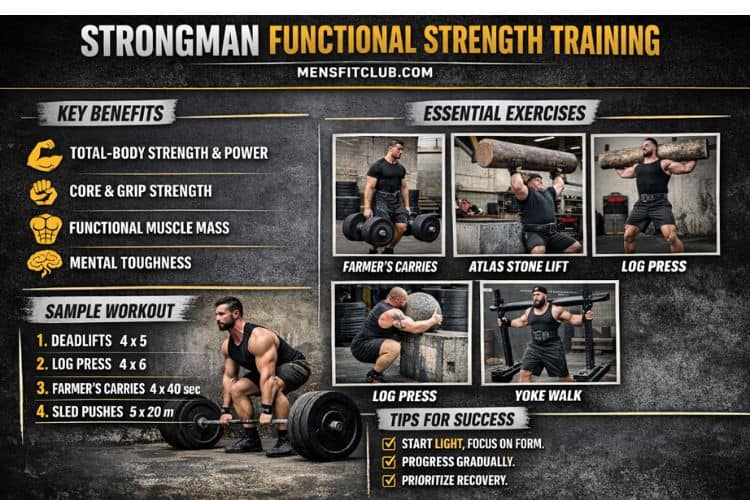
Functional strength is the foundation of real-world athleticism, and no training style builds it quite like strongman training. Unlike traditional bodybuilding routines that focus primarily on aesthetics, strongman workouts emphasize total-body strength, power, endurance, grip strength, and functional movement patterns that translate directly into everyday life and sports performance.
In this complete guide, you’ll learn what strongman functional strength training is, the benefits, essential exercises, programming strategies, and a sample workout plan to help you build serious power.
What Is Strongman Functional Strength Training?
Strongman training is a form of resistance training inspired by competitive strongman events such as Atlas stone lifts, farmer’s carries, log presses, and truck pulls. These movements require lifting, carrying, pushing, pulling, and stabilizing heavy objects—often awkwardly shaped and unevenly weighted.
Functional strength training refers to exercises that improve your ability to perform real-life movements. Strongman training fits this perfectly because it involves multi-joint, compound movements that engage the entire body, rather than isolating single muscles.
In short, strongman training builds strength that works outside the gym.
Benefits of Strongman Functional Strength Training
1. Total-Body Strength and Power
Strongman exercises recruit multiple muscle groups simultaneously, leading to massive strength gains. Movements like deadlifts, carries, and overhead presses develop explosive power that transfers to sports and daily activities.
2. Core and Grip Strength
Every strongman event challenges your core and grip. Carrying heavy objects, stabilizing loads overhead, and pulling sleds force your core muscles to brace and your hands to grip intensely.
3. Functional Muscle Mass
Strongman training builds dense, functional muscle rather than purely aesthetic hypertrophy. This type of muscle improves posture, performance, and injury resilience.
4. Mental Toughness
Strongman training pushes you beyond comfort zones. Lifting awkward objects and performing heavy carries builds grit, discipline, and confidence.
5. Cardiovascular Conditioning
Strongman circuits and carries elevate heart rate, improving conditioning while still building strength—making it a hybrid of strength and cardio training.
Key Principles of Strongman Functional Training
Progressive Overload
Just like bodybuilding and powerlifting, strongman training requires progressive overload. Gradually increase weights, distance, or reps to continue building strength.
Movement Patterns Over Muscles
Strongman training focuses on fundamental movement patterns:
- Push
- Pull
- Carry
- Hinge
- Squat
- Stabilize
Training these patterns improves overall athletic performance.
Unilateral and Odd Object Training
Odd objects such as sandbags, stones, logs, and kegs challenge stability and coordination, improving real-world strength.
Essential Strongman Functional Strength Training Exercises
1. Farmer’s Carries
Farmer’s carries involve walking while holding heavy weights in each hand. This exercise builds grip strength, traps, core, and legs.
How to Perform:
- Hold heavy dumbbells, kettlebells, or farmer’s handles
- Walk with an upright posture for distance or time
2. Atlas Stone Lifts (or Sandbag Lifts)
Lifting stones or sandbags develops explosive power, hip drive, and upper body strength.
How to Perform:
- Deadlift the stone or sandbag
- Pull it into your lap
- Explosively extend hips and load onto a platform
3. Log Press or Overhead Press Strongman Functional Training
Pressing a log or barbell overhead develops shoulders, triceps, upper chest, and core stability.
How to Perform:
- Clean the log or barbell to shoulders
- Press overhead using leg drive (push press)
4. Deadlifts
Deadlifts are a cornerstone of strongman training, building posterior chain strength.
Variations:
- Conventional deadlift
- Axle deadlift
- Trap bar deadlift
5. Yoke Walks
Yoke walks involve carrying a loaded yoke across your shoulders. This movement develops full-body strength, posture, and core stability.
6. Sled Pushes and Pulls Strongman Functional Training
Sled work improves conditioning, leg strength, and work capacity without excessive joint stress.
Strongman vs Traditional Strength Training
Traditional strength training often isolates muscle groups using machines and controlled movements. Strongman training, on the other hand, emphasizes free weights, awkward objects, and dynamic movements.
Key Differences:
- Strongman uses odd objects and carries
- Focuses on functional movement patterns
- Builds grip and core strength more effectively
- Improves real-world performance
Combining strongman training with traditional lifting can produce superior results.
How to Structure a Strongman Functional Strength Training Program
Frequency
Most lifters benefit from 3–4 strongman training sessions per week, depending on recovery and experience level.
Workout Split Options
Full-Body Split:
- 3 full-body strongman sessions per week
Upper/Lower Split:
- Day 1: Upper body strongman
- Day 2: Lower body strongman
- Day 3: Rest
- Day 4: Repeat
Hybrid Split:
- Powerlifting days + Strongman event days
Sample Strongman Functional Strength Training Workout Plan
Day 1 – Lower Body & Carry Strength
1. Deadlift
- 4 sets of 3–5 reps
2. Front Squat
- 3 sets of 6–8 reps
3. Farmer’s Carries
- 4 rounds of 40–60 seconds
4. Sled Pushes
- 5 rounds of 20–30 meters
Day 2 – Upper Body Press & Pull Strongman Functional Training
1. Log or Barbell Overhead Press
- 4 sets of 4–6 reps
2. Pull-Ups or Lat Pulldowns
- 3 sets of 8–12 reps
3. Dumbbell Bench Press
- 3 sets of 8–10 reps
4. Face Pulls
- 3 sets of 12–15 reps
Day 3 – Strongman Events Conditioning
1. Atlas Stone or Sandbag Loads
- 5 rounds
2. Yoke Walks
- 4 rounds of 20 meters
3. Sled Pulls
- 5 rounds
4. Core Circuit (Planks, Hanging Leg Raises, Russian Twists)
- 3 rounds
Strongman Conditioning and Work Capacity
Strongman athletes need both strength and endurance. Conditioning workouts often involve circuits or timed events.
Example Strongman Functional Training Conditioning Circuit
- Farmer’s Carry – 40 meters
- Sandbag Shouldering – 10 reps
- Sled Push – 20 meters
- Battle Ropes – 30 seconds
Repeat for 3–5 rounds.
Equipment Needed for Strongman Functional Training
While traditional strongman gyms have specialty equipment, you can replicate many exercises with standard tools:
- Barbells and plates
- Dumbbells and kettlebells
- Sandbags
- Trap bar
- Sled or prowler
- Weighted vest
DIY alternatives such as buckets filled with sand or water can also work.
Strongman Training for Beginners
Start Light and Focus on Technique
Beginners should prioritize form over weight. Strongman movements are demanding and require proper technique to avoid injury.
Build a Base Strength First
Before heavy strongman events, beginners should develop foundational strength with squats, deadlifts, presses, and rows.
Progress Gradually
Increase weights slowly and avoid overtraining. Strongman workouts are intense and require adequate recovery.
Nutrition for Strongman Functional Strength
Strongman training requires high energy intake to support recovery and muscle growth.
Protein Intake
Aim for 0.7–1 gram of protein per pound of body weight to support muscle repair.
Carbohydrates for Performance
Carbohydrates fuel intense training sessions. Focus on whole grains, fruits, and starchy vegetables.
Healthy Fats
Include healthy fats from nuts, seeds, olive oil, and fatty fish to support hormone production.
Recovery and Injury Prevention
Sleep
Aim for 7–9 hours of sleep per night to optimize recovery.
Mobility Work
Incorporate stretching, foam rolling, and mobility drills to maintain joint health.
Deload Weeks
Every 4–6 weeks, reduce training volume and intensity to prevent burnout and overuse injuries.
Strongman Functional Training for Fat Loss
While strongman training is often associated with mass gain, it can also be effective for fat loss.
High-Calorie Burn
Carrying heavy loads and performing circuits burns a significant number of calories.
Muscle Preservation
Strongman training preserves lean muscle during calorie deficits, improving body composition.
Strongman Training for Athletes and Everyday Performance
Functional strength is beneficial for athletes in sports such as football, rugby, MMA, and CrossFit. It also improves daily tasks like lifting groceries, moving furniture, and maintaining posture.
Strongman training develops:
- Explosive power
- Stability and coordination
- Grip and core strength
- Mental resilience
Common Mistakes in Strongman Training
Ignoring Technique
Poor form increases injury risk. Learn proper technique before adding heavy weight.
Overtraining
Strongman workouts are demanding. Schedule rest days and avoid excessive volume.
H3: Neglecting Mobility
Heavy lifting without mobility work can lead to stiffness and injury.
Strongman Functional Strength Training FAQs
Is strongman training safe for beginners?
Yes, with proper technique, progressive overload, and lighter weights, strongman training is safe for beginners.
Can strongman training build muscle?
Absolutely. Strongman exercises stimulate hypertrophy while improving functional strength.
Do I need special equipment?
No. Many strongman movements can be replicated with dumbbells, kettlebells, sandbags, and barbells.
How often should I train strongman events?
2–3 sessions per week is ideal for most lifters, depending on recovery.
Why You Should Try Strongman Functional Strength Training
Strongman functional strength training is one of the most effective ways to build real-world strength, power, muscle, and mental toughness. Unlike traditional gym routines, strongman workouts challenge your body in dynamic, practical ways that translate to everyday life and athletic performance.
Whether your goal is muscle growth, fat loss, or peak athletic performance, incorporating strongman exercises into your training routine can take your results to the next level.
If you’re looking to break through plateaus, improve functional fitness, and develop a powerful physique, strongman training might be exactly what you need.
Strongman functional strength training pairs perfectly with other full-body strength routines and functional fitness programs available on MensFitClub. If you want to expand your training beyond strongman events, check out our in-depth guide on Best Strongman Workout for Building Herculean Strength for additional event-style lifts and programming ideas. You can also enhance your functional strength with kettlebells using our Kettlebell Workout Program for Men, which builds power, conditioning, and muscle simultaneously. For versatile free-weight training, explore our Dumbbell Workouts for Men to target every major muscle group and improve stability. If conditioning is your goal, our Kettlebell HIIT Workout Guide delivers intense metabolic training while boosting strength. Finally, add loaded carry work to your routine with our Farmer’s Walk Workout Guide, one of the most effective full-body strongman-style exercises for grip, traps, and core development.


Most Recommended

Subscribe to our Newsletter
Stay up to date on the latest men’s health, fitness and lifestyle trends and tips.
About Us
Men’s Fit Club was started with the goal of empowering men to get the most out of their lives. This meant going beyond exercise and diet tips to really address the broad range of issues that men face on a daily basis – topics like recreation, finding love, sexual health and even sound fashion advice.
Quick Links
© COPYRIGHT MEN'S FIT CLUB 2026. All Rights Reserved