
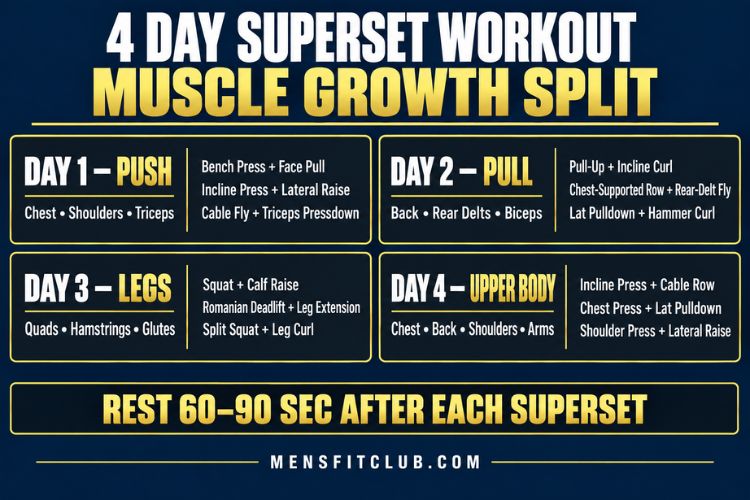
4 Day Superset Workout for Muscle Growth Complete Plan


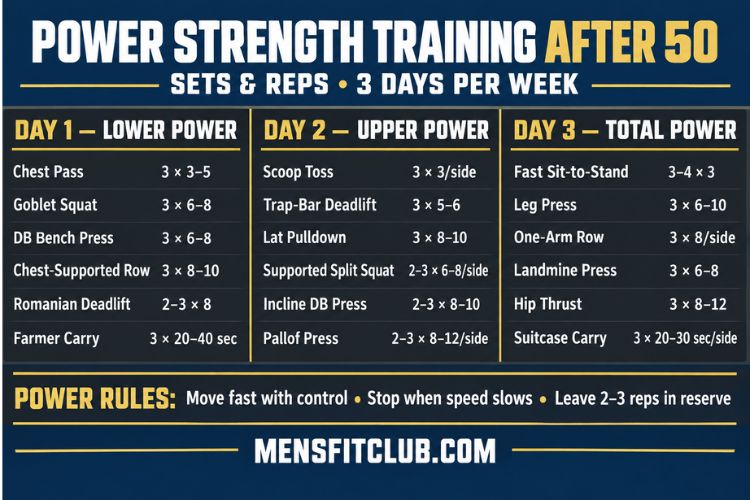
Power Strength Training After 50 Sets and Reps
4 Day Superset Workout for Muscle Growth Complete Plan
Building muscle does not require spending every evening in the gym. A well-designed 4 day superset workout for muscle growth can deliver enough weekly training volume, exercise variety, and progressive overload while keeping each session focused and efficient. By pairing compatible exercises and moving between them with limited rest, you can train more muscle in less time without turning a hypertrophy workout into random cardio.
This four-day plan is designed for intermediate lifters who know the basic movements and want a practical routine for adding size. It uses a push, pull, legs, and upper-body structure, giving every major muscle group meaningful work while allowing enough recovery between hard sessions. Most workouts take approximately 55 to 75 minutes, depending on equipment availability and how closely you follow the suggested rest periods.
The goal is not simply to feel exhausted. Every superset has a purpose. Some pair opposing muscle groups, such as chest and back, while others combine movements that emphasize different portions of the same muscle. The result is a balanced program that supports muscle growth, improves training density, and makes a four-day schedule feel productive from the first working set to the last.
What Is a Superset Workout For Muscle Growth?
A superset combines two exercises performed back-to-back with little or no rest between them. After completing both exercises, you rest before beginning the next round. For example, you might perform a set of dumbbell bench presses, immediately complete a set of chest-supported rows, rest for 75 seconds, and then repeat the pairing.
This muscle-building plan mainly uses antagonist and non-competing pairings. These formats help maintain performance because one muscle can recover while its opposing muscle works. Same-muscle pairings appear later in a session, when accumulating fatigue is safer and lighter isolation exercises can finish the target area effectively.
Why a 4 Day Superset Workout Can Build Muscle
Muscle growth depends on consistent resistance training, sufficient weekly volume, progressive overload, good technique, adequate protein, and recovery. Supersets do not replace those fundamentals. They provide an efficient way to organize them.
Training four days per week offers a useful middle ground. It gives you more room for quality sets than a two- or three-day schedule, but it is easier to recover from than many high-volume five- or six-day routines. The weekly split in this program gives priority to compound movements before using isolation work to add volume where it matters.
Supersets also increase training density, meaning you complete more work within a given period. That can help lifters who have limited time, but density should never come at the expense of load, range of motion, or control. The best muscle-growth superset is not the pairing that leaves you most breathless. It is the pairing that lets you challenge the intended muscles and repeat strong sets from week to week.
Who Should Use This Superset Workout For Muscle Growth Plan?
This routine is best suited to an intermediate trainee with at least six months of consistent resistance-training experience. You should understand how to squat or leg press, hinge at the hips, press weights safely, row with control, and stop a set when technique begins to fail.
If you have a current injury, significant joint pain, a medical condition affected by exercise, or a long break from training, get appropriate professional guidance before starting. No set or rep target is worth forcing through sharp pain, dizziness, chest discomfort, or a movement that you cannot perform safely.
Recommended Weekly Superset Muscle Growth Schedule
A productive schedule separates demanding sessions and avoids placing the leg workout immediately before another session that requires heavy bracing. One practical arrangement is:
- Monday: Day 1 — Push
- Tuesday: Day 2 — Pull
- Wednesday: Rest or light activity
- Thursday: Day 3 — Legs
- Friday: Rest or light activity
- Saturday: Day 4 — Upper-body hypertrophy
- Sunday: Rest
You can move the days to fit your life. Preserve the basic rhythm of two training days, one recovery day, one training day, one recovery day, and one final training day whenever possible. If weekends are busy, train Monday, Tuesday, Thursday, and Friday instead.
How to Perform the Superset Workout For Muscle Growth
Exercises marked A1 and A2 form one superset. Complete A1, take only the time needed to move safely to A2, and complete A2. Rest for the prescribed period after both movements, then repeat until all rounds are finished. Continue in the same way with B1 and B2, followed by C1 and C2.
Use controlled repetitions. Lower most weights for roughly two seconds, maintain a stable position, and lift with intent. You do not need to deliberately move slowly, but you should remain in control. Most working sets should end with one to three good repetitions still possible. This is commonly described as leaving one to three reps in reserve.
Day 1: Push Superset Workout for Chest, Shoulders, and Triceps
The first workout develops the chest, front and side deltoids, and triceps. The opening press receives full attention, while later supersets increase volume without requiring maximal loads.
A1. Barbell Bench Press — 4 Sets of 6–8 Reps Superset Workout For Muscle Growth
Set your shoulder blades down and back, keep your feet stable, and lower the bar to a consistent point on the chest. Stop before technique breaks down.
A2. Cable or Band Face Pull — 4 Sets of 12–15 Reps
Pull toward eye level while rotating the hands apart. Rest 90 to 120 seconds after A2.
B1. Incline Dumbbell Press — 3 Sets of 8–12 Reps Superset Workout For Muscle Growth
Use a low-to-moderate bench angle and press upward while keeping the shoulders controlled.
B2. Dumbbell Lateral Raise — 3 Sets of 12–20 Reps
Raise the dumbbells out and slightly forward without swinging. Rest 75 to 90 seconds after B2.
C1. Cable Chest Fly — 3 Sets of 10–15 Reps Superset Workout For Muscle Growth
Maintain a soft elbow bend and bring the arms across the body through a comfortable arc.
C2. Rope Triceps Pressdown — 3 Sets of 10–15 Reps
Keep the upper arms near the torso and separate the rope slightly at the bottom. Rest 60 to 75 seconds after C2.
D1. Overhead Cable Triceps Extension — 2 Sets of 12–15 Reps
Keep the ribs down and avoid arching the back. Rest 60 seconds between sets.
Day 2: Pull Superset Muscle Growth Workout for Back and Biceps
The pull day combines vertical and horizontal pulling patterns to train the lats, upper back, rear deltoids, and elbow flexors. Straps are optional if grip fatigue prevents your back from receiving enough work.
A1. Pull-Up or Lat Pulldown — 4 Sets of 6–10 Reps
Drive the elbows down and bring the upper chest toward the bar or handle. Use pulldowns if pull-ups fall below the target range.
A2. Incline Dumbbell Curl — 4 Sets of 8–12 Reps
Curl without moving the elbows forward, use a moderate weight, and avoid bouncing. Rest 90 seconds after A2.
B1. Chest-Supported Row — 3 Sets of 8–12 Reps Superset Workout For Muscle Growth
Keep the chest against the pad and pull the elbows back without shrugging.
B2. Reverse Pec Deck or Rear-Delt Fly — 3 Sets of 12–20 Reps
Lead with the elbows and use a controlled range. Rest 75 to 90 seconds after B2.
C1. Single-Arm Cable Lat Pulldown — 3 Sets of 10–15 Reps Per Side
Reach upward, then pull the elbow toward the hip while keeping the torso still.
C2. Hammer Curl — 3 Sets of 10–15 Reps
Use a neutral grip and keep the wrists stacked. Rest 60 to 75 seconds after C2.
D1. Straight-Arm Pulldown — 2 Sets of 12–15 Reps
Sweep the handle toward the thighs with nearly straight elbows. Rest 60 seconds between sets.
Day 3: Leg Superset Muscle Growth Workout for Quads, Hamstrings, and Glutes
Leg training demands more systemic recovery, so this session avoids pairing two highly fatiguing compound lifts. A primary movement is combined with a low-cost exercise, while later supersets target complementary lower-body muscles.
A1. Back Squat, Hack Squat, or Leg Press — 4 Sets of 6–10 Reps
Choose a pain-free variation, brace before every repetition, and keep the whole foot planted.
A2. Standing Calf Raise — 4 Sets of 10–15 Reps
Pause in the stretched position and avoid bouncing. Rest 120 seconds after A2.
B1. Romanian Deadlift — 3 Sets of 8–10 Reps Superset Workout For Muscle Growth
Push the hips backward with a slight knee bend and maintain a stable spine.
B2. Leg Extension — 3 Sets of 12–15 Reps
Lift smoothly and lower under control. If needed, substitute a split squat. Rest 90 seconds after B2.
C1. Bulgarian Split Squat — 3 Sets of 8–12 Reps Per Leg
Keep the front foot planted and descend through a comfortable range.
C2. Seated or Lying Leg Curl — 3 Sets of 10–15 Reps Superset Workout For Muscle Growth
Control the return. Rest 75 to 90 seconds after C2.
D1. Hip Thrust or Glute Bridge — 2 Sets of 10–15 Reps
Finish with the ribs down and avoid overextending the back. Rest 75 seconds between sets.
Day 4: Upper-Body Superset Workout for Added Muscle Volume
The fourth day increases the weekly frequency for the chest, back, shoulders, and arms. Loads are moderate, repetitions are slightly higher, and antagonist pairings keep the session efficient.
A1. Incline Barbell or Machine Chest Press — 3 Sets of 8–12 Reps
Use a stable variation and the same range on every repetition.
A2. Seated Cable Row — 3 Sets of 8–12 Reps Superset Workout For Muscle Growth
Pull toward the lower ribs without leaning backward. Rest 90 seconds after A2.
B1. Machine Chest Press or Weighted Push-Up — 3 Sets of 10–15 Reps
Use a smooth tempo and maintain shoulder position throughout.
B2. Neutral-Grip Lat Pulldown — 3 Sets of 10–15 Reps
Pull the elbows toward the sides. Rest 75 to 90 seconds after B2.
C1. Seated Dumbbell Shoulder Press — 3 Sets of 8–12 Reps
Press through a pain-free path and avoid excessive arching.
C2. Cable Lateral Raise — 3 Sets of 12–20 Reps Per Side
Lead with the elbow. Rest 75 seconds after C2.
D1. EZ-Bar Curl — 3 Sets of 10–15 Reps Superset Workout For Muscle Growth
Keep the torso steady and wrists comfortable.
D2. Cable Triceps Pressdown — 3 Sets of 10–15 Reps
Keep the upper arms quiet. Rest 60 to 75 seconds after D2.
How to Choose the Right Weight For Superset Workout For Muscle Growth
Choose a load that keeps every repetition technically sound while bringing you close to failure near the end of the target range. If the prescription is 8 to 12 repetitions, a good starting weight may allow 10 repetitions with approximately two reps in reserve.
Do not use the same effort for every exercise. Keep one to three reps in reserve on compound lifts. On stable isolation exercises, the final set can occasionally finish with zero to one rep in reserve. You do not need to reach failure on every set, and repeatedly doing so can reduce performance in later supersets.
Progressive Overload for Continued Muscle Growth
Use double progression. Stay with the same load until you reach the top of the rep range on every set with the intended technique and effort. Then increase the weight by the smallest practical amount and work upward through the range again.
For example, if the incline dumbbell press calls for three sets of 8 to 12, you might achieve 11, 10, and 9 repetitions in one workout. Keep the same weight next time and try to add one or two total repetitions. Once you can complete 12, 12, and 12 with one or two reps in reserve, increase the dumbbells and return closer to eight repetitions.
How Long to Follow the Program
Run this 4 day superset workout for six to eight weeks before making major changes. That gives you enough time to learn the movements, establish baseline loads, and create measurable progression. Avoid replacing exercises simply because they stop feeling novel.
After six to eight demanding weeks, use a deload if performance has stalled, soreness remains elevated, motivation drops, or joints feel unusually irritated. Reduce working sets by roughly one-third to one-half for a week and keep several repetitions in reserve. Then resume training or begin another block with a few strategic exercise changes.
Warm-Up for Each Superset Workout For Muscle Growth
Begin with five to eight minutes of easy movement to raise body temperature. Follow with dynamic motions relevant to the session, such as bodyweight squats and hip hinges before legs or controlled arm circles and light rows before upper-body training.
Next, perform specific warm-up sets for the first compound exercise. If your working bench press load is 185 pounds, for example, you might complete easy sets with the empty bar, 95 pounds, 135 pounds, and 165 pounds while gradually reducing repetitions. The purpose is preparation, not fatigue.
Nutrition and Recovery for Muscle Growth
A good program creates the training stimulus, but recovery allows adaptation. Consume enough total calories to support your goal. A small calorie surplus is often useful for maximizing muscle gain, although beginners and people returning after a layoff may build muscle while maintaining or slowly reducing body weight.
Aim for a consistent protein intake distributed across the day. A practical evidence-based range for many resistance-trained adults is approximately 1.6 to 2.2 grams of protein per kilogram of body weight per day. Individual needs vary, and people with medical dietary restrictions should follow guidance from a qualified clinician or dietitian.
Try to sleep seven to nine hours per night and keep rest-day activity easy enough to promote recovery. Walking, gentle mobility work, and light recreational movement are usually appropriate. If soreness, declining strength, poor sleep, and low motivation accumulate together, reduce training volume before adding more work.
Common Superset Training Mistakes
Pairing Two Exhausting Compound Lifts
Heavy squats followed immediately by heavy Romanian deadlifts may look efficient, but fatigue can compromise bracing and technique. Pair demanding lifts with low-fatigue exercises or give the main lift traditional rest.
Turning Every Set Into Cardio
If breathing is always the limiting factor, you may be moving too quickly. Extend the post-superset rest period and protect the quality of the repetitions. Hypertrophy training should challenge the target muscle, not merely test how fast you can move between stations.
Using Too Much Weight
Momentum, shortened repetitions, and unstable positions often indicate that the load is too heavy. Reduce it and make the target muscle do the work. Clean repetitions provide a more useful progression standard than inflated numbers.
Exercise Substitutions for a Busy Gym or Home Setup
The movement pattern matters more than a specific machine. Replace barbell bench presses with dumbbell or machine presses. Substitute pulldowns for pull-ups, one-arm dumbbell rows for cable rows, goblet squats for hack squats, and stability-ball leg curls for a leg-curl machine.
At home, adjustable dumbbells, a bench, resistance bands, and a pull-up bar can cover most of the plan. Use dumbbell floor presses, one-arm rows, split squats, Romanian deadlifts, band pulldowns, lateral raises, curls, and overhead triceps extensions. Increase repetitions when available loads are limited, provided sets still approach muscular fatigue with good form.
Frequently Asked Questions
Are Supersets Good for Muscle Growth?
Yes. Supersets can support hypertrophy when they provide adequate challenging volume and allow progressive overload. Antagonist or non-competing pairings usually preserve performance better than repeatedly combining two demanding exercises for the same muscle.
Is Four Days a Week Enough to Build Muscle?
Four well-planned sessions are enough for many lifters. Consistency, effort, total weekly volume, nutrition, and recovery matter more than training on the maximum possible number of days.
How Long Should I Rest Between Supersets?
Rest about 90 to 120 seconds after pairings that include a heavy compound lift, 75 to 90 seconds after moderate hypertrophy pairings, and 60 to 75 seconds after isolation work. Take longer if your next set would otherwise lose several repetitions or become technically poor.
Can Beginners Follow This Routine?
Beginners should reduce most exercises to two working sets, use conservative loads, and rest longer while learning technique. A simpler full-body routine may be a better starting point for someone completely new to lifting.
The 4 Day Superset Workout for Muscle Growth
This four-day plan gives you a complete framework for building muscle without living in the gym. The push, pull, legs, and upper-body structure distributes weekly volume logically, while carefully chosen supersets make each session time-efficient. Follow the listed exercise order, protect your technique, leave a small number of repetitions in reserve, and record your performance.
The routine works best when you resist the temptation to make it more complicated. Train hard enough to create a reason for the body to adapt, add repetitions or load gradually, eat to support your goal, and recover between sessions. Repeat that process for six to eight weeks and use your training log—not just soreness or a temporary pump—to judge progress.
To get even more from this four-day superset workout, explore MensFitClub’s guide to building an effective Superset Workout Routine and learn how different exercise pairings can improve training efficiency. You can compare this program with a traditional 4 Day Weight Lifting Routine For Strength And Muscle Growth or increase your weekly training frequency with this 4 Day Full Body Hypertrophy Workout. For more guidance on training volume, progressive overload, and rep ranges, read the complete Hypertrophy Workout Plan. If you prefer training with free weights, try this Dumbbell push Pull Legs Muscle Building Plan as an alternative weekly routine.


Most Recommended

Subscribe to our Newsletter
Stay up to date on the latest men’s health, fitness and lifestyle trends and tips.
About Us
Men’s Fit Club was started with the goal of empowering men to get the most out of their lives. This meant going beyond exercise and diet tips to really address the broad range of issues that men face on a daily basis – topics like recreation, finding love, sexual health and even sound fashion advice.
Quick Links
© COPYRIGHT MEN'S FIT CLUB 2026. All Rights Reserved