
Power Strength Training After 50 Sets and Reps
Beginner Rucking Workout Plan for Strength and Fat Loss
3 Day Strength and Balance Program for Older Men
Power Strength Training After 50 Sets and Reps
Strength matters after 50, but strength alone is not the whole story. A man may still be able to grind through a heavy repetition yet notice that getting out of a low chair, climbing stairs, catching himself after a stumble, or moving quickly on the court feels harder than it once did. These daily challenges depend partly on muscular power—the ability to produce force quickly. Power strength training after 50 combines traditional resistance exercise with selected movements performed with controlled speed and intent. It is not reckless lifting, maximum-effort jumping, or trying to train like a 25-year-old athlete. The goal is to build a capable body that can create force, use it promptly, and remain stable while doing so.
This guide explains the best sets and reps for power training after 50 and provides a practical three-day program for men. The plan can be performed in a commercial gym or adapted to a simple home setup with dumbbells, resistance bands, a bench, and a stable step.
What Is Power Strength Training After 50?
Muscular strength is the maximum force a muscle or group of muscles can produce. Power adds a time component: it is the ability to apply force rapidly. A heavy deadlift develops strength. Standing up from a box decisively, pushing a moderate load with fast intent, or throwing a medicine ball develops power.
The distinction matters because power can influence how effectively strength is expressed during real movement. Walking up a steep incline, lifting luggage, reacting to a loss of balance, and rising from the floor all require force to be produced within a useful amount of time. Training only slow, grinding repetitions may improve strength without fully addressing this quality.
For men over 50, the safest approach usually places strength first and then adds low-impact power work. You learn the movement, develop control, establish adequate mobility, and gradually increase speed with submaximal resistance. The repetition should look crisp rather than desperate.
Benefits of Power and Strength Training After 50
Regular resistance training supports muscle, bone, joint function, metabolic health, and daily tasks. Adding appropriate power exercises makes the program more specific to quick, decisive movement.
Maintain Muscle and Functional Strength
Progressive resistance training gives the body a reason to maintain and build active tissue. Squats, hinges, presses, rows, carries, and step-ups train patterns that transfer to daily activities.
Improve the Ability to Move Quickly
Power-focused repetitions teach you to accelerate a manageable load while maintaining position. Place one or two low-fatigue power movements early in the session, when coordination is fresh, then use controlled strength work.
Power Strength Training After 50 Support Balance and Confidence
Stronger legs, hips, trunk, and upper back provide a foundation for balance. Train balance directly with carries, split-stance exercises, step-ups, and supported single-leg work.
Preserve Independence
The most meaningful result is often the ability to carry groceries, use stairs, rise from a chair, travel, and continue recreational activities confidently.
Best Sets and Reps for Power Strength Training After 50
There is no single repetition range for the entire workout. Power, primary strength exercises, assistance work, and balance drills serve different purposes and should be programmed differently.
Power Exercises: 3 to 5 Sets of 3 to 5 Reps
Use low repetitions so each rep can remain fast, technically sound, and repeatable. A useful starting point is 3 sets of 3 reps. Rest 60 to 120 seconds between sets, or longer if breathing and coordination have not returned to normal.
Suitable options include a medicine-ball chest pass, medicine-ball scoop toss, kettlebell dead-stop swing, fast sit-to-stand, low step-up with intent, and landmine push press. Begin with the least complex variation. Stop the set when speed clearly falls or technique changes.
Power training is about quality, not exhaustion. Sets of 15 or 20 may create fatigue, but they usually do not preserve the speed needed for true power work. Never turn a power drill into a conditioning test.
Main Strength Exercises: 3 to 4 Sets of 4 to 8 Reps Power Strength Training After 50
Compound lifts work well in a moderate repetition range. Sets of 4 to 8 allow meaningful loading without requiring constant maximal attempts. Most men returning to lifting should begin with 2 or 3 working sets of 6 to 8 reps and add volume only after recovery is predictable.
Choose a load that leaves approximately two or three good repetitions in reserve. In practical terms, the final repetition should feel challenging but clean. You should not need to twist, bounce, hold your breath excessively, or depend on a spotter to complete it.
Assistance Exercises: 2 to 3 Sets of 8 to 15 Reps
Rows, pulldowns, split squats, hamstring curls, calf raises, lateral raises, curls, and triceps work fit well in this range. Assistance exercises add muscle-building volume and strengthen areas that support the major lifts. They should not interfere with the next session or irritate the joints.
Carries and Core Work: 2 to 4 Sets Power Strength Training After 50
For loaded carries, use 20 to 40 seconds or roughly 20 to 40 yards per set. For anti-rotation presses, dead bugs, and side planks, use 6 to 12 controlled repetitions or holds of 15 to 30 seconds. The aim is to resist unwanted movement while breathing normally.
How Heavy Should Men Over 50 Lift?
The correct weight is the heaviest load you can use while preserving the intended movement, repetition speed, and reserve. Age does not automatically require tiny weights, but training history, joint health, medical conditions, sleep, and recovery must shape the decision.
For strength work, begin around a moderate effort of 6 or 7 on a 10-point scale. Finish most sets with two or three repetitions in reserve. For power exercises, use a much lighter load that can be moved quickly without losing control. The load should never turn a fast repetition into a slow grind.
Avoid regular one-repetition maximum testing. It is not necessary for progress and can create a poor risk-to-reward tradeoff for recreational trainees. Rep quality, gradual load increases, and months of uninterrupted training provide more useful evidence of improvement.
Three-Day Power Strength Training Plan After 50
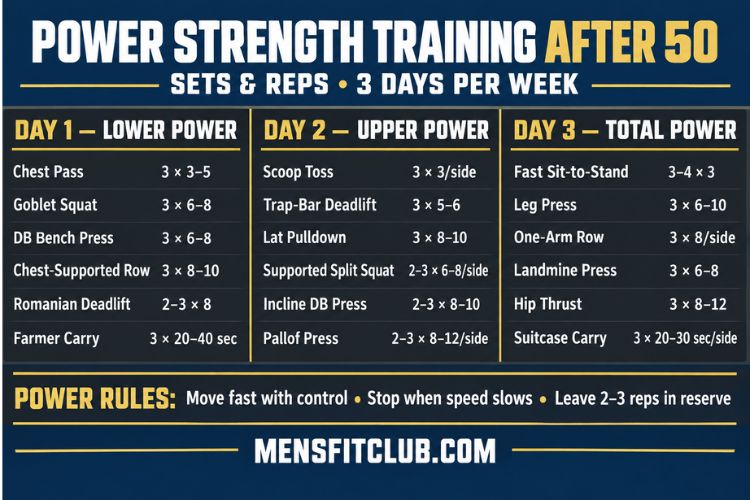
Train on nonconsecutive days, such as Monday, Wednesday, and Friday. Each workout should take approximately 45 to 65 minutes. If you are new, perform two sets of each strength exercise during the first two weeks. The listed work sets do not include lighter warm-up sets.
Day 1: Lower-Body Power and Full-Body Strength
Begin with 5 to 8 minutes of easy cycling, walking, or rowing. Follow it with controlled ankle rocks, hip hinges, bodyweight squats to a box, and shoulder circles. Complete one or two practice sets before loading each major lift.
Medicine-ball chest pass or fast incline push-up: Perform 3 sets of 3 to 5 reps. Use a ball and wall designed for throwing, or push rapidly from a stable elevated surface while keeping the body aligned.
Goblet squat or box squat: Perform 3 sets of 6 to 8 reps. Lower under control, lightly contact the box if used, and stand with steady intent. Choose a depth you can own without rounding the lower back or shifting onto the toes.
Dumbbell bench press or machine chest press: Perform 3 sets of 6 to 8 reps. Keep the shoulder blades supported and use a pain-free grip. A neutral grip is often comfortable for sensitive shoulders.
Chest-supported row: Perform 3 sets of 8 to 10 reps. Pause briefly with the elbows back and avoid shrugging.
Dumbbell Romanian deadlift: Perform 2 or 3 sets of 8 reps. Push the hips back, keep the weights close, and stop when the hamstrings are loaded without losing a neutral spine.
Farmer carry: Perform 3 sets of 20 to 40 seconds. Walk tall with short, controlled steps and enough load to challenge the grip without pulling the torso out of position.
Day 2: Upper-Body Power, Single-Leg Strength, and Balance Power Training After 50
Warm up with easy cardio followed by thoracic rotations, supported reverse lunges, wall slides, and light band rows.
Medicine-ball scoop toss or landmine push press: Perform 3 sets of 3 reps per side. Rotate through the hips and upper back rather than twisting aggressively through the lower spine. If throwing is not appropriate, use a light landmine press with a controlled return.
Trap-bar deadlift from raised handles or kettlebell deadlift: Perform 3 sets of 5 to 6 reps. Brace before lifting, push the floor away, and finish tall without leaning backward. Raise the starting position if mobility limits a safe setup.
Half-kneeling cable pulldown or lat pulldown: Perform 3 sets of 8 to 10 reps. Pull the elbows toward the ribs while keeping the neck relaxed.
Supported split squat: Perform 2 or 3 sets of 6 to 8 reps per side. Hold a rack or stable support if balance limits leg loading. Support is a training tool, not a failure.
Incline dumbbell press: Perform 2 or 3 sets of 8 to 10 reps with a comfortable grip and smooth range of motion.
Pallof press: Perform 2 or 3 sets of 8 to 12 reps per side. Resist rotation, exhale gently as the hands move away from the torso, and keep the ribs stacked over the pelvis.
Supported single-leg balance: Perform 2 rounds of 20 to 30 seconds per side. Stand near a wall or rack and use fingertip support as needed.
Day 3: Total-Body Power and Strength
Use the same general warm-up format, then include several unweighted step-ups, hip bridges, and light presses.
Fast sit-to-stand or low explosive step-up: Perform 3 to 4 sets of 3 reps. Stand quickly and lower under control. Do not jump unless you already have an athletic background, healthy joints, and professional guidance.
Leg press or front-foot-elevated split squat: Perform 3 sets of 6 to 10 reps. Use a range that keeps the feet stable and the knees tracking with the toes.
One-arm cable or dumbbell row: Perform 3 sets of 8 reps per side. Keep the torso stable rather than rotating to move the weight.
Landmine press or neutral-grip dumbbell overhead press: Perform 3 sets of 6 to 8 reps. The landmine option reduces the amount of overhead range and may suit men with limited shoulder mobility.
Hip thrust or glute bridge: Perform 3 sets of 8 to 12 reps. Finish with the glutes, not by overextending the lower back.
Calf raise: Perform 2 or 3 sets of 10 to 15 reps with a pause at the top and a controlled lowering phase.
Suitcase carry: Perform 3 sets of 20 to 30 seconds per side. Resist leaning toward the weight and walk slowly enough to maintain control.
How to Progress Safely After the First Month
Use double progression. Select a repetition range, such as 6 to 8. Keep the same weight until you can perform every set at the top of the range with good form and about two repetitions still available. Then add a small amount of weight and return to the lower end of the range.
Progress power exercises differently. First improve coordination. Next add a repetition only if speed stays high. Increase resistance last and in very small amounts. If the movement slows noticeably, reduce the load. The purpose is acceleration, not proving how much you can lift.
Change only one major variable at a time. Adding sets, repetitions, load, training days, and conditioning simultaneously makes it difficult to identify what caused pain or excessive fatigue.
Rest Periods, Tempo, and Breathing
Rest 60 to 120 seconds after power work and 2 to 3 minutes after demanding compound strength sets. Assistance work generally needs 60 to 90 seconds. Longer rest is appropriate when heart rate, breathing, or grip has not recovered.
For strength exercises, lower the weight in approximately two or three seconds and lift it smoothly with purposeful intent. Power exercises use a fast effort during the working phase and a controlled reset between repetitions. Never rush the setup.
Exhale through the hardest portion of moderate lifts and avoid prolonged breath-holding unless a qualified professional has taught you an appropriate bracing strategy. Men with cardiovascular concerns, uncontrolled blood pressure, eye conditions, hernias, or pelvic-floor issues should get individualized medical guidance.
Warm-Up for Power Strength Training After 50
A warm-up should prepare the exact patterns you will train. Start with several minutes of easy movement, then use dynamic mobility and rehearsal sets. Before squats, practice a box squat and a light goblet squat. Before pressing, use wall slides and light presses. Before deadlifts, practice hip hinges and progressively heavier warm-up sets.
Avoid exhausting circuits before power work. The objective is to feel warmer, more mobile, and more coordinated—not tired.
Cardio and Recovery Between Strength Sessions
On one or two nonlifting days, perform 20 to 30 minutes of easy to moderate aerobic work such as brisk walking, cycling, swimming, or an elliptical session. Keep at least one easy day each week.
Sleep, protein, total calories, hydration, and stress management influence adaptation. Men with kidney disease or medical nutrition restrictions should consult a clinician or registered dietitian before substantially increasing protein intake.
Mild soreness can occur, but severe soreness is not a sign of a better workout. If it alters how you walk or persists into the next session, cut a set or lower the load.
Common Power Training Mistakes After 50
Moving Fast Before Owning the Movement
Speed magnifies poor positioning. Learn each exercise slowly, then add intent while keeping the same mechanics.
Training Every Set to Failure
Frequent failure creates unnecessary fatigue and can degrade technique. Most sets should finish with two or three repetitions in reserve.
Using Too Much Impact
Power does not require box jumps or high-impact landings. Medicine-ball throws, fast sit-to-stands, low step-ups, and landmine presses can train speed with less impact.
Ignoring Unilateral Training
Split squats, step-ups, one-arm rows, suitcase carries, and supported balance work help address side-to-side differences.
Copying a Younger Athlete’s Program
Use your health, experience, movement quality, and recovery—not someone else’s routine—to set the training dose.
When to Get Medical or Professional Guidance
Speak with a healthcare professional before beginning vigorous exercise if you have known cardiovascular, metabolic, neurological, or significant joint conditions; unexplained dizziness; chest pressure; unusual breathlessness; recent surgery; or a long period of inactivity combined with health concerns. A physical therapist or qualified trainer can help modify movements for arthritis, prior injuries, balance limitations, or joint replacements.
Stop exercising and seek appropriate medical care for chest pain or pressure, fainting, sudden neurological symptoms, severe shortness of breath, or sharp and escalating pain. This program is general education and cannot replace personal medical advice.
Frequently Asked Questions
Can a 50-Year-Old Build Strength and Power?
Yes. Men over 50 can improve strength, muscle, coordination, and movement capacity with progressive training. The rate of improvement varies, but age does not eliminate the body’s ability to adapt. Begin with an appropriate dose and build consistently.
How Many Days a Week Should Men Over 50 Lift?
Two or three full-body sessions are effective for many men. Three days provide frequent practice while leaving recovery days between workouts. Men with limited recovery can use two sessions and alternate the three workouts across weeks.
Are Three Sets of Ten Best After 50?
Three sets of ten can be useful, but it is not universally best. Low-repetition power drills, moderate-repetition compound lifts, and somewhat higher-repetition assistance work create a more complete program. The appropriate range depends on the exercise and goal.
Should Power Exercises Be Done First?
Yes. After warming up, place technically simple power exercises near the start of the workout. Fatigue reduces speed and coordination, so power work should not be saved for the end.
How Quickly Should Weight Increase?
Increase weight only after completing the top of the prescribed repetition range with consistent form and repetitions in reserve. Small increases every few weeks are enough. Progress is also visible through better balance, cleaner technique, more comfortable range of motion, and faster movement with the same load.
The Power Strength Training After 50
The best power strength training plan after 50 is challenging enough to create adaptation and conservative enough to repeat week after week. Use 3 to 5 sets of 3 to 5 crisp repetitions for power exercises, 3 to 4 sets of 4 to 8 reps for primary strength movements, and 2 to 3 sets of 8 to 15 reps for assistance work. Leave repetitions in reserve and earn each increase through excellent technique.
Start with simple exercises, train on nonconsecutive days, and judge success by more than the weight on the bar. Better stair climbing, steadier balance, stronger carries, easier floor transfers, and confidence in daily movement are valuable signs that the program is working. After 50, power is not about training recklessly. It is about preserving the ability to act with strength when life demands it.
To build a stronger, more athletic body as you age, begin with the fundamentals in our Strength Training After 50: Sets Reps and Recovery guide. Men with limited training time can follow the 2 Hour Per Week Strength Workout Plan, while experienced lifters may prefer the structured 3 Day Barbell Strength Workout Program for Men Over 40. If you are coming back after time away, use the 4 Week Barbell Workout Reset to rebuild technique and training tolerance. You can also add variety and functional conditioning with the 60 Minute Full Body Kettlebell Workout Plan.


Most Recommended

Subscribe to our Newsletter
Stay up to date on the latest men’s health, fitness and lifestyle trends and tips.
About Us
Men’s Fit Club was started with the goal of empowering men to get the most out of their lives. This meant going beyond exercise and diet tips to really address the broad range of issues that men face on a daily basis – topics like recreation, finding love, sexual health and even sound fashion advice.
Quick Links
© COPYRIGHT MEN'S FIT CLUB 2026. All Rights Reserved