
Beginner Rucking Workout Plan for Strength and Fat Loss
3 Day Strength and Balance Program for Older Men

Best Hair and Beard Routine for Men Who Work Out Daily
30-Minute Weighted Walking Dumbbell Workout
A 30-minute weighted walking dumbbell workout turns one of the most accessible forms of exercise into a challenging full-body training session. By carrying dumbbells while walking—and changing the way you hold them—you can train your legs, core, shoulders, upper back, grip, posture, and cardiovascular system without complicated equipment or high-impact movements.
This workout is not simply a regular walk with random arm exercises added. It uses loaded carries, controlled walking intervals, and brief strength stations to create a structured session. The goal is to maintain strong posture and steady movement while the weights challenge your entire body. You can perform it on a treadmill, around a track, in a gym, on a flat outdoor path, or even in a long hallway.
Weighted walking can be especially useful for men who want practical conditioning but do not enjoy running. It can also fit into a muscle-building plan, a fat-loss routine, or a general fitness schedule. The session below requires only a pair of dumbbells and 30 minutes, but the load should be selected carefully. Carrying weights changes the demands of walking, so technique matters more than speed.
What Is a Weighted Walking Dumbbell Workout?
A weighted walking dumbbell workout combines purposeful walking with loaded carries. A farmer’s walk places dumbbells by your sides, a suitcase carry loads one side, and a front-rack carry holds the weights near the shoulders. Each position creates a different demand on the grip, upper back, core, and legs. The weight should never be maximal; use a load you can carry without leaning, shrugging, holding your breath, or losing control of your steps.
Benefits of Walking Dumbbell Workout
Builds Strength, Grip, and Conditioning
Loaded walking makes the body maintain tension while moving. The hands and forearms grip the dumbbells, the upper back organizes the shoulders, the core stabilizes the spine, and the legs propel you forward. Farmer’s walks can improve the grip endurance used in deadlifts, rows, pull-ups, and everyday carrying tasks, while suitcase carries train the core to resist side bending.
Adding resistance also raises the cardiovascular demand without requiring running or jumping. You can scale the challenge through load, pace, carry duration, or recovery time, making the same basic routine useful for several fitness levels. Although carries do not replace a complete strength program, they efficiently combine resistance, cardio, and core training on a busy day.
Equipment and Space You Need For Walking Dumbbell Workout
You need dumbbells, supportive shoes, a timer, and a flat, clear walking area. A track, quiet path, turf strip, hallway, or treadmill can work. Adjustable dumbbells are useful because most people can farmer-carry more than they can hold at the shoulders. If you have one pair, choose a conservative load that suits the most difficult position. Avoid crowded roads, uneven trails, slippery floors, stairs, and any space that forces sharp turns.
How to Choose the Right Dumbbell Weight
Select a load based on control, not ego. For a first attempt, many beginners can start with approximately 5 to 15 pounds in each hand. Intermediate trainees may use 15 to 30 pounds per hand, while advanced lifters may use more. These are broad starting ranges, not requirements. Training history, body size, grip strength, shoulder health, and the carry position all affect the correct weight.
Use the posture test: you should be able to walk with a tall torso, level shoulders, quiet steps, and normal breathing. At the end of an interval, you should feel challenged but still able to put the dumbbells down smoothly. Aim for a perceived effort of about 6 to 8 on a 10-point scale during the loaded intervals.
If you cannot maintain position for at least 30 seconds, the load is probably too heavy for this workout. If you could carry the weight for several minutes with no meaningful challenge, increase it slightly next time or walk at a more purposeful pace. Do not speed up so much that the dumbbells swing.
Walking Dumbbell Workout Form: Key Technique Tips
Stand tall before taking the first step. Keep your head neutral, look ahead, and gently draw the shoulder blades down rather than forcing them back. Stack the rib cage over the pelvis and brace the midsection as though preparing for a light punch. Your body should feel firm but not rigid.
Take natural, controlled steps. Avoid reaching far forward with the heel or shuffling with tiny steps. Keep the dumbbells stable instead of allowing them to bounce against the thighs. Breathe steadily through the entire interval. A short exhale can help reinforce the brace, but you should not hold your breath for long periods.
When changing direction, reduce your speed, take several small steps, and keep the feet under you. When the interval ends, stop completely, hinge at the hips, bend the knees, and place the weights down with control. Avoid dropping them, especially near your feet or on a treadmill.
Treadmill Safety
If you use a treadmill, practice every carry at a very slow speed before starting the workout. Do not step onto or off a moving belt while holding dumbbells. Keep the treadmill flat or at a mild incline, use a speed that allows full control, and leave plenty of room between your body and the front console. Skip overhead carries on a treadmill because balance errors can become dangerous quickly.
30-Minute Weighted Walking Dumbbell Workout
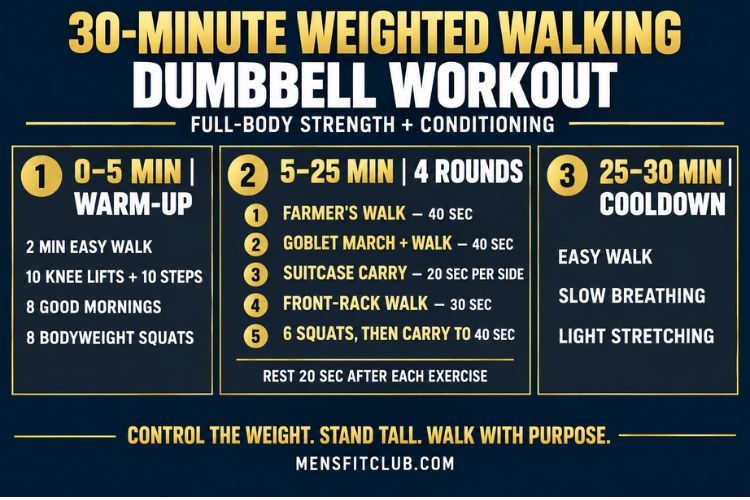
The workout includes a five-minute warm-up, a 20-minute main circuit, and a five-minute cooldown. Complete four rounds of the five-minute circuit. Each minute has a specific assignment, making the routine easy to follow without counting long sets of repetitions.
Workout Overview
| Time | Exercise | Instructions |
|---|---|---|
| 0:00–5:00 | Dynamic warm-up | Easy walk plus mobility drills |
| 5:00–10:00 | Main circuit, Round 1 | Five one-minute stations |
| 10:00–15:00 | Main circuit, Round 2 | Repeat the five stations |
| 15:00–20:00 | Main circuit, Round 3 | Repeat with controlled effort |
| 20:00–25:00 | Main circuit, Round 4 | Final quality round |
| 25:00–30:00 | Cooldown | Easy walk and breathing reset |
Minutes 0–5: Dynamic Walking Dumbbell Workout Warm-Up
Begin with two minutes of relaxed walking without weights. Gradually increase the pace until you feel warm but not tired. During the third minute, alternate 10 controlled knee lifts with 10 walking steps. Keep the knee lift comfortable rather than pulling it toward the chest.
During minute four, perform 8 bodyweight good mornings followed by easy walking. Place your hands across your chest, soften the knees, push the hips backward, and keep the spine long. During minute five, complete 8 bodyweight squats and then walk until the main circuit begins. Use a comfortable squat depth and keep the knees tracking with the toes.
Minute 1: Farmer’s Walk
Hold one dumbbell in each hand with the arms straight by your sides. Walk at a strong, controlled pace for 40 seconds, then set the weights down and walk without them for 20 seconds. Keep the dumbbells close to your body and prevent them from swinging. Your shoulders should remain level, and your torso should not lean forward.
The farmer’s walk is the heaviest carry in this routine. It trains grip, upper-back endurance, trunk stability, and total-body conditioning. If 40 seconds is too difficult, use 30 seconds of carrying followed by 30 seconds of unloaded walking.
Minute 2: Goblet March and Walk
Hold one dumbbell vertically against your chest with both hands. Perform 10 alternating marching steps, lifting one knee at a time without leaning backward. After the marches, continue walking while holding the dumbbell at your chest until 40 seconds have elapsed. Put the dumbbell down and recover for the remaining 20 seconds.
Keep the elbows close, brace the core, and avoid letting the dumbbell pull your rib cage forward. If the goblet position causes wrist or shoulder discomfort, hold the weight lower at the upper abdomen or perform the interval without a dumbbell.
Minute 3: Suitcase Carry Walking Dumbbell Workout
Hold one dumbbell at your right side and walk for 20 seconds. Change hands safely, then walk for 20 seconds with the dumbbell at your left side. Use the final 20 seconds for unloaded recovery walking. Your job is to remain upright rather than leaning away from or toward the weight.
Imagine balancing a glass of water on your head. Keep the shoulders and hips level as you walk. The unilateral load makes this a powerful anti-side-bending core exercise. Use less weight if you feel the lower back taking over.
Minute 4: Dumbbell Front-Rack Walk
Hold both dumbbells near the shoulders with the palms facing each other. Walk for 30 seconds, lower the weights to your sides if needed, and continue with a farmer’s walk for 10 seconds. Set the dumbbells down and recover for 20 seconds.
Keep the forearms close to vertical and avoid flaring the elbows excessively. The front-rack position makes breathing more difficult and challenges the upper back and core. A single-dumbbell goblet hold is a good substitute if two dumbbells feel awkward.
Minute 5: Squat-to-Carry Combination Walking Dumbbell Workout
With the dumbbells at your sides, perform 6 controlled dumbbell squats. Take about two seconds to lower, stand with purpose, and keep the weights stable. After the sixth repetition, immediately begin a farmer’s walk and continue until the 40-second mark. Set the weights down and walk easily for 20 seconds.
Use a squat depth you can control while keeping the entire foot planted. If squatting with weights is not appropriate for you, perform 8 bodyweight squats, then pick up the dumbbells for the carry. Repeat this five-minute circuit four times to complete the 20-minute main section.
Minutes 25–30: Cooldown
Put the dumbbells aside and walk slowly for three minutes. Let your breathing return toward normal and relax your hands. For the final two minutes, stop in a stable position and perform gentle calf, hip-flexor, chest, and forearm stretches. Hold each stretch briefly without forcing the range.
The cooldown does not need to be elaborate. Its purpose is to bring the effort down gradually and notice how your body feels. Sharp pain, dizziness, chest discomfort, or unusual shortness of breath should never be treated as normal workout fatigue.
Beginner, Intermediate, and Advanced Options
Beginner Version Walking Dumbbell Workout
Use light dumbbells and carry for 20 to 30 seconds of each minute. Spend the remaining time walking without weights. Replace the front-rack walk with a goblet walk, and perform bodyweight squats during minute five. Complete two or three rounds during your first session, then use the remaining time for relaxed walking.
Beginners should finish feeling as though they could have completed another round with good form. The first goal is learning safe pickups, controlled put-downs, and stable walking mechanics. Load and speed can increase later.
Intermediate Version
Follow the workout as written, carrying for 40 seconds and recovering for 20 seconds. Choose a moderate farmer’s-walk load and a slightly lighter load for the front-rack position if adjustable dumbbells are available. Maintain consistent pace and posture across all four rounds.
Advanced Walking Dumbbell Workout Version
Carry for 45 seconds and recover for 15 seconds, or use a heavier pair of dumbbells for farmer’s walks and squats. You can also replace the goblet march with an alternating single-arm front-rack carry, switching sides halfway through the interval. On a stable, obstacle-free surface, experienced trainees with healthy shoulders may use a light single-arm overhead carry, but this is optional and should not be performed to fatigue.
Advanced does not mean turning the workout into a sprint. Smooth movement under a challenging load is the objective. Increase only one variable at a time so you can identify what improves performance and what disrupts technique.
How to Progress the Workout
Perform this routine one or two times per week. Start by recording the dumbbell weight, total number of rounds, carry duration, and perceived effort. When you can complete every interval with stable posture at an effort below 7 out of 10, make one small progression.
You could add 5 pounds to each dumbbell, extend each loaded interval by five seconds, reduce recovery by five seconds, or increase your walking pace slightly. Another option is to keep the load unchanged but complete cleaner turns and more consistent distances. Do not increase weight, speed, and duration simultaneously.
A simple four-week progression might look like this: use 30-second carries in Week 1, 35-second carries in Week 2, 40-second carries in Week 3, and repeat 40 seconds with a small load increase in Week 4. After that, take an easier week or return to the original load while focusing on pace.
How Often Should You Do Weighted Walking?
One or two sessions per week is enough for most people. Allow at least one day between demanding carry workouts, especially if your program includes deadlifts, rows, pull-ups, or heavy leg training. Pair weighted walking with a balanced strength plan that covers pushing, pulling, squatting, and hinging. Regular unweighted walking can be performed more often because it does not create the same fatigue in the grip, upper back, and trunk.
Common Walking Dumbbell Workout Mistakes
The biggest mistake is choosing weights based on what you can pick up instead of what you can carry well. Reduce the load if your steps become uneven, your shoulders round, or you cannot set the dumbbells down smoothly. Keep the weights close to the body instead of swinging them, maintain a long neck rather than shrugging, and slow down before every turn. Avoid running, exaggerated strides, or performing curls and presses while walking. The final round should resemble the first even though it feels more difficult.
Safety and Exercise Modifications
Weighted carries may not suit everyone. Speak with a qualified medical professional before beginning if you have cardiovascular concerns, uncontrolled blood pressure, balance problems, recent surgery, or significant spine, hip, knee, foot, hand, or shoulder pain. Stop immediately if you experience chest pain, faintness, loss of balance, numbness, or sharp pain.
People with grip limitations can use lighter dumbbells and shorter intervals. Straps may allow a heavier carry, but they also attach you to the load and can make it harder to release quickly, so they are generally unnecessary for this conditioning workout. People with shoulder discomfort should keep the weights by their sides and avoid front-rack or overhead positions.
If walking with dumbbells changes your gait or aggravates joint pain, use stationary dumbbell exercises followed by unweighted walking intervals. For example, perform 8 goblet squats, place the dumbbell down, and walk briskly for 40 seconds. You can achieve a similar strength-and-cardio structure without carrying weight while moving.
Frequently Asked Questions Walking Dumbbell Workout
Does Weighted Walking Build Muscle?
Weighted walking provides a muscle-building stimulus, particularly for the forearms, traps, shoulders, core, and legs. The amount of growth will depend on load, training experience, nutrition, recovery, and the rest of your strength program. Traditional resistance exercises allow more targeted progressive overload, so combine carries with squats, hinges, presses, and rows when muscle gain is the main goal.
How Heavy Should Dumbbells Be for Walking?
Use a load you can carry with level shoulders, steady breathing, and natural steps for the prescribed interval. A beginner might use 5 to 15 pounds per hand, but there is no universal ideal weight. Start light, assess technique, and progress gradually.
The 30-Minute Weighted Walking Dumbbell Workout
The 30-minute weighted walking dumbbell workout is a practical way to combine strength and conditioning with minimal equipment. Farmer’s walks challenge grip and upper-back endurance, suitcase carries train lateral core stability, front-rack walks increase trunk demand, and squat-to-carry intervals add focused lower-body work. The result is a time-efficient session that can be adapted to many fitness levels.
Start lighter than you think you need, treat posture as the main performance standard, and progress one variable at a time. Consistent, technically sound carries will produce better results than struggling with weights that distort your walking pattern. Add the routine to your weekly schedule once or twice, support it with regular strength training and unweighted walking, and let steady progression do the work.
Build on this weighted walking session with the Beginner Rucking Workout Plan for another practical form of loaded cardio. For more dumbbell conditioning, try the 30 Minute Full Body Dumbbell Complex or the 30 Minute Dumbbell Density Workout. You can also incorporate weighted carries into this 2 Day Full Body Workout Plan or combine them with Strength Training After 50 to develop grip strength, total-body endurance, and functional fitness.


Most Recommended

Subscribe to our Newsletter
Stay up to date on the latest men’s health, fitness and lifestyle trends and tips.
About Us
Men’s Fit Club was started with the goal of empowering men to get the most out of their lives. This meant going beyond exercise and diet tips to really address the broad range of issues that men face on a daily basis – topics like recreation, finding love, sexual health and even sound fashion advice.
Quick Links
© COPYRIGHT MEN'S FIT CLUB 2026. All Rights Reserved