

High-Protein Slow-Cooker Meals for Muscle Gain
3 Day Barbell Strength Workout Program for Men Over 40

Ground Beef Sweet Potato and Cottage Cheese Bowl
2 Hour Per Week Strength Workout Plan Your Ultimate Guide
30-Minute Dumbbell Density Workout for Muscle Gain
Building muscle does not always require a long gym session, multiple machines, or an hour of isolation exercises. A well-designed 30-minute dumbbell density workout for muscle gain can challenge every major muscle group while keeping the pace high enough to make efficient use of your training time. By completing quality work within controlled time blocks, you can generate muscular tension, accumulate productive volume, and create the progressive stimulus needed for growth.
Density training is especially useful for busy men who want a practical full-body workout at home or in the gym. Instead of rushing through random exercises, you organize complementary movements into focused blocks and aim to complete more high-quality work over time. The result is a muscle-building session that combines resistance training efficiency with an athletic conditioning effect—without turning the workout into sloppy cardio.
This 30-minute dumbbell workout targets the chest, back, shoulders, arms, glutes, quadriceps, hamstrings, and core. All you need is a pair of dumbbells, a timer, and enough floor space to move safely.
What Is a Dumbbell Density Workout?
A density workout measures how much productive training you complete within a fixed period. You might perform two exercises repeatedly for eight minutes, resting only when necessary. Your goal is not to race. It is to accumulate technically sound repetitions while controlling fatigue.
Training density can be expressed as total reps, total sets, or total weight lifted within a time block. For example, completing five rounds of an exercise pairing in Week 4 instead of four rounds in Week 1 represents progress, provided your form and range of motion remain consistent. Using heavier dumbbells for the same number of rounds is another form of progressive overload.
Traditional straight-set training often includes longer scheduled rest periods. Density training uses flexible but limited rest, making it ideal for short sessions. The method can support hypertrophy because it allows you to accumulate meaningful volume while maintaining muscular tension. However, the dumbbells still need to be challenging. Light weights moved quickly may improve endurance, but they are less effective for muscle gain if each set ends far from muscular fatigue.
Benefits of a 30-Minute Dumbbell Density Workout For Muscle Gain
The biggest advantage is efficiency. Pairing noncompeting or complementary exercises reduces downtime without forcing the same muscle to work continuously. While your legs recover from goblet squats, for example, your upper body can perform rows. This lets you complete a substantial amount of full-body volume in half an hour.
Dumbbells also allow each side of the body to contribute independently. That can reveal strength differences and help prevent the dominant side from taking over. Their freedom of movement makes it easy to adjust joint angles and choose a comfortable grip, especially during presses and rows.
Density workouts provide a simple way to monitor progress. You can record the rounds and reps completed in each block, then try to improve gradually. They can also elevate your heart rate, but muscle-building execution remains the priority. Controlled lowering, full ranges of motion, stable positions, and challenging sets matter more than speed.
Equipment and Weight Selection For Dumbbell Density Workout For Muscle Gain
Use one moderately heavy pair of dumbbells if that is all you have. If several pairs are available, choose heavier weights for squats, deadlifts, and rows and lighter weights for overhead presses and curls. A mat is optional, and a sturdy bench can be used for presses, although the workout works perfectly well with floor presses.
Choose a load that lets you complete the prescribed reps with roughly two good repetitions left in reserve during the first round. As fatigue builds, the same weight should become more demanding. If you could complete five or more additional reps at the end of every set, increase the load. If you cannot reach the target without shortening the range of motion or losing control, use lighter dumbbells or reduce the reps.
The 30-Minute Dumbbell Density Workout For Muscle Gain at a Glance
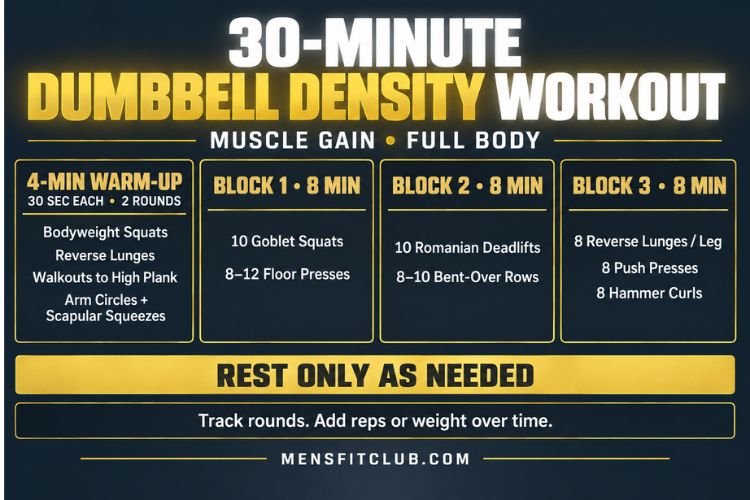
The session contains a four-minute warm-up, three eight-minute density blocks, and a two-minute cool-down. Set a timer for each block. Alternate between the two listed exercises and rest only as needed. Complete the repetitions with control, then transition efficiently. Stop adding rounds if technique deteriorates.
Four-Minute Dynamic Warm-Up
Perform 30 seconds of each movement and complete two rounds: bodyweight squats, alternating reverse lunges, walkouts to a high plank, and arm circles with scapular squeezes. Move gradually through a comfortable range rather than treating the warm-up as a test.
During the squats and lunges, keep the whole foot grounded and open the hips. On the walkouts, brace the abdomen and avoid dropping the hips. Finish with relaxed arm circles and deliberate shoulder-blade movement. By the end of four minutes, you should feel warmer and more mobile without feeling tired.
Density Block 1: Squat and Push Dumbbell Workout For Muscle Gain
Set the timer for eight minutes and alternate between 10 dumbbell goblet squats and 8 to 12 dumbbell floor presses. Complete as many quality rounds as possible while leaving approximately one or two repetitions in reserve. Rest for 15 to 30 seconds when needed.
For the goblet squat, hold one dumbbell vertically against the chest, brace the torso, sit between the hips, and drive through the full foot. Keep the knees tracking in line with the toes. Choose a depth you can control while maintaining a neutral spine.
For the floor press, lie on your back with the knees bent and a dumbbell in each hand. Keep the upper arms approximately 30 to 45 degrees from the torso. Lower slowly until the triceps touch the floor, pause briefly, and press the weights upward without crashing them together. The floor limits shoulder extension, making this an accessible pressing option for many lifters.
Density Block 2: Hinge and Pull
After Block 1, take only enough time to reset the timer and organize your dumbbells. For eight minutes, alternate between 10 dumbbell Romanian deadlifts and 8 to 10 bent-over dumbbell rows. Because both movements require torso control, use deliberate technique and take a short rest whenever your grip or lower back begins to limit good form.
For the Romanian deadlift, hold the dumbbells beside the thighs, soften the knees, and push the hips backward. Keep the weights close to the legs as you lower them until the hamstrings are strongly stretched. Squeeze the glutes and drive the hips forward to stand. Do not turn the movement into a squat or overextend the lower back at the top.
For the bent-over row, maintain a stable hip hinge and pull the dumbbells toward the lower ribs. Pause briefly, then lower them under control. Keep the neck neutral and avoid using momentum. If holding the hinged position becomes uncomfortable, perform one-arm rows with the free hand supported on a bench or sturdy surface, completing the prescribed reps on each side.
Density Block 3: Lunge, Shoulders, and Arms Dumbbell Workout For Muscle Gain
For the final eight-minute block, alternate between 8 dumbbell reverse lunges per leg and 8 dumbbell push presses followed immediately by 8 hammer curls. One lunge on each side counts as two total repetitions. Use a lighter pair of dumbbells if necessary for the upper-body combination.
Step backward into each reverse lunge, lower the rear knee toward the floor, and drive through the front foot to return to standing. Keep the front knee aligned with the foot and the torso tall. If balance is challenging, perform stationary split squats and complete all repetitions on one side before switching.
For the push press, hold the dumbbells at shoulder height, dip slightly through the knees and hips, then use leg drive to help press overhead. Finish with the ribs controlled and arms aligned comfortably overhead. Lower the weights to the shoulders, then transition into hammer curls with the palms facing each other. Keep the elbows near the ribs and avoid swinging. This combination finishes the shoulders and arms after the larger muscle groups have already done substantial work.
Two-Minute Cool-Down
Walk slowly and take deep breaths for 30 seconds. Spend the remaining time moving through a gentle hip-flexor stretch, hamstring stretch, and chest-opening position. The cool-down does not need to be elaborate; its purpose is to lower the intensity gradually and identify any area that may need additional mobility work later.
How to Score the Dumbbell Density Workout For Muscle Gain
Record the dumbbell weight and the number of completed rounds in every block. If the timer ends during a round, record the extra reps. A sample result might be four rounds plus 10 squats in Block 1, four complete rounds in Block 2, and three rounds plus 16 lunges in Block 3.
Your score is useful only when repetition standards remain consistent. A deeper controlled squat should not be compared with a hurried partial squat. Do not chase a higher number by cutting the range of motion, bouncing weights, or skipping pauses. Better technique with the same score can represent real progress.
Four-Week Progression Plan for Muscle Gain
During Week 1, learn the exercises, select appropriate loads, and establish a baseline. Stop most sets with two repetitions in reserve and record your rounds. In Week 2, use the same weights and try to add one or two total repetitions to each block. Small increases are enough.
In Week 3, increase one or both dumbbells by the smallest practical amount. It is normal for your round count to decline slightly after adding weight. In Week 4, keep the heavier load and try to match or exceed the previous week’s work. This creates a clear progression without demanding an unrealistic personal record every session.
Perform the workout two or three times per week on nonconsecutive days. Two weekly sessions work well alongside other strength training. Three sessions can function as a minimalist full-body program, but vary the effort: make one session challenging, one moderate, and one focused on technique. Muscles grow during recovery, so more density is not automatically better.
How Hard Should Each Block Feel?
The first round should feel controlled. The final few minutes should be demanding, with most sets ending about one or two clean reps before failure. You may take the last set of a safe exercise, such as curls or floor presses, closer to technical failure, but compound movements do not need to become grinders.
Use the talk test as a secondary guide. You should be breathing harder, yet still able to focus on bracing and movement cues. If breathlessness forces poor technique, extend your rest. This is resistance training for muscle gain—not a competition to avoid rest at all costs.
Nutrition and Recovery for Muscle Growth
The workout supplies the stimulus, but muscle gain also depends on nutrition and recovery. Eat enough total calories to support training and consume protein-rich meals built around foods such as lean meat, fish, eggs, Greek yogurt, beans, tofu, or protein powder. Carbohydrates help fuel hard sessions, while adequate hydration supports performance. Aim for consistent sleep and allow at least 48 hours before training the same movement patterns hard again. Persistent soreness or declining performance may indicate that you need more recovery.
Exercise Modifications for Beginners
Beginners can use six-minute blocks instead of eight-minute blocks and take 30 to 45 seconds of rest after each complete round. Start with 8 squats, 8 floor presses, 8 Romanian deadlifts, 8 rows, 6 reverse lunges per leg, 6 push presses, and 6 curls. This version retains the structure while reducing fatigue.
If lunges bother the knees or balance is limited, substitute goblet box squats or supported split squats. If overhead pressing causes discomfort, use neutral-grip floor presses. Pain is not a normal requirement for muscle gain. Stop any movement that causes sharp pain and consult a qualified health or fitness professional when appropriate.
FAQ About Dumbbell Density Workout For Muscle Gain
Can a 30-Minute Dumbbell Workout Really Build Muscle?
Yes. Muscle growth depends on sufficient tension, productive volume, proximity to muscular failure, progressive overload, nutrition, and recovery—not simply the length of a session. Thirty focused minutes can be effective when the exercises and weights are appropriate.
How Often Should I Do This Workout?
Two to three nonconsecutive sessions per week suit most people. If you also follow a separate lifting program, use this workout once or twice weekly and account for overlapping leg, chest, back, and shoulder volume.
Can I Do the Workout With One Dumbbell?
Yes. Perform goblet squats and Romanian deadlifts holding one dumbbell, use one-arm floor presses and rows, and complete both sides before moving on. Use a single-arm push press and curl in the final block. Alternate which side begins each round.
Should I Use Heavy or Light Dumbbells?
Use moderately heavy dumbbells that make the final repetitions challenging without disrupting form. Lower-body movements typically tolerate more load than shoulder and arm exercises, so multiple pairs are helpful but not essential.
Is This Workout Good for Fat Loss Too?
It can support fat loss by preserving muscle and increasing activity, but fat loss primarily requires an appropriate calorie deficit over time. Avoid making the weights so light that the session loses its muscle-building stimulus.
The 30-Minute Dumbbell Density Workout
A 30-minute dumbbell density workout for muscle gain works because it removes wasted time while preserving the elements that matter: challenging resistance, balanced movement patterns, controlled repetitions, sufficient volume, and measurable progression. The fixed blocks keep the session focused, and the simple score gives you a practical target for future workouts.
Start conservatively, learn your pace, and record every session. Over several weeks, aim to perform slightly more quality work or use slightly heavier dumbbells. Combine that progression with adequate protein, calories, sleep, and rest, and this compact full-body routine can become a powerful part of a sustainable muscle-building plan.
Want to expand this 30-minute dumbbell density workout into a complete training strategy? Try our 30-Minute Dumbbell AMRAP Circuit for another time-efficient challenge, or increase the conditioning demand with this Full-Body Dumbbell HIIT Routine. For longer-term progression, follow the 30-Day Dumbbell Workout Plan or organize your weekly training with our 5 Day Dumbbell Home Workout Split. You can also build on this density session with the structured 4 Week Full Body Dumbbell Workout designed to help increase muscle, strength, and overall fitness.


Most Recommended

Subscribe to our Newsletter
Stay up to date on the latest men’s health, fitness and lifestyle trends and tips.
About Us
Men’s Fit Club was started with the goal of empowering men to get the most out of their lives. This meant going beyond exercise and diet tips to really address the broad range of issues that men face on a daily basis – topics like recreation, finding love, sexual health and even sound fashion advice.
Quick Links
© COPYRIGHT MEN'S FIT CLUB 2026. All Rights Reserved