
4 Week Murph Workout Challenge A Complete Training Plan
Full Body HIIT Routine With Dumbbells (Build Muscle + Burn Fat)
CrossFit WOD Workout for Beginners to Get Started
40 Minute Beginner HIIT Workout: Full Body Routine
Full Body HIIT Routine With Dumbbells (Build Muscle + Burn Fat)
A full body HIIT routine with dumbbells is one of the most efficient ways to combine resistance training and cardiovascular conditioning in a single workout. Instead of separating strength training and cardio into different sessions, dumbbell HIIT uses challenging compound exercises, controlled rest periods, and repeated rounds to train multiple muscle groups while keeping the workout moving.
Dumbbells are particularly useful for HIIT because they provide enough resistance to challenge the chest, shoulders, back, arms, legs, glutes, and core without requiring a complicated gym setup. Exercises such as dumbbell squats, Romanian deadlifts, rows, presses, lunges, and thrusters can be combined into a structured routine that develops strength and muscular endurance while increasing the cardiovascular demand of the workout.
This full body dumbbell HIIT workout is designed for men who want an efficient training session that can be performed at home or in the gym. The workout can also be modified for different fitness levels by changing the dumbbell weight, work intervals, number of rounds, or rest periods.
What Is a Full Body HIIT Routine With Dumbbells?
High-intensity interval training, commonly called HIIT, alternates periods of challenging exercise with periods of recovery. Traditional HIIT is often associated with running, cycling, jumping, or bodyweight exercises. Adding dumbbells introduces resistance training to the interval format.
A full body HIIT routine uses exercises that collectively target the major muscle groups. Instead of spending an entire workout training only the chest or legs, for example, you might perform a squat followed by a dumbbell row, shoulder press, reverse lunge, and Romanian deadlift.
The result is a workout that challenges several physical qualities simultaneously.
Your muscles have to produce force against the dumbbells, while your cardiovascular system must support repeated bouts of activity. The relatively short recovery periods also increase the muscular endurance demands of the workout.
The objective, however, should not simply be to perform every movement as quickly as possible. Good dumbbell HIIT maintains a balance between intensity, resistance, exercise technique, and recovery.
Benefits of a Full Body HIIT Routine With Dumbbells
Combining dumbbells with interval training can provide several advantages for people who have limited training time.
Train Multiple Muscle Groups in One Session
Compound dumbbell exercises allow you to involve several muscles during a single movement. A dumbbell thruster, for example, combines a squat with an overhead press. The legs and glutes produce force during the squat while the shoulders, triceps, and upper body complete the press.
A well-designed routine can train the quads, hamstrings, glutes, chest, shoulders, back, arms, and core without requiring numerous isolation exercises.
Combine Strength and Conditioning
Dumbbell HIIT sits somewhere between traditional resistance training and cardiovascular interval training.
The weights provide resistance for the muscles, while repeated exercises and limited recovery increase cardiovascular demand.
It should not completely replace traditional strength training if maximizing strength or muscle growth is your primary goal, but it can be an excellent conditioning workout alongside a structured resistance-training program.
Efficient Workouts for Busy Schedules
One of the biggest advantages of HIIT is efficiency.
A properly structured 30- to 40-minute full body HIIT workout with dumbbells can include a warm-up, several resistance exercises, conditioning intervals, and a cooldown.
That makes it useful for anyone who struggles to fit separate cardio and resistance workouts into a busy schedule.
Easy to Perform at Home
You do not necessarily need a fully equipped gym for this routine. A pair of dumbbells and enough floor space to move safely may be sufficient.
Adjustable dumbbells are especially convenient because the resistance can be changed between exercises.
Improve Muscular Endurance
Performing repeated dumbbell exercises with controlled rest periods challenges your ability to sustain muscular effort.
Over time, appropriate training can improve muscular endurance, helping you perform more work before fatigue significantly reduces your performance.
Equipment Needed for This Dumbbell HIIT Routine
The main equipment required is a pair of dumbbells.
Ideally, choose a resistance that is challenging enough to make the working intervals demanding but light enough that you can maintain proper technique. Because lower-body muscles are generally stronger than smaller upper-body muscles, one dumbbell weight may not be ideal for every exercise.
If possible, have a heavier and lighter pair available.
You will also need enough open floor space to perform lunges, rows, squats, and floor exercises safely. A workout mat is optional but may make floor-based movements more comfortable.
How Heavy Should Your Dumbbells Be For This HIIT Routine?
Choosing the right dumbbell weight is essential for HIIT.
Using weights that are excessively heavy can cause technique to deteriorate as fatigue accumulates. Using weights that are extremely light may not provide enough resistance to challenge your muscles.
Choose dumbbells that allow you to complete the prescribed interval with controlled technique while still making the final portion of the interval challenging.
Beginners should generally prioritize movement quality over weight.
Intermediate and advanced trainees can gradually increase resistance as long as they remain in control of each repetition.
Remember that HIIT is not a competition to perform sloppy repetitions faster. A controlled repetition with appropriate resistance is more productive than rushing through an exercise with poor form.
Full Body HIIT Routine With Dumbbells Overview
This workout uses a combination of lower-body, upper-body, core, and compound movements.
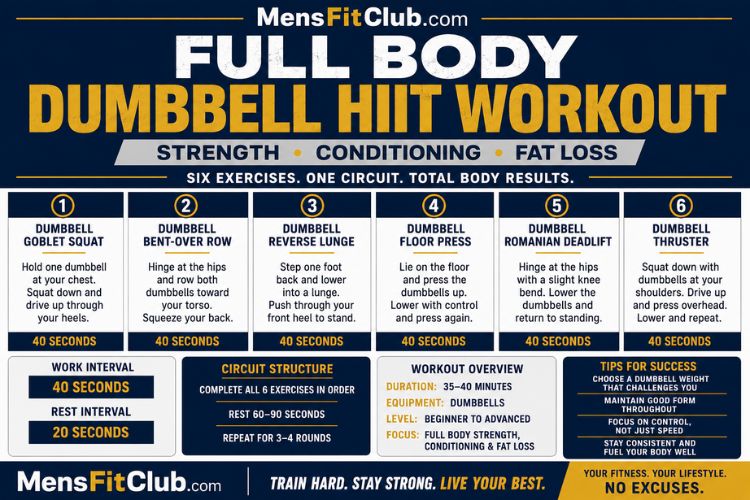
Workout duration: Approximately 35–40 minutes
Equipment: Dumbbells
Fitness level: Beginner to intermediate, with advanced modifications available
Work interval: 40 seconds
Rest interval: 20 seconds
Exercises per circuit: 6
Rounds: 3–4
Rest between rounds: 60–90 seconds
Beginners can start with 30 seconds of exercise followed by 30 seconds of rest. More experienced trainees can use the standard 40/20 structure.
Avoid reducing rest simply for the sake of making the workout harder. The objective is to maintain productive exercise quality across the entire session.
5-Minute Warm-Up Before Dumbbell HIIT Routine
Never underestimate the importance of preparing your body before a demanding interval workout.
Spend approximately five minutes gradually increasing your body temperature and moving the joints through comfortable ranges of motion.
Warm-Up Routine
Perform approximately 30–45 seconds of each movement:
March or light jog in place
Bodyweight squats
Alternating reverse lunges
Arm circles
Hip hinges
Walkouts
Bodyweight good mornings
Light dumbbell squats
Finish with a few controlled repetitions of the exercises you will perform during the workout.
The warm-up should leave you feeling prepared rather than exhausted.
Full Body Dumbbell HIIT Workout Routine
Perform each exercise for 40 seconds, followed by 20 seconds of recovery.
Complete all six exercises before resting for 60–90 seconds. Perform three rounds initially. A fourth round can be added if your fitness and technique remain strong.
Exercise 1: Dumbbell Goblet Squat
Hold one dumbbell vertically against your chest with both hands.
Stand with your feet approximately shoulder-width apart and brace your core. Push your hips back slightly while bending your knees and lowering into a comfortable squat.
Keep the dumbbell close to your torso and your chest controlled throughout the movement.
Drive through your feet to return to standing.
Muscles Worked
The goblet squat primarily trains the quadriceps and glutes while also involving the hamstrings and core.
Because large lower-body muscles are involved, it is also an effective exercise for increasing the overall intensity of the circuit.
Exercise 2: Dumbbell Bent-Over Row
Hold a dumbbell in each hand.
Push your hips backward while maintaining a stable spine until your torso is inclined forward. Allow the dumbbells to hang beneath your shoulders.
Pull the dumbbells toward your torso while keeping your elbows relatively close to your sides.
Pause briefly before lowering the weights under control.
Muscles Worked
Dumbbell rows primarily target the muscles of the upper and middle back while also involving the biceps, rear shoulders, and core.
Including pulling movements helps create a more balanced full-body routine instead of focusing exclusively on pressing exercises.
Exercise 3: Dumbbell Reverse Lunges
Stand upright while holding the dumbbells by your sides.
Step one foot backward and lower your body into a controlled lunge. Push through the front foot to return to the starting position before alternating legs.
Keep your torso controlled and avoid allowing the front knee to collapse inward.
Muscles Worked
Reverse lunges train the quadriceps, glutes, hamstrings, calves, and stabilizing muscles around the hips.
Alternating legs also creates a significant cardiovascular challenge during longer intervals.
Exercise 4: Dumbbell Floor Press
Lie on your back with one dumbbell in each hand.
Position your upper arms at a comfortable angle from your torso. Press the dumbbells upward until your arms are extended without aggressively locking the elbows.
Lower the dumbbells under control until your upper arms gently contact the floor.
Press upward again.
Muscles Worked
The dumbbell floor press primarily trains the chest, triceps, and front deltoids.
The floor also limits the bottom range of motion, which some trainees may find easier to control than a traditional bench press.
Exercise 5: Dumbbell Romanian Deadlift
Stand with a dumbbell in each hand in front of your thighs.
Keep your knees slightly bent and push your hips backward. Lower the dumbbells along your legs while maintaining a neutral, controlled torso position.
Stop when you reach your comfortable hamstring range.
Drive your hips forward and return to standing.
Muscles Worked
Romanian deadlifts emphasize the hamstrings and glutes while requiring the back and core muscles to stabilize the torso.
Avoid turning the movement into a squat. The primary movement should come from hinging at the hips.
Exercise 6: Dumbbell Thrusters
Hold the dumbbells near shoulder height.
Lower into a controlled squat before driving upward through your legs. As you stand, use the momentum from the lower body to transition into an overhead press.
Bring the dumbbells back to shoulder height before beginning the next repetition.
Muscles Worked
Thrusters involve the quadriceps, glutes, shoulders, triceps, and core, making them one of the most demanding full-body movements in the workout.
Because of their high conditioning demand, maintain a controlled pace rather than sprinting through the interval.
Full Body Dumbbell HIIT Workout Schedule
The complete circuit looks like this:
Dumbbell Goblet Squat: 40 seconds work / 20 seconds rest
Dumbbell Bent-Over Row: 40 seconds work / 20 seconds rest
Dumbbell Reverse Lunge: 40 seconds work / 20 seconds rest
Dumbbell Floor Press: 40 seconds work / 20 seconds rest
Dumbbell Romanian Deadlift: 40 seconds work / 20 seconds rest
Dumbbell Thruster: 40 seconds work / 20 seconds rest
Rest approximately 60–90 seconds after completing all six exercises.
Repeat for 3–4 total rounds.
Combined with the warm-up and cooldown, the workout should take approximately 35–40 minutes.
Beginner Full Body HIIT Routine With Dumbbells
Beginners do not need to perform the full workout at maximum intensity.
A better starting structure is:
30 seconds exercise
30 seconds recovery
2–3 rounds
90 seconds rest between rounds
Use relatively light dumbbells and become comfortable with the movements before increasing intensity.
If necessary, remove the dumbbells from lunges or squats temporarily while developing proper technique.
You can also replace thrusters with a basic dumbbell shoulder press if the combined squat-and-press movement becomes difficult to coordinate.
Advanced Dumbbell HIIT Modifications
Experienced trainees can increase the challenge without simply moving faster.
One option is gradually increasing dumbbell resistance. Another is performing an additional round.
Advanced trainees might use:
45 seconds work
15 seconds rest
4 rounds
60 seconds between rounds
However, shorter recovery periods are only useful if exercise quality remains acceptable.
You can also incorporate more challenging variations such as alternating dumbbell snatches, renegade rows, front-rack walking lunges, or clean-to-press combinations.
How Often Should You Do Full Body Dumbbell HIIT?
For many people, two to three dumbbell HIIT workouts per week can provide plenty of conditioning.
Recovery needs depend on training experience, exercise intensity, sleep, nutrition, age, and other workouts performed during the week.
Avoid assuming that HIIT needs to be performed every day.
High-intensity exercise creates fatigue, and repeatedly training hard without adequate recovery may reduce performance.
A sample weekly structure could include dumbbell HIIT on Monday and Thursday while using other days for strength training, lower-intensity cardio, mobility, recreational activities, or rest.
Full Body Dumbbell HIIT for Fat Loss
HIIT can be useful within a fat-loss program because it provides cardiovascular activity while incorporating resistance exercises.
However, no specific workout can guarantee fat loss from a particular part of the body.
Long-term fat loss primarily depends on maintaining an appropriate calorie deficit while consuming adequate nutrients and following a sustainable training program.
Resistance training can also be useful during a calorie deficit because it provides a stimulus for maintaining muscle.
Rather than thinking of dumbbell HIIT as a shortcut, use it as one component of a broader plan involving nutrition, strength training, daily activity, sleep, and recovery.
Dumbbell HIIT for Building Muscle
Dumbbell HIIT can challenge the muscles, but it should not necessarily replace dedicated hypertrophy training.
Muscle-building programs generally benefit from progressive overload, adequate training volume, sufficient recovery, and sets performed with resistance appropriate for hypertrophy.
HIIT circuits can complement that training by improving conditioning and providing additional resistance work.
If muscle growth is your main objective, prioritize structured resistance sessions and use HIIT strategically rather than turning every strength workout into a high-speed circuit.
Common Dumbbell HIIT Mistakes
Choosing Weights That Are Too Heavy
Heavy dumbbells may seem like the quickest way to make the workout more effective, but excessive resistance can cause technique to deteriorate.
Choose weights you can control throughout the interval.
Performing Repetitions Too Fast
HIIT refers to training intensity, not uncontrolled movement speed.
Maintain deliberate technique, especially during Romanian deadlifts, rows, lunges, and overhead exercises.
Skipping the Warm-Up
Going directly from sitting or resting into demanding dumbbell thrusters and lunges is unnecessary.
A brief warm-up prepares your muscles and joints for the movements ahead.
Ignoring Recovery
More HIIT is not automatically better.
Allow enough recovery between challenging workouts, particularly when combining HIIT with strength training.
Using the Same Dumbbells Forever
As you become stronger and fitter, your original weights may eventually stop providing an adequate challenge.
Progressively increase resistance, repetitions, work duration, or rounds when appropriate.
How to Progress Your Dumbbell HIIT Routine
Progression should be gradual.
Start by completing the routine consistently with good technique.
Once you can perform all three rounds comfortably, consider adding a fourth round.
After adapting to four rounds, you might increase the dumbbell weight slightly.
Another option is increasing work intervals from 30 seconds to 40 seconds or eventually 45 seconds.
Change one variable at a time whenever possible. This makes it easier to determine whether your fitness is genuinely improving.
Cooldown After Your Full Body HIIT Workout
After completing your final round, spend approximately five minutes allowing your heart rate and breathing to gradually settle.
Walk slowly around the room rather than stopping immediately.
You can then perform comfortable stretches for the major muscle groups used during the workout, including the quadriceps, hamstrings, glutes, chest, shoulders, and upper back.
Keep stretching gentle and controlled.
The cooldown does not need to be complicated. Its primary purpose is to provide a gradual transition from demanding exercise back toward rest.
Final Thoughts on a Full Body HIIT Routine With Dumbbells
A full body HIIT routine with dumbbells provides an efficient way to train multiple muscle groups while simultaneously challenging your cardiovascular fitness and muscular endurance. With only a pair of dumbbells and a relatively small workout space, you can create a demanding session involving squats, rows, lunges, presses, Romanian deadlifts, and thrusters.
The key is not simply working as fast as possible. Effective dumbbell HIIT requires appropriate resistance, good exercise technique, intelligent interval selection, and sufficient recovery.
Start with three rounds of 40 seconds of work and 20 seconds of rest, or use a 30/30 structure if you are a beginner. As your conditioning improves, gradually progress the resistance, number of rounds, or interval duration.
When combined with consistent resistance training, sensible nutrition, daily activity, sleep, and adequate recovery, a full body dumbbell HIIT workout can become a valuable part of a balanced fitness program for improving strength, conditioning, and overall fitness.
Want to add more variety to your full body HIIT routine with dumbbells? Start with this 30 Minute Dumbbell HIIT Workout for a time-efficient combination of resistance training and conditioning. You can also follow the 45 Minute HIIT Workout With Dumbbells when you want a longer full-body session, or challenge yourself with this Advanced Dumbbell HIIT Workout as your fitness improves. For more traditional strength-focused training, try the 3 Day Full Body Workout Plan With Dumbbells or use this 30 Minute Full Body Dumbbell Workout to build strength and muscle when you’re short on time.


Most Recommended

Subscribe to our Newsletter
Stay up to date on the latest men’s health, fitness and lifestyle trends and tips.
About Us
Men’s Fit Club was started with the goal of empowering men to get the most out of their lives. This meant going beyond exercise and diet tips to really address the broad range of issues that men face on a daily basis – topics like recreation, finding love, sexual health and even sound fashion advice.
Quick Links
© COPYRIGHT MEN'S FIT CLUB 2026. All Rights Reserved