
Full Body HIIT Routine With Dumbbells (Build Muscle + Burn Fat)
CrossFit WOD Workout for Beginners to Get Started
40 Minute Beginner HIIT Workout: Full Body Routine
Double Under Workout CrossFit WODs Sets And Reps
40 Minute Beginner HIIT Workout: Full Body Routine
A 40 minute beginner HIIT workout can be one of the most efficient ways to improve cardiovascular fitness, burn calories, build muscular endurance, and establish a consistent exercise routine without spending hours in the gym. High-intensity interval training, commonly called HIIT, alternates relatively challenging periods of exercise with planned recovery periods. For beginners, however, HIIT does not need to mean exercising at maximum intensity or performing complicated movements.
The best beginner HIIT workout uses simple exercises, manageable intervals, and enough recovery to maintain good technique throughout the session. This 40-minute routine combines bodyweight exercises such as squats, push-ups, marching high knees, step-back lunges, and mountain climbers to train the entire body while gradually introducing you to interval training.
You can perform this 40 minute HIIT workout for beginners at home, outdoors, or at the gym. Most of the workout requires no equipment, making it particularly useful for men who want an accessible fitness routine they can repeat several times per week.
What Is a Beginner HIIT Workout?
HIIT is a training method that alternates periods of increased effort with periods of lower-intensity activity or rest. Instead of maintaining exactly the same pace throughout your workout, you repeatedly increase and decrease your training intensity.
Advanced HIIT sessions sometimes use very demanding work-to-rest ratios. Beginners generally benefit from longer recovery periods and moderate exercise intensity.
For example, a beginner might perform an exercise for 30 seconds before recovering for 30 seconds. As conditioning improves, the working interval could gradually increase to 40 seconds while recovery decreases to 20 seconds.
The objective is not simply to become exhausted. A productive beginner HIIT workout should challenge your cardiovascular system while allowing you to maintain proper movement quality.
How Hard Should Beginner HIIT Feel?
Beginners should avoid treating every working interval as an all-out sprint.
On a perceived exertion scale of 1 to 10, where 1 represents extremely easy activity and 10 represents maximum effort, aim for approximately 6 to 8 during most working intervals.
During recovery periods, intensity should decrease considerably.
You should feel challenged, but you should still be capable of controlling your movements. If your technique starts breaking down, reduce your pace or use an easier exercise variation.
Benefits of a 40 Minute Beginner HIIT Workout
One reason HIIT has become popular is its efficiency. A properly structured session can combine cardiovascular conditioning and muscular endurance training within one workout.
Improves Cardiovascular Fitness
HIIT repeatedly challenges your heart and lungs by increasing exercise intensity and then allowing partial recovery.
Over time, consistent cardiovascular training can improve your ability to perform physical activity without becoming tired as quickly.
For someone beginning a fitness program, this can translate into improved stamina during workouts as well as everyday activities.
Burns Calories Efficiently
A full-body HIIT session uses multiple large muscle groups while maintaining an elevated training pace.
Exercises involving the legs, chest, shoulders, core, and back can increase the overall energy demand of the workout.
However, exercise should be combined with appropriate nutrition if fat loss is your primary goal. HIIT can support a calorie deficit, but it cannot compensate for consistently consuming more calories than your body requires.
Builds Full Body Muscular Endurance
Bodyweight HIIT exercises can challenge multiple muscle groups simultaneously.
Squats and lunges train the legs and glutes. Push-ups strengthen the chest, shoulders, and triceps. Mountain climbers and plank variations challenge the core while also increasing cardiovascular demand.
Repeating these movements during timed intervals helps develop muscular endurance.
Requires Minimal Equipment
One major advantage of this beginner HIIT workout at home is that you do not need expensive equipment.
Most exercises require only your body weight and enough floor space to move safely.
An exercise mat is optional but may make floor exercises more comfortable.
Easy to Modify
Beginners have different fitness levels, mobility limitations, and exercise backgrounds.
Every exercise in this workout can therefore be modified.
You can replace jumping exercises with low-impact alternatives, perform push-ups against a wall or bench, shorten working intervals, or extend recovery periods.
Progress is more important than performing the hardest variation.
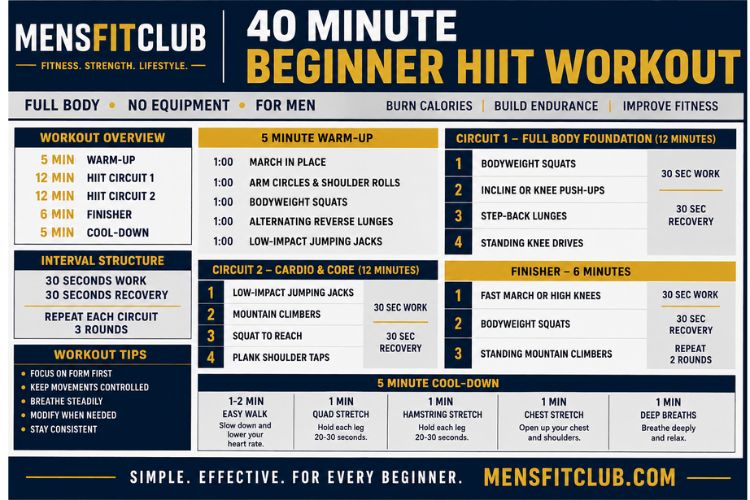
40 Minute Beginner HIIT Workout Overview
This workout is divided into four main sections:
5 minutes — Dynamic warm-up
12 minutes — HIIT Circuit 1
12 minutes — HIIT Circuit 2
6 minutes — Finisher
5 minutes — Cool-down
Total workout time: approximately 40 minutes.
During the main circuits, use a 30-second work and 30-second recovery structure.
Beginners who find this challenging can perform 20 seconds of exercise followed by 40 seconds of recovery.
More conditioned beginners can eventually progress toward 40 seconds of exercise and 20 seconds of recovery.
5 Minute Beginner HIIT Workout Warm-Up
Never jump directly into high-intensity exercise without preparing your body.
The warm-up should gradually increase your heart rate while moving the major joints and muscles that will be involved in the workout.
Minute 1: March in Place
Begin with a comfortable march.
Keep your posture upright and allow your arms to swing naturally.
Gradually increase your pace throughout the minute.
Minute 2: Arm Circles and Shoulder Rolls
Perform controlled arm circles forward and backward.
Follow them with several shoulder rolls.
This helps prepare the shoulders for push-ups and other upper-body movements.
Minute 3: Bodyweight Squats Beginner HIIT Workout
Stand approximately shoulder-width apart.
Push your hips backward and bend your knees while keeping your chest upright.
Only squat as deeply as you can comfortably control.
Stand back up by pushing through your feet.
Minute 4: Alternating Reverse Lunges
Step one foot backward and lower your body under control.
Return to the starting position before alternating legs.
Use a smaller range of motion if necessary.
Minute 5: Low-Impact Jumping Jacks
Step one foot sideways while raising your arms overhead.
Return to the middle and alternate sides.
Gradually increase the pace until you feel warm and ready for the first circuit.
HIIT Circuit 1: Full Body Foundation
The first circuit focuses on basic bodyweight movements.
Perform each exercise for 30 seconds, followed by approximately 30 seconds of recovery or easy movement.
Complete the circuit for three rounds.
Exercise 1: Bodyweight Squats Beginner HIIT Workout
Stand with your feet approximately shoulder-width apart.
Brace your core and push your hips backward while bending your knees.
Lower yourself comfortably before standing tall again.
Avoid rushing through repetitions.
Focus on smooth, controlled movement.
Beginner modification: Perform shallow squats or squat toward a chair.
Exercise 2: Incline or Knee Push-Ups
Push-ups train the chest, shoulders, triceps, and core.
If traditional push-ups are too difficult, place your hands against a sturdy bench, countertop, or elevated surface.
Keep your body relatively straight as you lower your chest toward your hands.
Push yourself back to the starting position.
Exercise 3: Step-Back Lunges
Stand tall before stepping your right foot backward.
Lower yourself until you feel comfortable, then push through the front foot to return to standing.
Alternate legs.
Step-back lunges can be easier for beginners to control than forward lunges.
Exercise 4: Standing Knee Drives
Stand upright with your hands approximately chest height.
Drive one knee upward before returning your foot to the floor.
Alternate sides while gradually increasing your speed.
Keep the movement low-impact by maintaining contact with the floor rather than jumping.
After completing all four exercises, repeat the circuit until you have completed approximately 12 minutes.
HIIT Circuit 2: Beginner Cardio and Core Workout
After completing the foundation circuit, transition into exercises that slightly increase cardiovascular and core demand.
Continue using approximately 30 seconds of work followed by 30 seconds of recovery.
Complete three rounds.
Exercise 1: Low-Impact Jumping Jacks
Instead of jumping both feet outward simultaneously, step your right foot sideways while raising your arms.
Return to center and repeat on the left.
Once your fitness improves, you can progress to regular jumping jacks.
Exercise 2: Mountain Climbers
Begin in a high plank position.
Bring one knee toward your chest before returning the foot to the starting position.
Alternate legs.
Beginners should prioritize control instead of speed.
If floor mountain climbers are too challenging, place your hands on a bench or other stable elevated surface.
Exercise 3: Squat to Reach
Perform a normal bodyweight squat.
As you stand, extend both arms overhead.
This simple addition increases total-body movement without requiring jumping.
Keep your core engaged and avoid excessively arching your lower back when reaching overhead.
Exercise 4: Plank Shoulder Taps
Begin in a high plank position.
Lift one hand and gently touch the opposite shoulder.
Return your hand to the floor and alternate sides.
Try to prevent your hips from rotating excessively.
If necessary, perform the exercise from your knees or with your hands elevated.
Repeat these four exercises for approximately 12 minutes.
6 Minute Beginner HIIT Finisher
The final training section uses short intervals to finish the workout without requiring complicated exercises.
Perform each movement for approximately 30 seconds, followed by 30 seconds of easy movement or recovery.
Complete the three exercises twice.
Fast March or High Knees
March quickly while driving your knees upward.
Beginners should keep one foot on the floor at all times.
As your fitness improves, gradually transition toward faster high knees.
Bodyweight Squats
Return to controlled squats.
At this stage of the workout, fatigue may make your technique less consistent.
Do not sacrifice form for speed.
Perform fewer quality repetitions if necessary.
Standing Mountain Climbers
Stand upright and bring one knee toward your chest while driving the opposite arm forward.
Alternate rapidly while maintaining balance.
This provides a beginner-friendly alternative to floor mountain climbers.
Repeat the sequence one more time to complete approximately six minutes.
5 Minute Cool-Down After Beginner HIIT
Your heart rate will still be elevated when the final interval ends.
Instead of immediately sitting or lying down, gradually decrease your activity.
Minutes 1–2: Easy Walking
Walk slowly around the room or march gently in place.
Take controlled breaths and allow your heart rate to gradually decrease.
Minute 3: Quad Stretch
Stand near a wall if you need support.
Bring one heel toward your glutes and gently hold your ankle.
Switch sides after approximately 20–30 seconds.
Minute 4: Hamstring Stretch
Extend one leg slightly forward while keeping the heel on the floor.
Push your hips backward gently until you feel a comfortable stretch along the back of the thigh.
Switch legs.
Minute 5: Chest and Shoulder Stretch
Bring your arms behind your body or use a doorway to gently open your chest and shoulders.
Finish with several slow, controlled breaths.
How Often Should Beginners Do This 40 Minute HIIT Workout?
Beginners generally do not need HIIT every day.
A reasonable starting schedule is two sessions per week, separated by recovery days.
After several weeks, you may progress toward three weekly sessions if you are recovering well.
For example:
Monday — 40-minute beginner HIIT
Tuesday — Walking or recovery
Wednesday — Strength training or rest
Thursday — 40-minute beginner HIIT
Friday — Walking or light activity
Saturday — Optional strength training
Sunday — Recovery
Your schedule should reflect your current fitness level and ability to recover.
How to Progress Your Beginner HIIT Workout
Progression should happen gradually.
You do not need to make every workout harder than the previous session.
Increase Working Time
Start with:
20 seconds work / 40 seconds rest.
Progress to:
30 seconds work / 30 seconds rest.
Eventually try:
40 seconds work / 20 seconds rest.
This increases workout difficulty without changing the exercises.
Increase Exercise Difficulty
Once basic movements become comfortable, progress individual exercises.
For example:
Incline push-ups can progress toward floor push-ups.
Step jacks can progress toward jumping jacks.
Standing knee drives can progress toward high knees.
Bodyweight squats can eventually progress toward faster squats or carefully introduced squat jumps.
Only add higher-impact exercises when you have developed adequate movement control.
Common Beginner HIIT Workout Mistakes
HIIT can be extremely effective, but beginners sometimes make their workouts unnecessarily difficult.
Starting Too Fast
Your first interval should not feel like your final interval.
Choose a pace that allows you to complete the entire workout.
Ignoring Exercise Form
Moving faster does not automatically produce a better workout.
Poor technique can reduce exercise effectiveness and increase injury risk.
Quality movement should remain your priority.
Eliminating Recovery Periods
Rest intervals are an important part of HIIT.
They allow you to partially recover so you can maintain better performance during subsequent working intervals.
Doing HIIT Every Day
More training is not always better.
Recovery allows your muscles and cardiovascular system to adapt to exercise.
Use lower-intensity activities such as walking between demanding sessions.
Choosing Exercises That Are Too Advanced
You do not need burpee box jumps, sprint intervals, or complicated plyometric combinations to benefit from HIIT.
Simple movements performed consistently can produce an effective workout.
Can a 40 Minute HIIT Workout Help With Weight Loss?
HIIT can contribute to a weight-loss program because it increases physical activity and calorie expenditure.
However, losing body fat ultimately requires maintaining an appropriate calorie balance over time.
For better results, combine your workout routine with nutritious foods, sufficient protein, appropriate portion sizes, regular daily movement, quality sleep, and consistent training.
Do not judge your progress based only on how many calories a fitness tracker says you burned during one workout.
Long-term consistency matters considerably more.
Should Beginners Combine HIIT With Strength Training?
Yes.
HIIT and resistance training can complement each other.
HIIT primarily improves cardiovascular fitness and muscular endurance, while structured resistance training provides a more direct way to progressively develop strength and muscle.
A beginner weekly program could include two HIIT workouts and two full-body resistance-training sessions.
Allow adequate recovery between challenging workouts.
Beginner HIIT Workout Safety Tips
Exercise should challenge you without causing sharp pain, dizziness, unusual shortness of breath, or other concerning symptoms.
Stop exercising if something feels wrong.
Choose low-impact modifications if jumping bothers your knees, ankles, hips, or back.
Keep water nearby, exercise in a safe environment, and wear appropriate footwear.
People who have been inactive for an extended period or have health concerns should consider speaking with a qualified healthcare professional before beginning vigorous exercise.
Frequently Asked Questions About a 40 Minute Beginner HIIT Workout
Is 40 Minutes of HIIT Too Much for a Beginner?
Forty minutes can be appropriate because the entire workout is not performed at maximum intensity. This routine includes a warm-up, recovery intervals, moderate-intensity exercises, and a cool-down.
If 40 minutes feels excessive, begin with 15–20 minutes and gradually increase workout duration.
Can I Do Beginner HIIT Without Equipment?
Yes.
Bodyweight exercises including squats, lunges, push-ups, mountain climbers, planks, and knee drives can create an effective full-body HIIT workout without gym equipment.
Can I Do This HIIT Workout at Home?
Yes.
The workout requires relatively little space and can be performed at home, in a hotel room, outdoors, or in a gym.
How Many Calories Does a 40 Minute HIIT Workout Burn?
There is no single accurate number for everyone.
Calorie expenditure varies according to body size, fitness level, exercise selection, workout intensity, age, and other individual factors.
Instead of targeting a specific calorie number, concentrate on performing the workout consistently and gradually improving your fitness.
How Long Until HIIT Gets Easier?
Many beginners notice improvements in exercise tolerance after several weeks of consistent training.
The exact timeline varies considerably between individuals.
Track improvements such as completing more repetitions with good technique, recovering more quickly between intervals, or progressing toward longer working periods.
Final Thoughts on the 40 Minute Beginner HIIT Workout
A 40 minute beginner HIIT workout does not need to involve extreme exercises or nonstop maximum-effort training. A well-designed beginner routine combines straightforward full-body movements with manageable intervals and sufficient recovery.
Start with exercises you can perform confidently, use approximately 30 seconds of work followed by 30 seconds of recovery, and reduce the intensity whenever your technique begins to deteriorate.
Performing this workout two or three times per week can help build cardiovascular fitness, muscular endurance, and confidence. As your conditioning improves, gradually increase working intervals, decrease recovery periods, or introduce more challenging exercise variations.
The key is progression rather than exhaustion. Consistent workouts that you can recover from and repeat will usually provide more value than occasional sessions that leave you completely depleted.
Continue building your HIIT training routine with more workouts from MensFitClub. Try the 30 Minute Morning HIIT Workout Routine when you need a shorter session, progress toward the Best Full Body HIIT Workout Routine as your conditioning improves, or follow the 4 Week HIIT Workout Training Plan for a structured progression. You can also explore the Best Gym HIIT Workouts Plan for gym-based training and learn how interval workouts can improve cardiovascular performance with HIIT for Increasing VO2 Max.


Most Recommended

Subscribe to our Newsletter
Stay up to date on the latest men’s health, fitness and lifestyle trends and tips.
About Us
Men’s Fit Club was started with the goal of empowering men to get the most out of their lives. This meant going beyond exercise and diet tips to really address the broad range of issues that men face on a daily basis – topics like recreation, finding love, sexual health and even sound fashion advice.
Quick Links
© COPYRIGHT MEN'S FIT CLUB 2026. All Rights Reserved