
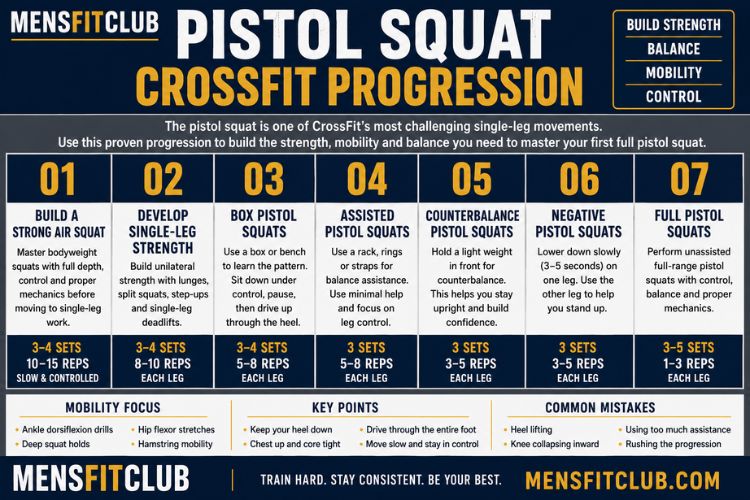
Pistol Squat CrossFit Progression From Beginner to Advanced
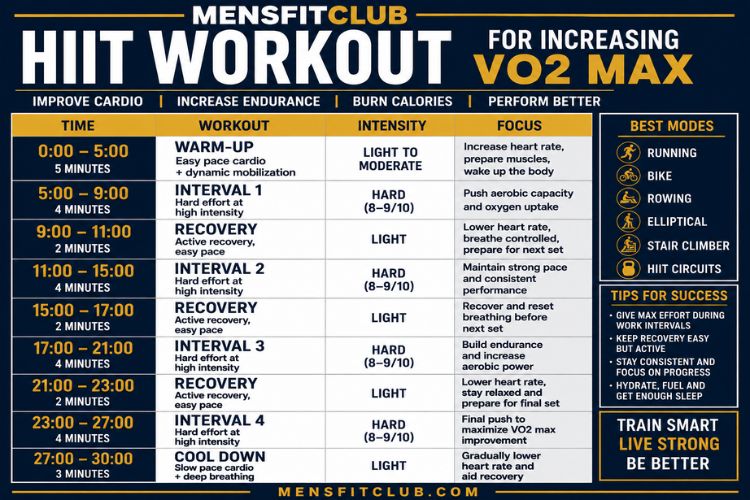
VO2 Max HIIT Workout: Improve Cardio and Endurance
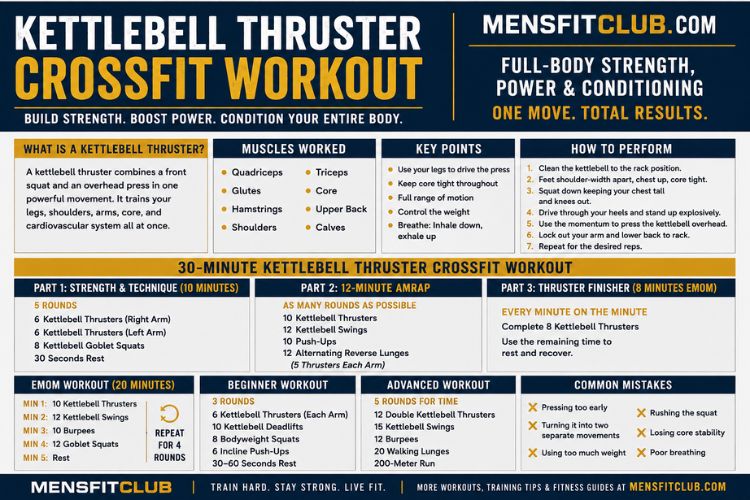
Kettlebell Thruster Workout for CrossFit Strength & Conditioning
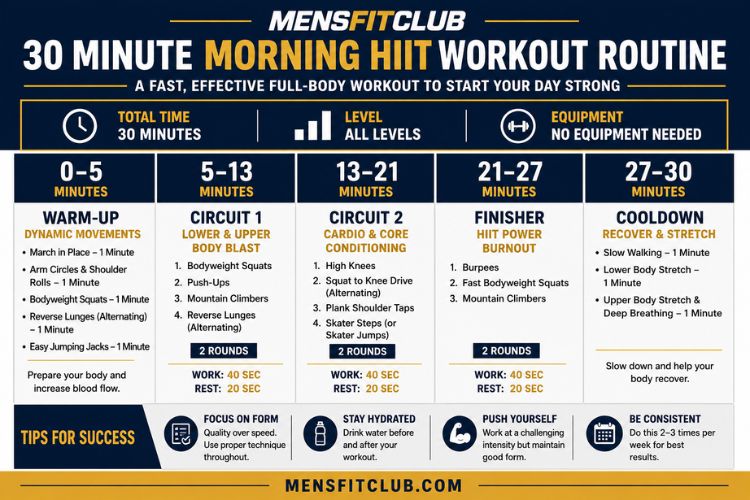
30 Minute Morning HIIT Routine to Start Your Day Strong
VO2 Max HIIT Workout: Improve Cardio and Endurance
Improving cardiovascular fitness is about more than simply being able to exercise longer without getting tired. One of the most important measurements of aerobic performance is VO2 max, which represents the maximum amount of oxygen your body can use during intense exercise. A higher VO2 max can help you run faster, cycle harder, recover more efficiently between demanding efforts, and maintain better overall endurance. One of the most time-efficient ways to improve aerobic capacity is HIIT for increasing VO2 max. High-intensity interval training alternates challenging periods of exercise with controlled recovery periods. Instead of maintaining one moderate pace throughout a workout, HIIT repeatedly pushes your cardiovascular system toward high levels of oxygen demand before allowing partial recovery.
For people who want to improve conditioning without spending hours performing traditional cardio, a properly designed VO2 max HIIT workout can be an effective addition to a weekly fitness program.
This guide explains how HIIT can improve VO2 max, how hard your intervals should be, which exercises work best, and provides a complete 30-minute HIIT workout for VO2 max that can be adapted to different fitness levels.
What Is VO2 Max?
VO2 max refers to the maximum amount of oxygen your body can take in, transport, and use while exercising intensely. It is commonly expressed relative to body weight in milliliters of oxygen per kilogram of body weight per minute.
Your lungs bring oxygen into the body, your cardiovascular system transports oxygen-rich blood to working muscles, and your muscles use that oxygen to produce energy. VO2 max reflects how effectively this entire system works when exercise intensity becomes very high.
Although genetics can influence aerobic potential, training status also matters. Regular cardiovascular exercise—particularly training that challenges the upper end of your aerobic capacity—can improve your body’s ability to perform demanding endurance work.
That is where high-intensity interval training becomes especially useful.
Why HIIT Can Help Increase VO2 Max
Steady-state cardio has an important place in endurance training, but increasing VO2 max requires sufficiently challenging cardiovascular work.
During HIIT, you repeatedly increase your workload to a level where breathing becomes difficult and your cardiovascular system must work aggressively to supply oxygen to your muscles. Recovery intervals then allow you to reduce intensity enough to prepare for another quality effort.
Repeating this process can provide a strong aerobic training stimulus without requiring the entire workout to be performed at maximum intensity.
The goal is not simply to make yourself exhausted. An effective HIIT workout to increase VO2 max should provide enough recovery to maintain a consistently high workload across multiple intervals.
If your first interval is extremely fast but your performance collapses immediately afterward, you may be training harder rather than training better.
Benefits of VO2 Max HIIT Training
Improving VO2 max can have benefits extending beyond a single type of cardio exercise.
Better Cardiovascular Endurance
A stronger aerobic system can make sustained physical activity easier. Running, cycling, swimming, hiking, rowing, recreational sports, and conditioning workouts can all benefit from improved aerobic capacity.
You may notice that workloads that previously caused heavy breathing gradually become easier to maintain.
Improved High-Intensity Exercise Capacity
A better aerobic foundation can also support repeated high-intensity efforts.
Although activities such as sprinting and heavy resistance training rely heavily on anaerobic energy systems, aerobic fitness contributes to recovery between demanding efforts.
This makes cardiovascular conditioning valuable even for people whose primary goal is strength or muscle development.
Time-Efficient Cardio
HIIT is attractive because productive cardiovascular training can often be completed in a relatively short session.
You do not necessarily need 60 minutes of continuous cardio. A structured 20- to 30-minute workout containing carefully programmed intervals can provide a demanding cardiovascular challenge.
Greater Workout Variety
VO2 max intervals can be performed using several forms of exercise, including running, cycling, rowing, stair climbing, elliptical training, swimming, or certain full-body conditioning movements.
This flexibility makes it easier to rotate training methods and reduce boredom.
How Hard Should HIIT Be for Increasing VO2 Max?
Intensity is one of the most important components of VO2 max training.
Your work intervals should feel hard enough that you cannot comfortably hold a conversation. However, most intervals should not begin as absolute all-out sprints.
A useful target is approximately 8 to 9 out of 10 on a perceived exertion scale during the hardest portion of the workout.
If you use a heart-rate monitor, longer intervals may eventually bring you toward roughly 85–95% of your maximum heart rate. Heart rate responds with a delay, however, so perceived effort, pace, power, and workout quality can also be useful guides.
The objective is to accumulate meaningful time at a high aerobic intensity.
The Best HIIT Interval Length for VO2 Max
There is no single interval format that works for everyone. Different work-to-rest combinations can provide effective cardiovascular training.
4-Minute Intervals
Longer intervals are particularly useful because they provide enough time for oxygen consumption and heart rate to rise substantially.
A classic structure is:
4 minutes hard
3 minutes active recovery
Repeat 4 times
This produces 16 minutes of challenging work and can be demanding even for experienced exercisers.
2- to 3-Minute Intervals
Intermediate athletes may prefer slightly shorter intervals.
For example:
3 minutes hard
2 minutes easy
Repeat 5 times
These intervals allow you to maintain a strong pace while still accumulating considerable high-intensity training volume.
60-Second Intervals
Shorter intervals can work well for beginners or people introducing HIIT into their program.
Try:
60 seconds hard
60–90 seconds easy
Repeat 6–10 rounds
The intensity can gradually increase as conditioning improves.
Best Exercises for Increasing VO2 Max With HIIT
Exercises that involve large muscle groups and allow intensity to be adjusted quickly generally work best.
Running
Running is one of the simplest options for VO2 max interval training.
A treadmill provides precise control over speed and incline, while outdoor running can be performed on a track, road, or suitable hill.
Instead of sprinting at absolute maximum speed, choose a hard pace you can reproduce throughout the planned intervals.
Stationary Bike
Cycling is an excellent option for people who prefer lower-impact conditioning.
Increase resistance and/or cadence during your work intervals, then reduce both during recovery.
Because cycling does not require the impact associated with running, it can also be easier to combine with certain strength-training programs.
Rowing Machine
Rowing combines cardiovascular conditioning with substantial involvement from the legs, back, core, and arms.
Good technique is important. Avoid sacrificing rowing mechanics simply to increase stroke rate.
Stair Climber
The stair climber can quickly increase cardiovascular demand while challenging the lower body.
Increase the pace during your work intervals and slow down during recovery while continuing to move.
Bodyweight Exercises
Bodyweight movements can also create a strong cardiovascular challenge.
Useful options include mountain climbers, squat thrusts, fast step-ups, high knees, skater steps and controlled burpees.
For VO2 max development, choose movements you can perform safely even when breathing heavily.
30-Minute HIIT Workout for Increasing VO2 Max
This workout can be performed on a treadmill, stationary bike, rower, elliptical machine, or another cardio modality that allows you to control intensity easily.
Minutes 0–5: Progressive Warm-Up
Begin with five minutes of easy movement.
Start at a comfortable pace for approximately two minutes. Gradually increase the intensity during minutes three and four.
During the final minute, perform two brief accelerations of approximately 10–15 seconds followed by easy movement.
The goal is to increase body temperature and prepare your cardiovascular system for harder exercise.
Minutes 5–9: Interval 1
Perform 4 minutes at a hard but controlled intensity.
Aim for approximately 8 out of 10 effort.
You should be breathing heavily by the second half of the interval, but your pace should remain sustainable for the full four minutes.
Minutes 9–11: Recovery
Reduce the intensity for two minutes.
Continue moving rather than stopping completely. Your breathing should begin settling, but you do not need to recover fully.
Minutes 11–15: Interval 2
Perform another four-minute high-intensity interval.
Try to maintain approximately the same speed, resistance, or power output as your first interval.
Avoid dramatically increasing the pace simply because you feel recovered.
Minutes 15–17: Recovery
Perform two minutes of easy active recovery.
Focus on controlled breathing and prepare for the second half of the workout.
Minutes 17–21: Interval 3
Complete your third four-minute interval.
Fatigue should now be noticeable.
Maintain good exercise technique and resist the temptation to start too quickly. Your goal is to keep your workload relatively consistent.
Minutes 21–23: Recovery
Reduce the intensity for another two minutes.
This is your final recovery before the last major interval.
Minutes 23–27: Interval 4
Perform your final four-minute hard interval.
Push strongly while maintaining control.
The final minute should feel very challenging, but you should still be able to maintain proper form.
Minutes 27–30: Cooldown
Gradually reduce your pace for three minutes.
Allow your breathing and heart rate to decrease rather than stopping abruptly after the final interval.
Beginner VO2 Max HIIT Workout
Beginners do not need to immediately perform four-minute intervals.
Start with shorter work periods such as:
60 seconds hard followed by 90 seconds easy.
Complete six rounds.
As your cardiovascular fitness improves, progress toward 90-second intervals and eventually two- to three-minute intervals.
The priority should be consistency rather than exhaustion.
Intermediate VO2 Max HIIT Workout
Intermediate exercisers can try:
3 minutes hard
2 minutes easy
5 rounds
This provides 15 total minutes of high-intensity work.
Your pace should remain relatively consistent across all five intervals.
If performance drops dramatically during the final rounds, slightly reduce the initial intensity.
Advanced VO2 Max HIIT Workout
Well-conditioned athletes can use longer intervals such as:
4 minutes hard
2–3 minutes active recovery
4–5 rounds
Another option is five three-minute intervals performed at a slightly higher intensity.
Advanced does not mean performing every interval as an uncontrolled sprint. Even experienced athletes benefit from pacing their sessions so the final interval remains productive.
How Often Should You Perform VO2 Max HIIT?
For many recreational exercisers, one or two VO2 max HIIT sessions per week can provide a substantial cardiovascular stimulus.
Highly trained athletes may use additional interval training, but their overall training volume and recovery strategies are usually more carefully managed.
Avoid assuming that more HIIT automatically produces faster results.
High-intensity cardiovascular training creates significant fatigue. Performing intense intervals every day can reduce workout quality and interfere with strength training, endurance work, and recovery.
Allow sufficient recovery between demanding sessions.
How to Progress Your VO2 Max Workout
Progress should be gradual.
One of the simplest methods is increasing the number of intervals. For example, you could begin with three three-minute intervals and eventually progress to five.
Another strategy is extending work duration.
You might progress from:
60 seconds hard
to 90 seconds hard
to 2 minutes hard
to 3 minutes hard.
You can also gradually increase treadmill speed, cycling resistance, rowing pace, or incline.
However, change only one or two variables at a time. Increasing intensity, duration, and total interval volume simultaneously can create unnecessary fatigue.
Combining VO2 Max HIIT With Strength Training
You do not have to choose between cardiovascular fitness and strength.
A balanced weekly program can include both.
For example:
Monday – Upper-body strength
Tuesday – VO2 max HIIT
Wednesday – Lower-body strength
Thursday – Easy cardio or recovery
Friday – Full-body strength
Saturday – VO2 max HIIT
Sunday – Rest or light activity
If lower-body strength is your priority, avoid placing your hardest running intervals immediately before an important leg workout.
Cycling or rowing may sometimes be easier to integrate into a strength-focused program than repeated high-impact running.
Common HIIT Mistakes That Can Limit VO2 Max Progress
Starting Too Fast
One of the most common mistakes is treating the first interval like a sprint test.
You feel fresh, perform the first round extremely hard, and then struggle through every remaining interval.
Instead, select an intensity that allows you to perform all planned intervals at a reasonably consistent level.
Making Recovery Too Hard
Recovery intervals should actually provide recovery.
If you continue exercising at a moderately hard intensity between intervals, you may not recover enough to produce high-quality work during the next round.
Slow down.
Taking Too Much Recovery
The opposite problem can also occur.
If recovery periods are excessively long, your cardiovascular demand may fall too far between efforts.
The correct recovery duration depends on your interval length and fitness level.
Performing HIIT Every Day
Daily high-intensity training is unnecessary for most people.
Your body needs time to adapt to the training stimulus.
Easy cardio, walking, mobility work, strength training and complete rest days can all complement your HIIT sessions.
Ignoring Exercise Technique
Fatigue should never become an excuse for poor movement quality.
This is especially important when performing burpees, rowing, running, or other movements where deteriorating technique may increase injury risk.
VO2 Max HIIT vs. Steady-State Cardio
You do not necessarily need to choose one.
HIIT provides a concentrated high-intensity cardiovascular stimulus, while steady-state exercise can help build an aerobic base with less fatigue per minute.
Combining the two approaches can create a well-rounded cardiovascular program.
For example, you might perform two HIIT workouts and two easy cardio sessions each week.
The easier sessions increase overall aerobic training volume while the interval workouts specifically challenge higher-intensity cardiovascular performance.
How Long Does It Take to Improve VO2 Max?
Fitness improvements do not happen overnight.
People who are relatively new to cardiovascular training may notice improved exercise tolerance within several weeks of consistent training. More experienced athletes may require more carefully structured progression to produce noticeable changes.
Rather than focusing exclusively on a VO2 max number, monitor practical performance markers.
Can you maintain a faster treadmill pace?
Can you produce more power on the bike?
Can you row farther during the same interval?
Does your breathing recover faster?
Can you complete an additional interval without losing performance?
These improvements can indicate that your cardiovascular fitness is progressing.
Recovery Tips for Better HIIT Performance
Quality interval training depends on recovery.
Prioritize adequate sleep and avoid scheduling demanding workouts when you are consistently under-recovered.
Nutrition also matters. Your body needs sufficient energy to support training, especially when combining HIIT with resistance exercise.
Hydration becomes particularly important when training in warm environments or performing workouts that cause heavy sweating.
Finally, remember that easy training has a purpose.
Not every workout needs to feel difficult.
Who Should Modify VO2 Max HIIT?
High-intensity exercise is demanding and is not appropriate at the same starting level for everyone.
People who are new to exercise should first develop a basic level of cardiovascular fitness and become comfortable with their chosen exercise modality.
Anyone with relevant medical concerns, unexplained chest pain, dizziness, significant shortness of breath, cardiovascular conditions, or other circumstances that could affect exercise safety should seek appropriate professional medical guidance before beginning vigorous interval training.
Beginners can also perform the workout using lower-impact options such as stationary cycling or an elliptical machine.
Sample Weekly HIIT for Increasing VO2 Max Plan
A simple four-week progression could look like this:
Week 1: 6 rounds of 1 minute hard and 90 seconds easy.
Week 2: 6 rounds of 90 seconds hard and 90 seconds easy.
Week 3: 5 rounds of 3 minutes hard and 2 minutes easy.
Week 4: 4 rounds of 4 minutes hard and 2–3 minutes easy.
Do not feel obligated to progress every week.
If a workout remains extremely challenging, repeat the same training structure before increasing the difficulty.
Sustainable progression is more important than rushing toward harder intervals.
Final Thoughts on HIIT for Increasing VO2 Max
HIIT for increasing VO2 max can be one of the most efficient ways to improve cardiovascular fitness when the workouts are programmed intelligently. The key is not simply exercising as hard as possible. Productive VO2 max training requires challenging but repeatable intervals, appropriate recovery, gradual progression, and enough rest between demanding sessions.
Start at a level appropriate for your current conditioning. Beginners can use 60- to 90-second intervals, while intermediate and advanced exercisers can progress toward three- and four-minute work periods.
A well-designed VO2 max HIIT workout performed one or two times per week can complement strength training, steady-state cardio, recreational sports, and other forms of fitness.
Most importantly, focus on consistency. Cardiovascular fitness develops through repeated high-quality training sessions—not one brutally difficult workout.
To continue improving your cardiovascular fitness, aerobic capacity, and overall conditioning, explore more HIIT training guides from MensFitClub. Start with this 30 Minute HIIT Workout for a time-efficient combination of high-intensity cardio and strength, or follow the complete HIIT Training Workout Plan to build a structured interval-training routine. If you’re new to high-intensity exercise, the Beginner HIIT Workout Plan provides an easier introduction to work-and-recovery intervals. For a longer-term approach, use the Weekly HIIT Workout Plan to organize cardio and conditioning throughout the week. You can also add the 30 Minute Full Body HIIT Workout when you want a total-body session that combines cardiovascular conditioning with challenging bodyweight movements.


Most Recommended

Subscribe to our Newsletter
Stay up to date on the latest men’s health, fitness and lifestyle trends and tips.
About Us
Men’s Fit Club was started with the goal of empowering men to get the most out of their lives. This meant going beyond exercise and diet tips to really address the broad range of issues that men face on a daily basis – topics like recreation, finding love, sexual health and even sound fashion advice.
Quick Links
© COPYRIGHT MEN'S FIT CLUB 2026. All Rights Reserved