
Pistol Squat CrossFit Progression From Beginner to Advanced
VO2 Max HIIT Workout: Improve Cardio and Endurance
Kettlebell Thruster Workout for CrossFit Strength & Conditioning
30 Minute Morning HIIT Routine to Start Your Day Strong
30 Minute Morning HIIT Routine to Start Your Day Strong
A 30 minute morning HIIT workout routine is one of the most efficient ways to start your day with movement, energy, and a full-body training stimulus. Instead of spending an hour in the gym, high-intensity interval training combines short periods of challenging exercise with controlled recovery periods, allowing you to train strength, cardiovascular fitness, coordination, and muscular endurance within a relatively short workout.
Morning HIIT can also be extremely convenient. You can perform this routine at home, outdoors, in a hotel room, or at the gym without needing complicated equipment. All you really need is enough space to perform basic bodyweight exercises safely.
This 30 minute morning HIIT workout combines squats, push-ups, mountain climbers, lunges, jumping jacks, burpees, planks, and other functional movements into a structured routine. The workout includes a warm-up, several HIIT circuits, and a cooldown so that the entire session fits into approximately 30 minutes.
Whether you want a quick workout before work or simply prefer exercising early in the day, this routine provides a practical way to make fitness part of your morning schedule.
What Is a 30 Minute Morning HIIT Workout Routine?
HIIT stands for high-intensity interval training. The basic idea is simple: alternate relatively intense periods of exercise with shorter periods of rest or lower-intensity activity.
For example, you might perform mountain climbers for 40 seconds and then rest for 20 seconds before beginning the next exercise.
Because the working intervals are relatively short, you can perform each movement with greater intensity than you normally would during a long steady-state cardio workout.
A morning HIIT routine can include cardio exercises, strength movements, core exercises, or a combination of all three. This particular workout uses bodyweight exercises so it can be completed without gym equipment.
The goal isn’t to perform every interval at maximum intensity. Instead, choose an effort level that allows you to maintain proper exercise technique throughout the workout.
Benefits of a 30 Minute Morning HIIT Workout Routine
A well-designed morning HIIT workout can provide several fitness benefits while requiring relatively little time.
Get Your Workout Finished Early
One of the biggest advantages of exercising in the morning is simply getting your training completed before the rest of the day becomes busy.
Work meetings, family responsibilities, errands, social activities, and unexpected events can easily interfere with evening workouts.
Completing a 30 minute HIIT workout in the morning can make exercise a consistent part of your daily routine.
Efficient Full-Body Training
HIIT allows you to train multiple physical qualities within one session.
Squats and lunges challenge the lower body. Push-ups train the chest, shoulders, and triceps. Mountain climbers and burpees increase cardiovascular demand, while planks strengthen the core.
Combining these movements creates an efficient full-body workout.
Improve Cardiovascular Fitness
Exercises such as high knees, jumping jacks, mountain climbers, skaters, and burpees quickly increase heart rate.
Regular cardiovascular exercise can help improve aerobic fitness and your ability to tolerate demanding physical activity.
Develop Muscular Endurance
HIIT workouts usually involve repeated bodyweight movements performed under moderate fatigue.
This can help develop muscular endurance, particularly in the legs, shoulders, chest, and core.
Minimal Equipment Required For Morning HIIT Workout Routine
One major advantage of bodyweight HIIT is convenience.
You don’t need barbells, dumbbells, machines, or a gym membership. A small exercise area and comfortable training clothes are usually enough.
That makes this routine useful for home workouts, travel workouts, or mornings when getting to the gym isn’t practical.
How the 30 Minute Morning HIIT Workout Routine Is Structured
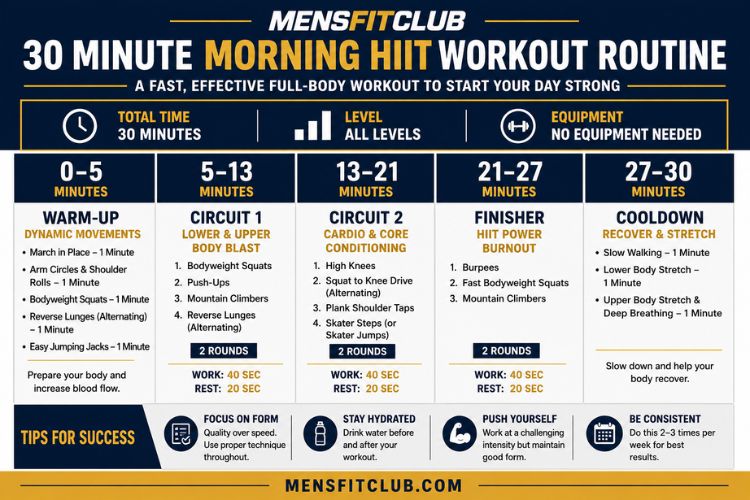
The workout is divided into four sections:
Minutes 0–5: Dynamic warm-up
Minutes 5–13: HIIT Circuit 1
Minutes 13–21: HIIT Circuit 2
Minutes 21–27: HIIT Circuit 3
Minutes 27–30: Cooldown
For most exercises, use approximately 40 seconds of work followed by 20 seconds of recovery.
Beginners can reduce the working period to 30 seconds and increase recovery to 30 seconds.
More experienced trainees can perform 45 seconds of exercise followed by approximately 15 seconds of recovery.
The important factor is maintaining good exercise technique rather than simply trying to perform as many repetitions as possible.
Minutes 0–5: Morning HIIT Routine Dynamic Warm-Up
A morning warm-up is particularly useful because you may feel stiff immediately after waking.
Spend approximately five minutes gradually increasing your body temperature and preparing your joints and muscles for faster movements.
Minute 1: March in Place
Begin with a comfortable march.
Allow your arms to swing naturally while gradually increasing your pace.
This provides a gentle transition from rest into physical activity.
Minute 2: Arm Circles and Shoulder Rolls
Perform controlled arm circles in both directions.
Follow them with several shoulder rolls.
The goal is to prepare your shoulders for push-ups, planks, and other upper-body movements.
Minute 3: Bodyweight Squats Morning HIIT Workout Routine
Perform slow bodyweight squats.
Stand with your feet approximately shoulder-width apart, sit your hips backward, bend your knees, and descend to a comfortable depth.
Stand back up while keeping your chest controlled.
Minute 4: Alternating Reverse Lunges
Step one foot backward and lower into a reverse lunge.
Return to standing and repeat with the opposite leg.
Move slowly and focus on balance.
Minute 5: Easy Jumping Jacks Morning HIIT Workout Routine
Finish the warm-up with approximately one minute of easy jumping jacks.
Start slowly and gradually increase your pace as your body becomes warmer.
You’re now ready to begin the first HIIT circuit.
Minutes 5–13: Morning HIIT Routine Circuit 1
The first circuit combines lower-body exercises with upper-body and cardiovascular movements.
Perform each exercise for approximately 40 seconds, followed by 20 seconds of rest or easy movement.
Complete the sequence twice.
Exercise 1: Bodyweight Squats
Stand with your feet around shoulder-width apart.
Push your hips backward and bend your knees as you descend into a squat.
Drive through your feet to return to standing.
Keep your repetitions smooth and controlled.
Avoid rushing simply to increase your repetition count.
Exercise 2: Push-Ups
Start in a high plank position with your hands slightly wider than shoulder width.
Lower your chest toward the floor while maintaining a strong core.
Press through your hands to return to the starting position.
If standard push-ups are too challenging, perform incline push-ups against a stable bench, table, or other elevated surface.
Exercise 3: Mountain Climbers Morning HIIT Workout Routine
Begin in a high plank.
Drive one knee toward your chest and then switch legs.
Continue alternating at a controlled but challenging pace.
Keep your hips relatively stable rather than allowing them to bounce excessively.
Exercise 4: Alternating Reverse Lunges
Stand upright and step one foot backward.
Lower your back knee toward the floor while maintaining balance.
Push through your front foot to return to standing and repeat with the opposite leg.
After completing the four exercises, repeat the circuit once more.
Minutes 13–21: Morning HIIT Routine Circuit 2
The second circuit increases the cardiovascular challenge while continuing to train the entire body.
Again, perform approximately 40 seconds of work followed by 20 seconds of recovery.
Complete two rounds.
Exercise 1: High Knees
Run or march quickly in place while lifting your knees.
Pump your arms naturally and maintain an upright torso.
You don’t need to bring your knees extremely high. Choose a range of motion that allows you to maintain good posture.
For a lower-impact version, perform fast marching instead.
Exercise 2: Squat to Knee Drive
Perform a bodyweight squat.
As you return to standing, drive one knee upward toward your chest.
Perform another squat and drive the opposite knee upward.
Continue alternating sides.
This combines lower-body strength with balance and core involvement.
Exercise 3: Plank Shoulder Taps
Begin in a high plank position.
Lift your right hand and touch your left shoulder.
Return your hand to the floor and repeat with the opposite side.
Try to keep your hips relatively stable throughout the movement.
A wider foot position can make the exercise easier to control.
Exercise 4: Skater Steps
Step laterally from side to side while allowing the opposite leg to move behind you.
Advanced trainees can turn the movement into a lateral jump.
Beginners can keep both movements low impact by stepping instead of jumping.
Repeat the four exercises for a second round.
Minutes 21–27: Morning HIIT Finisher
The final six minutes provide the most demanding section of the workout.
At this point, fatigue will be increasing, so prioritize movement quality.
Use approximately 40 seconds of work and 20 seconds of recovery.
Complete two rounds of the following three exercises.
Exercise 1: Burpees
Stand upright and place your hands on the floor.
Step or jump your feet backward into a plank position.
Bring your feet forward and return to standing.
Advanced trainees can add a push-up and jump.
Beginners can step backward and forward instead of jumping.
Exercise 2: Fast Bodyweight Squats
Perform bodyweight squats at a slightly quicker pace than earlier in the workout.
Maintain control throughout every repetition.
Your knees should track naturally in the same direction as your toes.
Exercise 3: Mountain Climbers
Finish each round with mountain climbers.
Maintain a strong plank position while alternating your knees toward your chest.
During the final round, maintain the fastest pace you can comfortably sustain without allowing your technique to deteriorate.
Minutes 27–30: Morning HIIT Cooldown
Don’t immediately stop moving after the final interval.
Spend approximately three minutes gradually lowering your heart rate.
Minute 27–28: Slow Walking
Walk around your workout area while taking slow, controlled breaths.
Allow your heart rate to decrease gradually.
Minute 28–29: Lower-Body Stretch
Perform gentle stretches for your quadriceps, hamstrings, calves, and hips.
Avoid aggressively forcing yourself into deep stretches immediately after intense exercise.
Minute 29–30: Upper-Body Stretch and Breathing
Finish with gentle shoulder and chest stretches.
Take several controlled breaths before ending your workout.
Your complete 30 minute morning HIIT workout routine is now finished.
30 Minute Morning HIIT Workout Routine at a Glance
Here is the complete workout:
Warm-Up – 5 Minutes
March in place
Arm circles and shoulder rolls
Bodyweight squats
Reverse lunges
Easy jumping jacks
Circuit 1 – 8 Minutes
Bodyweight squats
Push-ups
Mountain climbers
Reverse lunges
Complete two rounds.
Circuit 2 – 8 Minutes
High knees
Squat to knee drive
Plank shoulder taps
Skater steps
Complete two rounds.
Finisher – 6 Minutes
Burpees
Fast bodyweight squats
Mountain climbers
Complete two rounds.
Cooldown – 3 Minutes
Walking
Lower-body stretching
Upper-body stretching and breathing
Total workout time: approximately 30 minutes.
Beginner 30 Minute Morning HIIT Workout Modifications
If you’re new to HIIT, you don’t need to perform the routine at the same intensity as an experienced athlete.
Start with 30 seconds of exercise and 30 seconds of recovery.
You can also replace jumping exercises with low-impact alternatives.
Instead of jumping jacks, perform step jacks.
Instead of high knees, perform fast marching.
Instead of skater jumps, perform lateral skater steps.
Instead of jumping burpees, step backward into the plank and step forward before standing.
These modifications can reduce impact while still providing a challenging workout.
Advanced Morning HIIT Modifications
Experienced trainees can make the workout more challenging without dramatically increasing its duration.
Try increasing your working intervals to 45 seconds while reducing recovery to 15 seconds.
You can also use more demanding exercise variations.
Replace standard squats with squat jumps, regular push-ups with explosive push-ups, skater steps with skater jumps, and basic burpees with burpees that include a push-up.
Another option is to wear a weighted vest or incorporate light dumbbells into appropriate exercises, although additional resistance isn’t necessary for an effective HIIT workout.
How Often Should You Do a 30 Minute Morning HIIT Workout?
More HIIT isn’t necessarily better.
Because HIIT can be physically demanding, many people can start with approximately two or three HIIT sessions per week, with recovery or lower-intensity training between harder sessions.
For example:
Monday: Morning HIIT
Tuesday: Walking or strength training
Wednesday: Morning HIIT
Thursday: Mobility or light cardio
Friday: Strength training
Saturday: Morning HIIT or recreational activity
Sunday: Rest or easy walking
Your ideal training frequency depends on your fitness level, training history, sleep, recovery, and other workouts.
Should You Do Morning HIIT Before Breakfast?
Some people enjoy exercising before breakfast, while others perform better after eating something.
There isn’t one approach that works for everyone.
If you feel comfortable training before breakfast, you may choose to perform your morning HIIT session before eating.
If you feel weak, lightheaded, or unusually fatigued when training without food, eating a light meal or snack beforehand may be more appropriate.
Hydration is also important, particularly after several hours of sleep.
Drinking some water before beginning your workout is a simple habit that can help you start the session hydrated.
Tips for Making Morning HIIT a Consistent Habit
The best workout program only works when you can perform it consistently.
One of the easiest ways to make morning training more convenient is to prepare the night before.
Place your workout clothes somewhere visible, prepare your water bottle, and decide where you’ll perform the workout.
Removing small decisions can make it easier to start exercising when you’re still waking up.
You also don’t need to begin at maximum intensity.
The first few minutes should feel relatively easy. Allow the warm-up to gradually prepare your body before increasing your effort.
Tracking your workouts can also help.
Record how many sessions you complete each week or note how you feel during particular exercises.
Over several weeks, you may notice improvements in your conditioning, exercise technique, or ability to complete more repetitions.
Common Morning HIIT Mistakes to Avoid
One common mistake is skipping the warm-up.
Your body may feel particularly stiff early in the morning, making a gradual warm-up worthwhile.
Another mistake is treating every exercise like an all-out sprint.
HIIT should be challenging, but your movement quality still matters.
If your technique begins to deteriorate significantly, slow down, reduce the exercise difficulty, or take additional recovery.
Another common problem is performing HIIT every day without considering recovery.
Hard interval training places significant demands on your muscles and cardiovascular system. Combining HIIT with strength training, walking, mobility work, and recovery days can create a more balanced fitness routine.
Can a 30 Minute Morning HIIT Workout Help With Fat Loss?
HIIT can contribute to a fat-loss program because it increases physical activity and energy expenditure.
However, no individual workout specifically burns belly fat or guarantees weight loss.
Long-term fat loss depends largely on maintaining an appropriate calorie balance while supporting your body with adequate nutrition, sleep, and consistent physical activity.
A 30 minute morning HIIT workout routine can be one useful component of that larger strategy.
Combining HIIT with resistance training and regular daily movement can create a balanced approach to improving overall fitness and body composition.
How to Progress This Morning HIIT Routine
Your body gradually adapts to repeated workouts.
Instead of performing exactly the same routine indefinitely, gradually increase the challenge.
During your first couple of weeks, focus primarily on learning the exercises and completing the full workout.
After that, you can increase repetitions, slightly increase exercise speed, reduce rest periods, or progress to harder variations.
You could also rotate exercises.
For example, replace regular squats with alternating lunges, mountain climbers with plank jacks, or standard push-ups with close-grip push-ups.
Small changes can keep the workout challenging without completely redesigning your routine.
Final Thoughts on the 30 Minute Morning HIIT Workout Routine
A 30 minute morning HIIT workout routine provides a practical way to combine cardiovascular exercise, bodyweight strength training, core work, and muscular endurance into one efficient session.
With five minutes of warming up, 22 minutes of interval training, and three minutes of cooling down, you can complete a full-body workout before starting the rest of your day.
The routine is also highly adaptable.
Beginners can use slower movements, longer recovery periods, and low-impact exercise variations. More experienced trainees can shorten rest periods or progress to more challenging movements.
Most importantly, focus on consistency rather than trying to make every session as difficult as possible.
A sustainable morning workout performed regularly is far more useful than an extremely demanding routine you struggle to maintain.
Start with an intensity appropriate for your current fitness level, maintain proper exercise technique, allow sufficient recovery between challenging workouts, and gradually progress as your conditioning improves.
Over time, this simple 30 minute morning HIIT workout can become an efficient and convenient part of a well-rounded fitness routine.
Want to add more variety to your morning training? Explore our guide to the Best HIIT Workouts For Men for more interval-training ideas, or try these HIIT Workouts At Home For Men when you want an equipment-free training option. If you enjoy the 30-minute format, progress to our 30-Minute Full Body HIIT Workout for another fast-paced full-body session. You can also use our HIIT Cardio Workout For Men to focus more heavily on cardiovascular conditioning, or explore these HIIT Exercises For Men to build your own morning workout circuits.


Most Recommended

Subscribe to our Newsletter
Stay up to date on the latest men’s health, fitness and lifestyle trends and tips.
About Us
Men’s Fit Club was started with the goal of empowering men to get the most out of their lives. This meant going beyond exercise and diet tips to really address the broad range of issues that men face on a daily basis – topics like recreation, finding love, sexual health and even sound fashion advice.
Quick Links
© COPYRIGHT MEN'S FIT CLUB 2026. All Rights Reserved