
Double Under Workout CrossFit WODs Sets And Reps
4 Week HIIT Workout Training Plan for Strength & Endurance
CrossFit RX Workout: Complete RX WOD Training Guide
Best Full Body HIIT Workout Routine for Strength & Fat Loss
Double Under Workout CrossFit WODs Sets And Reps
The double under CrossFit workout is one of the most effective ways to combine cardiovascular conditioning, coordination, speed, agility, and muscular endurance into a fast-paced training session. Double unders are a classic CrossFit movement in which the jump rope passes underneath your feet twice during a single jump. Although the exercise looks simple when performed by an experienced athlete, learning to string together consistent double unders can take patience, practice, and efficient technique.
Double unders regularly appear in CrossFit WODs because they can rapidly elevate your heart rate without requiring heavy equipment or much floor space. They also challenge your ability to maintain coordination while fatigued, which becomes particularly important when double unders are combined with exercises such as thrusters, burpees, box jumps, kettlebell swings, pull-ups, or Olympic lifts.
Whether you are working toward your first double under or trying to complete 100 unbroken repetitions, structured practice can help you become more efficient with the rope while improving overall conditioning. This guide explains how to perform double unders, common mistakes, beginner progressions, workouts, sets and reps, and programming strategies for incorporating them into your CrossFit training.
What Are Double Unders in CrossFit?
A double under is a jump-rope exercise where the rope rotates around your body twice before your feet return to the floor.
With a traditional single under, the rope travels underneath the feet once per jump. During a double under, the athlete jumps slightly higher and rotates the rope faster so it can make two complete revolutions.
The basic sequence looks like this:
Jump vertically, quickly rotate the rope twice underneath your feet, land softly, and immediately repeat the movement.
The challenge is coordinating your jump height with your wrist speed. Many beginners assume they need to jump extremely high or swing their arms aggressively. In reality, efficient double unders require relatively small movements and consistent timing.
Once mastered, the exercise becomes surprisingly economical.
Benefits of Double Under CrossFit Workouts
Double unders offer much more than simply improving your ability to jump rope. Because they involve repeated explosive jumps combined with rapid rope rotations, they provide several athletic benefits.
Improve Cardiovascular Conditioning
Double unders can increase your heart rate very quickly.
Completing 30 to 50 repetitions at a fast pace can create a significant cardiovascular demand, especially when performed between strength movements.
For this reason, CrossFit workouts frequently use double unders as a conditioning component.
A workout might combine:
50 double unders
15 thrusters
40 double unders
12 thrusters
30 double unders
9 thrusters
The rope work keeps your heart rate elevated while the resistance exercise challenges muscular strength and endurance.
Develop Coordination
Double unders require synchronization between your hands, wrists, feet, and overall body position.
The wrists control rope speed while the legs maintain a consistent jumping rhythm.
Practicing this coordination can improve general athletic movement and body awareness.
Build Calf and Ankle Endurance
Every repetition requires the calves and ankles to absorb and produce force.
Over time, properly programmed jump-rope training can improve muscular endurance through the lower legs.
However, volume should be increased gradually. Performing hundreds of double unders before your body has adapted can create unnecessary soreness or overuse problems.
Improve Workout Efficiency
Double unders require very little equipment.
All you need is:
A jump rope
A suitable training surface
Enough overhead clearance
This makes them useful for home workouts, CrossFit boxes, garage gyms, and travel workouts.
Develop Mental Focus
Missing one repetition can interrupt an entire set.
Because of this, double unders force you to stay focused on rhythm and technique even when you’re tired.
Learning to remain relaxed under fatigue can also benefit other CrossFit movements.
Muscles Worked During Double Unders
Although double unders are primarily considered a conditioning exercise, several muscle groups contribute to the movement.
The calves are responsible for repeated plantar flexion during jumping. Your quadriceps help extend the knees while your glutes contribute to hip stability.
Your core muscles stabilize your torso and prevent unnecessary movement during each jump.
The forearms and shoulders help maintain rope position, although they should not dominate the exercise.
Efficient athletes rely primarily on wrist rotation rather than large arm circles.
This reduces fatigue and allows the rope to move faster.
How to Perform Double Unders Correctly
Before adding high-volume double unders to a CrossFit workout, you should understand the mechanics of the movement.
Step 1: Establish Your Starting Position
Stand tall with your feet approximately hip-width apart.
Hold the rope handles comfortably.
Keep your elbows close to your sides and position your hands slightly in front of your hips.
Your shoulders should remain relaxed.
Avoid extending your arms far away from your body because this effectively shortens the rope and makes consistent rotations more difficult.
Step 2: Begin With Single Unders
Start jumping with normal single unders.
Try to establish a smooth rhythm.
Your jumps should remain vertical rather than moving forward or backward.
Think about bouncing from the balls of your feet while maintaining a tall posture.
Step 3: Increase Jump Height Slightly
Double unders require slightly more air time than single unders.
Instead of dramatically tucking your knees toward your chest, simply jump a little higher.
Your body should remain relatively straight.
This creates enough time for the rope to pass underneath your feet twice.
Step 4: Accelerate the Wrists
The biggest change between single and double unders occurs at the wrists.
Quickly rotate your wrists to accelerate the rope.
Avoid making huge circles with your shoulders.
Fast, compact wrist movement creates much better rope speed.
Step 5: Land Softly
Land on the balls of your feet with your knees slightly bent.
Immediately rebound into the next repetition.
The goal is to develop a consistent pogo-stick-like rhythm rather than pausing between jumps.
Common Double Under Mistakes
Many athletes struggle with double unders because they develop inefficient movement patterns. Correcting these mistakes can dramatically improve consistency.
Jumping Too High
Beginners sometimes try to create excessive airtime.
This wastes energy and makes the exercise unnecessarily difficult.
You only need enough height for the rope to complete two rotations.
Focus on controlled vertical jumps rather than maximum-height jumps.
Tucking the Knees
Another common mistake is pulling the knees toward the chest.
This movement may allow the rope to pass underneath your feet temporarily, but it usually creates an inconsistent rhythm.
Keep your legs relatively straight and bounce vertically.
Using the Shoulders Instead of the Wrists
Large arm circles slow the rope and increase shoulder fatigue.
Keep your elbows near your torso and allow your wrists to generate most of the rope speed.
Moving the Hands Away From the Body
As fatigue increases, athletes often allow their hands to drift outward.
This effectively shortens the rope.
Eventually, the rope catches your feet.
Keep your hands near your hips throughout the set.
Kicking the Feet Backward
Some athletes bend their knees and kick their feet behind them.
This changes the timing of the jump and increases the chance of missing the rope.
Focus on jumping vertically with your feet underneath your body.
Double Under CrossFit Progression for Beginners
If you cannot perform consistent double unders yet, use a structured progression rather than repeatedly attempting random repetitions.
Phase 1: Master Single Unders
Start with normal jump-rope repetitions.
Try to complete:
3 sets of 50 single unders
Rest approximately 30 to 60 seconds between sets.
Your goal should be maintaining a relaxed rhythm without unnecessary arm movement.
Phase 2: Practice Power Jumps
Practice slightly higher jumps without the rope.
Complete:
3 sets of 20 controlled jumps
Focus on staying tall and landing softly.
These jumps should resemble the body position used during double unders.
Phase 3: Single-Single-Double
Begin jumping normally.
Perform:
Single under
Single under
Double under
Repeat the sequence.
This drill helps teach your wrists how to accelerate the rope while maintaining your jumping rhythm.
Phase 4: Single-Double
Once the previous drill becomes comfortable, alternate between:
Single under
Double under
Single under
Double under
Continue practicing until transitions feel natural.
Phase 5: Consecutive Double Unders
Now attempt:
2 consecutive double unders
3 consecutive double unders
5 consecutive double unders
10 consecutive double unders
Gradually increase your unbroken repetitions.
Avoid chasing huge sets immediately.
Consistency is more important than volume.
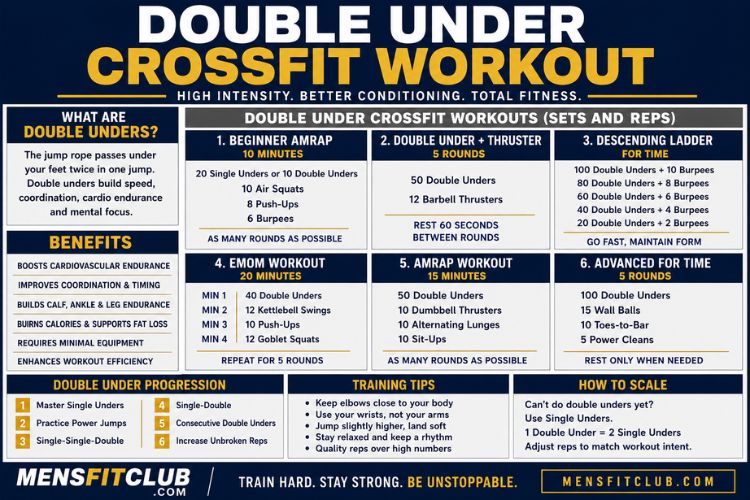
20-Minute Beginner Double Under CrossFit Workout
This beginner-friendly workout combines technique practice with basic conditioning.
Warm-Up – 5 Minutes
Perform:
1 minute easy single unders
10 air squats
10 alternating lunges
20 calf raises
20 jumping jacks
Repeat the sequence if necessary.
The objective is to warm up your calves, ankles, shoulders, and cardiovascular system.
Technique Practice – 5 Minutes
Practice double unders using the single-single-double progression.
Try to remain relaxed.
Don’t worry about completing large sets.
Focus on timing and wrist speed.
Conditioning Workout – 10-Minute AMRAP
Complete as many quality rounds as possible of:
20 single unders or 10 double unders
10 air squats
8 push-ups
6 burpees
Move continuously while maintaining good technique.
Beginners can substitute single unders whenever double unders become inconsistent.
30-Minute Double Under CrossFit Workout
Athletes who already have basic double-under proficiency can use this workout to develop conditioning.
Warm-Up – 7 Minutes
Complete two rounds:
40 single unders
10 air squats
10 walking lunges
10 push-ups
10 kettlebell deadlifts
20-second plank
Gradually increase your jump-rope speed during the second round.
Skill Work – 8 Minutes
Perform five rounds of:
20 to 30 double unders
30 seconds rest
The objective is to practice clean, unbroken sets.
Stop the set if your technique begins deteriorating.
Main WOD – 15-Minute AMRAP
Complete:
30 double unders
12 kettlebell swings
10 goblet squats
8 burpees
Continue cycling through the movements for 15 minutes.
Choose a kettlebell weight that allows you to maintain proper technique throughout the workout.
Double Under and Thruster CrossFit Workout
Double unders pair extremely well with thrusters because the exercises challenge different movement patterns while maintaining a high cardiovascular demand.
Complete five rounds:
50 double unders
12 barbell thrusters
Rest 60 seconds
Intermediate athletes can reduce the rope volume to 30 double unders.
Beginners can perform 60 single unders instead.
Choose a manageable thruster weight that allows you to maintain good form.
The workout should feel challenging but should not require repeated failed lifts.
Double Under and Burpee CrossFit Workout
For a simple conditioning session requiring minimal equipment, combine double unders with burpees.
Complete the following descending ladder:
100 double unders + 10 burpees
80 double unders + 8 burpees
60 double unders + 6 burpees
40 double unders + 4 burpees
20 double unders + 2 burpees
This workout creates significant cardiovascular demand without requiring heavy weights.
Athletes who are still developing double unders can substitute two single unders for every prescribed double under.
Double Under EMOM Workout
EMOM workouts are useful because scheduled rest periods help maintain movement quality.
Perform this 20-minute EMOM:
Minute 1: 40 double unders
Minute 2: 12 kettlebell swings
Minute 3: 10 push-ups
Minute 4: 12 goblet squats
Repeat for five rounds.
Complete each exercise early in the minute and use the remaining time to recover.
If 40 double unders consistently takes more than 40 to 45 seconds, reduce the repetitions.
Double Under AMRAP Workout
Try this 15-minute AMRAP:
50 double unders
10 dumbbell thrusters
10 alternating dumbbell lunges
10 sit-ups
Complete as many quality rounds as possible.
The goal is sustainable movement rather than sprinting through the first few rounds and dramatically slowing afterward.
Advanced Double Under CrossFit Workout
Experienced athletes with strong double-under capacity can attempt this higher-volume session.
Complete five rounds for time:
100 double unders
15 wall balls
10 toes-to-bar
5 power cleans
Rest only when necessary.
This workout challenges grip strength, core endurance, cardiovascular conditioning, and coordination.
Choose a power-clean weight that remains technically manageable while fatigued.
Double Under CrossFit Workout for Fat Loss
Double unders can contribute to a calorie-demanding conditioning program, but fat loss ultimately depends heavily on overall energy balance, nutrition, activity levels, recovery, and training consistency.
Try this 20-minute circuit:
40 double unders
15 kettlebell swings
12 goblet squats
10 burpees
8 push-ups
Rest 30 to 60 seconds after each round.
Repeat for approximately 20 minutes.
Rather than attempting to maximize calories burned during a single workout, focus on building a training routine you can recover from and perform consistently.
How Many Double Unders Should You Do?
Appropriate training volume depends on experience.
Beginners might practice approximately 20 to 50 successful repetitions during a skill session.
Intermediate athletes may accumulate around 50 to 150 repetitions depending on the workout.
Experienced CrossFit athletes may perform several hundred repetitions during high-volume conditioning sessions.
However, more isn’t automatically better.
Double unders place repetitive stress on the calves, Achilles region, feet, and ankles. Rapidly increasing volume can create unnecessary soreness and may increase overuse risk.
Increase total repetitions gradually.
How to Get 50 CrossFit Double Unders Unbroken
If your goal is completing 50 consecutive repetitions, avoid constantly testing your maximum.
Instead, build repeatable sets.
For example:
Week 1: 5 sets of 10
Week 2: 4 sets of 15
Week 3: 3 sets of 20
Week 4: 2 sets of 30
Once those sets become comfortable, attempt 40 to 50 consecutive repetitions.
Relaxation becomes increasingly important during longer sets.
Avoid gripping the handles too tightly because unnecessary tension can travel through your forearms and shoulders.
How Often Should You Practice Double Under CrossFit Workouts?
Athletes learning the movement often benefit from short practice sessions several times per week rather than one extremely long session.
For example, perform 5 to 10 minutes of double-under skill practice two to four times per week.
Short sessions allow you to accumulate technical repetitions without excessively fatiguing your calves.
You can practice before your main workout while you’re fresh or include moderate double-under volume during conditioning sessions.
Choosing the Right Jump Rope for Double Under CrossFit Workouts
Rope selection can influence your ability to learn the movement.
A lightweight speed rope generally rotates quickly and works well for athletes who already understand the timing.
Beginners sometimes prefer a slightly heavier cable because it provides more feedback during each rotation.
Rope length is also important.
If the rope is excessively long, it may drag against the floor.
If it’s too short, you’ll need to compensate by changing your arm position.
Ideally, your rope should allow you to maintain relaxed shoulders with your hands positioned near your hips.
Double Under CrossFit Workouts Warm-Up Routine
Because double unders involve repetitive jumping, warming up the ankles and calves can be particularly useful.
Try this five-minute warm-up:
30 seconds easy jump rope
15 calf raises
10 air squats
10 alternating lunges
20 ankle hops
30 seconds single unders
Repeat the sequence.
Gradually increase intensity rather than immediately attempting maximum-speed double unders.
Recovery After High-Volume Double Under CrossFit Workouts
High-volume jump-rope sessions can leave the calves surprisingly fatigued.
After training, allow adequate recovery before repeating another high-volume session.
Walking and normal light movement can help keep the legs active.
Adequate hydration, nutrition, and sleep also support overall training recovery.
If you’re new to double unders, avoid dramatically increasing your weekly jumping volume simply because your cardiovascular system can tolerate it. Your connective tissues may require more time to adapt than your lungs.
How to Scale Double Unders in CrossFit Workouts
Not being able to perform double unders should not prevent you from completing a CrossFit workout.
One common modification is replacing double unders with single unders.
A practical starting conversion is approximately:
1 double under = 2 single unders
Therefore:
25 double unders = 50 single unders
50 double unders = 100 single unders
100 double unders = 200 single unders
However, workout intent matters more than following an exact conversion.
If 200 single unders takes substantially longer than the prescribed double unders, reduce the number so you can maintain the intended pace.
You can also use attempts rather than completed repetitions during skill-focused workouts.
Sample Weekly Double Under Training Plan
A simple weekly structure can help improve technique without overwhelming your lower legs.
Day 1 – Technique
Practice for 10 minutes.
Focus on:
Single-single-double drills
Single-double transitions
Sets of 5 to 10 double unders
Keep total volume relatively low.
Day 2 – Conditioning
Complete:
5 rounds
30 double unders
10 kettlebell swings
10 push-ups
10 air squats
Rest approximately 45 seconds between rounds.
Day 3 – Rest or Strength Training
Avoid high-volume jumping.
Focus on strength training, mobility, walking, or another appropriate training session.
Day 4 – Double Under Endurance
Complete:
5 sets of 20 to 40 double unders
Rest 45 to 60 seconds between sets.
Try to keep every set smooth and controlled.
Day 5 – CrossFit WOD
Complete a mixed workout such as:
15-minute AMRAP
40 double unders
10 dumbbell thrusters
10 burpees
10 sit-ups
This allows you to practice double unders under fatigue.
Double Under CrossFit Workout Tips for Better Performance
The biggest secret to improving double unders is becoming more efficient rather than simply trying harder.
Keep your shoulders relaxed.
Maintain your hands near your hips.
Jump vertically instead of forward.
Use your wrists to accelerate the rope.
Keep your body tall.
Land softly.
Most importantly, establish a consistent rhythm.
When athletes become tired, they often start making larger movements. Their arms move outward, their jumps become irregular, and their shoulders tense.
Try to do the opposite.
As fatigue increases, concentrate even more on efficient technique.
Frequently Asked Questions About Double Under CrossFit Workouts
Are Double Unders Good for CrossFit?
Yes. Double unders combine cardiovascular conditioning, coordination, footwork, and muscular endurance, which makes them well suited to CrossFit-style training.
They can also be easily combined with barbells, dumbbells, kettlebells, bodyweight exercises, and gymnastics movements.
Are Double Unders Hard to Learn?
They can be challenging initially because the exercise requires precise timing between the jump and rope rotation.
Some athletes learn them quickly while others need weeks or months of consistent practice.
Short, frequent technique sessions are usually more productive than exhausting yourself with repeated failed attempts.
Should Beginners Do Double Unders?
Beginners can certainly learn double unders, but they should first become comfortable with single unders and basic jumping mechanics.
Progress gradually and avoid excessive jumping volume.
Why Do My Double Unders Keep Breaking?
Common causes include allowing the hands to move outward, jumping inconsistently, rotating the rope from the shoulders, bending the knees excessively, or changing rhythm as fatigue increases.
Film yourself from the front or side if possible. This can make technical problems easier to identify.
Can Double Unders Replace Running?
Double unders can provide an intense cardiovascular stimulus, but they don’t perfectly replicate running.
A well-rounded conditioning program can include jump rope, running, rowing, cycling, and other forms of cardiovascular exercise depending on your goals and equipment.
Final Thoughts on Double Under CrossFit Workouts
The double under CrossFit workout is a powerful addition to a conditioning program because it combines cardiovascular endurance, coordination, speed, agility, and lower-body muscular endurance in one relatively simple exercise.
The key is learning efficient technique before chasing high repetition numbers.
Start by mastering single unders. Practice controlled vertical jumps, keep your elbows close to your body, and generate rope speed primarily through your wrists. Progress from isolated double unders to small sets and eventually longer unbroken sequences.
Once your technique becomes reliable, double unders can be incorporated into AMRAPs, EMOMs, circuits, interval workouts, and traditional CrossFit WODs alongside movements such as kettlebell swings, thrusters, burpees, squats, push-ups, wall balls, and Olympic lifts.
Beginners should prioritize consistency and gradually increase volume, while experienced athletes can use larger sets to challenge cardiovascular capacity and their ability to maintain coordination under fatigue.
Whether your immediate goal is achieving your first successful repetition, completing 50 double unders unbroken, or improving your performance in CrossFit workouts, consistent practice and efficient mechanics are more valuable than simply performing more repetitions. Build the skill progressively, protect your calves and ankles by managing volume, and double unders can become one of the most versatile conditioning tools in your CrossFit training.
To build a more complete CrossFit conditioning routine, pair your double-under training with the CrossFit Tabata Workout Guide for short, high-intensity intervals, or challenge your strength and conditioning with the Kettlebell Thruster CrossFit Workout. You can also incorporate heavier strength work with the CrossFit Deadlift Workout Guide, develop full-body control with the CrossFit Turkish Get Up Workout, or follow the 4 Week CrossFit Workout for Muscle Building if you want a structured program combining CrossFit conditioning with muscle-building training.


Most Recommended

Subscribe to our Newsletter
Stay up to date on the latest men’s health, fitness and lifestyle trends and tips.
About Us
Men’s Fit Club was started with the goal of empowering men to get the most out of their lives. This meant going beyond exercise and diet tips to really address the broad range of issues that men face on a daily basis – topics like recreation, finding love, sexual health and even sound fashion advice.
Quick Links
© COPYRIGHT MEN'S FIT CLUB 2026. All Rights Reserved