
CrossFit RX Workout: Complete RX WOD Training Guide
Best Full Body HIIT Workout Routine for Strength & Fat Loss
Pistol Squat CrossFit Progression From Beginner to Advanced
VO2 Max HIIT Workout: Improve Cardio and Endurance
Best Full Body HIIT Workout Routine for Strength & Fat Loss
Finding the best full body HIIT workout routine can be a game changer when you want to improve cardiovascular fitness, build functional strength, burn calories, and train your entire body without spending hours in the gym. High-intensity interval training, commonly known as HIIT, combines short periods of challenging exercise with controlled recovery periods. When the workout includes movements for the legs, chest, shoulders, back, arms, and core, it becomes an efficient full-body training method.
A well-designed full body HIIT workout is not simply about performing exercises as fast as possible. The best routines balance intensity with proper exercise selection, recovery, technique, and progression. Compound movements such as squats, push-ups, lunges, rows, burpees, and mountain climbers allow several muscle groups to work simultaneously while keeping the heart rate elevated.
The workout below is designed for men who want a practical HIIT routine that can be adapted for home or gym training. It combines strength-based exercises with cardiovascular movements and core work to create a balanced session that can fit into approximately 30 to 40 minutes.
What Is a Full Body HIIT Workout Routine?
A full body HIIT workout combines exercises targeting multiple major muscle groups with short work and recovery intervals. Instead of performing traditional strength-training sets followed by several minutes of rest, HIIT typically keeps recovery relatively short so that cardiovascular demand remains elevated throughout the session.
For example, you might perform squats for 40 seconds, rest for 20 seconds, and immediately move into push-ups. The workout can continue through several exercises before taking a longer recovery period.
Full body HIIT sessions usually combine lower-body movements, upper-body exercises, core exercises, and cardiovascular conditioning. This structure allows you to accomplish a significant amount of training within a relatively short period.
The key word, however, is intensity. HIIT works best when the work intervals are genuinely challenging relative to your current fitness level. That does not mean every interval needs to be an all-out sprint. You should still maintain enough control to perform each exercise safely and with good technique.
Benefits of a Full Body HIIT Workout Routine
One reason HIIT has become so popular is its efficiency. A properly structured workout can challenge muscular strength and cardiovascular conditioning during the same training session.
Train Multiple Muscle Groups at Once
Full body HIIT workouts frequently use compound exercises. Squats train the quadriceps, hamstrings, and glutes. Push-ups work the chest, shoulders, triceps, and core. Lunges strengthen the lower body while challenging stability.
Combining these exercises allows you to train numerous muscle groups without needing an individual isolation exercise for every body part.
Improve Cardiovascular Fitness
Repeated high-intensity intervals challenge your cardiovascular system to deliver oxygen to working muscles. Consistent interval training can improve aerobic fitness and work capacity, particularly when training intensity and recovery are appropriately programmed.
Better conditioning can also carry over to strength workouts, recreational sports, running, cycling, and everyday physical activities.
Support Fat Loss
HIIT can be useful during a fat-loss program because it provides substantial physical activity in a relatively short workout.
However, no HIIT routine can guarantee fat loss by itself. Losing body fat ultimately depends on maintaining an appropriate calorie deficit over time. Combining regular training with adequate protein, nutritious foods, sleep, and calorie control produces a much more sustainable strategy.
Save Time
One of HIIT’s biggest advantages is convenience. You do not necessarily need a 90-minute gym session to get a challenging workout.
A 20- to 40-minute full body HIIT routine can provide substantial cardiovascular and muscular work, making it useful for busy schedules.
Best Full Body HIIT Workout Routine
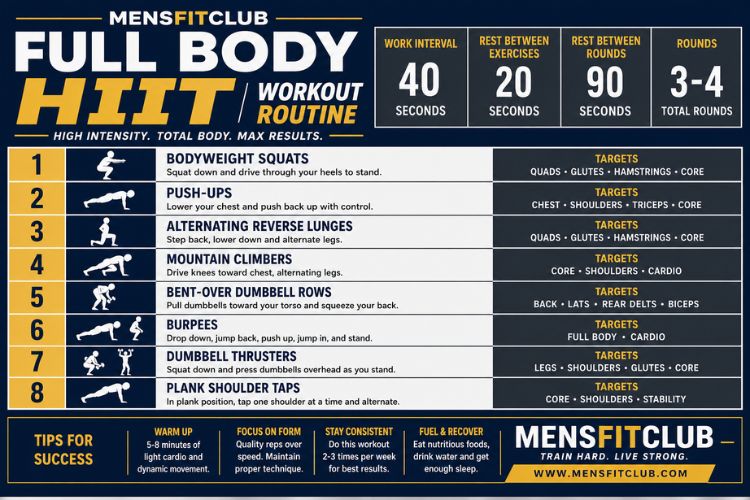
This routine uses eight exercises performed in a circuit.
Perform each exercise for:
40 seconds of work
20 seconds of rest
Complete all eight exercises to finish one round.
Rest for 90 seconds between rounds.
Complete 3 to 4 total rounds depending on your conditioning and experience.
Full Body HIIT Workout Routine Overview
1. Bodyweight Squats — 40 seconds
2. Push-Ups — 40 seconds
3. Alternating Reverse Lunges — 40 seconds
4. Mountain Climbers — 40 seconds
5. Bent-Over Dumbbell Rows — 40 seconds
6. Burpees — 40 seconds
7. Dumbbell Thrusters — 40 seconds
8. Plank Shoulder Taps — 40 seconds
Rest for 20 seconds after each exercise and 90 seconds after completing the entire circuit.
Beginners can start with two or three rounds. Intermediate trainees can perform three rounds, while experienced exercisers may complete four rounds while maintaining good technique.
Warm-Up Before Your Full Body HIIT Workout Routine
Never jump directly from sitting at a desk or driving to performing high-intensity burpees.
Spend approximately 5 to 8 minutes warming up before beginning your HIIT workout.
Start with light movement such as brisk walking, easy jogging, cycling, or marching in place. Gradually increase your movement speed before performing dynamic exercises.
A simple warm-up could include:
30 seconds of jumping jacks, 30 seconds of bodyweight squats, 30 seconds of alternating lunges, 30 seconds of arm circles, 30 seconds of high knees, and 30 seconds of walkouts.
Repeat the sequence if necessary.
The purpose of the warm-up is not to exhaust yourself. You simply want to increase body temperature, move the joints through useful ranges of motion, and prepare for the exercises ahead.
Exercise 1: Bodyweight Squats
Start your HIIT circuit with bodyweight squats.
Stand with your feet approximately shoulder-width apart. Brace your core and lower your hips while allowing your knees to track naturally in line with your feet. Descend as far as you can comfortably control before driving through your feet to stand.
Continue for 40 seconds.
Squats primarily target the quadriceps and glutes while also involving the hamstrings and core.
Avoid sacrificing squat depth and positioning simply to accumulate more repetitions. Controlled repetitions generally provide better training quality than rushing through sloppy reps.
Exercise 2: Push-Ups HIIT Workout Routine
Immediately after your recovery interval, move into push-ups.
Place your hands slightly wider than shoulder width and create a straight line from your head through your hips and legs. Lower your chest toward the floor while keeping your torso controlled. Press back to the starting position.
If standard push-ups become too difficult, elevate your hands on a bench, box, or sturdy surface.
Push-ups train the chest, shoulders, triceps, and core, providing an effective upper-body pushing movement within the circuit.
Exercise 3: Alternating Reverse Lunges
Stand upright and step one foot backward into a reverse lunge. Lower under control before pushing through the front foot to return to standing. Alternate legs throughout the interval.
Reverse lunges train the quadriceps, hamstrings, and glutes while requiring balance and trunk stability.
Keep your movements controlled rather than trying to turn every repetition into a speed exercise.
Exercise 4: Mountain Climbers
Move into a high plank position with your hands underneath your shoulders.
Bring one knee toward your torso and then switch legs. Continue alternating while maintaining a strong plank position.
Mountain climbers combine cardiovascular conditioning with core stabilization and shoulder endurance.
Your hips should remain relatively stable. If your form begins deteriorating, reduce your speed rather than continuing with poor positioning.
Exercise 5: Bent-Over Dumbbell Rows HIIT Workout Routine
A balanced full body HIIT workout should include pulling movements whenever equipment is available.
Hold a dumbbell in each hand and hinge forward from the hips while maintaining a neutral spine. Pull the dumbbells toward your torso, squeezing your shoulder blades together before lowering them under control.
Choose relatively light to moderate weights because the objective is to maintain good repetitions throughout the 40-second interval.
Dumbbell rows primarily train the upper back, lats, rear shoulders, and biceps.
If you are performing a completely equipment-free workout, substitute a suitable bodyweight pulling movement if you have safe equipment available. Otherwise, replace rows with another controlled posterior-chain exercise such as a prone swimmer.
Exercise 6: Burpees
Burpees dramatically increase the cardiovascular challenge of the workout.
Start standing, place your hands on the floor, move your feet back into a plank position, return your feet toward your hands, and stand.
Experienced trainees can add a jump at the top. Beginners can step one foot backward and forward at a time instead of jumping.
The objective is sustainable intensity throughout the interval rather than performing the first 10 seconds as fast as possible and spending the remaining time unable to continue.
Exercise 7: Dumbbell Thrusters HIIT Workout Routine
Hold a pair of dumbbells near shoulder level.
Lower into a squat and then drive upward. As you stand, use the momentum generated by your legs to press the dumbbells overhead. Return the weights to your shoulders and repeat.
Thrusters combine a squat with an overhead press, making them one of the most demanding compound movements in a full body HIIT workout.
Because fatigue accumulates quickly, use manageable dumbbells and prioritize technique.
If you do not have weights, substitute squat-to-reach movements or controlled squat jumps.
Exercise 8: Plank Shoulder Taps
Finish each round with plank shoulder taps.
Begin in a high plank position. Lift one hand and touch the opposite shoulder before returning it to the floor. Alternate sides.
Try to prevent your hips from rotating excessively as you move your hands.
This exercise strengthens the core while also challenging the shoulders, chest, and stabilizing muscles.
Once the 40-second interval finishes, rest for approximately 90 seconds before beginning your next round.
How Long Should a Full Body HIIT Workout Routine Be?
More HIIT is not automatically better.
Depending on the intensity, exercise selection, fitness level, and work-to-rest ratio, an effective session can often be completed within approximately 20 to 40 minutes, including warm-up and recovery.
Beginners might perform:
5-minute warm-up
16-minute circuit
5-minute cooldown
An experienced trainee might perform:
7-minute warm-up
30-minute HIIT circuit
5-minute cooldown
The harder your intervals are, the more important recovery becomes.
Beginner Full Body HIIT Workout Routine Modification
If you are new to HIIT, starting with 40-second work intervals may be unnecessarily difficult.
Instead, use:
30 seconds work
30 seconds rest
2 to 3 rounds
Modify the exercises as needed.
Perform incline push-ups instead of floor push-ups. Use step-back burpees rather than jumping burpees. Perform regular squats rather than squat jumps and use lighter dumbbells for rows and thrusters.
After several weeks, gradually increase work intervals or add another round.
Avoid increasing everything simultaneously.
Advanced Full Body HIIT Workout Routine Modification
Experienced trainees can make the workout more difficult without simply adding endless rounds.
Try:
45 seconds work
15 seconds rest
4 rounds
You can also progress selected movements.
Bodyweight squats can become squat jumps. Push-ups can become explosive push-ups for appropriately trained individuals. Reverse lunges can become alternating jumping lunges, while mountain climbers can be performed at a faster controlled pace.
Adding heavier dumbbells is another option for rows and thrusters.
However, advanced HIIT should still involve good movement quality. Increasing difficulty is only worthwhile when you can maintain proper technique.
Full Body HIIT Workout Routine Without Equipment
You can easily convert the routine into a home workout.
Try this equipment-free sequence:
Bodyweight Squats — 40 seconds
Push-Ups — 40 seconds
Reverse Lunges — 40 seconds
Mountain Climbers — 40 seconds
Walkouts — 40 seconds
Burpees — 40 seconds
Squat-to-Reach — 40 seconds
Plank Shoulder Taps — 40 seconds
Rest for 20 seconds between exercises and approximately 60 to 90 seconds between rounds.
Complete three rounds for a challenging full body HIIT workout at home.
How Often Should You Do Full Body HIIT Workout Routine?
Because high-intensity training creates considerable fatigue, you generally do not need to perform HIIT every day.
For many recreational trainees, two to three HIIT workouts per week can be enough to improve conditioning while leaving room for strength training and recovery.
A weekly schedule might look like this:
Monday: Full Body HIIT
Tuesday: Strength Training
Wednesday: Recovery or Light Cardio
Thursday: Full Body HIIT
Friday: Strength Training
Saturday: Walking, Mobility or Optional Cardio
Sunday: Rest
Your ideal schedule depends on training experience, workout intensity, sleep, nutrition, and other exercise you perform.
Full Body HIIT Workout Routine for Muscle Building
HIIT can contribute to muscular endurance and provide a strength stimulus, particularly for beginners, but it should not automatically replace traditional resistance training if maximizing muscle growth is your primary objective.
Hypertrophy training generally benefits from progressive overload, sufficient resistance, adequate volume, and enough recovery between challenging sets.
A good strategy is to make resistance training the foundation of your muscle-building program and use HIIT as supplementary conditioning.
For example, perform three or four resistance-training sessions and one or two shorter HIIT sessions each week.
Full Body HIIT for Fat Loss
If fat loss is your primary objective, focus on the entire lifestyle rather than looking for one “fat-burning” exercise.
HIIT can increase your weekly energy expenditure and improve fitness, but nutrition remains an important part of body-fat reduction.
Prioritize protein-rich foods, vegetables, fruits, whole grains, healthy fats, and minimally processed foods while maintaining an appropriate calorie intake.
Combine this with strength training, HIIT, walking, and sufficient sleep.
Consistency across several months is far more important than trying to destroy yourself with one extremely difficult workout.
Common Full Body HIIT Workout Mistakes
Starting Too Fast
Many people perform the first round at maximum speed and then struggle through every remaining interval.
Instead, choose a pace you can sustain across the entire workout.
Your final round should certainly feel difficult, but you should still be able to maintain acceptable exercise technique.
Using Weights That Are Too Heavy
HIIT resistance exercises generally require different loading than traditional strength sets.
Using dumbbells that are too heavy can quickly compromise technique as fatigue increases.
Select weights that allow controlled repetitions throughout each interval.
Turning Every Exercise Into Cardio
A full body routine should contain a balance of movement patterns.
Including squats, lunges, pushing, pulling, core exercises, and cardiovascular movements creates a more complete workout than performing eight different jumping exercises.
Ignoring Recovery
Recovery is part of HIIT programming.
Those 15-, 20-, or 30-second rest periods allow you to maintain higher-quality work during the next interval.
Do not feel guilty about using them.
Performing HIIT Every Day
High-intensity training creates stress that your body must recover from.
Daily intense workouts can become counterproductive when they interfere with strength performance, sleep, motivation, or movement quality.
Balance HIIT with lower-intensity activity and recovery days.
How to Progress Your Full Body HIIT Routine
Progressive overload matters even when your goal is cardiovascular conditioning.
You can progress HIIT in several ways.
During the first week, you might complete two rounds using a 30-second work and 30-second recovery format.
During subsequent weeks, progress toward three rounds.
Once three rounds become manageable, increase your work interval to 35 or 40 seconds.
Later, increase resistance on strength movements or use more challenging exercise variations.
Changing one variable at a time makes it easier to monitor progress and prevents the routine from becoming unnecessarily difficult.
Four-Week Full Body HIIT Progression
A simple four-week progression could look like this:
Week 1
Perform 2 rounds using 30 seconds of work and 30 seconds of rest.
Focus almost entirely on learning the exercises.
Week 2
Perform 3 rounds using 30 seconds of work and 30 seconds of rest.
Keep your exercise variations the same.
Week 3
Perform 3 rounds using 40 seconds of work and 20 seconds of rest.
Increase intensity while maintaining technique.
Week 4
Perform 3 to 4 rounds using 40 seconds of work and 20 seconds of rest.
Increase dumbbell resistance slightly if appropriate.
After week four, consider taking a lighter week before progressing to a more demanding HIIT program.
Cooldown After Full Body HIIT
After completing your final round, allow your heart rate to decrease gradually.
Walk slowly for several minutes rather than immediately sitting or lying down.
You can then perform gentle mobility exercises for areas that feel tight, including your hips, quadriceps, hamstrings, chest, shoulders, and upper back.
A cooldown does not need to be complicated. Five minutes of easy movement can provide a smooth transition from intense exercise back toward rest.
Is Full Body HIIT Better Than Regular Cardio?
HIIT and steady-state cardio serve different purposes, and you do not necessarily need to choose between them.
HIIT provides a time-efficient way to perform vigorous conditioning, while lower-intensity cardio can provide additional aerobic work with less fatigue.
Walking, jogging, cycling, rowing, and swimming can complement HIIT extremely well.
A balanced fitness program might include two HIIT sessions, two or three strength workouts, and several days of walking or lower-intensity cardio.
The “best” approach depends on your fitness goals and ability to recover.
Safety Tips for Full Body HIIT Training
Intensity should always be appropriate for your fitness level.
If you are completely new to exercise, begin with lower-intensity intervals and easier exercise variations before progressing toward demanding HIIT sessions.
Stop an exercise if you experience unusual chest pain, severe dizziness, faintness, or other concerning symptoms. People with medical conditions, injuries, or significant exercise restrictions should seek individualized guidance from an appropriate healthcare professional before beginning vigorous training.
Most importantly, remember that HIIT is about relative intensity. A beginner does not need to train at the same speed or difficulty as an advanced athlete.
Final Thoughts on the Best Full Body HIIT Workout Routine
The best full body HIIT workout routine does not need complicated equipment or dozens of exercises. A balanced combination of squats, push-ups, lunges, mountain climbers, rows, burpees, thrusters, and core work can provide an efficient training session that challenges nearly every major muscle group while improving cardiovascular conditioning.
Start with a work-to-rest ratio that matches your fitness level, complete two to four quality rounds, and gradually progress as your conditioning improves. Beginners can use 30-second intervals with longer recovery periods, while more experienced trainees can progress toward 40- or 45-second work intervals.
Most importantly, focus on consistency rather than exhaustion. Two or three well-structured full body HIIT sessions each week, combined with strength training, daily movement, balanced nutrition, and adequate recovery, can form a powerful foundation for improving overall fitness.
Whether your goal is better conditioning, increased work capacity, fat loss, or simply getting an effective workout into a busy schedule, this full body HIIT routine provides a straightforward plan you can modify and progress for weeks to come.
Want to add more variety to your HIIT training? MensFitClub has several workouts that can help you adjust your routine based on your available time, equipment, and fitness goals. Start with this 30-Minute Full Body HIIT Workout when you want a balanced combination of cardio and strength, or step up the challenge with this 45-Minute Full Body HIIT Workout. If you prefer resistance training, try this Full Body HIIT Workout With Weights to combine strength exercises with high-intensity intervals. For equipment-free training, explore these HIIT Workouts At Home For Men. You can also discover additional exercises and workout combinations in our guide to the Best Full Body HIIT Exercises For Men to keep your weekly training challenging and varied.


Most Recommended

Subscribe to our Newsletter
Stay up to date on the latest men’s health, fitness and lifestyle trends and tips.
About Us
Men’s Fit Club was started with the goal of empowering men to get the most out of their lives. This meant going beyond exercise and diet tips to really address the broad range of issues that men face on a daily basis – topics like recreation, finding love, sexual health and even sound fashion advice.
Quick Links
© COPYRIGHT MEN'S FIT CLUB 2026. All Rights Reserved