
CrossFit Deadlift Workout Plan For Strength Power & WOD
30 Minute Outdoor HIIT Workout: Full Body Routine
CrossFit Turkish Get Up Workout for Full Body Strength
40 Minute Outdoor HIIT Workout For Total Body Burn
CrossFit Deadlift Workout Plan For Strength Power & WOD
The CrossFit deadlift workout is one of the most effective ways to develop raw strength, explosive power, muscular endurance, and total-body conditioning. While the deadlift is traditionally associated with powerlifting and strength training, CrossFit takes this fundamental barbell movement and incorporates it into workouts that challenge strength and cardiovascular fitness at the same time.
Deadlifts appear frequently in CrossFit because they train one of the most practical movement patterns in everyday life: safely lifting an object from the ground. A properly performed deadlift recruits the glutes, hamstrings, back, core, forearms, and upper body, making it one of the most efficient compound exercises you can perform.
However, a CrossFit deadlift workout is not simply about putting as much weight as possible on a barbell. Depending on the workout, you might perform heavy sets for strength, moderate-weight deadlifts for multiple rounds, or lighter repetitions combined with exercises such as box jumps, burpees, rowing, or pull-ups.
This guide explains how to structure an effective CrossFit deadlift workout, including technique, warm-up recommendations, sets and reps, WOD examples, scaling options, programming strategies, and recovery tips.
What Is a CrossFit Deadlift Workout?
A CrossFit deadlift workout uses the conventional deadlift as either the primary strength exercise or part of a metabolic conditioning workout. Unlike a traditional bodybuilding session where deadlifts may be followed by several isolated back or hamstring exercises, CrossFit programming often combines the deadlift with functional movements performed at varying intensities.
A typical CrossFit session may begin with heavy deadlift strength work before transitioning into a shorter conditioning WOD. Another session could use relatively light deadlifts within an AMRAP, EMOM, or rounds-for-time format.
The key difference is the objective.
Heavy deadlifts primarily develop maximal strength. Moderate loads and repeated sets develop strength endurance, while lighter deadlifts performed during conditioning workouts increase the metabolic challenge.
A well-designed CrossFit program can include all three approaches without requiring you to perform maximal deadlifts every workout.
Muscles Worked During CrossFit Deadlifts
The deadlift is often described as a posterior-chain exercise, but it recruits considerably more than just your hamstrings and lower back.
Glutes
Your gluteus maximus plays a major role in extending your hips as you stand with the barbell. Strong glutes contribute to deadlift performance and are also important for movements such as squats, running, jumping, kettlebell swings, and Olympic lifts.
Hamstrings
The hamstrings assist with hip extension and help stabilize the legs throughout the lift. Deadlifts can therefore be particularly useful for developing posterior-chain strength.
Back Muscles
Your spinal erectors work isometrically to maintain a stable torso while the lats help keep the barbell close to your body.
This doesn’t mean you should intentionally “lift with your lower back.” The goal is to maintain a braced, controlled trunk while the hips and legs generate force.
Core
Your abdominal muscles and deeper trunk musculature stabilize your spine throughout the deadlift.
Effective bracing becomes particularly important during demanding CrossFit workouts because fatigue can make maintaining position more difficult.
Forearms and Grip
Holding a loaded barbell challenges your hands and forearms. High-repetition deadlift workouts can therefore become surprisingly demanding on grip strength.
Benefits of CrossFit Deadlift Workouts
The deadlift provides several advantages that make it valuable within CrossFit programming.
Develops Full-Body Strength
Few exercises allow you to move as much external resistance as the deadlift.
Progressively increasing your deadlift can strengthen your posterior chain and improve your overall capacity to produce force.
This strength can potentially carry over to other CrossFit movements, particularly cleans, kettlebell swings, rowing, and other hip-dominant exercises.
Builds Explosive Hip Power
Powerful hip extension is central to many athletic movements.
Although a heavy deadlift itself is not performed at the same speed as a jump or Olympic lift, developing a stronger posterior chain can create a foundation for explosive training.
Improves Work Capacity
Performing moderate-load deadlifts within a CrossFit conditioning workout requires you to repeatedly generate force while managing fatigue.
That combination can develop muscular endurance and overall work capacity.
Strengthens Grip
Deadlifts place substantial demands on your grip.
Improved grip endurance may also help during pull-ups, toes-to-bar, farmer carries, kettlebell exercises, and other pulling movements.
How to Perform the CrossFit Deadlift Correctly
Good technique should remain the priority whether you are performing one heavy repetition or a set of 15 during a WOD.
Step 1: Set Up Your Feet
Stand with approximately hip-width foot positioning and place the bar over your midfoot.
The exact stance varies slightly between athletes based on anatomy and mobility.
Step 2: Grip the Bar
Hinge at your hips and bend your knees enough to reach the bar while maintaining a strong trunk position.
Place your hands just outside your legs.
A double-overhand grip works well for lighter loads. Heavier training may require a hook grip or mixed grip, depending on your experience and goals.
Step 3: Brace Your Core
Take a controlled breath and brace your torso as though preparing to absorb force around your midsection.
Create tension before the bar leaves the floor.
Avoid starting the lift with a loose torso and suddenly jerking the bar upward.
Step 4: Push Through the Floor
Drive through your feet while extending your knees and hips.
Keep the bar close to your body throughout the movement.
Think about standing up with the bar rather than pulling it away from the ground with your arms.
Step 5: Reach Full Extension
Finish upright with your knees and hips extended.
Avoid aggressively leaning backward at the top.
Step 6: Lower the Bar Under Control
Push your hips backward and guide the bar down your legs before bending the knees further as the bar approaches the floor.
Reset your position when necessary instead of rushing into another repetition with compromised technique.
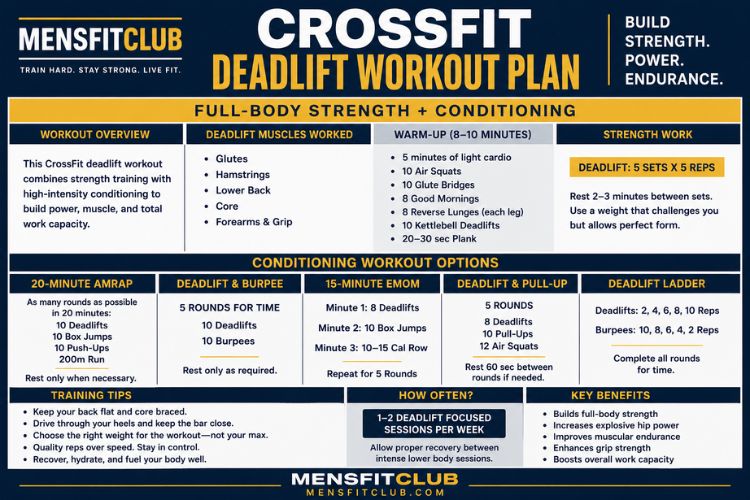
CrossFit Deadlift Workout Warm-Up
A productive deadlift session should begin with a warm-up that raises body temperature and prepares the hips, hamstrings, core, and back.
Start with approximately five minutes of easy cardiovascular activity such as rowing, cycling, jogging, or jumping rope.
Then perform two or three rounds of:
10 air squats
10 glute bridges
8 bodyweight good mornings
8 alternating reverse lunges per leg
10 light kettlebell deadlifts
20–30 seconds of plank work
Once you feel warm, begin practicing the deadlift with an empty bar or very light resistance.
Gradually increase the weight across several warm-up sets rather than immediately jumping to your working load.
CrossFit Deadlift Strength Workout
This portion of the session focuses on building strength before the conditioning WOD.
Strength Block
Perform:
Deadlift: 5 sets × 5 reps
Rest approximately 2–3 minutes between sets.
Choose a weight that allows all five repetitions to be performed with consistent technique. You should finish each working set feeling challenged without needing to sacrifice your position to complete the final repetition.
Beginners can start considerably lighter and concentrate on mastering technique.
More experienced athletes can progressively increase resistance as long as recovery and technique remain good.
20-Minute CrossFit Deadlift Workout
After completing your strength work, use the following workout to challenge conditioning.
20-Minute AMRAP
Complete as many quality rounds as possible in 20 minutes:
10 deadlifts
10 box jumps or step-ups
10 push-ups
200-meter run
Rest only when necessary.
The deadlift weight should be moderate rather than maximal. You need a load you can control even after your breathing rate increases.
The goal isn’t to turn every round into a maximal lifting effort.
Instead, maintain sustainable pacing throughout the workout.
CrossFit Deadlift and Burpee Workout
Deadlifts and burpees create a simple but challenging combination.
Try:
5 rounds for time
10 deadlifts
10 burpees
Rest only as required.
This workout becomes demanding quickly because the deadlift challenges the posterior chain and grip while burpees increase heart rate.
Select your deadlift weight conservatively. If your technique begins deteriorating significantly, reduce the load or repetitions.
CrossFit Deadlift EMOM Workout
EMOM means “every minute on the minute.”
At the beginning of each minute, complete the prescribed work. Whatever time remains in that minute becomes your recovery period.
15-Minute Deadlift EMOM
Minute 1: 8 deadlifts
Minute 2: 10 box jumps or step-ups
Minute 3: 10–15 calories on a rower
Repeat for five rounds.
This format provides predictable recovery periods while allowing you to train multiple physical qualities.
Avoid selecting a deadlift load that takes almost the entire minute from the beginning. You should have enough time to reset your breathing before the next interval.
CrossFit Deadlift and Pull-Up WOD
For athletes comfortable with pull-ups, combining vertical pulling with deadlifts creates a demanding back and grip workout.
Complete:
5 rounds
8 deadlifts
10 pull-ups
12 air squats
Rest 60 seconds after each round if necessary.
Because both deadlifts and pull-ups challenge grip strength, your forearms may become fatigued before your larger muscle groups.
Break your pull-ups into smaller sets when needed.
Beginners can substitute assisted pull-ups, ring rows, or another appropriate pulling variation.
CrossFit Deadlift Ladder Workout
A ladder gradually changes your repetitions as the workout progresses.
Try:
Deadlifts: 2, 4, 6, 8, 10 reps
Burpees: 10, 8, 6, 4, 2 reps
Complete two deadlifts followed by 10 burpees. Then perform four deadlifts and eight burpees, continuing until you finish 10 deadlifts and two burpees.
The decreasing burpee repetitions help offset the increasing number of deadlifts.
Beginner CrossFit Deadlift Workout
Beginners should prioritize movement quality before speed or heavy loading.
A simple beginner workout is:
3 rounds:
8 light deadlifts
10 box step-ups
8 incline push-ups
200-meter walk or easy jog
Rest 60–90 seconds between rounds.
Use a barbell, kettlebell, or dumbbells depending on your current ability and equipment availability.
The purpose of this workout is learning the movement while gradually developing conditioning.
Intermediate CrossFit Deadlift Workout
Intermediate athletes can increase volume and intensity.
Try this 15-minute AMRAP:
8 deadlifts
10 burpees
12 wall balls
150-meter run
Complete as many controlled rounds as possible within 15 minutes.
The deadlift should remain manageable enough that you aren’t repeatedly approaching muscular failure.
Advanced CrossFit Deadlift Workout
Experienced CrossFit athletes can combine heavier loading with challenging conditioning, but technique and intelligent load selection remain essential.
Try:
5 rounds for time
5 deadlifts
10 box jumps
15 kettlebell swings
250-meter row
The deadlifts should feel heavy but technically repeatable.
Advanced does not mean using the heaviest weight possible. It means selecting a challenging load that matches the workout’s intended stimulus.
How Heavy Should CrossFit Deadlifts Be?
There is no universal CrossFit deadlift weight.
The correct load depends on your strength, technique, training experience, fatigue level, workout format, and number of repetitions.
For strength-focused sets, you can use heavier loads with longer recovery periods.
For metabolic conditioning workouts, use lighter loads that allow you to maintain consistent technique while fatigued.
A practical guideline is to ask whether you could complete the prescribed repetitions while keeping your back position, bracing, and bar path consistent.
If your technique deteriorates significantly after only a few repetitions, the load is probably too heavy for that particular workout.
CrossFit Deadlift Sets and Reps
Different repetition ranges serve different purposes.
Strength Training
Use approximately:
3–5 sets of 3–5 repetitions
with relatively heavy but technically manageable resistance.
Strength and Muscle Development
Use:
3–5 sets of 5–8 repetitions.
This provides additional training volume while still allowing substantial resistance.
Conditioning
Use smaller repeated sets such as:
5–12 repetitions per round.
The objective is accumulating quality work while maintaining your technique throughout the conditioning session.
Extremely high-repetition deadlifting isn’t automatically better. Fatigue can increase quickly, making appropriate scaling particularly important.
Common CrossFit Deadlift Mistakes
Deadlifts become less productive when athletes prioritize speed or leaderboard performance over movement quality.
Rounding the Back Excessively
Some spinal movement occurs naturally, but repeatedly losing your intended trunk position under challenging loads is a sign that you should reconsider your weight, fatigue level, or technique.
Maintain a strong brace and controlled setup.
Barbell Drifting Forward
Keeping the bar close to your legs generally creates a more efficient bar path.
If the bar travels far away from your body, the lift can become more mechanically demanding.
Pulling Too Quickly From the Floor
Don’t violently jerk the bar to initiate the repetition.
Create tension first and then produce force smoothly.
Choosing Too Much Weight
A load you can deadlift once isn’t necessarily appropriate for a workout requiring 40 or 50 total repetitions.
Scale according to the workout.
Racing Through Repetitions
CrossFit encourages intensity, but intensity should not replace control.
Taking an extra moment to reset can be worthwhile if it helps maintain better positioning.
How Often Should You Do CrossFit Deadlift Workouts?
For many recreational athletes, one or two deadlift-focused sessions per week can provide plenty of training stimulus.
Your ideal frequency depends on your total CrossFit schedule.
Remember that exercises such as cleans, snatches, kettlebell swings, good mornings, and rowing can also place demands on the posterior chain.
If your lower back, hamstrings, or grip remain excessively fatigued from previous sessions, additional deadlift volume may not be productive.
Programming should account for your entire training week rather than treating every workout independently.
Recovery After CrossFit Deadlift Training
Deadlift workouts can generate substantial fatigue, particularly when heavy lifting is combined with metabolic conditioning.
After training, prioritize adequate hydration, nutrition, sleep, and recovery.
Protein intake helps support muscle repair and adaptation, while carbohydrates can help replenish energy following demanding training.
Light walking or easy mobility work may also feel useful on recovery days.
You don’t need to perform aggressive stretching immediately after every workout. Instead, focus on consistent recovery habits that allow you to return to training feeling prepared.
Sample Weekly CrossFit Deadlift Training Schedule
A balanced week could look like this:
Monday: Heavy deadlift strength + short conditioning workout
Tuesday: Upper-body CrossFit workout
Wednesday: Active recovery or rest
Thursday: Squat-focused strength + conditioning
Friday: Full-body CrossFit workout
Saturday: Moderate deadlift technique or posterior-chain conditioning
Sunday: Rest
Your schedule should be adjusted according to your experience, training volume, and recovery capacity.
Beginners may need fewer sessions, while experienced athletes may tolerate greater training frequency.
How to Progress Your CrossFit Deadlift Workout
Progress doesn’t have to mean adding weight every session.
You can improve your deadlift training by gradually increasing resistance, adding a small amount of volume, improving technique, completing the same workload with better control, or reducing unnecessary rest during conditioning sessions.
Change one variable at a time.
For example, if you successfully complete five sets of five with excellent technique, you might add a small amount of weight during your next strength session.
During conditioning workouts, focus first on maintaining consistent rounds before attempting to dramatically increase your speed.
Final Thoughts on CrossFit Deadlift Workouts
A well-structured CrossFit deadlift workout can develop strength, posterior-chain power, grip endurance, muscular stamina, and cardiovascular conditioning within the same training program.
The key is matching the deadlift load to the objective of the session.
Heavy deadlifts work well for strength development when paired with adequate rest. Moderate weights can be incorporated into AMRAPs, EMOMs, circuits, and rounds-for-time workouts. Beginners can use lighter barbells, kettlebells, or dumbbells while learning proper movement mechanics.
Regardless of your experience level, avoid allowing speed to become more important than technique. Brace your core, keep the bar close, maintain a controlled bar path, and scale the workout when fatigue begins affecting your form.
Used intelligently, the deadlift can become one of the most valuable movements in your CrossFit training routine, helping you build the strength and work capacity needed for demanding workouts both inside and outside the gym.
Want to build more strength and improve your performance beyond this CrossFit deadlift workout? Start with our CrossFit Workout Plan for a combination of functional strength, endurance, and conditioning. You can also add more multi-joint lifts with our Best Compound Workout Exercises, or follow this Compound Workout Routine to build a balanced strength program around movements such as deadlifts, squats, presses, and rows. For more structured strength development, check out our Best Strength Training Workout Routine. And if you want an alternative deadlift variation for home or gym training, our Dumbbell Deadlift Workouts Guide covers variations, technique, and workout ideas for building a stronger posterior chain.


Most Recommended

Subscribe to our Newsletter
Stay up to date on the latest men’s health, fitness and lifestyle trends and tips.
About Us
Men’s Fit Club was started with the goal of empowering men to get the most out of their lives. This meant going beyond exercise and diet tips to really address the broad range of issues that men face on a daily basis – topics like recreation, finding love, sexual health and even sound fashion advice.
Quick Links
© COPYRIGHT MEN'S FIT CLUB 2026. All Rights Reserved