
30 Minute Outdoor HIIT Workout: Full Body Routine
CrossFit Turkish Get Up Workout for Full Body Strength
40 Minute Outdoor HIIT Workout For Total Body Burn
Best Gym HIIT Workouts Plan To Burn Fat & Build Strength
CrossFit Turkish Get Up Workout for Full Body Strength
The CrossFit Turkish get up workout combines one of the most technical full-body strength movements with the intensity and functional training principles commonly associated with CrossFit. Unlike exercises that simply require you to move a weight from point A to point B, the Turkish get up challenges strength, mobility, coordination, balance, core stability, and body awareness through several different positions.
A Turkish get up begins with you lying on the floor while holding a kettlebell or dumbbell overhead. From there, you progressively move through a series of positions until you are standing upright with the weight still locked overhead. You then reverse the sequence under control until you return to the starting position.
That sounds straightforward, but performing the movement correctly requires tremendous concentration and total-body control. Adding Turkish get ups to a CrossFit workout can provide a different challenge from high-speed exercises such as burpees, box jumps, kettlebell swings, and rowing.
The goal should not be to complete Turkish get ups as quickly as possible. Instead, the exercise works best when quality movement remains the priority. This CrossFit Turkish get up workout uses the movement for strength, conditioning, stability, and athletic development while providing several workout formats you can adjust to your experience level.
What Is a CrossFit Turkish Get Ups?
The Turkish get up, commonly abbreviated as the TGU, is a multi-stage exercise traditionally performed with a kettlebell. Dumbbells can also be used, and beginners can practice the movement without additional weight.
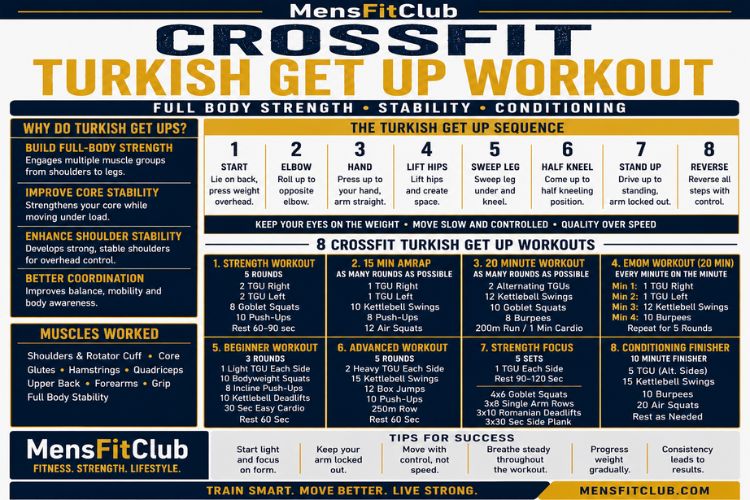
You begin lying on your back with one arm extended vertically toward the ceiling. While maintaining control of the overhead load, you transition through several positions that generally include rolling to the elbow, moving to the hand, lifting the hips, sweeping the leg underneath the body, reaching a half-kneeling position, and finally standing.
The entire sequence is then performed in reverse.
Because the weight stays overhead throughout most of the movement, your shoulder stabilizers must constantly work to maintain a strong position. Meanwhile, your core, hips, legs, and upper body coordinate to move you from the floor to standing.
This makes the Turkish get up much more than an abdominal exercise or shoulder exercise. It is a true full-body movement.
Why Include Turkish Get Ups in CrossFit Training?
CrossFit training emphasizes functional movements performed across different time domains and levels of intensity. Although Turkish get ups are usually slower than many traditional CrossFit exercises, they can complement faster movements extremely well.
A workout filled entirely with explosive movements can encourage athletes to focus heavily on speed. Turkish get ups force you to slow down and control your position.
That change in pace can be valuable.
Build Full-Body Strength
Nearly every major area of the body contributes to a Turkish get up. Your shoulder stabilizes the load overhead, your core prevents unwanted rotation, your hips generate force during the transition from the floor, and your legs help you move into the standing position.
As the load increases, the exercise becomes a serious full-body strength challenge.
However, increasing weight should only happen when you can consistently perform every stage with good control.
Improve Core Stability
Turkish get ups require the core to stabilize your torso while your body changes position underneath an overhead weight.
This creates a different challenge from conventional abdominal exercises.
Instead of repeatedly flexing your spine, you must resist unwanted movement while coordinating the upper and lower body. This can make Turkish get ups useful for developing functional trunk stability.
Develop Shoulder Stability
Holding a kettlebell overhead throughout the Turkish get up requires continuous shoulder control.
The shoulder must remain stable while your torso rotates and changes angles underneath the weight. Your rotator cuff and surrounding stabilizing muscles contribute throughout the movement.
For CrossFit athletes who regularly perform overhead presses, snatches, jerks, handstand work, and other overhead movements, developing controlled shoulder stability can be particularly useful.
Improve Coordination and Body Awareness
Few exercises require as many coordinated transitions as the Turkish get up.
You need to know where your arm, hips, knees, feet, and torso are positioned throughout the entire repetition. As a result, regular practice can improve movement awareness and coordination.
The benefits can carry over to other complex exercises where positioning matters.
Muscles Worked During a CrossFit Turkish Get Up Workout
The Turkish get up recruits muscles throughout the body rather than isolating one specific muscle group.
The shoulders and rotator cuff stabilize the overhead weight. Your triceps contribute to maintaining the locked-out arm position.
Your abdominals and obliques help stabilize the torso and resist excessive rotation.
The glutes and hamstrings contribute heavily during hip extension and the transition toward kneeling.
Your quadriceps help you rise from the half-kneeling position into standing.
Muscles throughout your upper back also contribute to maintaining shoulder and torso positioning.
Even your grip and forearms work continuously to keep the kettlebell or dumbbell secure.
This broad muscle involvement is one reason the Turkish get up fits well within a functional strength program.
How to Perform the Turkish Get Up
Before attempting a high-intensity CrossFit workout involving Turkish get ups, learn the movement sequence separately.
Use a light kettlebell, dumbbell, or even your closed fist while practicing.
Step 1: Start on Your Back
Lie flat on the floor with the kettlebell positioned beside you.
Roll toward the kettlebell and grip it securely before bringing it toward your chest. Press the weight upward until your arm is extended vertically.
If the kettlebell is in your right hand, bend your right knee and place your right foot firmly on the floor. Extend your left leg outward.
Keep your eyes on the kettlebell.
Step 2: Move Onto Your Elbow
Drive through the planted foot while using your abdominal muscles to roll toward the opposite elbow.
With the kettlebell in your right hand, you will generally move onto your left elbow.
The weighted arm remains extended.
Avoid allowing the shoulder to collapse.
Step 3: Move Onto Your Hand
From the elbow position, press your supporting hand firmly into the floor until your supporting arm is extended.
Your torso should now be taller while the kettlebell remains directly overhead.
Maintain control instead of rushing through this transition.
Step 4: Lift Your Hips
Drive through your planted foot and supporting hand to raise your hips away from the floor.
Create enough space underneath your body to move the extended leg.
Keep the overhead arm strong and stable.
Step 5: Sweep the Leg Underneath
Move the extended leg underneath your body until the knee reaches the floor.
This should place you into a supported kneeling position.
Take your time during this transition because losing balance while holding weight overhead can increase injury risk.
Step 6: Reach the Half-Kneeling Position
Bring your torso upright until you reach a conventional half-kneeling position.
The kettlebell should remain overhead with the arm extended.
Square your body and establish balance before attempting to stand.
Step 7: Stand Up
Drive through your feet and legs until you reach a fully standing position.
Pause briefly at the top.
You have now completed the upward half of the Turkish get up.
Step 8: Reverse the Movement
The repetition is not finished yet.
Reverse every stage under control until you return to the floor.
Step backward into the half-kneeling position, place your supporting hand on the ground, sweep your leg forward, lower your hips, move down to the elbow, and finally return your torso to the floor.
One complete Turkish get up includes both standing up and returning to the floor.
CrossFit Turkish Get Up Workout Warm-Up
Because the Turkish get up involves the shoulders, hips, thoracic spine, and core, a good warm-up should prepare all of these areas.
Spend approximately 8 to 10 minutes preparing before beginning the main workout.
Start with two or three minutes of easy rowing, cycling, jogging, or jump rope. The goal is simply to increase body temperature.
Then complete two rounds of:
10 bodyweight squats
8 alternating reverse lunges per side
10 glute bridges
8 arm circles in each direction
8 controlled thoracic rotations per side
20-second plank
3 unweighted Turkish get ups per side
Keep everything controlled.
The final Turkish get ups should serve as movement practice rather than conditioning.
CrossFit Turkish Get Up Strength Workout
This first workout focuses primarily on building strength and improving technique.
Perform:
5 rounds
2 Turkish get ups right side
2 Turkish get ups left side
8 goblet squats
10 push-ups
Rest 60 to 90 seconds between rounds.
Choose a kettlebell that allows you to maintain excellent overhead control throughout every Turkish get up.
The Turkish get ups should determine your weight selection rather than the goblet squats.
If the weight feels too light for squats, simply perform the squats more slowly.
Turkish Get Up CrossFit AMRAP Workout
AMRAP stands for “as many rounds as possible.” However, Turkish get ups should never become sloppy just because the workout is timed.
Try this 15-minute AMRAP:
1 Turkish get up right
1 Turkish get up left
10 kettlebell swings
8 push-ups
12 air squats
Continue repeating the circuit for 15 minutes.
The objective is to maintain steady movement rather than sprinting through the workout.
The Turkish get ups act almost like a controlled reset between faster conditioning exercises.
20-Minute CrossFit Turkish Get Up Workout
For a longer full-body conditioning session, try this 20-minute workout.
Complete as many quality rounds as possible of:
2 alternating Turkish get ups
12 kettlebell swings
10 goblet squats
8 burpees
200-meter run or approximately one minute of cardiovascular exercise
The combination creates an interesting contrast.
Kettlebell swings and burpees increase heart rate rapidly, while Turkish get ups demand patience and precision.
Avoid allowing fatigue from the faster exercises to compromise your Turkish get up technique.
Turkish Get Up EMOM Workout
EMOM means “every minute on the minute.”
This structure is particularly effective for technical exercises because built-in time limits can provide regular opportunities to reset.
Complete 20 minutes:
Minute 1: 1 Turkish get up right
Minute 2: 1 Turkish get up left
Minute 3: 12 kettlebell swings
Minute 4: 10 burpees
Repeat for five total rounds.
If necessary, reduce the kettlebell weight as fatigue accumulates.
The goal is consistent performance from the first round through the final round.
Beginner CrossFit Turkish Get Up Workout
Beginners should prioritize movement quality before increasing intensity.
Try three rounds of:
1 light Turkish get up per side
10 bodyweight squats
8 incline or regular push-ups
10 kettlebell deadlifts
30 seconds of easy cardio
Rest approximately one minute between rounds.
Beginners can also perform the Turkish get up without weight.
One useful technique drill is to balance a lightweight object on your closed fist while moving through the sequence. This encourages you to keep the arm vertical without introducing a heavy external load.
Advanced CrossFit Turkish Get Up Workout
Experienced athletes with strong Turkish get up technique can use heavier loads or more challenging conditioning combinations.
Try five rounds:
2 heavy Turkish get ups per side
15 kettlebell swings
12 box jumps
10 push-ups
250-meter row
Rest 60 seconds after each round.
Do not select a kettlebell weight simply because you can complete one repetition when fresh.
Choose a load you can safely control throughout the entire workout.
Fatigue changes everything.
Turkish Get Up Workout for Strength
If strength is your main objective, reduce the conditioning elements and focus on heavier, high-quality repetitions.
Perform:
5 sets of 1 Turkish get up per side.
Rest 90 to 120 seconds between sets.
Follow with:
4 sets of 6 goblet squats
3 sets of 8 single-arm kettlebell rows per side
3 sets of 10 Romanian deadlifts
3 sets of 30-second side planks per side
This format turns the Turkish get up into the primary strength exercise instead of treating it as part of a conditioning circuit.
How Heavy Should You Go?
There is no universal kettlebell weight that everyone should use.
Your ideal weight depends on experience, shoulder stability, body size, mobility, and technical ability.
Beginners should start very light.
An experienced lifter may have enough strength to press a heavy kettlebell overhead but still lack the mobility or coordination required to safely perform a Turkish get up with that weight.
Therefore, overhead pressing strength alone should not determine your TGU weight.
Increase the load gradually only after you can complete both sides with consistent control.
Common Turkish Get Up Mistakes
Using Too Much Weight
This is perhaps the most common mistake.
Heavy Turkish get ups can look impressive, but loading the movement beyond your technical ability increases the chance of losing position.
Build proficiency before chasing heavier kettlebells.
Taking Your Eyes Off the Weight Too Early
During the early stages of the movement, keeping your eyes on the kettlebell can help maintain awareness of its position.
As you transition toward standing, your head position may naturally change, but you should always remain aware of the overhead load.
Bending the Overhead Arm
The overhead elbow should generally remain locked throughout the movement.
Repeatedly bending and straightening the arm can reduce stability.
Think about actively reaching upward through the kettlebell.
Rushing the Leg Sweep
The leg sweep requires coordination and adequate hip clearance.
Trying to rush this transition can cause you to lose balance.
Create space by lifting your hips before bringing the leg underneath your body.
Sacrificing Technique for Time
This is especially relevant in CrossFit-style workouts.
The stopwatch should never determine whether you perform a technically poor Turkish get up.
Reduce your weight or slow your pace if your movement quality deteriorates.
How Often Should You Do Turkish Get Ups?
Most recreational athletes can include Turkish get ups approximately one to three times per week depending on overall training volume.
They can be used as part of a warm-up, strength workout, accessory session, or CrossFit conditioning workout.
For example, one weekly session might use light Turkish get ups during warm-ups, while another session could use moderately heavy TGUs as a strength exercise.
There is usually no need to perform high volumes every day.
Because the exercise involves significant shoulder stabilization, adequate recovery is important.
Turkish Get Up Workout Progression
Progress does not have to mean immediately using a heavier kettlebell.
You can improve Turkish get ups through better control, smoother transitions, greater mobility, more balanced left-to-right performance, or slightly increased weight.
A simple four-stage progression could look like this.
Stage 1: Learn the Movement
Practice unweighted Turkish get ups until you understand the sequence.
Stage 2: Add a Light Kettlebell
Perform 1 to 3 repetitions per side with a light load while maintaining control.
Stage 3: Increase Training Volume
Gradually add sets or incorporate Turkish get ups into simple CrossFit circuits.
Stage 4: Increase Resistance
Once your technique remains consistent under fatigue, begin increasing the kettlebell weight gradually.
Avoid increasing weight and training volume simultaneously.
How to Program Turkish Get Ups With Other CrossFit Exercises
Turkish get ups pair especially well with movements that are less technically demanding.
Kettlebell swings are one obvious choice because both exercises can use the same piece of equipment.
Goblet squats, push-ups, rowing, running, air squats, and controlled burpees can also work well.
Be more cautious when combining heavy Turkish get ups with large amounts of overhead pressing, snatches, handstand push-ups, or other exercises that heavily fatigue the shoulders.
If your shoulder stability is already compromised by fatigue, maintaining safe Turkish get up positioning becomes more difficult.
Programming should consider total workload rather than viewing every movement independently.
Recovery After a Turkish Get Up CrossFit Workout
Recovery requirements depend on workout intensity and your overall training schedule.
After your session, spend a few minutes gradually lowering your heart rate. Easy walking or cycling can work well.
Gentle mobility work for the hips, upper back, and shoulders may also feel beneficial.
Beyond the immediate cooldown, focus on adequate hydration, nutrition, and sleep.
If your shoulders, wrists, knees, or lower back experience unusual pain rather than ordinary muscular fatigue, stop and evaluate your technique before repeating the workout.
Final Thoughts on the CrossFit Turkish Get Up Workout
A CrossFit Turkish get up workout provides a unique combination of full-body strength, shoulder stability, core control, mobility, balance, and conditioning. While many CrossFit exercises emphasize explosive speed and power, the Turkish get up rewards patience, precision, and movement quality.
That makes it an excellent complement to exercises such as kettlebell swings, burpees, squats, push-ups, rowing, and running.
Beginners should first master the Turkish get up with little or no additional resistance. Once the movement becomes comfortable, a kettlebell or dumbbell can gradually be introduced. Experienced athletes can progress toward heavier Turkish get ups or incorporate them into AMRAP, EMOM, strength, and conditioning workouts.
Regardless of your experience level, resist the temptation to turn the Turkish get up into a race. Every stage should remain deliberate and controlled, particularly when you are holding a kettlebell overhead.
Use the movement consistently, progress gradually, and prioritize quality repetitions. With the right approach, the Turkish get up can become one of the most valuable full-body exercises in your CrossFit training program.
CrossFit Turkish Get Up Workout FAQ
Is the Turkish Get Up Good for CrossFit?
Yes. Turkish get ups can complement CrossFit training by developing full-body strength, core stability, coordination, shoulder control, and mobility. They can be programmed as a warm-up drill, strength movement, or part of a conditioning workout.
Are CrossFit Turkish Get Ups Good for Building Muscle?
Turkish get ups create muscular tension throughout the shoulders, core, glutes, legs, and upper body. However, they are usually better viewed as a full-body strength and stability movement than a primary hypertrophy exercise. Traditional presses, rows, squats, and other resistance exercises can provide additional muscle-building volume.
Can Beginners Do Turkish Get Ups?
Yes, but beginners should learn the movement without heavy resistance. Practice the sequence with your bodyweight before progressing to a light kettlebell or dumbbell.
How Many Turkish Get Ups Should I Do?
Quality is more important than high repetition counts. Depending on the workout, approximately 1 to 3 repetitions per side per set can provide plenty of training stimulus.
Can You Do CrossFit Turkish Get Ups With Dumbbells?
Yes. Although kettlebells are commonly associated with Turkish get ups, dumbbells can also be used. The movement sequence remains essentially the same, although the load may feel different overhead.
Should Turkish Get Ups Be Done Fast?
Generally, no. Turkish get ups are technical exercises that benefit from deliberate movement. Even when they are included in a timed CrossFit workout, maintain controlled transitions rather than rushing through repetitions.
What Exercises Pair Well With Turkish Get Ups?
Kettlebell swings, goblet squats, push-ups, rowing, running, lunges, air squats, and moderate-volume burpees can all complement Turkish get ups. The ideal combination depends on whether your primary goal is strength, conditioning, or general fitness.
Want to build a stronger kettlebell foundation before progressing to heavier Turkish get ups? Add more variety to your training with our CrossFit Kettlebell Workouts, which includes Turkish get ups alongside other functional kettlebell movements. You can also follow our Best Kettlebell Workout Program for Men to develop total-body strength and conditioning. Beginners can improve their technique and fitness with this 30-Minute Beginner Full Body Kettlebell Workout, while athletes wanting more conditioning can try the 40-Minute Kettlebell HIIT Workout. For a broader functional fitness program, check out our CrossFit Workout Plan for more ways to develop strength, endurance, power, and athletic conditioning.


Most Recommended

Subscribe to our Newsletter
Stay up to date on the latest men’s health, fitness and lifestyle trends and tips.
About Us
Men’s Fit Club was started with the goal of empowering men to get the most out of their lives. This meant going beyond exercise and diet tips to really address the broad range of issues that men face on a daily basis – topics like recreation, finding love, sexual health and even sound fashion advice.
Quick Links
© COPYRIGHT MEN'S FIT CLUB 2026. All Rights Reserved