
CrossFit Turkish Get Up Workout for Full Body Strength
40 Minute Outdoor HIIT Workout For Total Body Burn
Best Gym HIIT Workouts Plan To Burn Fat & Build Strength
Best CrossFit Tabata Workout for a Full Body Burn
40 Minute Outdoor HIIT Workout For Total Body Burn
A 40 minute full body outdoor HIIT workout is an effective way to combine cardiovascular conditioning, muscular endurance, strength, and calorie-burning exercise without spending hours in the gym. Whether you train at a park, on a field, in your backyard, at the beach, or on an outdoor running track, high-intensity interval training can turn almost any open space into a complete workout area.
HIIT, or high-intensity interval training, alternates challenging periods of exercise with shorter periods of recovery. Instead of maintaining the same pace throughout your workout, you repeatedly increase the intensity before allowing your heart rate to partially recover. This approach makes it possible to train multiple fitness qualities during one relatively short session.
This 40 minute outdoor HIIT workout combines bodyweight strength exercises, explosive movements, running intervals, core exercises, and conditioning drills. No complicated machines are required. Most people can complete the routine using nothing more than comfortable workout clothes, supportive shoes, water, and enough outdoor space to move safely.
The workout can also be adjusted according to fitness level. Beginners can reduce the speed and impact, while experienced athletes can increase their pace, repetitions, or exercise difficulty.
Benefits of a 40 Minute Full Body Outdoor HIIT Workout
Outdoor HIIT training provides benefits beyond simply burning calories. Because the workout combines several different movement patterns, you can train your legs, chest, shoulders, arms, core, and cardiovascular system during the same session.
A full body approach can also be useful when your schedule does not allow separate workouts for every muscle group.
Improve Cardiovascular Fitness
Repeated intervals of intense activity challenge your cardiovascular system to deliver oxygen to working muscles efficiently. Exercises such as high knees, mountain climbers, jumping jacks, burpees, and short running intervals quickly increase your heart rate.
The recovery periods then allow your breathing and heart rate to partially settle before the next effort begins.
Over time, properly programmed interval training can contribute to improved cardiovascular conditioning and work capacity.
Train the Entire Body
Unlike cardio workouts that primarily involve the lower body, this outdoor HIIT workout incorporates exercises for multiple major muscle groups.
Squats and lunges target the lower body. Push-ups train the chest, shoulders, and triceps. Mountain climbers and plank variations challenge the core, while burpees combine several movement patterns into one demanding conditioning exercise.
This variety creates a more complete workout without requiring gym equipment.
Increase Calorie Expenditure
HIIT can be physically demanding because you repeatedly perform exercises at relatively high intensity.
Exercises that recruit several muscle groups simultaneously generally require more energy than small isolation movements. Combining movements such as squats, running, push-ups, lunges, and burpees can therefore create a challenging conditioning session.
However, the exact number of calories burned depends on factors including body weight, fitness level, exercise intensity, workout experience, and individual physiology.
Build Muscular Endurance
Although bodyweight HIIT is not a replacement for progressive resistance training when maximum strength or muscle growth is your primary objective, it can be excellent for muscular endurance.
Performing repeated squats, lunges, push-ups, and core exercises with relatively short recovery periods teaches your muscles to continue working while fatigued.
That muscular endurance can carry over to sports, recreational activities, and other workouts.
Enjoy Training Outdoors
Training outdoors can provide a welcome change from treadmills and indoor workout spaces.
A park, backyard, running track, beach, or open field can provide plenty of room for bodyweight exercises and short running intervals. Changing your training environment can also make a familiar workout routine feel different without requiring entirely new exercises.
What You Need for This Outdoor HIIT Workout
One advantage of this 40 minute full body outdoor HIIT workout is that very little equipment is necessary.
At minimum, you need an open and relatively level training area, supportive athletic shoes, comfortable clothing, and drinking water. A workout mat can make push-ups, planks, and floor exercises more comfortable, especially when exercising on rough grass or pavement.
You can also use a timer or smartphone to manage the intervals.
Before beginning, inspect your workout area for holes, wet surfaces, rocks, traffic, broken glass, or other hazards. Weather matters as well. Extreme heat, poor air quality, thunderstorms, and slippery conditions are good reasons to move the workout indoors or postpone it.
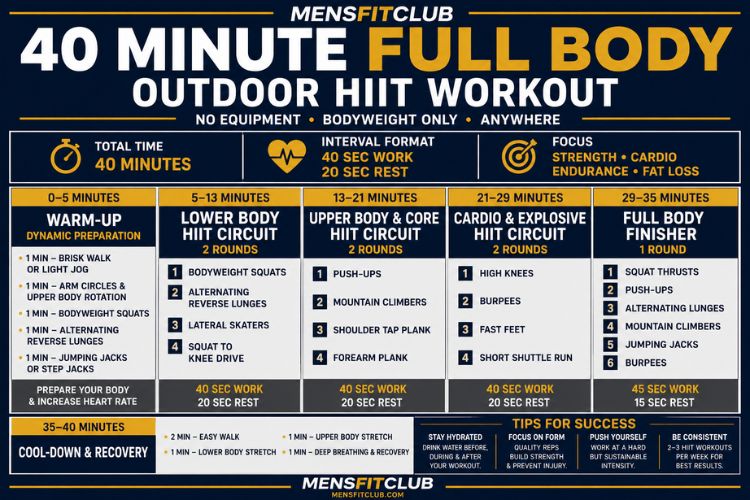
40 Minute Full Body Outdoor HIIT Workout Structure
The workout is divided into five sections:
5 minutes: Dynamic warm-up
8 minutes: Lower body HIIT
8 minutes: Upper body and core HIIT
8 minutes: Cardio and explosive HIIT
6 minutes: Full body finishing circuit
5 minutes: Cool-down and recovery
Total: 40 minutes
For most working intervals, aim for approximately 40 seconds of exercise followed by 20 seconds of recovery.
High intensity does not mean losing control of your technique. Your goal is to work hard while maintaining safe, consistent movement quality.
Minutes 0–5: Dynamic Outdoor HIIT Warm-Up
Never jump directly into maximum-intensity burpees, sprints, or jumping exercises while your body is cold. Use the first five minutes to gradually increase your heart rate and prepare your joints and muscles.
Minute 1: Brisk Walk or Light Jog
Begin with a brisk walk before transitioning into an easy jog.
Keep your shoulders relaxed and gradually increase your pace. This is preparation rather than a fitness test, so there is no reason to sprint.
Minute 2: Arm Circles and Upper Body Rotation
Perform controlled arm circles in both directions before adding gentle torso rotations.
These movements help prepare your shoulders and upper body for push-ups, planks, and burpees later in the workout.
Minute 3: Bodyweight Squats
Perform slow bodyweight squats.
Keep your chest lifted and knees tracking comfortably in the same general direction as your toes. Descend only as far as you can while maintaining control.
Minute 4: Alternating Reverse Lunges
Step backward into alternating reverse lunges.
Reverse lunges can be easier to control than aggressive forward lunges during a warm-up. Keep the movement smooth and focus on balance.
Minute 5: Jumping Jacks or Step Jacks
Finish the warm-up with jumping jacks.
For a low-impact alternative, perform step jacks by stepping one foot sideways at a time while moving your arms overhead.
By the end of five minutes, you should feel warmer and ready for harder intervals without feeling exhausted.
Minutes 5–13: Lower Body HIIT Circuit
The first main circuit targets your quadriceps, hamstrings, glutes, calves, and cardiovascular system.
Complete four exercises using 40 seconds of work and 20 seconds of rest. Repeat the four-exercise sequence twice for eight minutes.
Exercise 1: Bodyweight Squats
Stand approximately shoulder-width apart and perform controlled squats.
Push through your feet as you return to standing and squeeze your glutes near the top.
Advanced trainees can substitute jump squats, but regular squats are perfectly suitable when you want to reduce impact.
Exercise 2: Alternating Reverse Lunges
Step one leg backward and lower into a lunge before returning to the starting position and changing sides.
Maintain an upright torso and controlled tempo.
To increase the challenge, perform alternating jumping lunges only if you already have the necessary conditioning, coordination, and joint tolerance.
Exercise 3: Lateral Skaters
Push sideways from one leg to the other in a skating motion.
Keep your knees slightly bent and use your arms naturally for balance. Start with relatively small lateral movements before increasing distance.
For a low-impact variation, remove the jump and simply step laterally.
Exercise 4: Squat to Knee Drive
Perform a regular squat. As you stand, drive one knee toward your chest. Squat again and alternate sides.
The exercise combines lower-body training with balance and core engagement.
After exercise four, return to bodyweight squats and repeat the circuit.
Minutes 13–21: Upper Body and Core HIIT Circuit
Your legs receive a slight reduction in workload during this section while your chest, shoulders, triceps, and core become the primary focus.
Again, perform 40 seconds of work followed by 20 seconds of rest and complete two rounds.
Exercise 1: Push-Ups
Place your hands slightly wider than shoulder width and maintain a relatively straight line from your head through your hips.
Lower your chest toward the ground under control and press back upward.
If regular push-ups are too difficult, use an elevated surface such as a sturdy park bench. Avoid unstable objects.
Exercise 2: Mountain Climbers
Begin in a high plank position and alternate driving your knees toward your chest.
Keep your hands planted firmly and avoid allowing your hips to bounce excessively.
Move at a pace that allows you to maintain control.
Exercise 3: Shoulder Tap Plank
From a high plank position, lift one hand and touch the opposite shoulder. Replace your hand and alternate sides.
Try to minimize unnecessary hip rotation.
A wider foot position usually provides more stability.
Exercise 4: Forearm Plank
Finish the sequence with a forearm plank.
Brace your abdominal muscles and glutes while maintaining a neutral position through your torso.
Avoid holding your breath. Continue taking controlled breaths throughout the interval.
Repeat the four exercises for the second round.
Minutes 21–29: Cardio and Explosive Outdoor HIIT Circuit
This section raises the cardiovascular demand and introduces faster full-body movements.
Complete each exercise for 40 seconds, recover for 20 seconds, and repeat the sequence twice.
Exercise 1: High Knees
Run in place while lifting your knees comfortably toward your torso.
Use your arms as you would during running and maintain a quick but controlled rhythm.
Beginners can perform a fast marching variation instead.
Exercise 2: Burpees
From standing, lower your hands toward the ground and move your feet backward into a plank position. Return your feet toward your hands and stand.
More experienced trainees can add a push-up and vertical jump.
Beginners can step one foot backward at a time and eliminate the jump.
Exercise 3: Fast Feet
Take short, rapid steps while remaining relatively light on your feet.
Keep your knees slightly bent and maintain an athletic position.
This drill works particularly well on a flat grass field or running track.
Exercise 4: Short Shuttle Run
Choose two safe markers several yards apart.
Run between them continuously for 40 seconds while staying under control when changing direction.
If you do not have enough space, substitute running in place, jumping jacks, or another round of high knees.
Repeat all four exercises once more.
Minutes 29–35: Six-Minute Full Body HIIT Finisher
The final working section combines strength, cardio, and core training.
Complete the following six exercises for 45 seconds each followed by 15 seconds of recovery.
Minute 30: Squat Thrusts
Move from standing into a high plank and return to standing.
Think of this as a burpee without necessarily adding the push-up or jump.
Minute 31: Push-Ups
Perform controlled push-ups for the working interval.
At this stage of the workout, fatigue may reduce your repetition speed. Prioritize good technique instead of trying to accumulate sloppy repetitions.
Minute 32: Alternating Lunges
Perform alternating reverse lunges.
Control each repetition and maintain balance.
Minute 33: Mountain Climbers
Return to a high plank and perform mountain climbers.
Start moderately and increase the pace only if you can keep your trunk controlled.
Minute 34: Jumping Jacks
Perform jumping jacks at a sustainable but challenging pace.
Use step jacks when you need a lower-impact option.
Minute 35: Burpees
Finish the main workout with another burpee interval.
Choose the variation appropriate for your fitness level. The final interval should feel challenging, but you should still be able to perform every repetition safely.
Minutes 35–40: Outdoor HIIT Cool-Down
Do not finish the last burpee and immediately sit down.
Use approximately five minutes to gradually reduce the intensity.
Minutes 35–37: Easy Walk
Walk slowly around your training area while allowing your breathing to gradually return toward normal.
Relax your shoulders and take comfortable breaths.
Minute 38: Lower Body Mobility
Perform gentle movements for your quadriceps, hamstrings, calves, and hips.
Avoid forcing yourself into uncomfortable positions.
Minute 39: Upper Body Mobility
Gently move through comfortable stretches for your chest, shoulders, and upper back.
After multiple push-up and plank variations, your upper body may feel fatigued.
Minute 40: Breathing and Recovery
Finish standing or seated comfortably.
Take several slow breaths and allow your body to settle before ending the session.
Beginner Version of the 40 Minute Outdoor HIIT Workout
Beginners do not need to perform every interval at maximum speed.
A practical starting point is 30 seconds of exercise followed by 30 seconds of recovery. You can also choose lower-impact variations throughout the workout.
Replace jump squats with standard squats, jumping lunges with reverse lunges, high knees with fast marching, jumping jacks with step jacks, and full burpees with step-back burpees.
Your first objective should be completing the workout with consistent technique.
As your conditioning improves, gradually increase the working intervals toward 40 seconds while reducing recovery toward 20 seconds.
Advanced Outdoor HIIT Workout Progression
Experienced trainees can make this routine more challenging without dramatically increasing workout duration.
Instead of automatically performing more repetitions, increase difficulty strategically. You might use explosive push-ups, jump squats, longer lateral skater jumps, faster mountain climbers, more demanding burpee variations, or quicker shuttle runs.
Another progression is using 45 seconds of work followed by 15 seconds of recovery for selected circuits.
A weighted vest can significantly increase exercise difficulty, but added resistance is not necessary for an effective HIIT session and should only be introduced when your movement technique is already strong.
How Hard Should Outdoor HIIT Feel?
During the harder intervals, aim for a challenging effort that you can sustain without your exercise technique breaking down.
Not every interval needs to be an all-out sprint. In fact, repeatedly going to absolute maximum effort can cause your performance to collapse before the workout is finished.
Think about pacing the entire 40-minute session rather than trying to win the first five minutes.
Your first round should feel demanding but manageable. During later rounds, fatigue will naturally make the same exercises more difficult.
How Often Should You Do a 40 Minute Outdoor HIIT Workout?
For many recreational exercisers, two or three HIIT workouts per week can provide plenty of high-intensity conditioning when combined with appropriate recovery and other forms of training.
More is not automatically better.
Your weekly routine may also include resistance training, lower-intensity cardiovascular exercise, walking, mobility work, sports, and complete rest days.
Avoid scheduling demanding HIIT workouts every day simply because they are relatively short. Your muscles, joints, and cardiovascular system still need recovery.
Outdoor HIIT Workout Safety Tips
Outdoor workouts introduce variables that you do not encounter in a climate-controlled gym.
Check the weather before training and be particularly cautious during extreme heat or humidity. Bring water and consider exercising earlier or later in the day when conditions are more comfortable.
Choose a surface with adequate traction and enough space to perform exercises safely.
If you experience unusual chest discomfort, severe dizziness, faintness, or symptoms that feel significantly different from normal exercise fatigue, stop exercising and seek appropriate medical attention.
People returning to exercise after a long break or managing medical or orthopedic concerns should consider getting individualized guidance before beginning vigorous HIIT.
Can Outdoor HIIT Help With Fat Loss?
A full body outdoor HIIT workout can support a fat-loss program because it increases physical activity and energy expenditure.
However, no individual workout specifically removes fat from one area of the body.
Long-term fat loss primarily depends on maintaining an appropriate energy balance while supporting your body with nutritious food, adequate protein, consistent exercise, sleep, and recovery.
HIIT should therefore be viewed as one component of a complete fitness strategy rather than a shortcut.
Can You Build Muscle With Outdoor HIIT?
Bodyweight HIIT can improve muscular endurance and may contribute to muscle development, particularly for beginners.
However, people whose primary objective is maximizing muscle growth will generally benefit from dedicated resistance training with progressive overload.
You can combine the two approaches.
For example, perform structured strength workouts several days per week and use this 40 minute outdoor HIIT routine once or twice weekly for cardiovascular conditioning.
This allows you to develop strength and muscle while maintaining good overall conditioning.
Best Places to Perform an Outdoor HIIT Workout
One of the biggest advantages of outdoor training is flexibility.
A local park provides open space and may offer benches for elevated push-ups or step exercises. A running track works particularly well when you want to incorporate sprint or shuttle intervals. A backyard provides convenience and privacy.
A beach can dramatically increase the difficulty of running and jumping movements, although unstable sand also changes joint and muscular demands.
Wherever you train, prioritize a safe surface and sufficient space over scenery.
Frequently Asked Questions About a 40 Minute Full Body Outdoor HIIT Workout
Is 40 Minutes of HIIT Enough?
Yes. Forty minutes provides enough time for a warm-up, several conditioning circuits, and a cool-down.
Remember that the entire session does not need to consist of maximum-intensity exercise. Recovery intervals and lower-intensity transition periods are essential parts of a properly structured HIIT workout.
Do I Need Equipment?
No. This workout can be completed using bodyweight exercises.
A mat and interval timer can be convenient but are optional.
Can Beginners Do This Workout?
Yes, provided the exercises and intervals are modified appropriately.
Beginners should emphasize lower-impact variations, controlled movement, and longer recovery periods.
Can I Do Outdoor HIIT Every Day?
Daily high-intensity training is unnecessary for most people.
Allowing recovery between challenging sessions can improve workout quality and reduce excessive accumulated fatigue.
On non-HIIT days, consider walking, resistance training, mobility work, recreational activity, or lower-intensity cardio depending on your goals.
What If I Cannot Do Burpees?
Replace burpees with squat thrusts, elevated burpees using a sturdy bench, step-back burpees, fast bodyweight squats, or another cardiovascular exercise you can perform comfortably.
There is nothing magical about a particular exercise. The workout should fit your current ability.
Is Outdoor HIIT Better Than Running?
Neither is universally better.
Steady running develops aerobic endurance efficiently, while full-body HIIT incorporates more movement patterns and muscular conditioning.
Many balanced fitness programs include both.
Final Thoughts on the 40 Minute Full Body Outdoor HIIT Workout
A 40 minute full body outdoor HIIT workout can deliver an efficient combination of cardiovascular exercise, bodyweight strength training, muscular endurance, core work, and athletic conditioning without requiring a gym.
The structure is straightforward: spend five minutes warming up, complete three eight-minute HIIT circuits, finish with six minutes of full-body conditioning, and use the final five minutes to cool down.
More importantly, adjust the workout to your ability.
Beginners can use 30-second work intervals, longer recovery periods, and low-impact exercises. Intermediate trainees can follow the standard 40/20 format, while advanced exercisers can introduce harder variations or selected 45/15 intervals.
Consistency matters more than turning every workout into an exhaustion test. Train hard enough to challenge yourself, maintain good technique, recover properly, and gradually increase difficulty as your conditioning improves.
With nothing more than an open outdoor space and approximately 40 minutes, you have everything you need for a challenging full body outdoor HIIT workout.
To get even more from your 40 minute full body outdoor HIIT workout, you can rotate this routine with other MensFitClub training plans to keep your conditioning varied and progressive. Start with this 45 Minute Full Body HIIT Workout when you want a slightly longer total-body session, or use the 30 Minute Full Body HIIT Workout on days when you have less time. For equipment-free training that works especially well outdoors, add the Bodyweight HIIT Workout to your weekly schedule. You can also explore these Full Body HIIT Exercises for Men to find additional movements for changing your outdoor circuits. Finally, follow the Weekly HIIT Workout Plan if you want to organize your HIIT sessions into a more structured weekly fitness routine.


Most Recommended

Subscribe to our Newsletter
Stay up to date on the latest men’s health, fitness and lifestyle trends and tips.
About Us
Men’s Fit Club was started with the goal of empowering men to get the most out of their lives. This meant going beyond exercise and diet tips to really address the broad range of issues that men face on a daily basis – topics like recreation, finding love, sexual health and even sound fashion advice.
Quick Links
© COPYRIGHT MEN'S FIT CLUB 2026. All Rights Reserved