
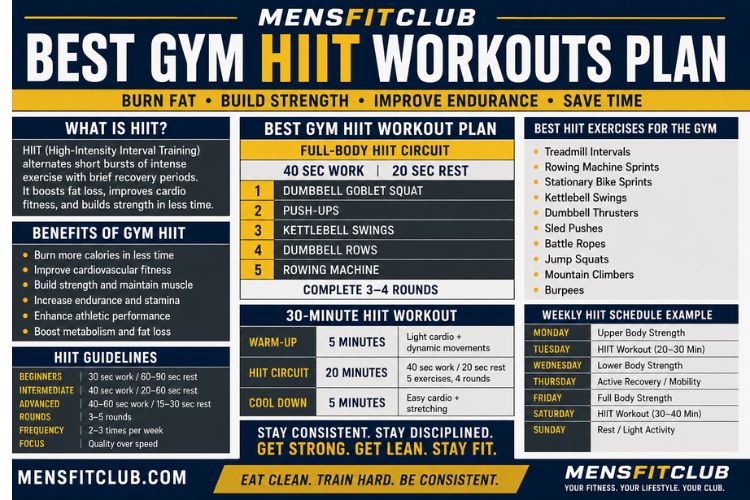
Best Gym HIIT Workouts Plan To Burn Fat & Build Strength
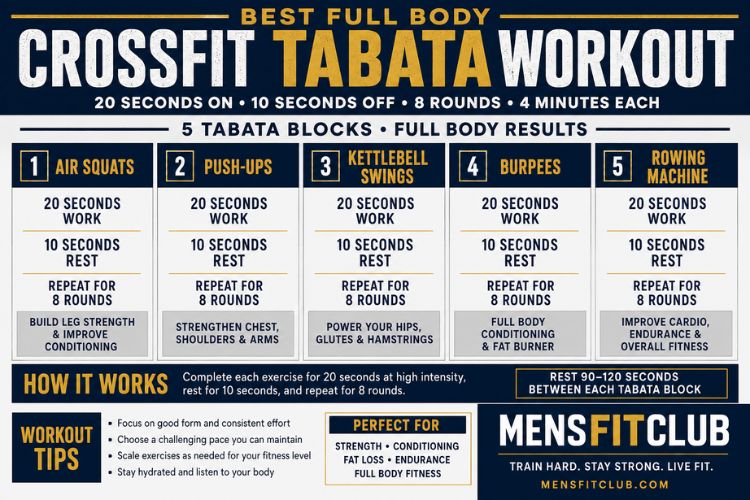
Best CrossFit Tabata Workout for a Full Body Burn
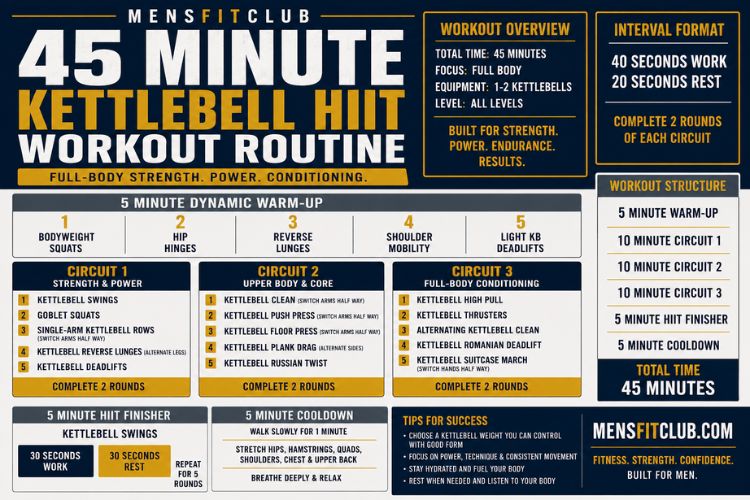
45-Minute Kettlebell HIIT Workout: Full-Body Fat Burning Routine
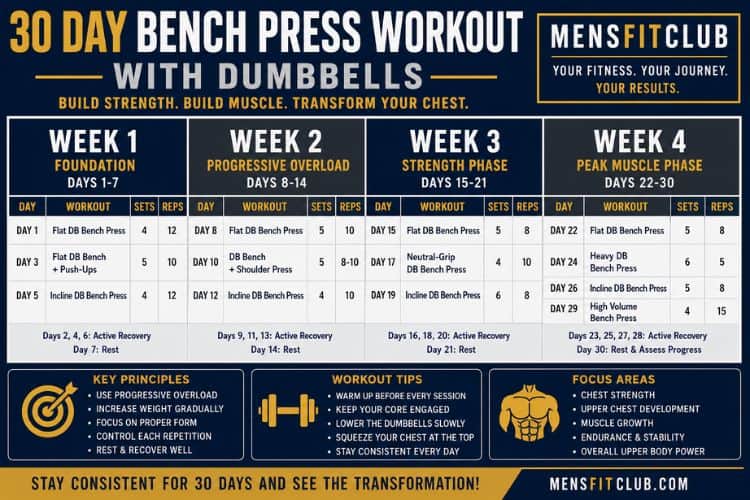
30 Day Dumbbell Bench Press Workout for a Bigger Chest
Best CrossFit Tabata Workout for a Full Body Burn
A CrossFit Tabata workout combines two highly effective training approaches: the functional, varied movements commonly associated with CrossFit and the short, intense work intervals of Tabata training. The result is a challenging workout format that can develop cardiovascular conditioning, muscular endurance, work capacity, and overall fitness without requiring hours in the gym.
Traditional Tabata training uses an extremely simple interval structure: 20 seconds of work followed by 10 seconds of rest, repeated for eight rounds. One complete Tabata therefore lasts only four minutes. However, those four minutes can become extremely demanding when you perform exercises such as burpees, kettlebell swings, thrusters, rowing, push-ups, squats, or box jumps at a challenging pace.
A CrossFit-style Tabata session can include several four-minute blocks separated by recovery periods. This allows you to train multiple movement patterns while maintaining the high-intensity nature of interval training.
Whether your goal is improving conditioning, increasing muscular endurance, burning calories, or simply adding variety to your workouts, the following CrossFit Tabata workout routine provides a practical structure you can modify according to your fitness level.
What Is a CrossFit Tabata Workout?
A CrossFit Tabata workout combines functional exercises with the classic Tabata interval format. During each interval, you perform an exercise for 20 seconds and then recover for 10 seconds before beginning the next interval.
Eight rounds produce one four-minute Tabata block.
The basic structure looks like this:
20 seconds: Work
10 seconds: Rest
Rounds: 8
Total time: 4 minutes
The original Tabata protocol became famous because of research involving high-intensity cycling intervals. Modern fitness programs have expanded the format to include resistance exercises, bodyweight movements, kettlebell exercises, and CrossFit-style conditioning movements.
The key difference between ordinary interval training and Tabata is the extremely short recovery period. Ten seconds provides just enough time to transition or briefly recover before beginning another intense effort.
Because fatigue accumulates rapidly, exercise selection and pacing become extremely important.
Benefits of CrossFit Tabata Training
CrossFit Tabata workouts offer several potential advantages for people who want challenging conditioning sessions without spending excessive time training.
Improve Cardiovascular Conditioning
Tabata intervals quickly increase your heart rate because the work periods are intense and recovery periods are extremely short.
Exercises involving large muscle groups—such as rowing, burpees, air squats, kettlebell swings, and thrusters—can make the cardiovascular system work particularly hard.
Consistently including appropriately programmed interval sessions in your training may help improve cardiovascular fitness and your ability to recover between repeated efforts.
Build Muscular Endurance
Muscular endurance is your ability to repeatedly produce force without experiencing a significant decline in performance.
CrossFit Tabata training challenges this ability because muscles receive very little recovery between rounds.
For example, completing eight rounds of push-ups using 20-second work periods can create considerable fatigue in the chest, shoulders, and triceps.
Similar effects occur with squats, kettlebell swings, lunges, and other resistance exercises.
Increase Overall Work Capacity
Work capacity describes how much physical work you can perform within a given period.
CrossFit athletes often develop impressive work capacity because workouts combine strength exercises, gymnastics movements, and cardiovascular conditioning.
Tabata training can complement this style of training by teaching you to maintain consistent output while fatigue increases.
Time-Efficient Training
One of the biggest advantages of Tabata workouts is efficiency.
A single block takes only four minutes. Even a workout containing five Tabata blocks requires only 20 minutes of actual interval work.
After adding warm-up periods, recovery between blocks, and a cool-down, you can complete an effective session in approximately 30–40 minutes.
Add Variety to Your Training
Repeating identical workouts can become monotonous.
CrossFit Tabata workouts provide numerous exercise combinations. You can use barbells, dumbbells, kettlebells, rowing machines, assault bikes, jump ropes, boxes, or simply your bodyweight.
This flexibility makes the format easy to modify.
How to Perform a CrossFit Tabata Workout
Before beginning the workout, choose exercises you can perform safely while fatigued.
Technical Olympic lifts such as heavy snatches or cleans generally aren’t ideal choices for high-speed Tabata intervals unless you have substantial experience and use an appropriately manageable load.
Simpler movements usually work better.
Set a timer for eight rounds consisting of 20 seconds of work and 10 seconds of rest.
During each work interval, perform controlled repetitions at a challenging but sustainable pace.
The objective shouldn’t necessarily be performing the maximum possible repetitions during the first round. Instead, try to maintain relatively consistent performance across all eight rounds.
CrossFit Tabata Workout Warm-Up
Spend approximately 8–10 minutes warming up before starting intense intervals.
Begin with two or three minutes of easy cardiovascular activity such as rowing, cycling, jogging, or jumping rope.
Next, perform dynamic movements such as arm circles, bodyweight squats, walking lunges, hip rotations, and shoulder mobility exercises.
Finish the warm-up with two rounds of:
10 air squats
8 push-ups
10 alternating reverse lunges
10 light kettlebell deadlifts
20 seconds of jumping jacks
Rest briefly before beginning the main workout.
Complete CrossFit Tabata Workout Routine
The following routine contains five Tabata blocks. Each block lasts four minutes and includes eight rounds.
Rest approximately 90 seconds to two minutes between blocks.
Beginners can complete three blocks, intermediate trainees can complete four, and experienced athletes can attempt all five.
Tabata 1: Air Squats
Perform air squats for 20 seconds followed by 10 seconds of rest.
Repeat for eight rounds.
Keep your chest upright while pushing your hips backward and bending your knees. Descend under control before driving through your feet to return to the standing position.
Avoid sacrificing squat depth or posture simply to increase repetitions.
Try to maintain approximately the same number of repetitions during each round.
This opening block targets the quadriceps, glutes, hamstrings, and cardiovascular system.
Tabata 2: Push-Ups
After recovering, begin the push-up block.
Perform:
20 seconds push-ups
10 seconds rest
Repeat for eight rounds.
Maintain a straight line from your head through your hips and heels. Lower your body under control before pressing back toward the starting position.
If standard push-ups become too difficult, elevate your hands on a sturdy bench or box rather than continuing with poor technique.
The goal is maintaining productive repetitions throughout the entire block.
Tabata 3: Kettlebell Swings
The third block introduces an explosive hip-hinge movement.
Perform kettlebell swings for 20 seconds followed by 10 seconds of rest.
Repeat for eight rounds.
Choose a kettlebell you can control comfortably while fatigued.
Drive the movement primarily through the hips rather than trying to lift the kettlebell using your arms. Maintain a neutral spine and allow the hips and glutes to generate the power.
If your technique begins deteriorating, reduce the weight or stop the interval.
Tabata 4: Burpees
Burpees can make this the most demanding section of the workout.
Perform:
20 seconds burpees
10 seconds rest
Repeat for eight rounds.
Start standing, place your hands on the floor, move your feet backward into a plank position, return your feet forward, stand, and finish with a controlled jump if appropriate for your fitness level.
Beginners can remove the jump or step backward and forward instead of jumping.
Avoid starting the first two rounds excessively fast. Maintaining steady movement usually produces better overall performance.
Tabata 5: Rowing Machine
Finish the workout using a rowing machine.
Row hard for 20 seconds and recover for 10 seconds.
Repeat for eight rounds.
Focus on strong leg drive followed by hip extension and then the arm pull. During the recovery portion of each stroke, reverse the sequence smoothly.
Try to maintain consistent power rather than sprinting the opening interval and dramatically slowing afterward.
If you don’t have access to a rowing machine, substitute mountain climbers, jumping rope, running, or an exercise bike.
CrossFit Tabata Workout Without Equipment
You don’t need a CrossFit gym or expensive equipment to use Tabata intervals.
A simple bodyweight CrossFit Tabata workout could include:
Air squats
Push-ups
Mountain climbers
Reverse lunges
Burpees
Perform each exercise for one complete four-minute Tabata block before moving to the next movement.
Rest 60–120 seconds between blocks depending on your conditioning level.
This creates a challenging workout that can be performed at home, outdoors, or while traveling.
Beginner CrossFit Tabata Workout
Beginners shouldn’t feel obligated to immediately complete five full Tabata blocks.
Start with three exercises:
Block 1: Air squats
Block 2: Incline push-ups
Block 3: Alternating reverse lunges
Use the standard 20-second work and 10-second rest intervals, but allow approximately two minutes of recovery between blocks.
The total interval portion of the workout lasts only 12 minutes.
As your conditioning improves, gradually add another block.
Progression should come from consistency rather than trying to make every workout brutally difficult.
Advanced CrossFit Tabata Workout
Experienced trainees can create a more demanding routine using resistance exercises and conditioning equipment.
One example includes:
Tabata 1: Dumbbell thrusters
Tabata 2: Kettlebell swings
Tabata 3: Box jumps
Tabata 4: Burpees
Tabata 5: Rowing
Tabata 6: Assault bike
This creates 24 minutes of interval work.
Allow approximately 60–120 seconds between blocks.
Even experienced athletes should choose resistance levels that allow proper technique throughout the workout.
The objective is productive intensity, not uncontrolled exhaustion.
CrossFit Tabata Workout With Dumbbells
Dumbbells provide another convenient way to increase resistance.
You could structure the workout around:
Dumbbell goblet squats
Dumbbell push press
Dumbbell Romanian deadlifts
Alternating dumbbell reverse lunges
Dumbbell thrusters
One approach is assigning one exercise to each four-minute block.
Another option is alternating two exercises.
For example:
Round 1: Dumbbell goblet squats
Round 2: Push press
Round 3: Dumbbell goblet squats
Round 4: Push press
Continue alternating until eight rounds are completed.
Choose moderate weights because fatigue accumulates quickly.
CrossFit Tabata Workout With Kettlebells
Kettlebells work particularly well for CrossFit-style conditioning because many kettlebell exercises combine strength and cardiovascular demands.
A kettlebell Tabata workout might include:
Kettlebell swings
Goblet squats
Kettlebell deadlifts
Alternating kettlebell reverse lunges
Kettlebell push press
Beginners should prioritize simple exercises such as swings, deadlifts, and goblet squats before attempting more technical movements.
How Heavy Should You Lift During Tabata?
Using extremely heavy resistance usually isn’t appropriate for Tabata training.
Remember that you’ll receive only 10 seconds of recovery between intervals.
Choose weights you can control for every repetition.
A useful guideline is selecting resistance that allows approximately 8–15 quality repetitions during a 20-second interval depending on the exercise.
Your repetitions may decrease slightly as fatigue accumulates.
However, a dramatic decline can indicate that the resistance or starting pace is too aggressive.
How Often Should You Do CrossFit Tabata Workouts?
For many recreational trainees, one to three Tabata-style conditioning sessions per week can be plenty.
The ideal frequency depends on your total training volume, experience, recovery, and goals.
If you’re already performing several CrossFit workouts, heavy strength sessions, running workouts, or other high-intensity activities each week, additional Tabata sessions may not be necessary.
High-intensity training creates substantial fatigue.
Recovery should therefore be considered part of the training program rather than an afterthought.
CrossFit Tabata Workout for Fat Loss
CrossFit Tabata training can contribute to a fat-loss program because vigorous exercise increases energy expenditure and can help maintain fitness while reducing body weight.
However, no workout can specifically target belly fat or guarantee weight loss.
Fat loss primarily depends on maintaining an appropriate calorie deficit over time.
For better results, combine structured training with adequate protein intake, nutrient-dense foods, sufficient sleep, daily movement, and a sustainable calorie intake.
Tabata should support your overall fitness strategy rather than becoming punishment for eating.
How to Track Your Tabata Performance
Recording your results can make your training more measurable.
Write down the number of repetitions completed during each interval.
For example, your air squat rounds might look like:
18 / 18 / 17 / 17 / 16 / 16 / 16 / 15
Instead of focusing only on your highest round, evaluate your consistency.
If you repeat the workout several weeks later and maintain higher repetitions across all eight rounds, your conditioning may be improving.
You can also track calories or distance when using rowing machines, bikes, or running intervals.
Common CrossFit Tabata Workout Mistakes
Starting Too Fast
The first 20-second interval often feels easy.
This can encourage people to sprint immediately.
Unfortunately, an excessively aggressive opening pace can cause performance to collapse during later rounds.
Start hard but controlled.
Using Too Much Weight
Tabata isn’t designed for maximal lifting.
Heavy resistance combined with severe fatigue can negatively affect technique.
Use loads appropriate for repeated high-intensity intervals.
Choosing Overly Technical Exercises
Complex exercises become more difficult when fatigue increases.
Choose movements you can execute confidently.
Ignoring Recovery
Performing intense workouts every day isn’t necessarily better.
Muscles, connective tissues, and the nervous system need recovery.
Balance demanding sessions with lower-intensity training and rest.
Sacrificing Technique for Repetitions
Your score doesn’t matter if your movement quality deteriorates.
Reduce your pace, modify the exercise, or stop the interval if you cannot maintain safe technique.
CrossFit Tabata Cool-Down
After completing the final block, spend approximately five minutes gradually reducing your heart rate.
Walk slowly or perform easy cycling for two to three minutes.
Then perform gentle mobility work for areas used during the workout, including the hips, quadriceps, hamstrings, calves, chest, shoulders, and upper back.
Avoid immediately sitting or lying down after an extremely demanding interval.
Give your body time to transition from intense exercise toward recovery.
Sample Weekly CrossFit Tabata Training Schedule
Tabata training can fit into a broader weekly program.
For example:
Monday: Strength training
Tuesday: CrossFit Tabata workout
Wednesday: Active recovery or mobility
Thursday: Strength training
Friday: CrossFit conditioning workout
Saturday: Easy cardio or recreational activity
Sunday: Rest
This schedule provides a mixture of resistance training, high-intensity conditioning, and recovery.
Your ideal program may differ depending on your goals and experience.
Final Thoughts on CrossFit Tabata Workouts
A CrossFit Tabata workout provides a simple but demanding way to combine functional exercises with high-intensity interval training. Using the classic 20 seconds of work and 10 seconds of rest for eight rounds, you can turn exercises such as squats, push-ups, kettlebell swings, burpees, dumbbell thrusters, and rowing into compact conditioning blocks.
A complete workout doesn’t need to be complicated. Start with a proper warm-up, choose three to five movements, complete one four-minute Tabata for each exercise, and allow enough recovery between blocks to maintain good technique.
Beginners should start conservatively with bodyweight movements and fewer blocks. More experienced trainees can gradually introduce kettlebells, dumbbells, rowing machines, bikes, and additional rounds.
Most importantly, don’t confuse intensity with recklessness. The effectiveness of CrossFit Tabata training comes from performing challenging intervals consistently while maintaining proper movement quality. When combined with sensible strength training, nutrition, sleep, and recovery, Tabata workouts can become a useful tool for developing cardiovascular conditioning, muscular endurance, and overall fitness.
For readers who want to expand their CrossFit Tabata workout into a complete conditioning program, MensFitClub has several useful workouts to try next. Start with the Tabata Workout Plan to learn more about structuring the classic 20-seconds-on, 10-seconds-off training format, or explore these Tabata Exercises for Men for additional movements to rotate into your sessions. If you want to focus more heavily on functional training, follow the CrossFit Workout Plan for a broader strength and endurance approach. For a longer metabolic session, try this 45-Minute Full Body CrossFit Workout, or train without heading to the gym with these CrossFit Workouts at Home. Together, these workouts can help you add variety while developing strength, endurance and full-body conditioning.


Most Recommended

Subscribe to our Newsletter
Stay up to date on the latest men’s health, fitness and lifestyle trends and tips.
About Us
Men’s Fit Club was started with the goal of empowering men to get the most out of their lives. This meant going beyond exercise and diet tips to really address the broad range of issues that men face on a daily basis – topics like recreation, finding love, sexual health and even sound fashion advice.
Quick Links
© COPYRIGHT MEN'S FIT CLUB 2026. All Rights Reserved