
Best Gym HIIT Workouts Plan To Burn Fat & Build Strength
Best CrossFit Tabata Workout for a Full Body Burn
45-Minute Kettlebell HIIT Workout: Full-Body Fat Burning Routine
30 Day Dumbbell Bench Press Workout for a Bigger Chest
45-Minute Kettlebell HIIT Workout: Full-Body Fat Burning Routine
A 45 minute kettlebell HIIT workout routine is an efficient way to combine strength training, cardiovascular conditioning, muscular endurance, and full-body movement into a single training session. Instead of separating resistance training and cardio into different workouts, kettlebell high-intensity interval training allows you to challenge multiple fitness qualities at the same time.
Kettlebells are particularly useful for HIIT because many kettlebell exercises involve large, coordinated movements. Swings, cleans, squats, presses, rows, and carries can recruit several muscle groups while keeping the workout moving at a challenging pace.
This 45-minute kettlebell workout uses structured work and recovery periods so you can train hard without turning every interval into an all-out effort. The routine includes a warm-up, strength-focused HIIT circuits, conditioning work, and a cooldown.
Whether your goal is improving overall fitness, building functional strength, increasing work capacity, or simply getting more from a limited amount of training time, this 45 minute kettlebell HIIT workout provides a practical full-body routine.
What Is a Kettlebell HIIT Workout Routine?
Kettlebell HIIT combines kettlebell resistance exercises with high-intensity interval training. Rather than completing traditional sets with long rest periods, you perform exercises for predetermined work intervals followed by shorter periods of recovery.
For example, you might perform kettlebell swings for 40 seconds, rest for 20 seconds, and then move directly into goblet squats.
The goal is not necessarily to perform as many repetitions as possible. Good HIIT training requires maintaining proper technique while working at a challenging intensity.
Because kettlebells can be used for both explosive and controlled exercises, a workout can alternate between movements such as swings and more strength-oriented exercises such as rows or presses.
Benefits of a 45 Minute Kettlebell HIIT Workout Routine
A properly structured kettlebell HIIT workout can provide several training benefits.
Full-Body Strength Training
Kettlebell exercises rarely isolate only one muscle. A goblet squat trains the legs while requiring the core and upper body to stabilize the weight. A kettlebell clean involves the hips, legs, back, shoulders, grip, and core.
Combining these exercises allows you to train most major muscle groups within one session.
Cardiovascular Conditioning
Exercises such as kettlebell swings, cleans, snatches, and squat variations can quickly elevate your heart rate.
When these movements are performed with limited recovery, the workout also challenges cardiovascular conditioning and muscular endurance.
Efficient Training Kettlebell HIIT Workout Routine
One of the biggest advantages of a 45 minute kettlebell workout is efficiency.
Instead of completing separate strength and cardio sessions, you can incorporate elements of both into one workout.
Improved Hip Power
Many popular kettlebell exercises use a hip-hinge movement.
The kettlebell swing, for example, teaches you to generate force through the hips rather than simply lifting the kettlebell with your arms.
Developing stronger hip extension can benefit many athletic movements and traditional strength exercises.
Core Stability Kettlebell HIIT Workout Routine
Your abdominal muscles, obliques, lower back, and other stabilizing muscles must constantly work to control the kettlebell.
Single-arm movements can be particularly useful because your body must resist unwanted rotation while maintaining good posture.
Grip Strength
Holding and controlling a kettlebell repeatedly challenges the hands and forearms.
Over time, this can help develop grip endurance that may transfer to exercises such as deadlifts, rows, pull-ups, and loaded carries.
Equipment Needed for This Workout
You only need one or two kettlebells and enough space to move safely.
Choose a kettlebell that allows you to complete each interval with controlled technique. You may prefer a heavier kettlebell for swings, squats, and deadlifts and a lighter kettlebell for presses or other upper-body movements.
If you only have one kettlebell, the entire routine can still be performed effectively.
Keep water nearby and make sure your training area has enough clearance for swings and overhead movements.
45 Minute Kettlebell HIIT Workout Routine
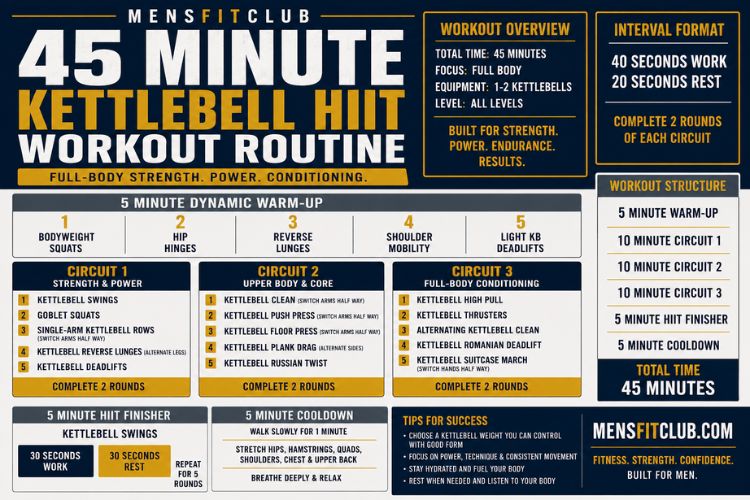
The workout is divided into five sections:
Warm-Up – 5 minutes
HIIT Circuit 1 – 10 minutes
HIIT Circuit 2 – 10 minutes
HIIT Circuit 3 – 10 minutes
Conditioning Finisher – 5 minutes
Cooldown – 5 minutes
Total training time: approximately 45 minutes.
For the main circuits, use approximately 40 seconds of work followed by 20 seconds of transition or recovery unless otherwise specified.
5-Minute Dynamic Warm-Up Kettlebell HIIT Workout Routine
Never jump directly into high-intensity kettlebell exercises without preparing your body.
Use the first five minutes to gradually increase your heart rate and practice the movement patterns that will appear later in the workout.
Minute 1: Bodyweight Squats
Perform slow bodyweight squats.
Keep your chest upright, brace your core, and push through your entire foot as you stand.
Minute 2: Hip Hinges
Practice the hip-hinge pattern without weight.
Push your hips backward while maintaining a neutral spine, then squeeze your glutes as you return to standing.
Minute 3: Reverse Lunges
Alternate legs while performing controlled reverse lunges.
Keep the movement smooth rather than trying to move quickly.
Minute 4: Arm Circles and Shoulder Mobility
Perform arm circles, shoulder rolls, and gentle overhead reaches.
This helps prepare the shoulders for presses and kettlebell rack positions.
Minute 5: Light Kettlebell Deadlifts
Finish the warm-up with light kettlebell deadlifts.
Use these repetitions to reinforce proper hip-hinge mechanics before beginning kettlebell swings.
Circuit 1: Kettlebell Strength and Power HIIT Routine
Perform the following five exercises for 40 seconds each, followed by 20 seconds of rest.
Complete two rounds for approximately 10 minutes.
Exercise 1: Kettlebell Swings
Stand with your feet approximately shoulder-width apart and place the kettlebell slightly in front of you.
Hinge at your hips, grip the kettlebell, and pull it between your legs. Drive your hips forward aggressively to propel the kettlebell upward.
The power should come primarily from your hips rather than your shoulders.
Allow the kettlebell to return naturally and immediately begin the next repetition.
Exercise 2: Goblet Squats
Hold the kettlebell close to your chest.
Sit your hips downward while keeping your torso controlled and your knees tracking naturally over your feet.
Push through the floor to return to standing.
Avoid rushing your repetitions. Controlled squats can still create significant cardiovascular demand during a 40-second interval.
Exercise 3: Single-Arm Kettlebell Rows
Place the kettlebell in one hand and hinge forward while keeping your spine neutral.
Pull the kettlebell toward your hip while keeping your elbow relatively close to your body.
Switch arms halfway through the interval.
Exercise 4: Kettlebell Reverse Lunges
Hold the kettlebell at chest height or in a goblet position.
Step one leg backward and lower into a reverse lunge.
Push through your front foot to return to standing and alternate legs.
Exercise 5: Kettlebell Deadlifts
Place the kettlebell between your feet.
Hinge at your hips, grab the handle, brace your core, and stand by extending your hips.
Squeeze your glutes at the top without excessively leaning backward.
After completing all five exercises, repeat the circuit once more.
Circuit 2: Upper-Body and Core HIIT Kettlebell Routine
The second circuit shifts more attention toward the shoulders, arms, back, and core while still incorporating lower-body movement.
Perform each exercise for 40 seconds with 20 seconds of recovery.
Complete two rounds.
Exercise 1: Kettlebell Clean
Begin with the kettlebell slightly in front of your body.
Use your hips to generate momentum and guide the kettlebell smoothly into the rack position.
Avoid allowing the kettlebell to slam against your forearm.
Switch arms halfway through the interval.
Exercise 2: Kettlebell Push Press
Start with the kettlebell in the rack position.
Slightly bend your knees and use leg drive to help press the kettlebell overhead.
Lower the kettlebell under control.
Switch sides halfway through the interval.
Exercise 3: Kettlebell Floor Press
Lie on your back with the kettlebell in one hand.
Press the kettlebell upward until your arm is extended, then lower it under control until your upper arm gently contacts the floor.
Switch arms halfway through.
Exercise 4: Kettlebell Plank Drag
Begin in a high plank position with the kettlebell outside one hand.
Reach across your body with the opposite hand and carefully drag the kettlebell underneath your torso.
Alternate sides while keeping your hips as stable as possible.
Exercise 5: Kettlebell Russian Twist
Sit on the floor with your torso slightly leaned backward.
Hold the kettlebell close to your chest and rotate your torso from side to side.
Keep the movement controlled.
Repeat the five exercises for a second round.
Circuit 3: Full-Body Kettlebell Conditioning HIIT Routine
The third circuit increases the conditioning challenge while continuing to train major muscle groups.
Use the same 40 seconds work and 20 seconds recovery structure.
Complete two rounds.
Exercise 1: Kettlebell High Pull
Begin with a kettlebell swing motion.
As the kettlebell rises, guide your elbow backward and upward before allowing the kettlebell to return.
Keep the kettlebell relatively close to your body.
Exercise 2: Kettlebell Thrusters
Hold the kettlebell at your chest.
Perform a squat and drive upward powerfully.
Use the momentum from your legs to help press the kettlebell overhead.
Return the kettlebell to your chest and immediately begin the next squat.
Exercise 3: Alternating Kettlebell Clean
Perform a kettlebell clean on one side, return the kettlebell safely, and alternate arms.
Focus on smooth transitions rather than maximum speed.
Exercise 4: Kettlebell Romanian Deadlift
Hold the kettlebell in front of your thighs.
Push your hips backward while maintaining a neutral spine.
Lower the kettlebell until you feel tension through your hamstrings, then extend your hips to return to standing.
Exercise 5: Kettlebell Suitcase March
Hold the kettlebell beside your body with one arm.
Stand tall and slowly march in place while resisting the kettlebell’s pull.
Switch hands halfway through.
Repeat the entire circuit once more.
5-Minute Kettlebell HIIT Finisher Routine
The final conditioning section uses a simple kettlebell swing interval.
Perform:
30 seconds kettlebell swings
30 seconds recovery
Repeat for five rounds.
Because you have already completed approximately 30 minutes of interval work, don’t sacrifice technique simply to perform more repetitions.
If your swing mechanics begin to deteriorate, reduce your speed or switch to kettlebell deadlifts.
5-Minute Cooldown
After finishing the HIIT portion, gradually lower your training intensity rather than immediately sitting down.
Spend approximately one minute walking slowly while taking controlled breaths.
Use the remaining four minutes for gentle stretches targeting the hips, hamstrings, quadriceps, shoulders, chest, and upper back.
Avoid aggressive stretching immediately after the workout.
How Heavy Should Your Kettlebell Be For This HIIT Routine?
There is no universal kettlebell weight that works for everyone.
Your ideal weight depends on your training experience, strength, exercise selection, and ability to maintain proper technique.
For explosive lower-body exercises such as swings and deadlifts, you may be able to use a heavier kettlebell.
For overhead presses, cleans, or complex movements, a lighter kettlebell may be more appropriate.
The kettlebell should feel challenging near the end of an interval without forcing you to compromise your technique.
If you cannot maintain control for most of the 40-second interval, reduce the weight.
How to Modify This Kettlebell HIIT Workout Routine for Beginners
Beginners should prioritize technique before intensity.
Instead of using 40-second work intervals, start with:
30 seconds work
30 seconds rest
You can also complete only one round of each main circuit during your first few sessions.
Replace complicated movements with simpler alternatives when necessary.
For example, replace kettlebell cleans with deadlifts or replace thrusters with goblet squats.
As your conditioning and kettlebell skills improve, gradually progress toward the complete 45-minute routine.
How to Make the Kettlebell HIIT Workout Routine More Difficult
Experienced kettlebell users have several ways to progress the routine.
You can gradually increase kettlebell weight, perform more repetitions during the same work interval, improve movement quality, or slightly reduce recovery periods.
Another option is using two kettlebells for selected exercises.
However, increasing difficulty should not come at the expense of technique.
Progress gradually and allow your body enough time to adapt.
How Often Should You Do a 45 Minute Kettlebell HIIT Workout?
For many recreational trainees, two or three kettlebell HIIT sessions per week can provide plenty of conditioning work.
Recovery requirements vary considerably depending on workout intensity, training experience, sleep, nutrition, and other exercise performed during the week.
Avoid assuming that more HIIT automatically produces better results.
You could combine kettlebell HIIT with traditional resistance training, walking, moderate cardio, mobility work, or recreational activities.
A sample week could include kettlebell HIIT on Monday and Thursday with strength training or lower-intensity activity on other days.
Common Kettlebell HIIT Mistakes
Choosing a Kettlebell That Is Too Heavy
Using excessive weight can quickly compromise technique, especially as fatigue accumulates.
Select a load you can control throughout the workout.
Turning Swings Into Squats
The kettlebell swing should primarily use a hip hinge.
Excessively bending your knees can turn the movement into more of a squat.
Lifting the Kettlebell With Your Arms
During swings, your hips should create the majority of the power.
Your arms primarily guide the kettlebell.
Ignoring Rest Periods
HIIT does not mean eliminating recovery.
Rest intervals allow you to maintain better movement quality during subsequent rounds.
Training Through Poor Technique
When fatigue causes your form to break down, stop the interval early or switch to an easier movement.
Completing a few additional repetitions is rarely worth increasing unnecessary injury risk.
Can a 45 Minute Kettlebell HIIT Workout Help With Fat Loss?
Kettlebell HIIT can be a useful component of a fat-loss program because it provides physical activity while helping maintain strength and muscle.
However, fat loss ultimately depends heavily on your overall energy balance.
Training should therefore be combined with an appropriate nutrition strategy, sufficient protein intake, adequate sleep, and consistent daily activity.
Instead of viewing kettlebell HIIT as a shortcut for burning fat, use it as one component of a sustainable fitness program.
Nutrition and Recovery After Kettlebell HIIT
Recovery becomes increasingly important as workout intensity increases.
A balanced post-workout meal containing protein, carbohydrates, and nutrient-rich foods can support recovery.
Hydration is also important, particularly when training in warm conditions or sweating heavily.
Sleep is another major component of recovery.
If you consistently feel exhausted before your next workout, consider reducing training volume or increasing recovery between HIIT sessions.
Final Thoughts on the 45 Minute Kettlebell HIIT Workout Routine
A 45 minute kettlebell HIIT workout routine offers a practical way to train strength, conditioning, muscular endurance, coordination, grip, and core stability within one session.
The workout doesn’t need dozens of complicated exercises to be effective. Fundamental movements such as kettlebell swings, goblet squats, deadlifts, rows, presses, lunges, and carries can create an extremely demanding full-body training session when organized into structured intervals.
Start with a kettlebell weight you can control, focus on clean repetitions, and gradually increase the challenge as your strength and conditioning improve.
The most important goal isn’t completing every interval at maximum speed. It is maintaining consistent effort while performing each kettlebell exercise safely and effectively.
When combined with sensible strength training, nutrition, daily activity, and adequate recovery, this 45 minute kettlebell HIIT workout can become a versatile addition to your weekly fitness routine.
To get more from your 45 minute kettlebell HIIT workout routine, you can mix up your weekly training with other kettlebell sessions from MensFitClub. Start with the Best Kettlebell HIIT Workout to learn more about combining high-intensity intervals with kettlebell exercises, or try the 40-Minute Kettlebell HIIT Workout for a slightly shorter full-body strength and conditioning session. On days when time is limited, the 30-Minute HIIT Workout With Kettlebell or 25-Minute Full Body Kettlebell HIIT Workout can keep your training consistent without requiring a full 45 minutes. For a longer strength-focused alternative with less emphasis on HIIT intervals, add the 45-Minute Full-Body Kettlebell Workout to your weekly routine to develop full-body strength, power, and conditioning.


Most Recommended

Subscribe to our Newsletter
Stay up to date on the latest men’s health, fitness and lifestyle trends and tips.
About Us
Men’s Fit Club was started with the goal of empowering men to get the most out of their lives. This meant going beyond exercise and diet tips to really address the broad range of issues that men face on a daily basis – topics like recreation, finding love, sexual health and even sound fashion advice.
Quick Links
© COPYRIGHT MEN'S FIT CLUB 2026. All Rights Reserved