
Best Gym HIIT Workouts Plan To Burn Fat & Build Strength
Best CrossFit Tabata Workout for a Full Body Burn
45-Minute Kettlebell HIIT Workout: Full-Body Fat Burning Routine
Best Gym HIIT Workouts Plan To Burn Fat & Build Strength
High-intensity interval training has become one of the most effective ways to combine cardiovascular conditioning, strength training, and calorie-burning exercise into a relatively short workout. The best gym HIIT workouts plan takes advantage of equipment such as dumbbells, kettlebells, barbells, rowing machines, treadmills, stationary bikes, and functional training stations to create challenging workouts that develop the entire body.
Unlike traditional steady-state cardio, where you maintain approximately the same intensity for an extended period, HIIT alternates challenging periods of exercise with recovery intervals. This allows you to perform repeated bursts of higher-intensity work while still having enough recovery to maintain good technique.
For men who want to lose body fat, improve endurance, maintain muscle, and become more athletic, a well-designed gym HIIT workout plan can be an excellent addition to a balanced fitness routine.
The key is not simply exercising as hard as possible. Effective HIIT requires intelligent exercise selection, appropriate work-to-rest ratios, progressive overload, and adequate recovery.
This guide provides a complete gym HIIT training strategy, including sample workouts, weekly programming, exercise options, and progression guidelines.
What Is a Gym HIIT Workout?
A gym HIIT workout combines periods of relatively intense exercise with predetermined recovery periods. A simple example might involve performing 30 seconds of hard work followed by 30–60 seconds of recovery before repeating the exercise.
The training can involve cardio equipment, resistance exercises, or a combination of both.
A gym provides significantly more possibilities than a basic home HIIT workout. You can combine exercises such as kettlebell swings, dumbbell thrusters, rowing, treadmill running, battle ropes, sled pushes, and bodyweight movements into one conditioning session.
A typical gym HIIT workout might last approximately 20–45 minutes, including warm-up and cooldown.
The actual high-intensity portion can be considerably shorter because the goal is quality rather than simply accumulating exercise time.
Benefits of the Best Gym HIIT Workouts
A structured gym HIIT workout provides several advantages for people who want an efficient training program.
Burn More Calories in Less Time
HIIT allows you to perform a considerable amount of work within a relatively short period.
Exercises that recruit large muscle groups—such as squats, rowing, swings, and thrusters—can significantly increase energy demands during the workout.
HIIT should not be viewed as a magical solution for fat loss, however. Your overall calorie balance, nutrition, sleep, daily activity, and resistance-training program remain extremely important.
Improve Cardiovascular Fitness
Repeated intervals challenge the cardiovascular system to deliver oxygen and nutrients to working muscles.
Cardio-based HIIT exercises such as treadmill intervals, rowing sprints, cycling, and stair climbing can gradually improve your conditioning when programmed appropriately.
Better conditioning can also help you recover more efficiently between sets during conventional strength workouts.
Maintain Strength and Muscle
Traditional HIIT is primarily conditioning rather than bodybuilding. However, resistance-based HIIT can provide a muscular stimulus when exercises are selected carefully.
Dumbbell squats, kettlebell swings, push-ups, rows, lunges, and loaded carries allow you to train muscles while increasing your heart rate.
For maximizing muscle growth, continue using traditional resistance training as the foundation of your program and use HIIT as supplementary conditioning.
Improve Athletic Conditioning
Many gym HIIT workouts involve explosive movements, rapid transitions, and full-body exercises.
These workouts can improve your ability to repeatedly produce effort while fatigued—a valuable quality for recreational sports and general physical preparedness.
Best Exercises for a Gym HIIT Workout Plan
The best HIIT exercises are movements that can be performed safely under fatigue and allow you to control the intensity.
You do not need complicated exercises. Simple movements performed consistently are often more effective.
Treadmill Intervals
The treadmill is one of the easiest pieces of equipment for structured HIIT.
After warming up thoroughly, alternate faster running intervals with walking or easy jogging.
For example:
30 seconds fast running
60–90 seconds walking
Repeat for 6–10 rounds
Beginners should avoid immediately attempting maximum-speed sprints. Gradually increase speed as conditioning and confidence improve.
Rowing Machine Intervals
The rowing machine provides an effective full-body cardiovascular workout involving the legs, hips, back, arms, and core.
Try:
30 seconds hard rowing
60 seconds easy rowing
Repeat for 8–12 rounds
Focus on maintaining efficient rowing technique rather than simply increasing stroke rate.
Stationary Bike Sprints
Cycling intervals are useful because they allow you to increase cardiovascular intensity without requiring complex movement patterns.
A straightforward workout is:
20 seconds hard cycling
70 seconds easy cycling
Repeat for 8–10 rounds
Resistance should be challenging enough to require effort but not so high that your pedaling mechanics deteriorate.
Kettlebell Swings
Kettlebell swings are excellent for developing hip power and conditioning.
The movement primarily involves the glutes, hamstrings, hips, back, and core.
Because technique is important, beginners should learn proper hip-hinge mechanics before incorporating high-volume swings into HIIT sessions.
Dumbbell Thrusters
The dumbbell thruster combines a squat with an overhead press.
Because the exercise involves both the upper and lower body, it can quickly elevate your heart rate.
Choose moderate dumbbells that allow you to maintain control throughout every repetition.
Sled Pushes
If your gym has a training sled, sled pushes can be an excellent conditioning exercise.
Push the sled approximately 15–30 meters before resting or walking back to the starting position.
Sled resistance can easily be adjusted according to your fitness level.
Battle Ropes
Battle ropes allow you to perform short, intense upper-body conditioning intervals.
A simple interval might be:
20 seconds battle ropes
40 seconds recovery
Repeat for 8–12 rounds
You can alternate between waves, slams, and other rope patterns.
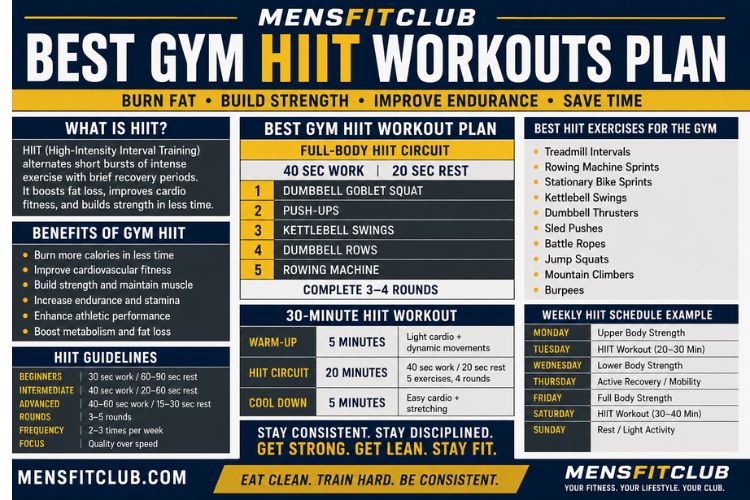
Best Gym HIIT Workout Plan
The following workout combines resistance exercises and cardio movements to train the entire body.
Begin with a 5–10 minute warm-up.
Perform light cardio followed by dynamic movements for the shoulders, hips, knees, and ankles.
Circuit 1: Full-Body Conditioning
Perform:
Dumbbell goblet squat – 40 seconds
Rest – 20 seconds
Push-ups – 40 seconds
Rest – 20 seconds
Kettlebell swings – 40 seconds
Rest – 20 seconds
Dumbbell rows – 40 seconds
Rest – 20 seconds
Rowing machine – 40 seconds
Rest – 60 seconds
Complete approximately three rounds.
This circuit combines pushing, pulling, lower-body training, hip-dominant movement, and cardiovascular exercise.
Choose weights that allow you to maintain good technique throughout the interval.
30-Minute Gym HIIT Workout
When time is limited, a 30-minute HIIT session can provide an efficient workout.
5-Minute Warm-Up
Spend approximately five minutes performing easy cycling, rowing, or treadmill walking.
Gradually increase the intensity.
Add several dynamic movements such as bodyweight squats, arm circles, lunges, and hip hinges.
20-Minute HIIT Circuit
Perform each exercise for 40 seconds followed by 20 seconds of recovery:
Dumbbell thrusters
Kettlebell swings
Mountain climbers
Dumbbell reverse lunges
Rowing machine
Complete four rounds.
Rest for approximately 60 seconds between rounds if necessary.
5-Minute Cooldown
Finish with easy walking or cycling.
Allow your breathing and heart rate to gradually return toward normal.
45-Minute Gym HIIT Workout
A longer HIIT workout should not simply involve 45 minutes of maximum effort.
Instead, divide the session into training blocks.
Block 1: Strength Conditioning
Perform three rounds:
Goblet squats – 10–12 reps
Dumbbell bench press – 10–12 reps
Dumbbell rows – 10 reps each side
Walking lunges – 10 reps each leg
Rest approximately 60–90 seconds between rounds.
Block 2: Cardio Intervals
Choose the treadmill, bike, or rowing machine.
Perform:
30 seconds hard effort
60 seconds recovery
Repeat approximately eight times.
Block 3: Conditioning Finisher
Perform:
Kettlebell swings – 30 seconds
Battle ropes – 30 seconds
Rest – 60 seconds
Repeat for four rounds.
This structure provides resistance training, cardiovascular intervals, and a short conditioning finisher without requiring continuous maximum-intensity exercise.
Dumbbell Gym HIIT Workout
Dumbbells are particularly useful for HIIT because you can perform many different exercises without moving around the gym.
Try this circuit:
Dumbbell goblet squat – 12 reps
Dumbbell push press – 10 reps
Dumbbell Romanian deadlift – 12 reps
Dumbbell reverse lunge – 8 reps each leg
Dumbbell bent-over row – 10 reps
Dumbbell floor or bench press – 10 reps
Rest approximately 60–90 seconds.
Complete 3–4 rounds.
Use moderate weights and prioritize controlled repetitions rather than rushing.
Beginner Gym HIIT Workout Plan
Beginners should start with longer recovery periods and relatively simple exercises.
Try:
Bike – 30 seconds moderate-hard
Rest – 60 seconds
Bodyweight squat – 30 seconds
Rest – 60 seconds
Dumbbell row – 30 seconds
Rest – 60 seconds
Incline push-up – 30 seconds
Rest – 60 seconds
Rowing machine – 30 seconds
Rest – 90 seconds
Complete 2–3 rounds.
As your conditioning improves, gradually increase the work interval, reduce recovery slightly, or add another round.
Avoid changing everything simultaneously.
Advanced Gym HIIT Workout
Experienced trainees can use more demanding exercises and shorter recovery intervals.
Try four rounds of:
Kettlebell swings – 40 seconds
Dumbbell thrusters – 40 seconds
Rowing machine – 40 seconds
Burpees – 40 seconds
Battle ropes – 40 seconds
Rest approximately 20 seconds between exercises and 90 seconds between rounds.
The objective is maintaining a challenging but sustainable pace across the entire workout rather than dominating the first round and struggling through the remaining rounds.
Gym HIIT Workout for Fat Loss
If fat loss is your primary goal, HIIT should be combined with an appropriate nutrition strategy and regular resistance training.
A useful fat-loss HIIT workout could include:
Treadmill incline walk/run – 45 seconds
Kettlebell swings – 30 seconds
Dumbbell squats – 30 seconds
Rowing machine – 45 seconds
Mountain climbers – 30 seconds
Rest approximately 60–90 seconds before repeating.
Complete 3–5 rounds depending on your fitness level.
HIIT can increase calorie expenditure, but nutrition will ultimately play a major role in whether body weight decreases.
Weekly Gym HIIT Workout Schedule
HIIT is demanding, so more is not automatically better.
For many recreational trainees, approximately two or three HIIT sessions per week can provide plenty of conditioning.
A balanced weekly schedule might look like this:
Monday: Upper-body strength training
Tuesday: 25–30 minute gym HIIT workout
Wednesday: Lower-body strength training
Thursday: Recovery or light cardio
Friday: Full-body strength training
Saturday: 30–40 minute gym HIIT workout
Sunday: Rest or low-intensity activity
This schedule allows HIIT to complement resistance training rather than constantly competing with recovery.
How Long Should a Gym HIIT Workout Be?
HIIT workouts do not need to be extremely long.
A complete workout may take approximately 20–45 minutes once warm-up, intervals, recovery periods, and cooldown are included.
Beginners might start with 15–25 minutes.
Intermediate trainees might perform approximately 25–35 minutes.
Experienced trainees may occasionally perform longer conditioning sessions, but intensity should be adjusted appropriately.
Remember that HIIT refers to the intensity and interval structure rather than simply exercising quickly for a long time.
How Often Should You Do HIIT at the Gym?
Most people do not need daily HIIT.
Performing very demanding conditioning workouts every day can interfere with recovery, resistance-training performance, and exercise quality.
Two sessions per week are a practical starting point.
You can potentially progress to three sessions depending on your fitness level, training volume, recovery, and goals.
Leave adequate recovery between especially demanding lower-body HIIT sessions.
How to Progress Your Gym HIIT Workout
Progression is necessary if you want your fitness to continue improving.
However, HIIT progression should be gradual.
Increase Work Time
You might progress from:
30 seconds work / 60 seconds rest
to:
40 seconds work / 60 seconds rest.
Reduce Recovery
Another option is maintaining the same work interval while slightly reducing rest.
For example:
30 seconds work / 60 seconds rest
could eventually become:
30 seconds work / 45 seconds rest.
Add Another Round
If you currently complete three rounds comfortably, progress to four rounds.
Increase Resistance
For dumbbell or kettlebell exercises, gradually increase weight while maintaining good technique.
Do not increase resistance simply to make the workout feel harder.
Improve Output
Progress can also mean covering more distance on the rower, maintaining a slightly faster treadmill speed, or producing more consistent bike power across the same intervals.
Common Gym HIIT Workout Mistakes
One of the biggest mistakes is treating every HIIT session like a competition.
HIIT should be challenging, but uncontrolled fatigue can lead to poor technique.
Another mistake is choosing exercises that are too complicated. Technical barbell lifts may not be ideal for fast-paced conditioning circuits unless you are experienced and the programming is carefully controlled.
Using excessively heavy weights is another common problem.
The goal of resistance-based HIIT is usually conditioning rather than testing your one-repetition maximum.
Finally, avoid skipping the warm-up.
High-intensity training places considerable demand on the muscles, joints, and cardiovascular system. A progressive warm-up helps prepare your body for the harder work ahead.
Safety Tips for High-Intensity Gym Workouts
Always begin with an appropriate warm-up and increase intensity gradually.
If you are new to exercise, returning after a long break, or have a medical condition that may affect exercise tolerance, consider getting appropriate medical or professional guidance before starting vigorous HIIT.
Stop exercising if you experience concerning symptoms such as chest pain, faintness, or unusual shortness of breath.
Exercise quality should remain more important than speed.
When technique begins to deteriorate significantly, increase the recovery period or end the interval.
Best Gym HIIT Workouts Plan: Final Thoughts
The best gym HIIT workouts plan does not require dozens of complicated exercises. A combination of fundamental resistance movements and effective cardio equipment can create an extremely versatile conditioning program.
Exercises such as dumbbell squats, kettlebell swings, push-ups, rows, lunges, treadmill intervals, cycling, and rowing can be combined in countless ways.
Beginners should start with approximately two HIIT workouts per week and use generous recovery intervals. More experienced trainees can gradually increase training density, resistance, rounds, or cardiovascular output.
Most importantly, treat HIIT as one component of your overall fitness program.
Combine gym HIIT workouts with progressive strength training, balanced nutrition, sufficient protein, quality sleep, and appropriate recovery. This approach can help you improve cardiovascular fitness, increase work capacity, support fat-loss goals, and build a stronger, more athletic body without spending hours performing traditional cardio.
Want to add more variety to your gym HIIT training? Start with our Best HIIT Workouts for Men for additional high-intensity training ideas, or follow the 30 Minute HIIT Workout when you need a shorter fat-burning session. For a longer total-body challenge, try this 45-Minute Full Body HIIT Workout. You can also increase resistance with the 30 Minute Dumbbell HIIT Workout or incorporate explosive strength and conditioning with the Best Kettlebell HIIT Workout. Together, these workouts can help you build a more varied HIIT schedule while targeting cardiovascular fitness, strength, conditioning, and full-body performance.


Most Recommended

Subscribe to our Newsletter
Stay up to date on the latest men’s health, fitness and lifestyle trends and tips.
About Us
Men’s Fit Club was started with the goal of empowering men to get the most out of their lives. This meant going beyond exercise and diet tips to really address the broad range of issues that men face on a daily basis – topics like recreation, finding love, sexual health and even sound fashion advice.
Quick Links
© COPYRIGHT MEN'S FIT CLUB 2026. All Rights Reserved