
Best Gym HIIT Workouts Plan To Burn Fat & Build Strength
Best CrossFit Tabata Workout for a Full Body Burn
45-Minute Kettlebell HIIT Workout: Full-Body Fat Burning Routine
4 Week CrossFit Workout for Muscle Building
Building muscle does not always require traditional bodybuilding workouts built around slow isolation exercises and long gym sessions. A properly structured 4 week CrossFit workout for muscle building can combine heavy strength training, functional movements, moderate-to-high training volume, and challenging conditioning to help develop a stronger, more muscular, athletic physique.
CrossFit is often associated with high-intensity circuits, burpees, box jumps, rowing, and fast-paced workouts. However, CrossFit training can also include squats, deadlifts, presses, pull-ups, Olympic lifting variations, dumbbell exercises, and other compound movements that provide significant muscular stimulus.
The key is programming.
If every workout becomes an all-out conditioning competition, muscle growth may not be the primary adaptation. Instead, a muscle-building CrossFit program should prioritize progressive resistance training while using conditioning strategically.
This 4 week CrossFit workout plan for muscle building is designed around that principle. You will train major movement patterns multiple times per week, gradually increase training demands, and finish many sessions with short CrossFit-style workouts that improve work capacity without allowing conditioning to dominate the entire program.
Can CrossFit Build Muscle?
Yes, CrossFit can help build muscle when resistance, volume, recovery, and nutrition are properly managed.
Muscle hypertrophy occurs primarily when muscles repeatedly experience sufficient mechanical tension and training volume. CrossFit provides numerous opportunities to create these conditions through movements such as squats, deadlifts, presses, rows, pull-ups, lunges, carries, and Olympic lifting variations.
The problem is that not every CrossFit workout is optimized specifically for hypertrophy.
Completing hundreds of lightweight repetitions as quickly as possible may improve conditioning and muscular endurance, but that does not automatically make it the best strategy for maximizing muscle growth.
For this program, the workouts combine traditional strength and hypertrophy principles with CrossFit-style conditioning.
The goal is simple: lift first, condition second.
How the 4 Week CrossFit Muscle Building Program Works
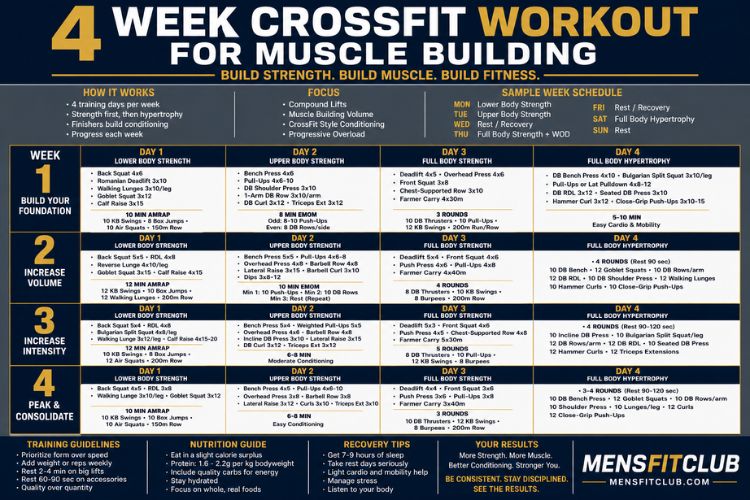
This four-week program uses four primary training days each week.
A typical schedule looks like this:
Monday: Lower-body strength and conditioning
Tuesday: Upper-body strength and hypertrophy
Wednesday: Recovery
Thursday: Full-body strength and CrossFit conditioning
Friday: Recovery
Saturday: Full-body muscle-building workout
Sunday: Complete rest
You can move the days around according to your schedule, but try to avoid completing all four sessions consecutively.
Recovery becomes increasingly important as training intensity rises.
Strength Work Comes First For CrossFit Muscle Building
The primary compound lift is performed near the beginning of each workout while energy levels are highest.
These exercises include movements such as back squats, deadlifts, bench presses, overhead presses, and front squats.
Generally, you will perform approximately 3–5 sets of 4–8 repetitions.
Use challenging resistance while maintaining technically sound repetitions.
Hypertrophy Work Builds Additional Volume
After the primary strength movement, you will perform accessory exercises using moderate repetitions.
Most accessory movements fall within approximately 8–15 repetitions per set.
These exercises increase training volume for major muscle groups without requiring maximum weights.
CrossFit Finishers Improve Work Capacity
Short AMRAP, EMOM, or circuit-style workouts are included near the end of selected sessions.
These should be intense but controlled.
You do not need to collapse on the floor after every workout. The purpose of the conditioning component is to develop fitness while supporting the overall muscle-building program.
Week 1: Build Your CrossFit Muscle Strength Foundation
The first week establishes baseline training volume and allows you to become comfortable with the exercises.
Avoid chasing personal records during Week 1.
Choose weights that allow you to complete every repetition with good technique while leaving approximately one or two quality repetitions available at the end of most working sets.
Day 1: Lower Body Strength
Begin with 5–10 minutes of easy rowing, cycling, or jogging followed by dynamic lower-body mobility.
Back Squat: 4 sets x 6 reps
Romanian Deadlift: 3 sets x 10 reps
Walking Lunges: 3 sets x 10 reps per leg
Goblet Squat: 3 sets x 12 reps
Standing Calf Raise: 3 sets x 15 reps
Finish with a 10-minute AMRAP:
10 kettlebell swings
8 box jumps or step-ups
10 air squats
150-meter row
Move steadily rather than sprinting through the opening rounds.
Day 2: Upper Body CrossFit Muscle Building
Bench Press: 4 sets x 6 reps
Pull-Ups: 4 sets x 6–10 reps
Dumbbell Shoulder Press: 3 sets x 10 reps
One-Arm Dumbbell Row: 3 sets x 10 reps per arm
Dumbbell Lateral Raise: 3 sets x 12–15 reps
Dumbbell Curl: 3 sets x 12 reps
Triceps Extension: 3 sets x 12 reps
Finish with an 8-minute EMOM.
Odd minutes: 8–10 push-ups.
Even minutes: 8 dumbbell rows per side.
Day 3: Full Body Strength
Deadlift: 4 sets x 5 reps
Overhead Press: 4 sets x 6 reps
Front Squat: 3 sets x 8 reps
Chest-Supported Row: 3 sets x 10 reps
Farmer Carry: 4 x 30 meters
Finish with three controlled rounds:
10 dumbbell thrusters
10 pull-ups or assisted pull-ups
12 kettlebell swings
200-meter run or row
Rest approximately 60–90 seconds between rounds when necessary.
Day 4: Full Body Hypertrophy CrossFit Muscle Building
Dumbbell Bench Press: 4 sets x 10 reps
Bulgarian Split Squat: 3 sets x 10 reps per leg
Lat Pulldown or Pull-Ups: 4 sets x 8–12 reps
Dumbbell Romanian Deadlift: 3 sets x 12 reps
Seated Dumbbell Shoulder Press: 3 sets x 10 reps
Hammer Curl: 3 sets x 12 reps
Close-Grip Push-Ups: 3 sets x 10–15 reps
Finish with 5–10 minutes of easy cardio and mobility.
Week 2: Increase Training Volume
During Week 2, your objective is to increase total workload.
You can accomplish this by adding a small amount of weight to your primary lifts or performing an additional set on selected accessory movements.
Avoid increasing everything simultaneously.
Small improvements accumulate quickly.
Day 1: Squat and Leg Development CrossFit Muscle Building
Back Squat: 5 sets x 5 reps
Romanian Deadlift: 4 sets x 8 reps
Reverse Lunge: 4 sets x 10 reps per leg
Goblet Squat: 3 sets x 15 reps
Calf Raise: 4 sets x 15 reps
12-minute AMRAP:
12 kettlebell swings
10 box jumps
12 walking lunges
200-meter row
Day 2: Upper Body Strength
Bench Press: 5 sets x 5 reps
Weighted or Bodyweight Pull-Ups: 4 sets x 6–8 reps
Overhead Press: 4 sets x 8 reps
Barbell Row: 4 sets x 8 reps
Lateral Raise: 3 sets x 15 reps
Barbell Curl: 3 sets x 10 reps
Dips: 3 sets x 8–12 reps
Finish with a 10-minute alternating EMOM:
Minute 1: 10 push-ups
Minute 2: 10 dumbbell rows
Minute 3: Rest
Repeat.
Day 3: Deadlift and Full Body Power
Deadlift: 5 sets x 4 reps
Front Squat: 4 sets x 6 reps
Push Press: 4 sets x 6 reps
Pull-Ups: 4 sets x 8 reps
Farmer Carry: 4 x 40 meters
Finish with four rounds:
8 dumbbell thrusters
10 kettlebell swings
8 burpees
200-meter row
Keep technique consistent even as fatigue increases.
Day 4: Hypertrophy CrossFit Muscle Building Workout
Perform four rounds at a controlled muscle-building pace:
10 dumbbell bench presses
12 goblet squats
10 dumbbell rows per arm
12 Romanian deadlifts
10 dumbbell shoulder presses
12 walking lunges per leg
10 hammer curls
10 close-grip push-ups
Rest approximately 90 seconds between rounds.
Unlike a traditional WOD, the objective is not necessarily to finish as quickly as possible. Control the eccentric portion of each repetition and maintain muscular tension.
Week 3: Increase Intensity
Week 3 is the hardest week of the program.
Training volume remains significant while resistance increases on major compound exercises.
This is where disciplined recovery becomes extremely important.
Day 1: Heavy Lower Body
Back Squat: 5 sets x 4 reps
Romanian Deadlift: 4 sets x 8 reps
Bulgarian Split Squat: 4 sets x 8 reps per leg
Walking Lunge: 3 sets x 12 reps per leg
Calf Raise: 4 sets x 15–20 reps
Finish with a 12-minute AMRAP:
10 kettlebell swings
8 box jumps
12 air squats
200-meter row
Day 2: Heavy Upper Body
Bench Press: 5 sets x 4 reps
Weighted Pull-Ups: 5 sets x 5 reps
Overhead Press: 4 sets x 6 reps
Barbell Row: 4 sets x 8 reps
Incline Dumbbell Press: 3 sets x 10 reps
Lateral Raise: 3 sets x 15 reps
Dumbbell Curl: 3 sets x 12 reps
Triceps Extension: 3 sets x 12 reps
Finish with 6–8 minutes of moderate conditioning rather than maximum-intensity cardio.
Day 3: Full Body Strength and Power
Deadlift: 5 sets x 3 reps
Front Squat: 4 sets x 6 reps
Push Press: 4 sets x 5 reps
Chest-Supported Row: 4 sets x 8 reps
Farmer Carry: 5 x 30 meters
Complete five rounds:
8 dumbbell thrusters
10 pull-ups
12 kettlebell swings
8 burpees
Rest 60 seconds after each round.
Day 4: Muscle Building Circuit
Perform four rounds:
10 incline dumbbell presses
10 Bulgarian split squats per leg
12 dumbbell rows per arm
12 dumbbell Romanian deadlifts
10 seated shoulder presses
12 hammer curls
12 triceps extensions
Rest 90–120 seconds between rounds.
Focus on muscular contraction rather than speed.
Week 4: Peak and Consolidate Your Progress
Week 4 does not need to become an endless test of physical exhaustion.
Instead, use this week to demonstrate improvements in strength, muscular endurance, technique, and overall work capacity.
Day 1: Lower Body Strength
Back Squat: 4 sets x 5 reps
Romanian Deadlift: 3 sets x 8 reps
Walking Lunge: 3 sets x 10 reps per leg
Goblet Squat: 3 sets x 12 reps
Finish with a 10-minute AMRAP:
10 kettlebell swings
10 box jumps
10 air squats
150-meter row
Day 2: Upper Body Strength
Bench Press: 4 sets x 5 reps
Pull-Ups: 4 sets x 6–10 reps
Overhead Press: 3 sets x 8 reps
Barbell Row: 3 sets x 8 reps
Lateral Raise: 3 sets x 12 reps
Curls: 3 sets x 10 reps
Triceps Extensions: 3 sets x 10 reps
Finish with an easy 6–8 minute conditioning circuit.
Day 3: Full Body CrossFit Strength
Deadlift: 4 sets x 4 reps
Front Squat: 3 sets x 6 reps
Push Press: 3 sets x 6 reps
Pull-Ups: 3 sets x 8 reps
Farmer Carry: 3 x 40 meters
Finish with three rounds:
10 dumbbell thrusters
12 kettlebell swings
8 burpees
200-meter row
Day 4: Final Muscle Building Workout
Complete three or four rounds:
10 dumbbell bench presses
12 goblet squats
10 dumbbell rows per arm
12 Romanian deadlifts
10 shoulder presses
10 lunges per leg
12 curls
12 close-grip push-ups
Take your time and maintain good technique.
How Heavy Should You Lift?
For primary compound exercises, choose weights that feel challenging near the end of each working set while still allowing technically sound repetitions.
You generally do not need to reach muscular failure.
For example, when performing six repetitions, select a weight you could potentially perform for another one or two repetitions if necessary.
This approach creates significant training stimulus while controlling fatigue.
Accessory exercises can be performed somewhat closer to failure, particularly during the final set.
Progressive Overload During the 4 Week Program
Progressive overload is one of the most important principles for building muscle.
Your body adapts when training gradually becomes more demanding.
During this 4 week CrossFit muscle building workout, progression can come from several sources:
- Increasing resistance
- Performing additional repetitions
- Adding sets
- Improving exercise technique
- Increasing range of motion
- Reducing unnecessary rest
- Completing more quality work during conditioning
Do not attempt to improve every variable simultaneously.
For major lifts, adding approximately 2.5–5 pounds to upper-body exercises or 5–10 pounds to lower-body exercises can represent meaningful progression when technique remains strong.
Rest Periods for Muscle Building
Rest periods depend on the exercise.
For heavy squats, deadlifts, bench presses, and presses, approximately 2–4 minutes between demanding sets may be appropriate.
Accessory exercises generally require approximately 60–90 seconds.
During hypertrophy circuits, rest whenever necessary to maintain quality repetitions.
Remember that shorter rest is not automatically better.
If inadequate recovery causes your strength to decrease dramatically, you may actually reduce the quality of your muscle-building stimulus.
Nutrition for CrossFit Muscle Growth
Training creates the stimulus for muscle development, but nutrition provides the materials necessary for recovery and growth.
Protein should be a major nutritional priority.
A commonly used range for resistance-trained adults is approximately 1.6–2.2 grams of protein per kilogram of body weight per day, depending on overall calorie intake, training volume, goals, and individual needs.
Quality protein sources include eggs, poultry, fish, lean meat, Greek yogurt, cottage cheese, dairy products, beans, lentils, and other protein-rich foods.
Do Not Ignore Carbohydrates
CrossFit workouts can rely heavily on glycogen.
Carbohydrates can therefore play an important role in supporting training performance.
Foods such as rice, potatoes, oats, fruit, whole grains, pasta, and other carbohydrate sources can help provide energy for demanding workouts.
Eat Enough Calories
Building muscle is difficult when you are consistently consuming far fewer calories than your body requires.
A modest calorie surplus may help support muscle gain, although beginners and individuals returning to training may sometimes gain muscle without a substantial surplus.
Avoid using muscle building as an excuse for uncontrolled overeating.
The objective should be gradual improvements in strength and muscle mass rather than rapid increases in body weight.
Recovery Between CrossFit Workouts
Muscles grow during recovery, not during the workout itself.
Aim for consistent, adequate sleep and avoid turning every recovery day into another demanding training session.
Light activities such as walking, easy cycling, stretching, or mobility work can be useful on recovery days.
Pay attention to persistent signs of inadequate recovery such as decreasing performance, unusual soreness, disrupted sleep, declining motivation, or consistently heavy-feeling workouts.
One poor workout does not necessarily mean anything is wrong. A pattern of declining performance deserves attention.
Common CrossFit Muscle Building Mistakes
Turning Every Workout Into a Race
Speed has a place in CrossFit, but muscle-building exercises should not automatically become competitions.
Control your repetitions and prioritize tension.
Performing Too Much Conditioning
More conditioning is not necessarily better when hypertrophy is the primary goal.
Excessive conditioning can increase fatigue and interfere with recovery from strength training.
Keep conditioning relatively short and purposeful.
Using Poor Technique Under Fatigue
Do not sacrifice movement quality just to complete a faster time.
This becomes particularly important with technical or heavily loaded exercises.
Changing Workouts Constantly
CrossFit is known for variety, but muscle growth benefits from measurable progression.
Repeating major exercises allows you to determine whether you are becoming stronger.
Variety should complement progression rather than replace it.
Ignoring Recovery
Four demanding CrossFit sessions plus several additional intense workouts every week can quickly become excessive.
Your recovery capacity is limited.
Use rest days strategically.
Who Should Use This 4 Week CrossFit Muscle Building Workout?
This program is best suited to people who already understand basic resistance-training movements and want to combine muscle building with CrossFit-style fitness.
Complete beginners may benefit from learning foundational exercises with a qualified coach before attempting faster circuits or technical movements.
Exercises can also be modified according to experience and available equipment.
For example, box jumps can become step-ups, pull-ups can become assisted pull-ups or pulldowns, and running can be replaced with rowing or cycling.
Olympic lifts are intentionally not essential to this plan because exercises such as cleans and snatches require technical proficiency that cannot be adequately learned from a written workout program alone.
What Results Can You Expect After 4 Weeks?
Four weeks is enough time to establish momentum, improve exercise technique, increase strength, and potentially notice early changes in muscular development.
However, substantial muscle growth requires more than one month.
Think of this four-week CrossFit program as a training block rather than a complete transformation.
At the end of Week 4, compare your performance with Week 1.
Look at your squat, deadlift, bench press, overhead press, pull-up performance, workout quality, and recovery.
If you are stronger and completing more high-quality work, the program is moving in the right direction.
What Should You Do After Week 4?
After completing the program, consider taking several easier training days before beginning another demanding block.
You can then repeat the program with slightly heavier starting weights or move into another structured strength and hypertrophy phase.
Avoid repeating exactly the same loads indefinitely.
Your next training block should provide a new but manageable progression challenge.
Final Thoughts on the 4 Week CrossFit Workout for Muscle Building
A successful 4 week CrossFit workout for muscle building should combine the best elements of strength training, hypertrophy programming, and functional conditioning rather than relying entirely on exhausting WODs.
Heavy compound movements provide the foundation. Moderate-repetition accessory exercises increase muscle-building volume. Short CrossFit-style finishers develop conditioning and work capacity.
Most importantly, progression gives the program direction.
Train four days per week, gradually increase your workload, consume enough protein and calories, prioritize recovery, and maintain good exercise technique even when workouts become challenging.
CrossFit does not have to be purely about finishing workouts faster. With intelligent programming, it can become an effective approach for developing strength, muscle, conditioning, and athletic performance within the same training plan.
Consistency beyond these four weeks ultimately determines your results. Use the program to establish a strong foundation, track your progress, and continue building on your strength and performance during future training blocks.
Want to continue building strength, muscle, and athletic conditioning after completing this 4 week CrossFit workout? MensFitClub has several training guides that complement this program. Try our 45 Minute Full Body CrossFit Workout for a combination of strength and metabolic conditioning, or use our complete CrossFit Workout Plan to explore additional CrossFit programming strategies. For more hypertrophy-focused training, check out the Full Body Muscle Building Workout for Men and our guide to the Top Muscle Building Workouts to Gain Size and Strength. You can also add more structured resistance training with our Full Body Workout Split Routine to keep progressing after your four-week CrossFit training block.


Most Recommended

Subscribe to our Newsletter
Stay up to date on the latest men’s health, fitness and lifestyle trends and tips.
About Us
Men’s Fit Club was started with the goal of empowering men to get the most out of their lives. This meant going beyond exercise and diet tips to really address the broad range of issues that men face on a daily basis – topics like recreation, finding love, sexual health and even sound fashion advice.
Quick Links
© COPYRIGHT MEN'S FIT CLUB 2026. All Rights Reserved