
Full Body HIIT Routine With Dumbbells (Build Muscle + Burn Fat)
CrossFit WOD Workout for Beginners to Get Started
40 Minute Beginner HIIT Workout: Full Body Routine
Double Under Workout CrossFit WODs Sets And Reps
CrossFit WOD Workout for Beginners to Get Started
Starting CrossFit can feel intimidating when you first see athletes performing heavy barbell lifts, pull-ups, box jumps, kettlebell swings, and high-intensity conditioning workouts. Fortunately, you do not need advanced strength or elite conditioning to begin. A properly designed CrossFit WODs workout for beginners focuses on learning fundamental movements, developing cardiovascular fitness, improving strength, and gradually increasing workout intensity.
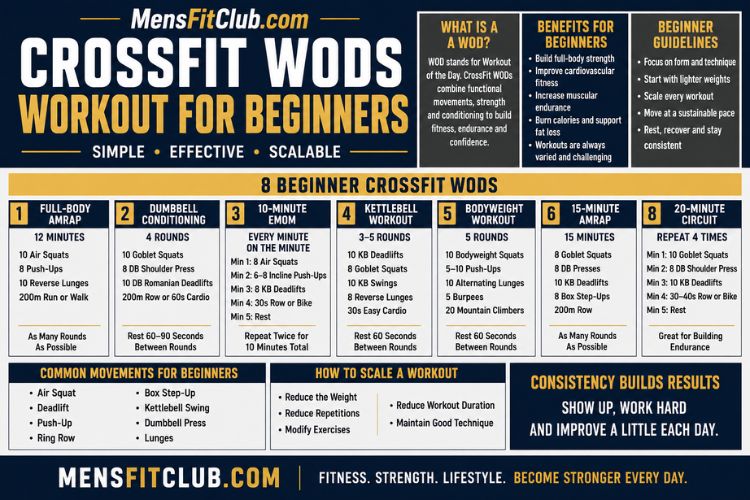
WOD stands for Workout of the Day, and it is one of the most recognizable parts of CrossFit-style training. A WOD typically combines several exercises into a structured workout using formats such as rounds for time, AMRAPs, EMOMs, circuits, or strength-and-conditioning sessions.
For beginners, the goal should not be completing workouts as quickly as possible. Instead, the priority is developing proper technique, learning how to pace workouts, building a foundation of strength, and becoming comfortable with common CrossFit exercises.
This guide explains how beginner CrossFit WODs work and provides several workouts you can use to build strength, endurance, conditioning, and confidence.
What Is a CrossFit Beginner WOD Workout?
A CrossFit WOD is a structured workout that typically combines elements of strength training, gymnastics, bodyweight exercise, and cardiovascular conditioning.
Instead of following exactly the same routine every training session, CrossFit workouts frequently change exercises, rep ranges, workout duration, and training formats. This variation can help athletes develop multiple areas of fitness instead of focusing exclusively on one physical quality.
A WOD might include movements such as squats, push-ups, kettlebell swings, rowing, running, deadlifts, burpees, box step-ups, presses, and pull-ups.
A beginner workout could be as simple as completing several rounds of air squats, push-ups, and rowing.
More advanced workouts may involve Olympic weightlifting movements, heavy barbells, handstand exercises, muscle-ups, and high-volume gymnastics.
Beginners should concentrate on scalable movements before progressing toward those advanced exercises.
Benefits of CrossFit WODs for Beginners
CrossFit-style workouts can provide an efficient combination of resistance training and cardiovascular conditioning.
Build Full-Body Strength
Many CrossFit exercises use compound movement patterns that involve several muscle groups simultaneously.
Squats train the quadriceps, glutes, hamstrings, and core. Deadlifts strengthen the posterior chain, while presses develop the shoulders and triceps.
When these movements are programmed consistently, beginners can gradually develop full-body strength.
Improve Cardiovascular Conditioning
Running, rowing, cycling, jump rope, burpees, and other conditioning exercises frequently appear in WODs.
Combining these movements with resistance exercises can significantly increase the cardiovascular demand of a workout.
Beginners should initially maintain a sustainable pace rather than trying to match experienced CrossFit athletes.
Increase Muscular Endurance
CrossFit WODs often involve moderate-to-high repetitions performed across several rounds.
Over time, this style of training can improve your ability to repeatedly perform movements while experiencing muscular fatigue.
Make Workouts More Interesting
One reason many people enjoy CrossFit is workout variety.
One session might involve kettlebells and rowing, while another might combine dumbbells, squats, and burpees.
This variation can make training feel less repetitive.
How Often Should Beginners Do CrossFit WODs Workout?
Most beginners can start with approximately three CrossFit workouts per week.
A simple weekly schedule could look like:
Monday – CrossFit WOD
Tuesday – Rest or light activity
Wednesday – CrossFit WOD
Thursday – Rest
Friday – CrossFit WOD
Saturday – Walking, mobility, or easy cardio
Sunday – Rest
Three weekly workouts provide opportunities to practice movements while leaving recovery days between demanding sessions.
After several weeks of consistent training, some people may gradually increase training frequency depending on experience, recovery, goals, and workout intensity.
Beginner CrossFit WOD Workout Structure
A well-designed beginner session should include more than simply starting a stopwatch and exercising as hard as possible.
Warm-Up
Spend approximately 5–10 minutes preparing your muscles and joints.
A beginner warm-up could include brisk walking or easy rowing followed by bodyweight squats, arm circles, hip hinges, lunges, and light movement practice.
The objective is to gradually raise your body temperature and rehearse the movements appearing in the workout.
Skill or Strength Practice
Before the conditioning portion, spend approximately 10–20 minutes practicing one fundamental movement.
Examples include:
Air squats
Goblet squats
Deadlifts
Dumbbell presses
Kettlebell swings
Ring rows
Box step-ups
Technique should remain the priority.
WOD
The main conditioning workout might last approximately 8–20 minutes for a beginner.
Starting with shorter sessions makes it easier to maintain good movement quality.
Cooldown
Finish with several minutes of easy walking or cycling followed by comfortable mobility work.
CrossFit WODs Workout for Beginners
The following beginner CrossFit WODs use relatively simple exercises that can be scaled according to your current fitness level.
Beginner WOD Workout 1: Full-Body AMRAP
Perform as many quality rounds as possible in 12 minutes.
Workout
10 air squats
8 push-ups
10 alternating reverse lunges
200-meter walk or run
Rest whenever necessary.
The objective is consistent movement throughout the entire 12 minutes.
Beginner Modification
Perform push-ups against a bench or elevated surface if standard floor push-ups are too difficult.
You can also replace running with approximately one minute of brisk walking, cycling, or rowing.
Beginner WOD 2: Dumbbell Conditioning Workout
Complete 4 rounds.
Workout
10 dumbbell goblet squats
8 dumbbell shoulder presses
10 dumbbell Romanian deadlifts
200-meter row or approximately 60 seconds of cardio
Rest 60–90 seconds between rounds if necessary.
Choose dumbbells that allow every repetition to be completed with controlled technique.
Beginner WOD Workout 3: 10-Minute EMOM
EMOM means Every Minute on the Minute.
Perform the assigned exercise at the beginning of each minute. Whatever time remains in that minute becomes your recovery period.
Workout
Minute 1: 8 air squats
2: 6–8 incline push-ups
3: 8 kettlebell deadlifts
4: 30 seconds easy rowing or cycling
Minute 5: Rest
Repeat twice for 10 minutes.
This format teaches beginners how to manage workload and recovery.
Beginner WOD 4: Kettlebell Workout
Complete 3–5 rounds depending on your fitness level.
Workout
10 kettlebell deadlifts
8 goblet squats
10 kettlebell swings
8 alternating reverse lunges
30 seconds of easy cardio
Rest approximately one minute between rounds.
Beginners who have not learned kettlebell swings should continue using kettlebell deadlifts until they understand the hip-hinge movement.
Beginner WOD 5: Bodyweight CrossFit Workout
No equipment is required for this workout.
Complete 5 rounds at a comfortable pace.
Workout
10 bodyweight squats
5–10 push-ups
10 alternating lunges
5 burpees or step-back burpees
20 mountain climbers
Rest 60 seconds between rounds.
Rather than racing through the workout, concentrate on completing every repetition with consistent technique.
Beginner WOD Workout 6: 15-Minute AMRAP
Complete as many controlled rounds as possible in 15 minutes.
Workout
8 goblet squats
8 dumbbell presses
10 kettlebell deadlifts
8 box step-ups
200-meter row
Keep track of your completed rounds.
Several weeks later, you can repeat the workout and compare your performance.
Beginner WOD Workout 7: Simple Rounds for Time
Complete 3 rounds.
Workout
10 air squats
8 ring rows
10 dumbbell deadlifts
8 box step-ups
200-meter walk, run, or row
Record your total time while maintaining good technique.
Do not sacrifice movement quality simply to achieve a faster score.
Beginner WOD Workout 8: 20-Minute CrossFit Circuit
Perform four rounds of the following circuit.
Workout
Minute 1: 10 goblet squats
2: 8 dumbbell shoulder presses
3: 10 kettlebell deadlifts
4: 30–40 seconds rowing or cycling
Minute 5: Rest
Repeat the five-minute sequence four times.
This provides a manageable introduction to longer CrossFit conditioning sessions.
Common CrossFit WOD Exercises for Beginners Workout
Learning a relatively small collection of fundamental exercises will prepare you for many beginner WODs.
Air Squat
Stand approximately shoulder-width apart and keep your torso controlled while bending your knees and hips.
Drive through your feet to return to standing.
Developing a comfortable bodyweight squat can help prepare you for goblet squats, front squats, and back squats.
Deadlift
The deadlift teaches the hip-hinge pattern used in numerous CrossFit movements.
Beginners should start with manageable resistance and concentrate on maintaining control through the entire repetition.
Push-Up
Push-ups strengthen the chest, shoulders, triceps, and core.
If floor push-ups are difficult, elevate your hands on a stable bench or box.
Gradually lower the height of the elevated surface as you become stronger.
Ring Row
Ring rows are an excellent beginner alternative to pull-ups.
Changing your body angle allows you to increase or decrease difficulty.
Box Step-Up
Box step-ups train the legs while providing a lower-impact alternative to box jumps.
Beginners should become confident performing controlled step-ups before attempting repetitive jumping.
Kettlebell Swing
The kettlebell swing is a common conditioning exercise, but technique is important.
Learn the hip hinge and kettlebell deadlift first before progressing to swings.
How to Scale CrossFit WODs
Scaling is one of the most important concepts beginners should understand.
Scaling means modifying a workout so it matches your current fitness and skill level.
Reduce the Weight
If a workout recommends a load that compromises your technique, use a lighter weight.
The correct training weight is one you can control consistently.
Reduce Repetitions
A workout calling for 20 repetitions can be reduced to 10 or 12 repetitions.
You still perform the same movement while decreasing total training volume.
Modify Exercises
Advanced movements can often be replaced with beginner alternatives.
For example:
Pull-ups can become ring rows.
Box jumps can become box step-ups.
Floor push-ups can become incline push-ups.
Double-unders can become single jump-rope repetitions.
Barbell squats can become goblet squats.
Reduce Workout Duration
A 20-minute AMRAP could initially become a 10- or 12-minute workout.
You can gradually increase duration as conditioning improves.
How Hard Should Beginner CrossFit WODs Feel?
A common beginner mistake is assuming every WOD must leave you completely exhausted.
It does not.
Most beginner sessions should feel challenging but manageable.
You should generally be able to maintain controlled technique and understand what you are doing throughout the workout.
If your movement quality deteriorates dramatically after the first few minutes, the workout may need to be scaled.
CrossFit intensity should be developed progressively rather than forced immediately.
Beginner CrossFit WOD Mistakes to Avoid
Using Too Much Weight
Trying to match experienced athletes can quickly compromise technique.
Use lighter resistance until you are confident performing the movement.
Starting Too Fast
The first minute of a workout often feels easy.
Starting at maximum speed can result in severe fatigue halfway through the session.
Begin at a sustainable pace and increase intensity later if you still feel strong.
Ignoring Technique
Poor movement mechanics become more noticeable as fatigue increases.
Learn each exercise before attempting to perform it quickly.
Comparing Yourself to Advanced Athletes
Experienced CrossFit athletes may have trained for years.
Compare your current performance primarily against your previous workouts rather than someone else’s results.
Skipping Recovery
CrossFit combines resistance exercise with demanding conditioning.
Adequate sleep, nutrition, hydration, and recovery days help support consistent training.
4-Week Beginner CrossFit WOD Schedule
A simple four-week plan can help you become comfortable with CrossFit-style training.
Week 1
Monday: Beginner WOD 1
Wednesday: Beginner WOD 2
Friday: Beginner WOD 3
Keep the workouts controlled and learn the movement patterns.
Week 2
Monday: Beginner WOD 4
Wednesday: Beginner WOD 5
Friday: Beginner WOD 1
Try to improve consistency rather than dramatically increasing intensity.
Week 3
Monday: Beginner WOD 6
Wednesday: Beginner WOD 3
Friday: Beginner WOD 7
At this point, you may begin tracking rounds, repetitions, weights, and workout times.
Week 4
Monday: Beginner WOD 8
Wednesday: Beginner WOD 5
Friday: Repeat Beginner WOD 1
Compare your final WOD 1 performance with your first attempt.
Progress might mean completing another round, using better technique, taking fewer breaks, or simply feeling more comfortable during the workout.
How to Progress After Your First Month
After completing several weeks of beginner CrossFit WODs, gradually increase the difficulty of your workouts.
Progress can come from several directions.
You might increase resistance slightly, complete additional repetitions, perform another round, reduce rest periods, or progress toward more challenging exercise variations.
However, avoid changing everything simultaneously.
For example, if you increase the weight used for goblet squats, keep the workout duration and repetitions approximately the same.
Small progressive changes make training easier to manage.
Should Beginners Do CrossFit Every Day?
Most beginners do not need daily CrossFit workouts.
Your muscles, connective tissues, and cardiovascular system need time to adapt to training.
Three weekly workouts are enough for many beginners to make meaningful progress.
More experienced athletes may train four or five days per week, but increased frequency should come after developing a foundation of movement quality and recovery habits.
What Equipment Do Beginners Need?
You can perform many beginner CrossFit workouts with minimal equipment.
Useful equipment includes:
Dumbbells
Kettlebell
Jump rope
Exercise mat
Pull-up bar or rings
Plyometric box
Rowing machine or stationary bike
A barbell and weight plates can eventually provide additional training options, but beginners can develop substantial fitness using dumbbells, kettlebells, and bodyweight movements.
CrossFit WODs for Beginners at Home
CrossFit-style workouts do not necessarily require a specialized gym.
A simple home workout might include:
15-minute AMRAP
10 air squats
8 push-ups
10 alternating lunges
5 step-back burpees
20 mountain climbers
If you have a dumbbell or kettlebell, you can add goblet squats, deadlifts, presses, and rows.
The fundamental principle remains the same: combine functional movements into a structured workout and gradually improve performance.
How to Track Your CrossFit Progress
Keeping a workout log can be extremely useful.
Record the workout, exercises, weights, rounds, repetitions, total time, and any modifications.
For example:
12-minute AMRAP
10 air squats
8 incline push-ups
10 reverse lunges
200-meter row
Result: 4 rounds + 12 repetitions
When you repeat the workout several weeks later, you have an objective benchmark.
You might complete more rounds or perform a harder push-up variation.
Both represent progress.
Frequently Asked Questions About Beginner CrossFit WODs
Is CrossFit Good for Complete Beginners?
CrossFit-style training can be adapted for beginners when exercises, resistance, repetitions, and intensity are appropriately scaled.
Beginners should prioritize learning technique before increasing speed or resistance.
How Long Should a Beginner WOD Workout Be?
Approximately 8–20 minutes can be enough for the conditioning portion of many beginner workouts.
Remember that the complete training session may also include a warm-up, movement practice, strength work, and cooldown.
How Many CrossFit WODs Workout Should Beginners Do Weekly?
Approximately three workouts per week is a practical starting point for many beginners.
Training frequency can gradually increase as your fitness and recovery capacity improve.
What Is the Best Beginner CrossFit Exercise?
There is no single best exercise.
Fundamental movements such as air squats, deadlifts, push-ups, ring rows, lunges, carries, and step-ups provide an excellent foundation.
Do Beginners Need to Lift Heavy?
No.
Beginners should use resistance that allows controlled technique.
Heavier lifting can be introduced gradually after fundamental movement patterns become consistent.
Final Thoughts on CrossFit WODs Workouts for Beginners
A CrossFit WODs workout for beginners does not need complicated Olympic lifts or extremely demanding exercises. Some of the most effective beginner workouts rely on fundamental movements such as squats, push-ups, deadlifts, lunges, rows, step-ups, kettlebell exercises, and basic cardiovascular conditioning.
Start with approximately three workouts per week and scale every workout according to your current abilities. Learn proper movement patterns, use manageable resistance, maintain a sustainable pace, and gradually increase training difficulty.
Most importantly, think about your first few months as foundation-building rather than a competition.
Consistent training can improve strength, cardiovascular conditioning, muscular endurance, movement skills, and overall fitness. As your abilities improve, you can gradually progress toward heavier strength work, more challenging gymnastics movements, longer WODs, and advanced CrossFit exercises.
The best beginner CrossFit workout is ultimately one you can perform safely, recover from, and consistently improve over time.
If you’re new to CrossFit, building a strong foundation before progressing to harder WODs can make your training more effective. Start with our CrossFit Workout Plan to learn how strength, conditioning, and functional movements fit together, then explore these CrossFit Workouts at Home for additional WOD ideas you can scale to your fitness level. Beginners who want to improve conditioning without complicated equipment can incorporate this 15-Minute Full Body Bodyweight Workout, while those ready to introduce weights can follow the 30-Minute Beginner Full Body Kettlebell Workout. You can also progress into these CrossFit Kettlebell Workouts to develop the strength, endurance, and conditioning needed for more challenging CrossFit WODs.


Most Recommended

Subscribe to our Newsletter
Stay up to date on the latest men’s health, fitness and lifestyle trends and tips.
About Us
Men’s Fit Club was started with the goal of empowering men to get the most out of their lives. This meant going beyond exercise and diet tips to really address the broad range of issues that men face on a daily basis – topics like recreation, finding love, sexual health and even sound fashion advice.
Quick Links
© COPYRIGHT MEN'S FIT CLUB 2026. All Rights Reserved