
4 Week Murph Workout Challenge A Complete Training Plan
Full Body HIIT Routine With Dumbbells (Build Muscle + Burn Fat)
CrossFit WOD Workout for Beginners to Get Started
40 Minute Beginner HIIT Workout: Full Body Routine
4 Week Murph Workout Challenge A Complete Training Plan
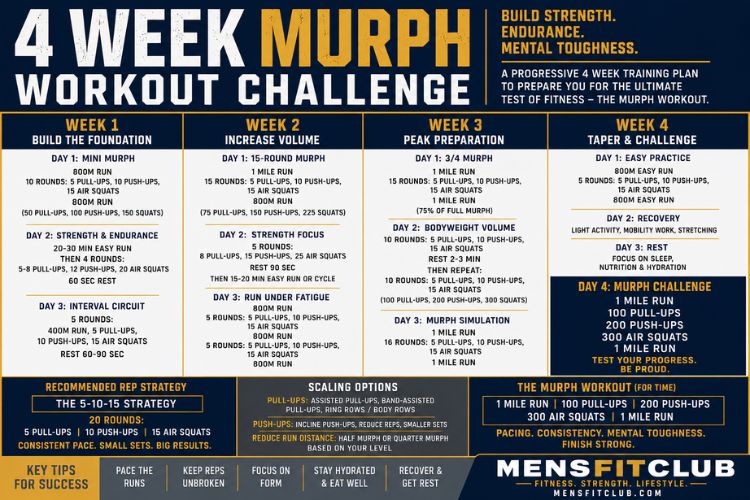
The 4 week Murph workout challenge is a demanding training program designed to prepare your body for one of the most recognizable hero-style CrossFit workouts. Combining running, pull-ups, push-ups, and air squats, the Murph workout tests cardiovascular endurance, muscular stamina, pacing, grip strength, and mental toughness in one long training session.
The traditional Murph workout consists of a 1-mile run, 100 pull-ups, 200 push-ups, 300 air squats, and another 1-mile run. Advanced athletes may complete the workout while wearing a weighted vest. However, attempting the full workout without adequate preparation can quickly overwhelm your shoulders, arms, legs, and cardiovascular system.
That is where a structured 4 week Murph training plan becomes valuable.
Rather than repeatedly performing the entire workout, this four-week challenge gradually increases training volume while improving the movements required for Murph. You’ll practice running under fatigue, develop higher-repetition bodyweight strength, experiment with different rep strategies, and learn how to control your pace.
Whether your goal is completing your first Murph, improving a previous performance, or simply challenging yourself with four weeks of functional fitness training, this program provides a practical progression.
What Is the Murph Workout?
The classic Murph workout is:
1-mile run
100 pull-ups
200 push-ups
300 air squats
1-mile run
Advanced athletes sometimes perform the workout wearing a weighted vest, traditionally 20 pounds for men and 14 pounds for women.
The bodyweight repetitions can be completed in different ways depending on the version of the workout and your training goals. Many athletes partition the repetitions into smaller rounds rather than attempting all 100 pull-ups before progressing to push-ups.
One popular strategy is:
20 rounds of:
5 pull-ups
10 push-ups
15 air squats
This creates exactly 100 pull-ups, 200 push-ups, and 300 squats.
The approach is often easier to manage because muscular fatigue is distributed throughout the workout.
Why Follow a 4 Week Murph Workout Challenge?
Murph contains a very high amount of training volume.
Even someone capable of performing 10 or 15 pull-ups at once may struggle after accumulating dozens of repetitions. Push-ups can become especially difficult because the chest, shoulders, and triceps receive little opportunity to recover.
The squat volume creates another challenge. Three hundred air squats can significantly fatigue the quadriceps, glutes, and hips before the final run.
A 4 week Murph workout challenge allows you to progressively expose your body to these demands instead of suddenly performing hundreds of repetitions.
Over four weeks, the goal is to develop:
Cardiovascular endurance
Pull-up capacity
Push-up endurance
Squat stamina
Grip strength
Running efficiency
Movement quality
Pacing discipline
Recovery between movements
Mental resilience
The objective isn’t simply to become better at individual exercises. You need to become comfortable transitioning between them while already fatigued.
Who Should Try This 4 Week Murph Workout Training Plan?
This challenge is best suited to people who already have some experience with running and bodyweight training.
Ideally, you should be comfortable jogging approximately one mile and performing basic variations of pull-ups, push-ups, and squats.
You do not need to be capable of completing 100 pull-ups before starting.
Movements can be scaled throughout the program.
Beginners may substitute assisted pull-ups, ring rows, or another appropriate pulling movement. Push-ups can be performed with the hands elevated on a stable surface when necessary.
The priority should always be consistent movement quality rather than forcing repetitions with poor technique.
If you’re completely new to exercise, spend several weeks establishing basic strength and conditioning before attempting a high-volume challenge like Murph.
How the 4 Week Murph Workout Challenge Works
The program uses four progressively harder weeks.
Week 1: Build the Foundation
The first week introduces moderate-volume Murph training while emphasizing movement quality and aerobic conditioning.
Week 2: Increase Training Volume
Increases the number of repetitions and introduces longer Murph-style circuits.
Week 3: Peak Murph Preparation
This is the highest-volume training week. You’ll experience sessions that more closely resemble the fatigue generated by the complete workout.
Week 4: Reduce Volume and Complete Murph Workout
Training volume decreases early in the week so your body can recover before the final Murph challenge.
Three primary workouts per week are enough for most people.
Avoid performing hard Murph-style sessions every day. The body needs time to recover from repeated pulling, pushing, squatting, and running.
Week 1: Murph Workout Foundation Training
The first week focuses on establishing sustainable movement patterns.
Day 1: Mini Murph Workout
Begin with:
800-meter run
Then complete:
10 rounds of:
5 pull-ups
10 push-ups
15 air squats
Finish with:
800-meter run
Total repetitions:
50 pull-ups
100 push-ups
150 squats
This represents approximately half of the traditional bodyweight volume.
Do not race the opening run.
Maintain a comfortable pace that allows you to begin the first round without needing several minutes to recover.
Day 2: Running and Strength Development
Complete:
20-30 minute easy run
After running, perform:
4 rounds:
5-8 pull-ups
12 push-ups
20 air squats
60 seconds rest
This workout builds basic strength endurance without excessive fatigue.
If necessary, reduce the repetitions so every set remains controlled.
Day 3: Murph Workout Interval Circuit
Complete:
5 rounds:
400-meter run
5 pull-ups
10 push-ups
15 squats
Rest approximately 60-90 seconds between rounds when needed.
This workout teaches you to transition between running and bodyweight exercises.
Week 2: Increase Murph Workout Volume
During week two, total training volume begins moving closer to full Murph demands.
Day 1: 15-Round Murph Workout
Begin with:
1-mile easy run
Complete:
15 rounds:
5 pull-ups
10 push-ups
15 air squats
Finish with:
800-meter run
Totals:
75 pull-ups
150 push-ups
225 squats
Your goal should be consistent round times.
Avoid performing the first five rounds extremely quickly only to slow dramatically later.
Day 2: Pull-Up and Push-Up Endurance Murph Workout
Complete:
5 rounds:
8 pull-ups
15 push-ups
25 air squats
Rest 90 seconds between rounds.
Then complete:
15-20 minutes of easy running or cycling.
This session strengthens the muscles that often become limiting factors during Murph.
Day 3: Running Under Fatigue
Complete:
800-meter run
Then:
5 rounds:
5 pull-ups
10 push-ups
15 squats
Run 800 meters.
Complete another:
5 rounds:
5 pull-ups
10 push-ups
15 squats
Finish with:
800-meter run.
Keep your running pace controlled rather than treating each segment like a sprint.
Week 3: Peak Murph Preparation
Week three is the most demanding portion of the 4 week Murph workout challenge.
Recovery becomes particularly important.
Day 1: Three-Quarter Murph
Complete:
1-mile run
Then:
15 rounds:
5 pull-ups
10 push-ups
15 air squats
Finish with:
1-mile run
This gives you the complete Murph running distance with approximately 75% of the bodyweight exercise volume.
Use this workout to test your pacing strategy.
Day 2: Bodyweight Volume Workout
Complete:
10 rounds:
5 pull-ups
10 push-ups
15 squats
Rest 2-3 minutes.
Then repeat:
10 rounds:
5 pull-ups
10 push-ups
15 squats
This produces the full:
100 pull-ups
200 push-ups
300 squats
without the two miles of running.
This is a demanding workout. Scale the volume if your technique begins deteriorating significantly.
Day 3: Murph Simulation
Complete:
1-mile run
Then:
16 rounds:
5 pull-ups
10 push-ups
15 squats
Finish with:
1-mile run
The objective is not necessarily maximum speed.
Think of this workout as your final major rehearsal.
Practice the exact rep strategy you intend to use during the final challenge.
Week 4: Taper and Murph Challenge
The final week reduces training stress before the full workout.
Trying to squeeze additional fitness into the final few days can backfire. Your goal is to arrive at the challenge recovered rather than exhausted.
Day 1: Easy Murph Practice
Complete:
800-meter easy run
5 rounds:
5 pull-ups
10 push-ups
15 squats
800-meter easy run
Keep the intensity moderate.
Day 2: Recovery
Perform light activity such as:
Walking
Easy cycling
Mobility work
Gentle stretching
Avoid high-volume pull-ups or push-ups.
Day 3: Rest
Take a full rest day or perform only very light movement.
Prioritize hydration, nutritious food, and sleep.
Day 4: Full Murph Challenge
It’s time to test your progress.
Complete:
1-mile run
100 pull-ups
200 push-ups
300 air squats
1-mile run
Record your finishing time along with notes about your pacing.
This information can help you structure your next Murph training cycle.
Best Rep Strategy for the Murph Workout
Partitioning the repetitions can make Murph considerably more manageable.
The 5-10-15 Strategy
Complete:
20 rounds:
5 pull-ups
10 push-ups
15 squats
This is one of the simplest strategies because the numbers are easy to track.
It also prevents you from accumulating excessive fatigue on one movement.
Smaller Sets for Push-Up Fatigue
For many athletes, push-ups become the biggest problem.
An alternative round could be:
5 pull-ups
5 push-ups
15 squats
5 push-ups
You still complete 10 push-ups per round, but splitting them into smaller sets may help maintain better technique.
Larger Sets for Advanced Athletes
Experienced athletes may choose larger blocks, such as:
10 rounds:
10 pull-ups
20 push-ups
30 squats
However, larger sets can create more local muscular fatigue.
Unless you already have excellent bodyweight endurance, smaller sets are generally easier to sustain.
How to Pace Your First Mile
The opening mile should not feel like a running race.
One of the most common Murph mistakes is starting too fast because you feel fresh.
Remember that you still have 600 bodyweight repetitions and another mile ahead of you.
Aim for a controlled aerobic pace.
You should finish the first mile feeling like you could have continued running.
Saving a minute on the opening run means little if you lose several minutes later because your heart rate is too high.
How to Pace the Bodyweight Exercises
Consistency is usually more important than speed.
Imagine your first few rounds take 45 seconds each.
If you continue at approximately that pace, you can maintain steady progress.
But if you attack the first rounds in 25 seconds and eventually require long breaks, your total workout time may become slower.
Use deliberate transitions.
Move from pull-ups to push-ups to squats efficiently without rushing unnecessarily.
How to Approach the Final Mile
The second run feels very different from the first.
Your legs may feel heavy after 300 squats, while your heart rate may already be elevated.
Begin the final mile conservatively.
Allow your legs several minutes to regain their running rhythm.
Once you feel stable, gradually increase your pace.
If you have energy remaining during the final portion, finish stronger.
Scaling the Murph Workout Challenge for Beginners
There is nothing wrong with scaling Murph.
In fact, appropriate scaling can make the workout much more productive.
Half Murph
Complete:
800-meter run
50 pull-ups
100 push-ups
150 squats
800-meter run
You can partition the bodyweight movements into:
10 rounds:
5 pull-ups
10 push-ups
15 squats
Quarter Murph
Complete:
400-meter run
25 pull-ups
50 push-ups
75 squats
400-meter run
This version can be useful for newer athletes.
Scaling Pull-Ups
Possible substitutions include:
Assisted pull-ups
Band-assisted pull-ups
Ring rows
Body rows
Choose a variation that allows you to accumulate repetitions without excessive breakdown in technique.
Scaling Push-Ups
Try:
Incline push-ups
Reduced repetitions
Smaller sets
The objective is to maintain controlled repetitions throughout the workout.
Should You Wear a Weighted Vest?
A weighted vest significantly increases the difficulty of Murph.
If you’re attempting Murph for the first time, completing the workout without a vest can already provide an enormous challenge.
Only consider adding weight if you have developed sufficient experience with the workout and can safely handle high-volume bodyweight exercise.
Do not suddenly wear a heavy vest on challenge day if you haven’t trained with it.
If weighted Murph is your eventual goal, gradually introduce vest training during future preparation cycles.
Recovery During the 4 Week Murph Challenge
Recovery can determine how successfully you progress through this program.
Pull-ups and push-ups place repeated stress on the shoulders, elbows, wrists, chest, and upper back.
Running and squatting create additional lower-body fatigue.
Give yourself at least one recovery day between demanding Murph sessions whenever possible.
A simple weekly structure could look like:
Monday: Murph training
Tuesday: Recovery
Wednesday: Murph training
Thursday: Recovery
Friday: Murph training
Saturday: Light activity
Sunday: Rest
Your recovery days may include walking, easy cycling, mobility work, or complete rest.
Nutrition and Hydration for Murph Training
Long, high-volume workouts require adequate energy.
Avoid dramatically reducing calories while simultaneously increasing Murph training volume.
Include balanced meals containing protein, carbohydrates, healthy fats, vegetables, fruits, and adequate fluids.
Carbohydrates can be particularly useful before demanding training because Murph relies heavily on sustained muscular and cardiovascular work.
Protein supports recovery and muscle repair between workouts.
Hydration is equally important, especially if you’re training outdoors in warm conditions.
Common Murph Training Mistakes
Doing Full Murph Too Often
You don’t need to perform the complete workout several times during your four-week preparation.
The full workout creates substantial fatigue.
Use progressive sessions to prepare for it.
Starting Every Workout Too Fast
Murph rewards sustainable pacing.
Learn to control your effort early.
Ignoring Push-Up Fatigue
Many athletes focus heavily on pull-ups while overlooking push-ups.
Two hundred push-ups can create considerable fatigue.
Train push-up endurance throughout your preparation.
Sacrificing Technique for Speed
Fast repetitions are not useful if your movement quality collapses.
Keep your repetitions controlled and use appropriate scaling.
Skipping Recovery
More training isn’t always better.
High-volume bodyweight training requires recovery.
4 Week Murph Workout Challenge Schedule
Here is the complete program at a glance:
Week 1: Build your running base and complete approximately 50% Murph-style sessions.
2: Increase bodyweight volume and practice running while fatigued.
3: Complete your highest-volume training and rehearse your challenge-day strategy.
4: Reduce training volume, recover, and perform the full Murph workout.
The progression gives your muscles, joints, cardiovascular system, and movement skills time to adapt before the final test.
How to Improve Your Murph Time
After completing your first four-week challenge, review your performance.
Ask yourself where you lost the most time.
Was it the pull-ups?
Did push-ups require increasingly long breaks?
Your legs struggle during the final mile?
Did you start too quickly?
Your answer identifies what to emphasize during your next training block.
If push-ups were your limiting factor, increase push-up endurance. Running was difficult, spend more time developing aerobic conditioning. If pull-ups slowed you down, focus on pulling strength and sustainable sets.
Improving Murph isn’t only about becoming fitter overall. It’s about identifying and improving your weakest component.
Final Thoughts on the 4 Week Murph Workout Challenge
The 4 week Murph workout challenge combines running, bodyweight strength, muscular endurance, and mental discipline into one demanding training goal.
The key is progression.
Instead of jumping directly into a 1-mile run, 100 pull-ups, 200 push-ups, 300 squats, and another 1-mile run, gradually increase your workload over several weeks. Practice sustainable repetition schemes, improve your running under fatigue, and give your body enough recovery between high-volume sessions.
During the final challenge, resist the temptation to race the opening mile or blast through the first several rounds. Maintain a sustainable pace, break the repetitions into manageable sets, and save enough energy for the final run.
Whether you complete a scaled version, half Murph, full bodyweight Murph, or eventually progress toward a weighted version, finishing the challenge represents a significant test of full-body fitness.
Use your first result as a benchmark rather than an endpoint.
Record your time, identify where you struggled, continue developing those areas, and return to the challenge stronger, faster, and better prepared.
Preparing for the Murph challenge requires a combination of CrossFit conditioning, bodyweight endurance, pulling strength, and smart workout progression. Start by exploring the MensFitClub CrossFit Workout Plan for additional WODs and strength-and-endurance training ideas. Since Murph relies heavily on high-repetition pulling, the Pull-Up Workout Routine can help you improve pull-up strength, grip, and repetition capacity. You can also build the muscular stamina needed for push-ups and squats with this Full Body Bodyweight Workout. For additional conditioning options, check out these CrossFit Workouts at Home featuring workouts such as Murph and Cindy. Finally, add more structured bodyweight conditioning to your preparation with these Body Weight Circuit Exercises for Strength and Endurance.


Most Recommended

Subscribe to our Newsletter
Stay up to date on the latest men’s health, fitness and lifestyle trends and tips.
About Us
Men’s Fit Club was started with the goal of empowering men to get the most out of their lives. This meant going beyond exercise and diet tips to really address the broad range of issues that men face on a daily basis – topics like recreation, finding love, sexual health and even sound fashion advice.
Quick Links
© COPYRIGHT MEN'S FIT CLUB 2026. All Rights Reserved