
Beginner Rucking Workout Plan for Strength and Fat Loss
3 Day Strength and Balance Program for Older Men

Best Hair and Beard Routine for Men Who Work Out Daily
Beginner Rucking Workout Plan for Strength and Fat Loss
Rucking is one of the simplest ways to turn an ordinary walk into a productive full-body conditioning session. You put a manageable amount of weight in a backpack or purpose-built rucksack, walk with good posture, and gradually increase the challenge as your body adapts. For men who want to improve cardiovascular fitness, strengthen their legs and core, spend more time outdoors, or add low-skill conditioning to a busy schedule, a beginner rucking workout plan can be an effective place to start.
The appeal is easy to understand. Rucking does not require complicated exercise technique, a gym membership, or a long list of equipment. It can be done on sidewalks, park paths, treadmills, tracks, and easy trails. However, carrying weight changes the demands of walking. The feet, ankles, knees, hips, back, and shoulders all have to manage more stress. A smart plan must therefore begin with a light load, sensible distances, comfortable terrain, and enough recovery between sessions.
This six-week beginner rucking plan is designed to build capacity without turning every walk into a test. You will begin with two short rucks per week, use effort rather than speed as the main guide, and progress one training variable at a time. The goal is not to carry the heaviest possible pack. The goal is to move well, finish with energy in reserve, and establish a routine you can continue long after the first six weeks.
What Is A Beginner Rucking Workout Plan?
Rucking is walking while carrying weight in a backpack or rucksack. The term has military roots, but recreational rucking does not need to resemble military selection or forced marches. A fitness-focused ruck can be a controlled walk with a light pack, a brisk urban session, or a longer outing over gentle trails.
Compared with regular walking, rucking increases the amount of work your body must perform with every step. Your legs propel a greater total mass, your trunk stabilizes the load, and the muscles around your upper back and shoulders help control the pack. Your heart and lungs also work harder, particularly when you increase pace or walk uphill. Yet rucking remains technically simple and can be adjusted by changing load, distance, pace, terrain, or time.
For beginners, that flexibility is both an advantage and a potential trap. Adding weight, distance, speed, and hills at the same time can raise fatigue quickly. The safest and most sustainable approach is to keep most variables steady while gradually changing only one.
Benefits of a Beginner Rucking Workout Plan
Builds Practical Full-Body Strength
Rucking is primarily an endurance activity, but the pack creates continuous resistance. The quadriceps, hamstrings, glutes, calves, and foot muscles work through thousands of controlled repetitions. The abdominals and spinal stabilizers help maintain an upright position, while the upper back supports the shoulder straps and keeps the load close. It will not replace progressive strength training, but it can complement squats, hinges, rows, carries, and other resistance exercises.
Improves Cardiovascular Endurance
A brisk ruck can elevate your heart rate more than an unloaded walk at the same pace. Beginners can use this to develop aerobic fitness without immediately moving to running. Because effort can be changed in small increments, rucking works well for steady conditioning. You can slow down, shorten the route, reduce the pack weight, or choose flatter terrain whenever the session becomes too demanding.
Supports an Active Lifestyle and Measurable Progress
Rucking can fit into a lunch break, morning routine, weekend hike, or commute. It also gives you useful numbers to track, including time, distance, pace, effort, route, and load. Early progress may simply mean that the same walk feels easier or your posture remains stronger near the finish.
What You Need to Start Beginner Rucking Workout Plan
A Comfortable Backpack or Rucksack
You do not need premium equipment for your first sessions. A sturdy backpack with wide, adjustable shoulder straps can work if it holds the load securely and does not rub. A sternum strap can help stabilize the bag. A hip belt may improve comfort on longer outings, although beginners should not use it as a reason to carry more weight than they are ready for.
Pack the weight high and close to your back rather than letting it collect at the bottom of the bag. Wrap a weight plate, dumbbell, books, or water containers in a towel so hard edges do not press into your spine and the load cannot bounce. Water is a convenient beginner load because some can be poured out if necessary, but every container must be sealed carefully.
Supportive Footwear
Choose walking shoes, trail shoes, or boots that fit well and are already comfortable. Your first loaded walk is not the time to break in stiff footwear. The best choice depends on your route, foot shape, weather, and personal comfort. Wear moisture-managing socks and address hot spots early; a small irritation can become a blister during a longer session.
A Sensible Starting Weight For Beginner Rucking Workout Plan
For a true beginner, approximately 5 percent of body weight is a conservative starting point. For many men, a load of 5 to 10 pounds is enough to make walking feel different. A previously active person may tolerate slightly more, but there is no prize for starting heavy. The right initial load lets you walk tall, breathe under control, and finish without joint pain, numbness, or unusual back discomfort.
The weight of the backpack itself counts toward the total. Weigh the fully packed bag rather than estimating the plates or supplies inside it. If you are returning after a long break, have significant excess body weight, or have a history of foot, knee, hip, back, cardiovascular, or balance problems, begin with unloaded walking and seek appropriate medical or rehabilitation guidance before adding weight.
A Safe Route
Begin on a flat, predictable surface near home. A loop makes it easy to stop if equipment rubs or fatigue rises. Avoid technical trails, steep descents, loose gravel, extreme heat, and isolated locations while learning how your body responds. Tell someone your route when going alone, carry identification and a phone, and use reflective gear or a light when visibility is poor.
How Hard Should a Beginner Ruck?
Your first rucks should feel controlled rather than competitive. Use a rate of perceived exertion, or RPE, of about 4 to 6 on a 10-point scale. At this effort, you are working but can still speak in full sentences. Breathing is deeper than during an easy stroll, yet you do not feel desperate for air.
Do not chase a universal pace. Height, stride length, surface, hills, weather, pack weight, and fitness all affect walking speed. A pace of 18 minutes per mile may be easy for one person and too aggressive for another. Begin at a brisk but natural rhythm and record the result. Let pace improve as a consequence of better fitness, not forced overstriding.
Shorter steps usually work better than reaching far in front of the body. Keep your head neutral, ribs stacked over the pelvis, and shoulders relaxed. A small forward inclination from the ankles may occur, especially uphill, but avoid bending sharply at the waist. Your pack should remain stable enough that you do not have to twist or shrug to control it.
The 6-Week Beginner Rucking Workout Plan
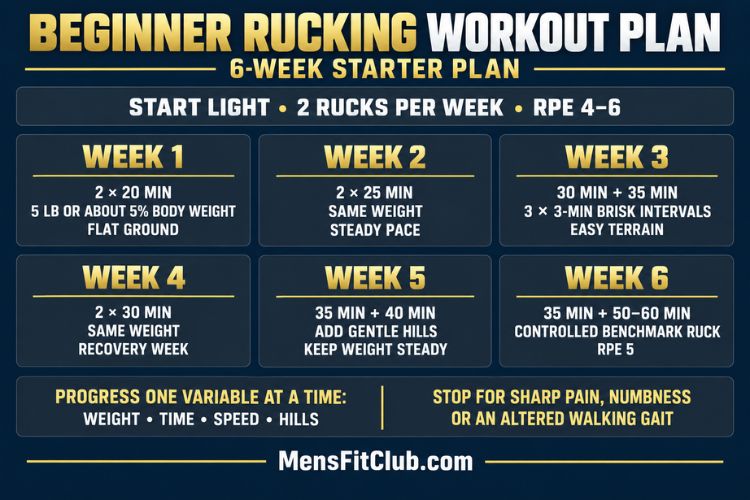
This plan uses two dedicated rucking days per week with at least 48 hours between them. It is suitable for someone who can already walk for 30 minutes without pain. If that is not yet comfortable, spend two to four weeks building an unloaded walking base first.
The listed pack weight is a guide, not a requirement. Stay with the lower end if your posture changes, recovery worsens, or your feet and joints remain sore. Repeat a week whenever necessary. Progress is earned by completing sessions comfortably, not by reaching a particular calendar date.
Week 1: Learn the Setup
Complete two 20-minute rucks on flat ground with 5 pounds or roughly 5 percent of body weight, whichever is more appropriate and comfortable. Keep the effort near RPE 4. Your priority is learning how the pack sits and identifying any rubbing, bouncing, or pressure points.
Walk easily for the first five minutes, settle into a purposeful pace for 10 minutes, and use the final five minutes to cool down. After each session, note how your feet, knees, back, and shoulders feel during the walk, later that day, and the following morning.
Week 2: Add a Little Time
Perform two 25-minute rucks with the same pack weight and flat route. Keep your effort between RPE 4 and 5. Do not add weight simply because the first week felt easy; the added time is the progression.
During the middle 10 minutes, practice smooth, slightly quicker steps without jogging. If your breathing becomes too heavy for conversation, slow down. Both workouts should end with the feeling that you could have continued for another five to 10 minutes.
Week 3: Build Steady Endurance With Beginner Rucking Workout Plan
Complete one 30-minute easy ruck and one 35-minute steady ruck. Continue with the same load or add no more than a few pounds if every previous session was pain-free, your pack remained stable, and you recovered by the next day. Most beginners should still be using a light pack.
Use flat or gently rolling terrain. During the 35-minute session, include three 3-minute sections at a brisk RPE 6, with three minutes of relaxed walking between them. These are controlled pace changes, not all-out intervals.
Week 4: Consolidate and Recover
Use week four as a consolidation week. Complete two 30-minute rucks at RPE 4 to 5. Keep the same weight you used in week three and choose familiar terrain. This small reduction in total time gives connective tissues and feet a chance to catch up while preserving the routine.
Pay attention to technique. Check that you are not hunching, overstriding, or gripping the shoulder straps throughout the walk. Finish each session with several minutes of unloaded walking and gentle ankle, calf, hip, and upper-back movement.
Week 5: Introduce Gentle Hills
Perform one 35-minute flat ruck and one 40-minute session on a route with a few mild inclines. Maintain the same pack weight. Hills are the new challenge, so do not increase load this week.
Shorten your stride uphill and let the pace slow while keeping effort near RPE 6. Walk carefully on descents; downhill sections can place substantial braking demand on the quadriceps and may challenge the knees. Choose gradual slopes and stay in control rather than racing down.
Week 6: Complete the Beginner Benchmark
Complete one 35-minute easy ruck early in the week. For the second workout, perform a 50- to 60-minute ruck on flat or gently rolling terrain at RPE 5. Use the pack weight that felt reliable in weeks four and five. The benchmark is steady completion with good posture and no need to push through pain.
Record the route, time, distance, pack weight, and effort. Compare these notes with week one. You may be moving farther, breathing more comfortably, or simply feeling more confident under the load. Any of those outcomes represents useful progress.
Weekly Schedule for Beginner Rucking Workout Plan
A balanced week might place rucking on Tuesday and Saturday, full-body strength training on Monday and Thursday, mobility or easy walking on Wednesday, and recovery on Friday and Sunday. The exact days can change, but avoid stacking your hardest lower-body strength workout, hill ruck, and long ruck back-to-back.
Strength training should support rucking rather than exhaust you for it. Two concise sessions are enough for most beginners. Focus on controlled squats or split squats, hip hinges, rows, push-ups or presses, calf raises, and anti-movement core exercises. Start with two or three sets per exercise and leave two or three good repetitions in reserve.
A Simple Strength Workout to Support Beginner Rucking Workout Plan
Twice per week, perform goblet squats, Romanian deadlifts, and one-arm dumbbell rows for 2 to 3 sets of 8 to 12 repetitions. Add low step-ups for 2 sets of 8 repetitions per leg, calf raises for 2 sets of 12 to 15, and side planks for 2 holds of 20 to 30 seconds per side. Use controlled form and finish each set with two or three good repetitions in reserve. This combination strengthens the legs, hips, trunk, and upper back without requiring a long gym session.
How to Warm Up Before Your Beginner Rucking Workout Plan
Begin with five minutes of easy unloaded walking, then perform ankle circles, calf raises, leg swings, bodyweight squats, and gentle trunk rotations. Put the pack on and walk below training pace for another three minutes. If it immediately changes your stride or creates discomfort, adjust the straps, reposition the load, or reduce the weight.
Recovery After a Rucking Workout
Walk without the pack for several minutes after the session. Check your feet for hot spots or blisters and change out of damp socks. Eat balanced meals, hydrate for the weather and session length, and prioritize sleep. Muscle fatigue can be normal; sharp or escalating pain, an altered gait, numbness, chest pain, faintness, or unusual shortness of breath are reasons to stop and seek appropriate medical care.
Common Beginner Rucking Mistakes
The biggest mistake is starting too heavy. Your breathing may feel capable before your feet, tendons, joints, and skin have adapted. Beginners also progress too many variables at once. Change weight, duration, speed, or elevation—not all four together. Keep walking rather than jogging with the pack, secure the load so it cannot bounce, and stop when pain changes your gait. A light, repeatable workout builds more fitness than a heroic effort that disrupts the next two weeks.
How to Progress After Six Weeks
After six weeks, select one goal: longer endurance rucks, faster short sessions, hill fitness, or slightly heavier loading. Keep other variables steady while adding five minutes to the long ruck every one or two weeks or adding a small amount of weight. A practical routine is one 30- to 40-minute ruck and one 45- to 75-minute ruck per week. Consider an easier week every fourth or fifth week by reducing time, load, or hills.
Beginner Rucking for Weight Loss
Rucking can support fat loss by increasing activity, but body composition still depends on nutrition, total movement, recovery, and consistency. Do not use an excessively heavy pack to chase a calorie estimate. Pair two weekly rucks with strength training, regular walking, adequate protein, high-fiber foods, and an appropriate eating plan, then assess trends over several weeks.
Frequently Asked Questions About Rucking
How Much Weight Should a Beginner Ruck With?
Around 5 percent of body weight, often 5 to 10 pounds, is a sensible conservative start. Some people should begin with no additional weight. Choose the lightest load that lets you learn pack fit and walking mechanics, then progress only after repeated pain-free sessions.
How Often Should Beginners Ruck?
Two sessions per week are enough to build a foundation while allowing recovery. After several weeks, a third easy session may be appropriate, but it is optional. More sessions are not automatically better if they interfere with strength training, daily activity, or recovery.
Can I Ruck on a Treadmill?
Yes. A treadmill offers a predictable surface and easy control of pace and incline. Keep the incline modest at first, do not hold the rails, and use the treadmill safety clip. Step off carefully because the pack changes your balance and momentum.
Can Beginners Ruck Every Day?
Daily weighted walking is unnecessary for most beginners. Use unloaded walks between two weekly rucking days and give sore tissues time to recover.
The Beginner Rucking Workout Plan
Rucking works best when it remains simple. Pack a light, stable load, walk with good posture, keep your effort controlled, and progress gradually. The six-week beginner rucking workout plan provides enough structure to build endurance while leaving room for individual recovery and ability.
Do not compare your pack weight or pace with someone else’s highlight reel. A successful beginner ruck ends with sound movement and confidence that you can train again. Build that repeatable foundation first, and heavier loads, longer routes, and challenging hills can be considered later.
Related Workouts
Build a complete routine around your rucking days with the Best Full Body Workout Plan for Men for balanced strength, the Best Lower Intensity Workouts for recovery-day activity, and the Best Aerobic Exercises for Men for more endurance options. Men training later in life can adapt the ideas in this Workout Plan for Males Over 40, while anyone who wants a simple strength base can use The Best Home Workout Routine for Men alongside two weekly rucks.


Most Recommended

Subscribe to our Newsletter
Stay up to date on the latest men’s health, fitness and lifestyle trends and tips.
About Us
Men’s Fit Club was started with the goal of empowering men to get the most out of their lives. This meant going beyond exercise and diet tips to really address the broad range of issues that men face on a daily basis – topics like recreation, finding love, sexual health and even sound fashion advice.
Quick Links
© COPYRIGHT MEN'S FIT CLUB 2026. All Rights Reserved