
Beginner Rucking Workout Plan for Strength and Fat Loss
3 Day Strength and Balance Program for Older Men

Best Hair and Beard Routine for Men Who Work Out Daily
3 Day Strength and Balance Program for Older Men
Growing older does not mean giving up strength, independence, or confidence. In fact, following a well-designed strength and balance program may be one of the most valuable investments an older man can make in his long-term health. Strong muscles help support the joints, maintain bone health, improve posture, and make everyday activities easier. Better balance can improve movement confidence and reduce the likelihood of falls.
This three-day strength and balance program for older men combines practical resistance exercises with controlled balance drills. It is designed for men in their 50s, 60s, 70s, and beyond who want to remain active without following an unnecessarily complicated or exhausting routine.
The program trains the major muscle groups three times per week while allowing adequate time for recovery. It can be performed at home or in a gym using dumbbells, resistance bands, a chair, and a stable support. Each workout takes approximately 40 to 55 minutes.
The goal is not to lift the heaviest possible weight. The goal is to build useful strength, improve stability, preserve mobility, and help you perform daily tasks with greater ease.
Why Strength and Balance Training Program Matters for Older Men
Muscle mass and strength naturally tend to decline with age, especially when a person becomes less active. This age-related loss of muscle can affect much more than appearance. It can make climbing stairs, carrying groceries, getting out of a chair, maintaining good posture, and recovering from a stumble more difficult.
Strength training provides the muscles with a reason to remain capable. Regular resistance exercise can help older adults maintain muscle, improve physical function, and support stronger bones. Training the legs, hips, back, chest, shoulders, arms, and core also makes everyday movement more efficient.
Balance deserves equal attention. Good balance depends on coordination among the muscles, joints, vision, inner ear, and nervous system. If one part of that system becomes less effective, the body may respond more slowly when footing changes unexpectedly.
Balance exercises train you to control your body over its base of support. They can also strengthen the feet, ankles, hips, and core, which play important roles in maintaining stability.
Current physical-activity guidance encourages older adults to combine aerobic movement, muscle-strengthening exercise, and balance-focused activity. This multicomponent approach helps address the different physical abilities needed to remain independent. The CDC’s physical-activity guidance for older adults recommends regular muscle-strengthening activity alongside aerobic and balance work.
Who Should Follow This Strength and Balance Program?
This three-day program is suitable for generally healthy older men who can stand, walk, and perform basic daily activities independently. It can also be modified for beginners who have not exercised consistently in several years.
Speak with a qualified healthcare professional before starting if you have recently experienced a fall, chest pain, unexplained dizziness, severe shortness of breath, uncontrolled blood pressure, a recent operation, or a significant heart, neurological, bone, or joint condition.
Men who use mobility aids or have a diagnosed balance disorder may benefit from working with a physical therapist or qualified trainer. Professional supervision can help ensure that exercises are selected and modified appropriately.
Exercise should feel challenging, but it should not produce sharp pain, sudden weakness, chest pressure, or severe dizziness. Stop the session and seek appropriate medical advice if concerning symptoms appear.
Equipment Needed For Strength and Balance Program
You do not need an elaborate home gym to complete this strength and balance program. The basic equipment includes:
- A sturdy chair without wheels
- One or two pairs of dumbbells
- A light or medium resistance band
- A stable countertop, railing, or wall
- Comfortable athletic shoes
- A clear exercise area without rugs or clutter
Beginners may perform many exercises using body weight alone. As strength improves, dumbbells or resistance bands can provide additional resistance.
A supportive chair is especially useful. It can be used during squats, step-ups, balance drills, and floor-exercise alternatives. Do not rely on a lightweight folding chair or any object that could slide.
How to Schedule the Three Weekly Strength and Balance Program
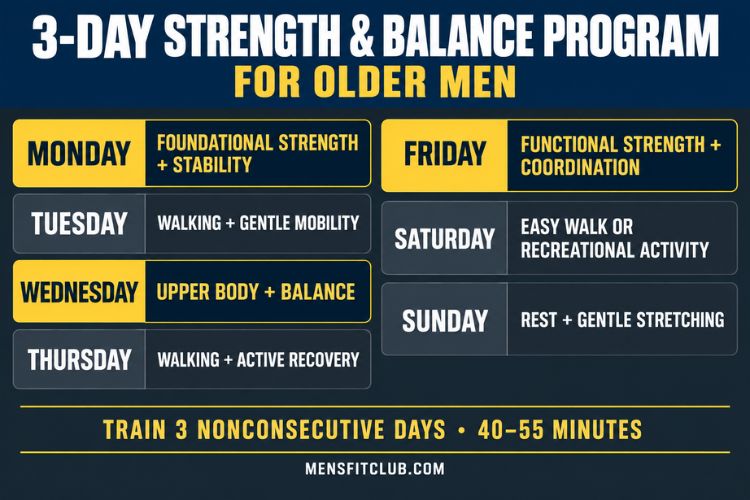
Perform the program on three nonconsecutive days. A Monday, Wednesday, and Friday schedule works well because it provides at least one recovery day between workouts.
A typical week might look like this:
- Monday: Workout One — Foundational Strength and Stability
- Tuesday: Walking or gentle mobility
- Wednesday: Workout Two — Upper Body, Posture, and Balance
- Thursday: Walking or active recovery
- Friday: Workout Three — Functional Strength and Coordination
- Saturday: Recreational activity or comfortable walking
- Sunday: Rest or gentle stretching
The workouts do not need to be performed on those exact days. Tuesday, Thursday, and Saturday can work equally well. The important point is to avoid completing all three sessions on consecutive days, particularly during the first several weeks.
On non-strength days, consider taking a 20- to 30-minute walk at a comfortable pace. Walking supports cardiovascular health, but it does not replace strength or balance training. Each form of exercise provides different benefits.
How Hard Should Older Men Train?
Choose a resistance that allows you to perform every repetition with controlled technique. The final two or three repetitions should feel challenging, but you should not need to hold your breath, swing the weight, or rush the movement.
A useful target is a perceived effort of approximately six or seven on a scale of one to ten. An effort of one would feel extremely easy, while ten would represent a maximum effort. Most working sets in this program should feel moderate to moderately hard.
Leave approximately two or three good repetitions “in reserve” at the end of each set. This approach provides enough challenge to stimulate progress without turning every workout into a test of maximum strength.
Rest for 60 to 90 seconds between strength exercises. Take longer when necessary. Balance exercises can require considerable concentration, so rest until you feel steady before beginning the next drill.
Warm-Up Before Every Strength and Balance Program Workout
Spend seven to ten minutes preparing your joints, muscles, and nervous system before each session. A good warm-up gradually raises your body temperature and rehearses the movements you will perform during the workout.
Begin with two to three minutes of easy walking around the room or marching in place. Continue with ten shoulder rolls in each direction, ten controlled heel raises, eight chair-assisted squats, and ten gentle hip hinges.
Finish with ten alternating knee lifts and several slow side steps. Hold a stable support if necessary.
The warm-up should leave you feeling more mobile and alert, not tired. Avoid aggressive stretching before strength exercises. Controlled movement is generally a better way to prepare the body for training.
Day One: Foundational Strength and Stability
The first workout develops strength in the legs, hips, chest, back, and core. It also introduces basic balance positions that can be adjusted to suit your current ability.
Chair Squat Strength and Balance Program
Perform two or three sets of eight to twelve repetitions.
Stand in front of a sturdy chair with your feet approximately shoulder-width apart. Push your hips back, bend your knees, and lower yourself toward the chair. Touch the seat lightly or sit down under control. Lean slightly forward and drive through your feet to stand.
Keep your knees pointing in the same general direction as your toes. Avoid collapsing heavily onto the chair or using momentum to stand.
To make the movement easier, use your hands on the chair’s arms or place the chair near a stable counter. To make it harder, hold one dumbbell in front of your chest.
The chair squat strengthens the thighs and hips while practicing one of the most important daily movements: sitting down and standing up.
Dumbbell Floor Press or Incline Push-Up
Perform two or three sets of eight to twelve repetitions.
For the floor press, lie on your back with your knees bent and hold a dumbbell in each hand. Position the upper arms on the floor and press the weights upward until your arms are straight without forcefully locking the elbows. Lower slowly until the upper arms gently contact the floor.
If getting onto the floor is difficult, perform incline push-ups against a wall, countertop, or stable bench. Keep the body in a straight line and bring the chest toward the support before pushing away.
This exercise strengthens the chest, shoulders, and triceps, which are used during pushing and bracing activities.
Supported Dumbbell Row Strength and Balance Program
Perform two or three sets of ten to twelve repetitions on each side.
Place one hand on the back of a stable chair or on a countertop. Step back slightly and hinge forward from the hips while keeping your spine comfortably neutral. Hold a dumbbell in the other hand and pull it toward your lower ribs. Pause briefly and lower it under control.
Avoid twisting the torso or shrugging the shoulder. Use a weight you can move smoothly through a comfortable range.
Rows strengthen the upper back and arms and can help counter the rounded posture that may develop from prolonged sitting.
Supported Split Squat
Perform two sets of six to ten repetitions on each side.
Stand beside a sturdy support and place one foot forward and the other behind you. Keep your feet approximately hip-width apart rather than positioning them directly in one line. Bend both knees and lower only as far as you can control. Press through the front foot to return to standing.
Use a shallow range of motion initially. This exercise strengthens each leg independently and challenges stability without requiring you to balance unsupported.
Heel-to-Toe Stance Strength and Balance Program
Perform three holds of 15 to 30 seconds on each side.
Stand beside a countertop and place one foot directly or nearly directly in front of the other. Distribute your weight evenly and look straight ahead. Keep one or two fingertips on the support if needed.
As your balance improves, reduce hand assistance. Do not close your eyes unless a qualified professional has instructed you to do so in a controlled setting.
Standing Heel Raise
Perform two or three sets of ten to fifteen repetitions.
Hold a chair or countertop and rise onto the balls of your feet. Pause at the top and lower your heels slowly. Keep your body tall rather than leaning forward.
Heel raises strengthen the calf muscles and ankles, which help control the body during walking and standing.
Day Two: Upper Body, Posture, and Balance
The second workout emphasizes upper-body strength, posture, hip stability, and single-leg control. It also provides the legs with a different training stimulus from Day One.
Dumbbell Romanian Deadlift Strength and Balance Program
Perform two or three sets of eight to twelve repetitions.
Stand with your feet about hip-width apart and hold the dumbbells in front of your thighs. Soften your knees and push your hips backward while lowering the weights along your legs. Stop when you feel tension in the backs of your thighs or when maintaining good posture becomes difficult. Drive your hips forward to stand.
This is a hip-hinge movement rather than a deep squat. Keep the weights close to the body and avoid rounding your lower back.
The exercise strengthens the hamstrings, glutes, and back muscles needed for lifting objects and controlling the body during forward movement.
Seated Dumbbell Shoulder Press
Perform two or three sets of eight to twelve repetitions.
Sit tall on a sturdy chair with a dumbbell in each hand. Begin with the weights near shoulder height and press them overhead through a pain-free range. Lower them slowly.
If overhead pressing is uncomfortable, perform a low-incline press or a resistance-band chest press instead. Never force the shoulder through a painful range.
Resistance-Band Row Strength and Balance Program
Perform two or three sets of ten to fifteen repetitions.
Anchor a resistance band securely at approximately chest height. Hold the handles, step back until the band has light tension, and pull your hands toward your ribs. Bring the shoulder blades gently together, pause, and return with control.
Check the band and its anchor before every set. Do not attach a band to an unstable chair, loose railing, or sharp surface.
Low Step-Up
Perform two sets of eight to ten repetitions on each side.
Use the bottom stair or a stable platform approximately four to six inches high. Hold a railing if needed. Place one foot fully on the step, press through that foot, and bring the other foot up. Step back down slowly.
Keep the knee aligned over the foot and avoid pushing excessively from the trailing leg. Begin with a lower step if necessary.
Step-ups strengthen the legs while improving coordination for stairs, curbs, and uneven surfaces.
Supported Single-Leg Stand Strength and Balance Program
Perform three holds of 10 to 20 seconds on each side.
Stand tall beside a countertop. Shift your weight onto one leg and lift the opposite foot slightly from the floor. Keep your hips level and your supporting knee softly bent.
Use as much hand support as necessary. A beginner may keep the toes of the lifted foot touching the floor like a kickstand. Progress by using fewer fingers rather than attempting a much longer hold immediately.
Side Leg Raise
Perform two sets of ten to fifteen repetitions on each side.
Stand behind a chair and lift one leg to the side without leaning your torso. Keep the toes facing forward and move through a controlled range. Lower slowly.
This exercise strengthens the muscles on the outside of the hips. These muscles help stabilize the pelvis during walking and single-leg balance.
Day Three: Functional Strength and Coordination
The third session integrates strength, controlled movement, carrying ability, and dynamic balance. The exercises are intended to transfer directly to everyday tasks.
Goblet Squat to Chair Strength and Balance Program
Perform three sets of eight to twelve repetitions.
Hold a dumbbell vertically against your chest and stand in front of a chair. Lower toward the chair under control, touch it lightly, and stand. Keep the weight close to your body and maintain steady pressure through the whole foot.
Use a bodyweight chair squat if holding a dumbbell causes you to lose position.
One-Arm Supported Row
Perform three sets of eight to twelve repetitions on each side.
Repeat the supported row from Day One, using a slightly heavier weight or one additional repetition if your technique remains strong. The repeated exposure allows you to improve the movement without learning too many different exercises.
Incline Push-Up
Perform two or three sets of eight to fifteen repetitions.
Place your hands on a wall or sturdy countertop. Walk your feet backward and keep your body aligned from head to heels. Bend your elbows and bring your chest toward the surface, then press away.
A wall makes the exercise easier. A lower support makes it harder. Choose an angle that allows smooth repetitions without straining your shoulders or lower back.
Farmer Carry Strength and Balance Program
Perform three rounds of 20 to 40 seconds.
Hold a dumbbell in each hand and walk slowly through a clear area. Stand tall, keep your ribs stacked over your pelvis, and take deliberate steps. Turn carefully rather than pivoting suddenly.
The farmer carry trains grip strength, posture, core stability, walking control, and the ability to carry groceries or household objects.
If two weights feel unstable, hold one lighter weight and keep the opposite hand near a countertop. Avoid carrying heavy weights if you cannot maintain a steady walking pattern.
Clock Tap
Perform two rounds on each leg.
Stand beside a stable support. Imagine that you are standing in the center of a clock. Shift your weight onto one leg and lightly tap the other foot forward toward twelve o’clock. Return to the center, tap to the side at three or nine o’clock, and then tap slightly backward.
Keep the standing leg stable and make the taps short at first. The goal is controlled weight shifting rather than reaching as far as possible.
Heel-to-Toe Walk
Perform three passes of six to ten controlled steps.
Walk beside a countertop and place the heel of one foot close to the toes of the other with each step. Look ahead instead of staring directly at your feet. Use the countertop whenever necessary.
If the full heel-to-toe position is too difficult, leave a small space between the feet or use a slightly wider walking line.
Four-Week Progression Plan
Progress gradually rather than changing several variables at once.
Week One: Learn the Movements
Perform two sets of most strength exercises and use comfortable resistance. Hold the balance positions for 10 to 15 seconds with hand support. Concentrate on posture, breathing, and controlled movement.
Week Two: Build Consistency
Add one or two repetitions to each strength set when possible. Extend balance holds by approximately five seconds. Continue using support whenever it improves control.
Week Three: Increase Training Volume
Progress selected strength exercises from two sets to three. Do not add a third set to everything if recovery is poor. For balance drills, try using fewer fingers on the support while keeping it within reach.
Week Four: Add Modest Resistance
Increase dumbbell weight slightly on exercises that have become comfortable. A small increase is sufficient. Alternatively, keep the same weight and slow the lowering phase to approximately three seconds.
After Week Four, repeat the program with gradually heavier resistance, additional repetitions within the prescribed range, or slightly more difficult balance variations.
How to Progress Safely
Progress is necessary because the body adapts to repeated exercise. However, progress does not always mean adding more weight.
You can advance an exercise by improving technique, increasing the range of motion, performing an extra repetition, adding a set, slowing the movement, or relying slightly less on support. Change only one variable at a time.
For strength exercises, increase the weight when you can complete the top of the repetition range for every set with excellent control and still feel capable of performing two or three additional repetitions.
For balance exercises, prioritize quality over duration. Twenty seconds of steady balance is more useful than 45 seconds of repeatedly grabbing the support.
Keep a training log that records the exercise, weight, sets, repetitions, and balance-hold duration. This simple habit makes gradual improvement easier to recognize.
Breathing and Exercise Technique For Strength and Balance Program
Breathe continuously during every exercise. As a general rule, exhale during the more difficult portion of the movement and inhale during the easier portion. For example, exhale as you stand from a squat and inhale as you lower.
Avoid holding your breath and straining, particularly if you have high blood pressure or cardiovascular concerns.
Move at a controlled pace. Most repetitions should take approximately two seconds to lift and two or three seconds to lower. Fast repetitions are not required for this program.
Posture should remain comfortable rather than rigid. Keep the chest open, shoulders relaxed, and spine in a stable position. Stop a set when your form begins to deteriorate.
Common Strength and Balance Program Mistakes to Avoid
One frequent mistake is starting with too much exercise. Older men who previously trained may remember the weights or workload they handled years ago and try to resume at the same level. Current capacity—not past performance—should determine the starting point.
Another mistake is performing balance exercises without a safe support nearby. Even if an exercise appears easy, a countertop, wall, or railing should remain within reach.
Training only the upper body is also limiting. Strong arms and shoulders are useful, but leg and hip strength are essential for walking, climbing stairs, rising from a chair, and recovering from a loss of balance.
Avoid rushing repetitions. Speed can hide weak positions and reduce the amount of control being trained. The purpose of this program is not to finish as quickly as possible.
Finally, do not treat soreness as the main measure of success. Mild muscle fatigue can be expected, particularly during the first two weeks, but severe soreness is not necessary for progress.
Recovery Between Strength and Balance Workout Program
Muscles need both training and recovery. Aim for consistent sleep, balanced meals, sufficient protein, and adequate hydration.
Older adults may require more recovery time than younger trainees, particularly after starting a new program. If you remain unusually sore or fatigued for several days, reduce the number of sets or use lighter resistance during the next workout.
Protein-rich foods such as fish, poultry, eggs, Greek yogurt, cottage cheese, lean meat, beans, lentils, and soy products can help support muscle maintenance. Men with kidney disease or other conditions affecting dietary protein should follow guidance from their healthcare professional.
Light walking on rest days can reduce stiffness and maintain the habit of daily movement. Recovery does not necessarily mean remaining completely inactive.
Frequently Asked Questions About Strength and Balance Program
Can a 70-year-old man start strength training?
Many men can begin strength training in their 70s and beyond. The starting exercises, resistance, and range of motion should match the individual’s health and current ability. Men with medical limitations or a history of falls should seek professional guidance before beginning.
Is three days of strength training too much for older men?
Three nonconsecutive training days can be appropriate when volume and intensity are managed responsibly. Each workout should be challenging enough to stimulate improvement but not so demanding that recovery takes several days.
Beginners can perform two sets per exercise or complete only two weekly sessions during the first few weeks.
How long does it take to improve balance?
Some people notice better confidence and control within several weeks, but meaningful progress requires consistent practice. Balance drills should be performed regularly and progressed gradually.
Strengthening the legs, hips, ankles, and core can also support better balance over time.
Should older men use machines or free weights For Strength and Balance Program
Both can be effective. Weight machines provide additional external stability and may help beginners learn to apply force safely. Dumbbells and resistance bands are versatile and can train coordination alongside strength.
The best option is the one that can be used comfortably, consistently, and with good technique.
What if getting onto the floor is difficult?
The entire program can be adapted to avoid floor exercises. Replace the dumbbell floor press with wall or countertop push-ups. Perform core work while standing or seated, and use a chair for additional support.
Floor mobility can be trained separately with professional assistance if getting down and standing up is an important personal goal.
Can this program help prevent falls?
No exercise plan can guarantee that a fall will never occur. However, strengthening the lower body and practicing balance, coordination, and controlled stepping may improve several physical abilities involved in maintaining stability.
Home safety, vision, medication effects, footwear, blood pressure, and medical conditions can also influence fall risk. Anyone experiencing repeated falls or dizziness should speak with a healthcare professional.
The Strength and Balance Training Program for Older Men
A successful fitness plan for older men should improve life outside the gym. It should make stairs feel easier, help you rise confidently from a chair, support better posture, and allow you to carry everyday objects without feeling unstable.
This three-day strength and balance program provides a practical framework for developing those abilities. Start with manageable resistance, use stable support during balance exercises, and focus on gradual improvement instead of rapid progression.
Consistency will always matter more than one perfect workout. Three controlled sessions each week, supported by walking and adequate recovery, can create a strong foundation for healthier aging. Train with patience, respect your current ability, and allow your strength to build one repetition at a time.
To continue building strength and staying active as you age, explore our guide to Strength Training After 50 for safe training principles and practical exercise advice. You can also follow a Full Body Dumbbell Workout For Men, improve everyday movement with our Mobility Routine For Older Men, develop stronger legs with a Lower Body Workout For Senior Men, and use our Walking And Zone 2 Cardio Guide to support cardiovascular fitness between strength sessions.


Most Recommended

Subscribe to our Newsletter
Stay up to date on the latest men’s health, fitness and lifestyle trends and tips.
About Us
Men’s Fit Club was started with the goal of empowering men to get the most out of their lives. This meant going beyond exercise and diet tips to really address the broad range of issues that men face on a daily basis – topics like recreation, finding love, sexual health and even sound fashion advice.
Quick Links
© COPYRIGHT MEN'S FIT CLUB 2026. All Rights Reserved