
Kettlebell Mobility Flow for Men Over 40: A 20-Minute Routine
Dumbbell Strength Standards for Men Benchmarks by Exercise

Skin Scents for Men What They Are and How to Wear Them
4-Week Barbell Technique Program for Better Form
Learning to lift a barbell well is one of the best investments a man can make in his long-term strength. Good 4 Week Barbell Technique Program does more than make an exercise look clean. It helps you place tension on the muscles you intend to train, maintain a stable lifting position, use a consistent range of motion, and progress without turning every workout into a maximum-effort test. Whether you are new to free weights, returning after time away, or trying to correct habits that developed while chasing heavier numbers, a focused block of technique work can make your future training more productive.
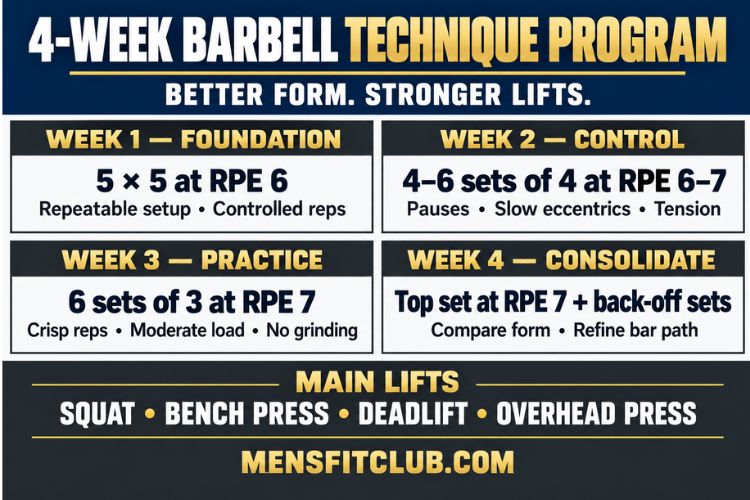
This 4-week barbell technique program is built around the back squat, bench press, deadlift, and overhead press. Instead of relying on fatigue, grinders, or one-rep-max attempts, it uses moderate loads, repeated practice, pauses, tempo work, and simple accessories. The purpose is to give you enough high-quality repetitions to build reliable movement patterns while still developing strength. Four weeks will not make anyone a perfect lifter, but it is long enough to identify weak positions, improve consistency, and establish a stronger foundation for the program that follows.
Who Should Use This 4-Week Barbell Technique Program?
This plan is appropriate for beginners who already understand basic gym safety, intermediate lifters whose form changes as weight increases, and experienced men returning from a layoff. It can also work as a technique reset after a demanding strength or hypertrophy phase. The program assumes that you have access to a barbell, weight plates, a squat rack, a flat bench, and enough open floor space to deadlift safely.
You do not need an impressive starting strength level. In fact, leaving your ego outside the rack is essential. The loads should be heavy enough to provide feedback but light enough for you to control every phase of every repetition. If your technique deteriorates, the working weight is too heavy for the goal of this training block.
Men with a current injury, unexplained pain, dizziness, or a medical restriction should obtain guidance from an appropriate healthcare professional before beginning. Muscle effort is expected; sharp pain, numbness, or a sudden loss of control is not. Stop a lift that produces those warning signs and have the issue assessed rather than trying to push through it.
Why A 4 Week Barbell Technique Program Deserves Its Own Training Block
Strength is partly a skill. Your muscles produce force, but your nervous system must coordinate that force through a specific path while your body remains balanced and braced. The squat requires you to keep pressure over the midfoot as the hips and knees bend together. The bench press asks you to stabilize the upper back while moving the bar through a repeatable path. The deadlift depends on creating tension before the plates leave the floor. The overhead press requires a strong trunk and efficient movement around the head.
When these skills are practiced only under heavy fatigue, errors can become part of the pattern. A lifter may rush the setup, lose abdominal pressure, bounce out of a weak position, or change the bar path to complete a difficult rep. Reducing the load and deliberately practicing the setup and execution gives you a chance to replace those habits with better ones.
Program Overview and 4 Week Barbell Technique Schedule
The plan uses four training days each week. A Monday, Tuesday, Thursday, and Saturday schedule works well. Each workout has one primary lift, a secondary technique movement, and two or three accessories. Most sessions should take approximately 50 to 70 minutes.
Weekly Training Split
Day 1: Squat technique and lower-body control
Back squat, paused squat, Romanian deadlift, and trunk work.
2: Bench press technique and upper-body stability
Bench press, paused bench press, barbell row, and upper-back work.
Deadlift technique and posterior-chain strength
Deadlift, tempo deadlift, split squat, and loaded carry or plank.
4: Overhead press technique and full-body practice
Overhead press, light squat variation, close-grip bench press, and pulling work.
Rest two to four minutes between sets of the main lifts and approximately 60 to 90 seconds between accessory sets. Longer rest is appropriate when it helps you reproduce the same good technique. This is practice, not a race.
How to Choose the Correct Starting Weight For 4 Week Barbell Technique Program
Use a load that feels like an RPE 6, meaning you could complete about four additional repetitions with sound form at the end of the set. For many lifters, this will be around 55 to 70 percent of a current one-repetition maximum. If you do not know your maximum, that is not a problem. Begin with the empty bar, add weight gradually, and stop when the bar feels substantial but every rep remains crisp.
Your last repetition should resemble your first. Reduce the load by 5 to 10 percent if the bar path becomes unpredictable, your range of motion shortens, or you cannot maintain the intended pause or tempo. Do not increase weight simply because the written sets and reps were completed. Earn progression through technical consistency.
A useful rule is to record the final work set from a front-side angle. Review balance, depth, bar path, bracing, and speed.
The Essential 4 Week Barbell Technique Program Warm-Up
Begin each session with five minutes of easy cycling, rowing, or brisk walking. Follow with movements that prepare the positions used that day. A squat session might include bodyweight squats, ankle rocks, and glute bridges. A pressing session can include arm circles, scapular push-ups, and light band pull-aparts.
Then perform lift-specific ramp-up sets. For a working squat weight of 185 pounds, for example, you might use the empty bar for two sets of eight, 95 pounds for five, 135 for three, and 165 for one or two. Warm-up sets should improve readiness without causing fatigue. Use them to rehearse the same stance, grip, brace, and unracking routine you will use for the work sets.
Week 1: Establish Positions and Consistency
The first week is about creating a repeatable setup. Keep loads conservative and resist the urge to add weight during the workout. Your main goal is to make each repetition begin the same way.
Day 1: Back Squat Foundation
Perform the back squat for 5 sets of 5 reps at RPE 6. Next, complete the paused squat for 3 sets of 3, holding the bottom position for two seconds without relaxing. Finish with the Romanian deadlift for 3 sets of 8 and a front plank for 3 sets of 30 to 45 seconds.
Set the bar securely across the upper back, pull the elbows into a comfortable position, and take a breath into the abdomen and sides of the torso before unracking. Step back with as few steps as possible. Keep the whole foot connected to the floor, allow the knees and hips to bend together, and descend only as low as you can while maintaining control. Drive up through the midfoot without allowing the chest and hips to separate dramatically.
Day 2: Bench Press Foundation 4 Week Barbell Technique Program
Perform the bench press for 5 sets of 5 at RPE 6. Follow it with the paused bench press for 3 sets of 4, pausing the bar gently on the chest for one full second. Complete the session with the barbell row for 3 sets of 8 and band pull-aparts or face pulls for 3 sets of 12 to 15.
Place your eyes near the bar before unracking. Keep the feet planted, draw the shoulder blades back and down, and maintain contact between your upper back and the bench. Lower the bar toward the lower chest or upper sternum while keeping the wrists stacked over the forearms. Press the bar slightly back toward the shoulders rather than straight toward the ceiling.
Day 3: Deadlift Foundation
Perform the conventional or sumo deadlift for 6 sets of 3 at RPE 6. Use the stance that best fits your build and experience; do not switch styles every session. Follow with a three-second tempo deadlift for 3 sets of 3 at a light load, lowering the bar under control. Add a rear-foot-elevated split squat for 3 sets of 8 per leg and a suitcase carry for 3 rounds per side.
Approach the bar so it is positioned over the middle of the foot. Take your grip, bring the shins toward the bar, brace the trunk, and pull the slack out before initiating the lift. Think about pushing the floor away while keeping the bar close. Finish tall by standing with the hips and knees extended, not by leaning backward.
Day 4: Overhead Press Foundation 4 Week Barbell Technique Program
Perform the overhead press for 5 sets of 5 at RPE 6. Then complete a light front squat for 3 sets of 5, a close-grip bench press for 3 sets of 8, and a pulldown or assisted pull-up for 3 sets of 8 to 12.
Grip the bar just outside shoulder width, stack the wrists above the elbows, squeeze the glutes, and brace the abdomen. Move the head slightly back as the bar begins to rise, then bring it through once the bar clears the forehead. Finish with the bar balanced over the midfoot. Avoid turning the press into a standing incline bench by excessively arching the lower back.
Week 2: Add Pauses and Controlled Tempo
In Week 2, keep the same four-day structure but use deliberate tempo to expose weak positions. Add only 2.5 to 5 pounds to upper-body lifts and 5 to 10 pounds to lower-body lifts if every Week 1 set was controlled. Otherwise, repeat the same loads.
Week 2 Workouts 4 Week Barbell Technique Program
On Day 1, perform the back squat for 5 sets of 4 at RPE 6 to 7, using a controlled two-second descent. Complete paused squats for 4 sets of 3, Romanian deadlifts for 3 sets of 8, and planks for 3 sets.
On Day 2, perform the bench press for 6 sets of 4 at RPE 6 to 7. Pause every first repetition on the chest for two seconds. Then complete a close-grip paused bench press for 3 sets of 5, barbell rows for 4 sets of 8, and upper-back work for 3 sets of 15.
On Day 3, perform the deadlift for 5 sets of 3 at RPE 6 to 7. Pause each rep for one second just below the knee while keeping the bar close. Follow with tempo Romanian deadlifts for 3 sets of 6, split squats for 3 sets of 8 per leg, and suitcase carries for 3 rounds.
On Day 4, perform the overhead press for 6 sets of 4 at RPE 6 to 7. Pause the bar for one second at shoulder level before each rep. Add front squats for 4 sets of 4, close-grip bench presses for 3 sets of 8, and pull-ups or pulldowns for 3 sets of 8 to 12.
Keep muscular tension during every pause. Do not sink farther into a squat, let the bench press collapse into the chest, or rest a deadlift against the legs.
Week 3: Practice Strong Repetitions With Moderate Load
Week 3 is the most demanding week, but it should still feel technically controlled. Standard repetitions return for the main lifts, allowing you to apply what the pauses and tempos taught you. The secondary lifts continue to reinforce the most important positions.
Week 3 Workouts
On Day 1, complete the back squat for 6 sets of 3 at RPE 7. Follow with a two-second paused squat for 3 sets of 3, Romanian deadlifts for 4 sets of 6, and a weighted plank for 3 sets of 30 seconds.
On Day 2, complete the bench press for 6 sets of 3 at RPE 7. Perform every repetition with a brief competition-style pause rather than bouncing. Follow with a Spoto press—stopping the bar just above the chest—for 3 sets of 5, barbell rows for 4 sets of 6 to 8, and face pulls for 3 sets of 15.
On Day 3, perform the deadlift for 7 sets of 2 at RPE 7. Reset fully between repetitions instead of using touch-and-go reps. Follow with paused deadlifts for 3 sets of 3, split squats for 3 sets of 6 per leg, and farmer carries for 4 short rounds.
On Day 4, perform the overhead press for 6 sets of 3 at RPE 7. Then use front squats for 4 sets of 3, close-grip bench presses for 4 sets of 6, and pull-ups or pulldowns for 4 sets of 6 to 10.
An RPE 7 set should leave approximately three good reps in reserve. If a rep slows dramatically or your position changes, end the set and adjust the remaining load.
Week 4: Consolidate Technique and Assess Progress
The final week reduces total volume so you can demonstrate skill without accumulated fatigue. This is not a max-testing week. You will work up to a technically strong set, then complete lighter back-off work. The best result is a load that moves smoothly and looks noticeably more consistent than it did in Week 1.
Week 4 Workouts
On Day 1, work up to one set of 3 back squats at RPE 7, then reduce the weight by approximately 10 percent and perform 3 sets of 3. Complete paused squats for 2 sets of 3, Romanian deadlifts for 2 sets of 6, and planks for 2 sets.
On Day 2, work up to one set of 3 bench presses at RPE 7, using a clean pause on every rep. Reduce the load by approximately 10 percent for 3 sets of 3. Finish with paused bench presses for 2 sets of 4, barbell rows for 3 sets of 8, and light upper-back work.
On Day 3, work up to one set of 2 deadlifts at RPE 7, then reduce the load by 10 percent for 4 sets of 2. Add paused deadlifts for 2 sets of 2, split squats for 2 sets of 6 per leg, and light carries.
On Day 4, work up to one set of 3 overhead presses at RPE 7, then perform 3 back-off sets of 3 with 10 percent less weight. Complete front squats for 3 sets of 3, close-grip bench presses for 2 sets of 6, and easy pulldowns for 2 sets of 10.
Record the top set of each primary lift and compare it with your Week 1 footage. Look for fewer setup adjustments, steadier balance, a more repeatable touch point or depth, better bar control, and a finish that does not require compensation. These improvements matter even if the load increase is modest.
How to Modify the Program
If four days per week is unrealistic, combine the deadlift and overhead press work into one third session and reduce each accessory exercise to two sets.
If mobility limits a position, select a variation that lets you train without pain. Options include a box squat, slightly elevated deadlift, or landmine press. The long-term objective is to build the safest effective range of motion available to you.
Lifters over 40 or 50 can use the program, but recovery should guide volume. Start with one fewer accessory set and add work only if joints and energy feel good between sessions.
What to Do After the Four Weeks
At the end of the block, take two or three easy days. If technique improved and the lifts feel stable, move into a progressive strength program using sets of three to six repetitions while preserving the setup routines developed here.
If one lift still feels inconsistent, continue its paused or tempo variation for another four weeks. You do not need to repeat the entire program. Keep the successful lifts on normal strength work and devote additional practice to the movement that needs attention.
Do not rush into a one-rep-max test. A better assessment is whether you can lift moderately heavier weights with the same bar path, range of motion, and control.
Related MensFitClub Barbell Training Guides
Continue building your barbell skills with the 4 Week Barbell Workout Reset for Returning to the Gym if you are coming back after a layoff, or move into the 3 Day Barbell Strength Workout Program for Men Over 40 when you want a sustainable strength schedule with more recovery. You can also combine lifting and aerobic work with the Barbell Strength and Zone 2 Cardio Weekly Workout Plan, build toward a longer progression with the 30 Day Barbell Workout Challenge, or sharpen your pressing progression using the Progressive Overload Bench Press Guide.
The 4-Week Barbell Technique Program
A strong barbell foundation comes from deliberate repetition. Over these four weeks, moderate loads, controlled tempos, pauses, and frequent practice teach you to own the positions that matter most and approach the bar with a clear plan.
Keep a simple training log, film selected sets, and judge progress by more than weight alone. A cleaner setup, consistent depth, steadier bar path, and better control are genuine improvements. Once those qualities become habitual, heavier training becomes easier to manage and future strength gains have a more reliable foundation.


Most Recommended

Subscribe to our Newsletter
Stay up to date on the latest men’s health, fitness and lifestyle trends and tips.
About Us
Men’s Fit Club was started with the goal of empowering men to get the most out of their lives. This meant going beyond exercise and diet tips to really address the broad range of issues that men face on a daily basis – topics like recreation, finding love, sexual health and even sound fashion advice.
Quick Links
© COPYRIGHT MEN'S FIT CLUB 2026. All Rights Reserved