
Kettlebell Mobility Flow for Men Over 40: A 20-Minute Routine
Dumbbell Strength Standards for Men Benchmarks by Exercise

Skin Scents for Men What They Are and How to Wear Them
Dumbbell Strength Standards for Men Benchmarks by Exercise
How strong should you be with dumbbells? A pair of 50-pound dumbbells might be a major milestone for one man and a warm-up for another. The answer depends on the exercise, your body size, training history, technique, and the number of repetitions you perform. A dumbbell bench press with two 50s for eight controlled reps tells a different story from a single shaky repetition with the same pair. Dumbbell strength standards can give you direction, but they work best as reference points rather than judgments. This guide gives men practical targets for the bench press, overhead press, row, squat, Romanian deadlift, and carry. It also explains exactly how to record a result, compare it fairly, and move toward the next level. The ranges below are editorial training benchmarks, not population percentiles or clinical norms. They are intended for healthy adults using the specified technique and repetition target.
What Do Dumbbell Strength Standards Actually Measure?
A useful strength standard describes an exercise, the load, the repetitions, and the quality of movement. Saying “I press 60-pound dumbbells” leaves too many questions unanswered. Did you press one or two? Was it a flat bench or an incline? Did the weights touch your chest? Were the reps controlled? All of these details change the difficulty.
Dumbbells also test stabilization and coordination. Each arm works independently, so a stronger side cannot hide a large imbalance as easily as it might with a barbell. Yet a dumbbell number cannot be translated directly into a barbell one-rep maximum. The loading, balance, and setup are different. Compare dumbbell lifts with the same dumbbell lifts over time.
The rules used in this guide
All numbers in the benchmark section are pounds per dumbbell, unless a section specifically says one dumbbell. A pair of 40-pound dumbbells means 80 pounds of external load in total. For presses, use a controlled lowering phase, a comfortable full range of motion, and no help from a spotter during the recorded reps. For rows, keep the torso stable and avoid swinging. Record the heaviest load with which you can complete eight clean repetitions at roughly one to two repetitions in reserve. One to two reps in reserve means you believe you could perform only one or two more good reps before form breaks down.
These rules create a repeatable personal test. They do not make an eight-rep set equally demanding for every exercise or every man. If you have a shoulder, back, or cardiovascular condition, select movements and testing intensity with an appropriate clinician or qualified coach rather than forcing a benchmark.
Dumbbell Strength Standards for Men by Exercise
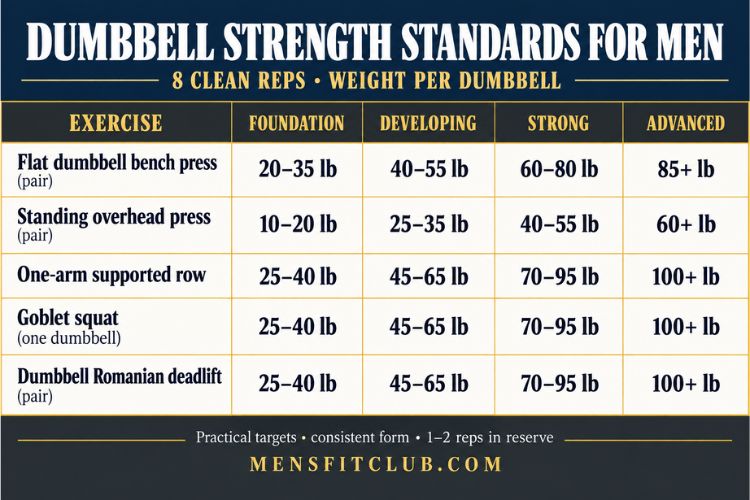
The following bands are approximate working targets for an adult man using commercial gym dumbbells. Foundation means building reliable technique; developing means consistent strength training has produced a solid working weight; strong and advanced are ambitious recreational targets. These labels are not rankings of men in the general population. Body size and lever lengths matter, especially for lower-body exercises. If the top available dumbbell is too light, improve the challenge through a unilateral variation rather than claiming a comparable standard.
| Exercise and test | Foundation | Developing | Strong | Advanced |
|---|---|---|---|---|
| Flat dumbbell bench press, pair × 8 | 20–35 lb each | 40–55 lb each | 60–80 lb each | 85+ lb each |
| Standing overhead press, pair × 8 | 10–20 lb each | 25–35 lb each | 40–55 lb each | 60+ lb each |
| One-arm supported row, each side × 8 | 25–40 lb | 45–65 lb | 70–95 lb | 100+ lb |
| Goblet squat, one dumbbell × 8 | 25–40 lb | 45–65 lb | 70–95 lb | 100+ lb |
| Dumbbell Romanian deadlift, pair × 8 | 25–40 lb each | 45–65 lb each | 70–95 lb each | 100+ lb each |
These numbers are deliberately broad. A man can be strong at rowing and still be developing an overhead press. You may also find that your gym’s five-pound weight jumps put you between bands. That is normal. A technically clean set at the lower end of a band is more meaningful than a partial set at its upper end.
Flat Dumbbell Bench Press Strength Standards
The dumbbell bench press is an accessible upper-body benchmark because it trains the chest, shoulders, and triceps while challenging each side independently. Start with feet planted and the shoulder blades comfortably set against the bench. Lower the dumbbells under control until your upper arms reach a range your shoulders tolerate, then press to a stable top position without banging the weights together. Keep your forearms roughly vertical from the front view.
For a man new to lifting, two 20- to 35-pound dumbbells for eight good reps can be a useful starting milestone. Two 40s to 55s indicate developing strength; 60s to 80s for eight controlled reps are a strong recreational result. If your range of motion becomes shorter as the weight rises, keep the previous result in your log as the valid benchmark. An incline bench, neutral grip, or floor press is a separate exercise with its own history.
Standing dumbbell overhead press standards
Standing presses demand more trunk control and are usually lighter than bench presses. Begin with the dumbbells near shoulder height, ribs stacked over the pelvis, and feet planted. Press overhead without turning the movement into a leaning back exercise. Finish with the weights balanced over your shoulders, then lower smoothly. A seated press with back support is a different test.
A pair of 10s to 20s for eight strict reps is a practical foundation range. Two 25s to 35s reflect developing ability, while two 40s to 55s mark a strong result under these rules. Two 60s or more for eight strict standing reps is an advanced recreational target. Shoulder mobility and arm length affect performance; use a pain-free grip and range rather than forcing a textbook shape.
One-Arm Dumbbell Row Strength Standards
For the row, support one hand on a sturdy bench or rack and position your torso consistently each time. Pull the dumbbell toward your hip or lower ribs, pause briefly, and lower until the working arm is extended without rounding aggressively. Keep your hips and shoulders mostly square. Test both sides and use the weaker side as the result you plan around.
A 25- to 40-pound row for eight controlled reps is a sensible foundation target. Loads of 45 to 65 pounds suggest developing strength; 70 to 95 pounds are strong; 100 pounds or more with the same controlled range is advanced. Heavy rows invite body rotation and momentum. If you heave the weight upward, the higher number is not comparable to your earlier strict set.
Goblet squat standards
Hold one dumbbell vertically at the chest. Squat to a repeatable depth you can control while keeping the whole foot planted. Stand up without collapsing the torso or bouncing out of the bottom. One 25- to 40-pound dumbbell for eight reps is a foundation target; 45 to 65 pounds is developing; 70 to 95 pounds is strong; and 100 pounds or more is advanced for this particular lift.
The goblet squat often stops being a useful maximum-strength test because gripping and positioning a large dumbbell becomes the limiting factor before your legs are fully challenged. That does not mean your legs are weak. Progress to heavier split squats, step-ups, two-dumbbell squats, or another suitable lower-body lift, then track that exercise separately. Never treat a heavy goblet squat as a substitute for checking squat depth and balance.
Dumbbell Romanian deadlift Strength standards
The Romanian deadlift tests your ability to load a hip hinge while keeping the dumbbells close to the legs. Stand tall, soften the knees, push the hips backward, and lower until you feel a substantial hamstring stretch without losing a stable spine position. Stand by driving through the feet and extending the hips. Set a consistent bottom position rather than lowering farther simply to touch the floor.
Two 25s to 40s for eight reps form a reasonable foundation range. Two 45s to 65s are developing, two 70s to 95s are strong, and two 100s or more are advanced. Grip can become the limiting factor. If you use straps, mark that in your training log and compare strapped sets with strapped sets. If back position changes to reach a heavier weight, reduce the load.
Are Dumbbell Curls, Lunges, and Carries Worth Tracking?
Yes, but they require their own rules. A strict standing curl with the elbows near the torso and no swing is a better measure than a heavier curl with full-body momentum. For most men, progression from 15- to 25-pound dumbbells toward clean sets with 30s or 40s is a useful training goal, not a universal cutoff. Specify whether the arms curl simultaneously or alternately and whether each arm completes eight repetitions.
For reverse lunges, track the weight in each hand, eight reps per leg, step length, and whether the back knee approaches the floor. Your balance and mobility may determine the load before your leg strength does. Start with bodyweight or light dumbbells, build control, and add load only when each side looks similar. A split squat with a fixed stance can be easier to standardize than a walking lunge.
For a farmer’s carry, record both dumbbells and the walking distance. A pair of 40s carried for 30 meters cannot be compared fairly with a pair of 60s carried for 10 meters. A practical milestone is to carry challenging dumbbells for 30 to 45 seconds with an upright torso, normal steps, and no repeated setting down. Increase load, distance, or time one variable at a time. Carries are particularly useful when traditional grip tests do not reflect the work you want to perform.
How to Test Your Dumbbell Strength Standards Safely
Choose a day when you are rested and use the exact variation you intend to repeat. Warm up for five to ten minutes with comfortable movement, then do two or three gradually heavier practice sets. Your first warm-up set might be very light for eight to ten reps; later sets can use fewer reps as the weight increases. Rest two to three minutes before a challenging eight-rep attempt. You do not need to attempt a risky true one-rep maximum to learn whether you are progressing.
Select a weight you expect to lift eight times with one or two good reps left. Count only repetitions completed through your agreed range without assistance or obvious technique changes. If you finish eight easily, rest and try the next dumbbell increment. If you cannot reach eight, log the load and completed reps, then test a lighter pair another day or after adequate recovery. Avoid repeatedly taking multiple lifts to failure in one session.
Write down the date, exercise variation, load per hand, reps, rest time, and any meaningful setup detail. For a bench press, note bench angle and grip. For a row, note hand support and torso angle. Film a side or front view occasionally if it helps you check consistency. Re-test after four to eight weeks of regular training rather than chasing a new record every workout.
Why estimated one-rep maximums can mislead Someone Dumbbell Strength Standards
Some lifters convert an eight-rep dumbbell set into an estimated one-rep maximum. Such formulas can help describe a trend, but they are less reliable when you change range of motion, lift explosively, or use a movement where balance limits performance. A calculated “maximum” also assumes the eight-rep set was close enough to failure. For most recreational lifters, comparing eight clean reps at the same exercise is simpler and more useful.
Never combine the weights of two dumbbells and call the result your barbell maximum. Two 50-pound dumbbells represent 100 pounds of external weight, but the coordination demands and mechanics differ from a 100-pound barbell. If your goal is a barbell competition lift, test and train that lift directly.
How Body Weight, Age, and Experience Affect the Numbers
A larger man often moves more absolute load, especially after substantial training, but the relationship is not linear. Dividing the weight by body weight may provide another perspective, yet simple ratios can unfairly favor smaller lifters in some movements. Use absolute load and body weight together when interpreting a result. For example, two men pressing the same pair of dumbbells may have different relative challenges without either performance being invalid.
Age does not automatically place a man in a lower category. A man who starts strength training at 50 may initially lift less than a trained 50-year-old, and both can improve. Recovery, joint comfort, prior injuries, and training consistency deserve more attention than an arbitrary age cutoff. If you return after a long break, establish a new baseline and build gradually rather than trying to reclaim an old number immediately.
Training experience is specific to the movement. Years of machine presses do not guarantee skill with free dumbbells. Likewise, someone who performs heavy barbell deadlifts may need practice balancing two dumbbells in an RDL. Give a new exercise several sessions for technique to settle before using its number as a meaningful benchmark.
A Simple Plan to Improve Your Dumbbell Strength
Train your main movement patterns two or three times a week, leaving enough recovery between hard sessions. A straightforward full-body session might include a dumbbell squat or split squat, a bench or floor press, a supported row, an RDL, and a carry. Another session can substitute an overhead press and lunge variation. Start with two or three sets per exercise. Work in a six- to ten-rep range for the main lifts, maintaining controlled form and approximately one to three reps in reserve on most sets.
Use double progression: keep the same dumbbells while adding reps within the target range. If you perform three sets of six reps with two 40-pound dumbbells, build toward three sets of ten with the same technique. Then move to the next available pair and begin again near six reps. A five-pound increase in each hand can be substantial on an overhead press. If the jump is too large, add a set, extend the rep range, or use smaller incremental plates if your equipment allows.
For a sample week, train Monday and Thursday with a squat, press, row, hinge, and carry. If you prefer three days, alternate two sessions across Monday, Wednesday, and Friday. Maintain at least one easier day between demanding full-body workouts. Keep a short log, and look at four- to eight-week trends rather than reacting to one tired session. Sleep, food intake, stress, and recent endurance work can all affect performance on test day.
The American College of Sports Medicine’s 2026 resistance-training guidance emphasizes consistent training and tailoring load and volume to the goal. It highlights heavier loading, around 80% of one-repetition maximum, for maximizing strength, while also recognizing that effective resistance training can take several forms. That guidance supports progressive training; it does not establish the exercise-specific dumbbell tiers in this article. genui{“citation”:{“ref”:”turn0search0″}}
What to do when progress stalls
First check whether the sets are truly comparable. More strict reps at the same weight are progress even if the dumbbell number has not changed. If several weeks pass without improvement, review total hard sets, rest periods, and whether you are attempting every set to exhaustion. Take a lighter week when accumulated fatigue is high. You may also need more food or better sleep, but avoid assuming every plateau has one cause.
If a particular movement causes persistent pain, stop forcing it to meet a standard. A neutral-grip press, supported row, or split squat may let you train the same general pattern comfortably. Track the replacement on its own terms. Strength training is most valuable when you can repeat it over months and years.
Common Mistakes When Comparing Dumbbell Numbers
The first mistake is confusing per-hand weight with total weight. A bench press with two 50s is recorded as 50 pounds per hand, or 100 pounds combined. The second is ignoring repetitions: a single rep and a set of eight represent different performances. Third is comparing distinct exercises, such as a seated shoulder press with a strict standing press.
Another mistake is allowing technique to change whenever the dumbbells get heavier. Shorter reps, bouncing, twisting, and using leg drive may be useful in a specifically defined exercise, but they invalidate a comparison with a stricter prior test. Finally, online rankings often draw from self-selected lifters who log workouts. They do not necessarily describe the average man. Treat any public chart as context and give priority to your own repeatable results.
Frequently Asked Questions About Dumbbell Strength Standards
Is pressing 50-pound dumbbells good for a man?
It depends on the movement and reps. Pressing two 50-pound dumbbells for eight clean flat-bench reps falls in the developing band used here and represents a worthwhile achievement for many recreational lifters. Pressing two 50s overhead for eight strict standing reps falls in the strong band. Neither result should be judged without the exercise, form, and training history.
What is a good dumbbell weight for beginners?
Choose the lightest weight that lets you practice a full, controlled range and complete the planned set with a few reps left. That may be 10 pounds for an overhead press and considerably more for an RDL. Your first goal is repeatable technique. Increase weight when all prescribed sets become reliably manageable.
Should both arms lift the same weight?
For paired exercises, use the same weight in each hand unless a qualified coach has a specific reason to do otherwise. For one-arm rows or other unilateral movements, start with the weaker side and match its clean repetitions on the stronger side. A small difference is common; a large or sudden change deserves attention.
How often should I test my strength?
Every four to eight weeks is enough for most men. You can still log ordinary working sets every session. Formal testing is useful when it helps you adjust training, not when it pressures you to lift beyond your current control.
The Best Standard Is Repeatable Progress
Dumbbell strength standards for men are useful when they answer a specific question: what can you lift today for a defined number of clean reps, and how has that changed? Use the benchmark ranges as broad landmarks. Set a consistent technique, record weight per hand, build repetitions, and then add load. A stronger, more controlled set six weeks from now matters more than any category on a chart.
Related Dumbbell Training Guides From MensFitClub
Once you have recorded your baseline, use our Dumbbell Bench Press Standards for a closer look at your chest press, then put your numbers to work with The Best Dumbbell Workout Program. If you want a weekly structure that separates upper- and lower-body lifts, follow the Upper Lower Split Dumbbell Workout Plan. The 4 Week Full Body Dumbbell Workout gives you a focused block for progressive training, while the 45 Minute Full Body Dumbbell Workout offers a single-session option for practicing the major movement patterns.


Most Recommended

Subscribe to our Newsletter
Stay up to date on the latest men’s health, fitness and lifestyle trends and tips.
About Us
Men’s Fit Club was started with the goal of empowering men to get the most out of their lives. This meant going beyond exercise and diet tips to really address the broad range of issues that men face on a daily basis – topics like recreation, finding love, sexual health and even sound fashion advice.
Quick Links
© COPYRIGHT MEN'S FIT CLUB 2026. All Rights Reserved