

30 Day Dumbbell Bench Press Workout for a Bigger Chest


5×5 Dumbbell Bench Press Workout The Ultimate Guide to Gains

30 Day Weight Loss Transformation Workout Without Gym
4-Week Burpee Training Plan for Strength And Stamina
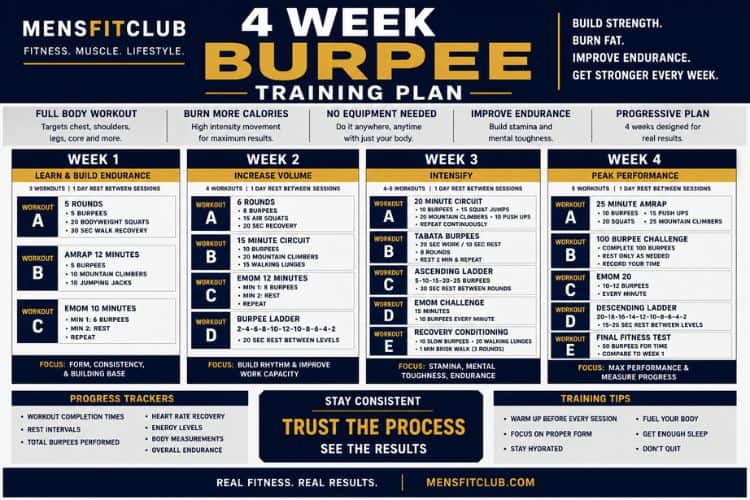
Burpees are one of the most powerful bodyweight exercises ever created. They combine strength, cardio, endurance, mobility, and explosive power into one movement. Whether your goal is fat loss, improved conditioning, increased athletic performance, or building mental toughness, a structured 4 week burpee training plan can transform your fitness level quickly.
Many people love to hate burpees because they challenge nearly every muscle in the body. They raise your heart rate fast, torch calories, and force your body to work as one complete unit. Unlike isolated exercises, burpees deliver full-body results without requiring equipment or a gym membership.
The problem is that most people jump into burpee workouts with no progression strategy. They perform too many reps too early, burn out, lose motivation, and eventually quit. That is why following a progressive four-week system can dramatically improve your results while reducing injury risk.
This guide provides a complete 4 week burpee training plan designed for beginners and intermediate fitness enthusiasts looking to improve endurance, conditioning, and total-body performance.
Why Burpees Are One of the Best Exercises
Burpees have remained popular for decades because they provide multiple benefits simultaneously.
Burpees target:
- Chest
- Shoulders
- Triceps
- Core
- Glutes
- Quadriceps
- Hamstrings
- Calves
- Hip flexors
- Cardiovascular system
Unlike traditional cardio sessions, burpees combine resistance training and aerobic conditioning in one movement.
Benefits include:
Full-body muscle activation
Almost every major muscle group participates during the movement.
Improved conditioning
Burpees rapidly elevate your heart rate and improve cardiovascular endurance.
Increased calorie burn
Because multiple muscle groups work together, calorie expenditure becomes extremely high.
Enhanced athletic performance
Athletes use burpees to improve explosiveness, agility, and endurance.
Minimal equipment
No gym required.
Time efficiency
Short workouts can produce significant results.
Muscles Worked During Burpee Training Plan
Understanding the movement helps maximize training effectiveness.
Lower Body
The squat portion activates:
- Quadriceps
- Glutes
- Hamstrings
- Calves
Upper Body
The push-up phase recruits:
- Chest
- Triceps
- Deltoids
Core
The entire movement requires stabilization from:
- Rectus abdominis
- Obliques
- Transverse abdominis
- Lower back muscles
Cardiovascular System
Burpees challenge:
- Heart
- Lungs
- Oxygen efficiency
Proper Burpee Training Plan Technique
Before beginning the four-week plan, master correct mechanics.
Step 1: Stand tall
Feet shoulder-width apart.
Keep core engaged.
Step 2: Squat down
Push hips backward.
Place hands on floor.
Step 3: Jump feet backward
Land in push-up position.
Maintain straight body alignment.
Step 4: Perform push-up
Lower chest toward floor.
Press upward.
Beginners can skip the push-up initially.
Step 5: Jump feet back forward
Bring knees toward chest.
Step 6: Jump upward
Explode vertically.
Reach arms overhead.
Land softly and repeat.
Common Burpee Training Plan Mistakes
Even simple exercises can become ineffective with poor form.
Avoid:
Rounding the back
Keep neutral spine alignment.
Landing too hard
Soft landings reduce joint stress.
Losing core tension
Brace your abs throughout movement.
Moving too quickly
Quality beats speed.
Skipping warmups
Burpees place stress on joints and muscles.
Dynamic Warm-Up Before Every Burpee Training Plan Session
Perform for 5–7 minutes.
Arm circles
30 seconds
High knees
30 seconds
Bodyweight squats
15 reps
Walking lunges
10 reps each side
Hip rotations
30 seconds
Jumping jacks
45 seconds
Inchworm walkouts Burpee Training Plan
8 reps
Week 1: Learning Mechanics and Building Endurance
Week one introduces movement patterns while gradually increasing work capacity.
Goal:
- Learn technique
- Build consistency
- Improve cardio baseline
Train:
3 sessions
Rest:
1 day between sessions
Week 1 Workout A Burpee Training Plan
5 rounds:
5 burpees
20 bodyweight squats
30-second walk recovery
Week 1 Workout B
AMRAP 12 minutes:
5 burpees
10 mountain climbers each side
10 jumping jacks
Move steadily.
Do not sprint.
Week 1 Workout C Burpee Training Plan
EMOM 10 minutes:
Minute 1:
6 burpees
Minute 2:
Rest
Repeat sequence.
Week One Focus
Prioritize movement quality.
Breathing should remain controlled.
You should finish workouts feeling challenged but not exhausted.
Week 2: Increase Volume and Work Capacity
Week two introduces higher repetition demands.
Goal:
- Improve conditioning
- Increase endurance
- Raise calorie burn
Train:
4 sessions
Workout A Burpee Training Plan
6 rounds:
8 burpees
15 air squats
20-second recovery
Workout B
15-minute circuit:
10 burpees
20 mountain climbers
15 walking lunges
Repeat continuously.
Workout C Burpee Training Plan
EMOM 12 minutes:
Minute 1:
8 burpees
Minute 2:
Rest
Repeat.
Workout D
Burpee ladder:
2 reps
4 reps
6 reps
8 reps
10 reps
12 reps
Then descend:
10
8
6
4
2
Rest:
20 seconds between levels
Week Two Goal Burpee Training Plan
Build rhythm.
Your recovery between rounds should improve noticeably.
Week 3: Intensify Conditioning
By week three your body adapts to movement efficiency.
Now intensity rises.
Goal:
- Build stamina
- Improve mental toughness
- Increase total work
Train:
4–5 sessions
Workout A Burpee Training Plan
20-minute circuit:
10 burpees
15 squat jumps
20 mountain climbers
10 pushups
Repeat continuously.
Workout B
Tabata Burpees
20 seconds work
10 seconds rest
8 rounds
Rest 2 minutes
Repeat entire sequence.
Workout C Burpee Training Plan
Ascending burpee ladder
5 reps
10 reps
15 reps
20 reps
25 reps
Rest 30 seconds between rounds
Workout D
EMOM Challenge
15 minutes:
10 burpees each minute
Remaining time equals recovery.
Workout E Burpee Training Plan
Recovery conditioning
3 rounds:
10 slow burpees
20 walking lunges
1-minute brisk walk
Week Three Goal Burpee Training Plan
Push effort while maintaining quality.
Expect heavier breathing and muscular fatigue.
Week 4: Peak Performance Week
Week four combines endurance and intensity.
Goal:
- Maximize conditioning
- Test progress
- Build confidence
Train:
5 sessions
Workout A Burpee Training Plan
25-minute AMRAP:
10 burpees
15 pushups
20 squats
Workout B
100 Burpee Challenge
Complete:
100 burpees
Rest only as needed
Record completion time
Workout C Burpee Training Plan
EMOM 20
10–12 burpees every minute
Workout D
Descending ladder:
20
18
16
14
12
10
8
6
4
2
Rest:
15–20 seconds
Workout E
Final Fitness Test
Complete:
50 burpees for time
Compare with week one performance.
Progress Markers to Track Burpee Training Plan
Measure improvements beyond body weight.
Track:
Workout completion times
Rest intervals
Total burpees performed
Heart rate recovery
Energy levels
Body measurements
Endurance
Most people notice improvements after only two weeks.
How Many Calories Does Burpee Training Plan Burn?
Calorie expenditure varies based on:
- Body weight
- Intensity
- Duration
- Fitness level
Approximate estimates:
150-pound person:
10 minutes = 90–120 calories
20 minutes = 180–240 calories
30 minutes = 270–360 calories
Higher intensity often increases calorie burn after workouts due to excess post-exercise oxygen consumption.
Nutrition Tips During Your 4 Week Burpee Training Plan
Training adaptation depends heavily on nutrition.
Increase protein intake
Aim for:
0.7–1 gram per pound of bodyweight
Protein supports:
- Recovery
- Muscle repair
- Performance
Good sources:
- Eggs
- Chicken
- Fish
- Greek yogurt
- Lean beef
Eat quality carbohydrates
Fuel training with:
- Oats
- Rice
- Potatoes
- Fruit
- Whole grains
Stay hydrated
Hydration directly affects endurance and performance.
Prioritize sleep
Recovery drives progress.
Aim:
7–9 hours nightly.
Burpee Training Plan Modifications for Beginners
Not everyone starts at the same fitness level.
Reduce difficulty using:
Step-back burpees
Walk feet backward rather than jump.
Remove push-up
Skip push-up phase.
Eliminate jump
Stand instead of explosive jump.
Elevated burpees
Place hands on bench or sturdy platform.
These modifications still provide excellent results.
Advanced Burpee Training Plan Variations
Once week four becomes manageable:
Burpee box jumps
Dumbbell burpees
One-arm burpees
Burpee pull-ups
Lateral burpees
Burpee broad jumps
These increase athletic challenge and calorie expenditure.
Recovery Burpee Training Plan Strategies
Burpee training can create substantial fatigue.
Support recovery through:
Foam rolling
Stretching
Mobility work
Walking
Sleep
Hydration
Proper nutrition
Recovery often determines long-term success.
Frequently Asked Questions Burpee Training Plan
Can I do burpees every day?
Daily burpees may eventually lead to overtraining. Most individuals perform best with 3–5 weekly sessions.
Will burpees build muscle?
They can improve muscular endurance and strength but are primarily conditioning-focused.
Are burpees effective for fat loss?
Yes. Burpees burn significant calories and elevate heart rate rapidly.
Can beginners do this plan?
Absolutely. Use movement modifications when needed.
How long before results appear?
Most people notice conditioning improvements in two weeks.
Visible body composition changes typically occur within four to eight weeks when paired with proper nutrition.
A structured 4 week burpee training plan delivers far greater results than random workouts. By progressively increasing volume, intensity, and endurance demands, you create a sustainable path toward better conditioning and improved total-body fitness.
Burpees are challenging because they force your entire body to work together. The same challenge that makes them difficult also makes them incredibly effective.
Stay consistent, focus on technique, trust the progression, and by the end of four weeks you will likely move faster, recover quicker, and feel significantly stronger.
The hardest burpee is often the first one. Start there and keep going.
Related MensFitClub Workouts You May Like: If you’re enjoying this 4 Week Burpee Training Plan and want to continue building endurance, strength, and full-body conditioning, explore more training resources at MensFitClub. Learn proper burpee programming with the Burpee Workout Guide, improve conditioning with our Bodyweight HIIT Workout, and add more fat-burning sessions using the 30 Minute Full Body Circuit Workout. You can also build foundational bodyweight strength with our Bodyweight Workout Plan or challenge yourself with the 30 Day Push-Up Challenge for additional upper-body endurance and performance gains.


Most Recommended

Subscribe to our Newsletter
Stay up to date on the latest men’s health, fitness and lifestyle trends and tips.
About Us
Men’s Fit Club was started with the goal of empowering men to get the most out of their lives. This meant going beyond exercise and diet tips to really address the broad range of issues that men face on a daily basis – topics like recreation, finding love, sexual health and even sound fashion advice.
Quick Links
© COPYRIGHT MEN'S FIT CLUB 2026. All Rights Reserved