
Strength Training After 50: Build Muscle and Stay Strong

How Many Hard Sets Per Muscle Group Per Week?
Training to Failure vs Reps in Reserve for Muscle Growth
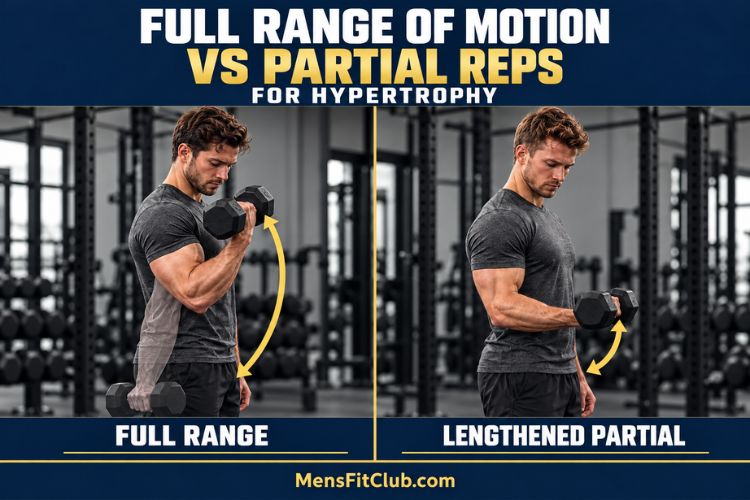
Full Range of Motion vs Partial Reps for Hypertrophy
Full Range of Motion vs Partial Reps for Hypertrophy
Building muscle requires more than choosing a weight and counting repetitions. How far you move through each exercise also influences the training stimulus. A deep squat, a shallow squat, a complete curl, and a bottom-half curl may look similar, but they place different demands on your muscles. That makes full range of motion vs partial reps for hypertrophy an important question for anyone trying to improve their workouts.
For years, the standard advice was straightforward: use a full range of motion and avoid incomplete repetitions. That remains a useful starting point. However, research into partial repetitions performed at longer muscle lengths has made the discussion more nuanced. A deliberately shortened movement can be productive when it targets an appropriate portion of an exercise.
The practical answer is that full range of motion provides a dependable foundation, while carefully selected partial reps can complement it. Understanding the difference between lengthened partials, shortened partials, and repetitions that become smaller through fatigue will help you apply each method intelligently.
What Is Full Range of Motion in Strength Training?
Full range of motion, often abbreviated as full ROM, means performing an exercise through its intended movement range while maintaining control and appropriate positioning. The exact endpoints depend on the exercise, equipment, and individual lifter.
During a dumbbell curl, this generally involves moving from a comfortably extended elbow to a flexed position without swinging the upper arm. During a squat, it involves descending to a depth you can control and returning to standing. During a calf raise, it includes lowering the heel into a comfortable stretch and rising onto the forefoot.
Full ROM does not mean forcing every joint to its anatomical limit. It means completing the exercise through a consistent, suitable range rather than cutting the movement short simply to lift more weight.
Full Range of Motion Is Individual
Two lifters can perform technically sound squats at different depths. Limb proportions, stance, ankle mobility, and exercise selection influence how the movement looks. Similarly, the bottom position of a dumbbell press will vary with shoulder comfort and arm length.
The useful standard is a range you can repeat without pain, bouncing, or major changes in posture. Your deepest possible position is not automatically your best training position. Establish controlled endpoints, then build strength within them.
What Are Partial Reps?
Partial repetitions use a selected portion of an exercise’s available range. Instead of moving between both normal endpoints, you reverse direction earlier.
For example, a partial curl might cover the lower half or upper half of the movement. A partial calf raise might emphasize the stretched bottom position or the elevated top position. These variations are all partial reps, but they are not interchangeable.
The location of the partial matters because joint position changes muscle length and exercise leverage. Equipment also affects where resistance is greatest. Calling every shortened repetition a “partial” hides these important differences.
Lengthened Partial Reps: Full Range of Motion
Lengthened partials emphasize the portion of an exercise where the target muscle is relatively elongated. A lower-range preacher curl and a calf raise performed around the bottom position are common examples.
These repetitions involve movement under load. They are not simply passive stretching or bouncing at an endpoint. The lifter controls the lowering phase, reverses direction deliberately, and repeatedly works within a defined range.
Shortened Partial Reps
Shortened partials emphasize positions where the target muscle is relatively contracted. Examples include upper-range curls or calf raises performed near the top.
They can create a strong local burning sensation and may serve specific training purposes. However, that sensation does not establish that they produce more growth. Shortened partials and lengthened partials should be evaluated separately.
What Does Research Say About Full Range of Motion vs Partial Reps?
Research does not support a universal claim that every partial repetition is inferior—or superior—to every full repetition. Outcomes depend on which muscle is trained, which exercise is used, and which portion of the movement receives emphasis.
An eight-week study published in 2025 compared lengthened partials with full ROM in resistance-trained participants using an upper-body training program. Both approaches produced comparable improvements in the measured muscle-growth and strength-endurance outcomes. This supports lengthened partials as a viable training option without establishing that they always outperform full repetitions.
A separate 12-week trial conducted across 15 sites included 297 participants assigned to full ROM or lengthened-partial training. The authors interpreted the between-group differences as small and practically similar, although the study did not meet its strict prespecified statistical criteria for establishing equivalence. That distinction matters: small observed differences are not proof that two methods produce identical results.
Why Exercise-Specific Findings Matter: Full Range of Motion
A small 2025 trial involving trained participants compared full-range preacher curls with lower-range partial curls over eight weeks. Both conditions produced hypertrophy, with findings suggesting a possible advantage for the lengthened-partial condition in that particular setting. The sample included only 13 participants, so it should inform experimentation rather than dictate every lifter’s program.
These studies examine particular exercises, training periods, and measurements. They cannot establish the best technique for every muscle or predict precisely how you will respond. The practical interpretation is to keep effective full-range training and consider lengthened partials where they are comfortable and easy to standardize.
Why Muscle Length Matters for Hypertrophy
Muscle length changes as joints move. In some exercises, the target muscle becomes relatively stretched near the bottom; in others, its position depends on more than one joint.
For example, elbow position influences the biceps, but shoulder position also matters. Likewise, knee and hip positions both influence the hamstrings. This is why “bottom-half reps” and “lengthened partials” do not always mean the same thing.
A Stretch Must Be Paired With Useful Resistance: Full Range of Motion
Feeling a stretch does not necessarily mean the target muscle is experiencing substantial loading. An exercise can place a muscle in a long position while providing little resistance there.
Dumbbell curls illustrate the issue. When the forearm hangs nearly vertically, the dumbbell produces relatively little external torque around the elbow. Simply performing tiny repetitions near that position does not reproduce every studied lengthened-partial curl variation.
Evaluate the entire setup: body position, resistance direction, equipment, and the portion of the movement you are using. A productive partial should involve meaningful muscular effort throughout its intended range.
Benefits of Full Range of Motion for Muscle Growth
Full ROM gives most lifters a straightforward framework for learning exercises and measuring progress. It establishes recognizable endpoints and encourages control through the complete movement.
It also reduces the temptation to treat a heavier weight as automatic evidence of improvement. If your repetitions become progressively shorter, the exercise has changed even when the name remains the same.
Easier Technique Tracking
Consistent full-range repetitions make workout records more useful. Ten repetitions with the same depth, posture, and tempo can be compared with a previous session. Ten repetitions performed with different endpoints cannot be interpreted as confidently.
This is especially valuable for beginners, who are still learning how an exercise should feel. A clear movement standard helps them distinguish muscular effort from swinging, bouncing, or shifting into an easier position.
Practice Across the Complete Movement: Full Range of Motion
Full-range training gives you repeated practice through both ends of an exercise. That matters when you want to improve the complete lift rather than become better at one portion.
For example, full squats develop familiarity with descending, controlling the bottom, and standing up. Partial squats practice a more limited task. Both can have uses, but the movement you want to perform should remain represented in your training.
Benefits of Lengthened Partial Reps for Hypertrophy
Lengthened partials allow you to emphasize a selected region of an exercise while keeping the movement deliberate. They can be useful when a stable setup makes that region easy to load and reproduce.
Their appeal is not that shorter repetitions are inherently better. It is that you can concentrate work within a particular muscle-length range without completing another portion of the movement on every repetition.
An Additional Programming Option: Full Range of Motion
If a muscle has stopped progressing, changing an accessory exercise’s range may offer a useful variation. However, first examine more basic explanations: inconsistent training, insufficient effort, poor recovery, or unrealistic expectations.
A reasonable experiment is to replace one existing accessory set with a lengthened-partial set. This lets you evaluate the technique without simultaneously increasing your entire workload. Keep the rest of the program stable enough to interpret your response.
Suitable for Stable Exercise Setups
Machines and supported isolation exercises often make partials easier to control. You can focus on the intended range without also managing balance or a heavy barbell.
A calf machine or supported curl may therefore be a more practical starting point than a free-weight compound lift. The exercise should let you stop safely, maintain position, and recognize when your chosen range begins to deteriorate.
Limitations of Partial Reps
The main limitation of partial training is that it can become difficult to standardize. A planned half-range movement may gradually shrink into a small pulse as fatigue increases.
Another limitation is that partial repetitions can make heavier loads possible without demonstrating improved performance through the complete exercise. That can create misleading workout records.
More Weight Does Not Automatically Mean More Growth: Full Range of Motion
A shallow squat with a heavier bar is a different task from a deeper squat with a lighter bar. Comparing their loads alone tells you little about which provides the better stimulus for a particular muscle.
The same principle applies to presses and curls. Evaluate weight together with range, control, effort, and exercise mechanics. Partial reps are most useful when you choose them for a clear purpose, rather than to make the numbers look better.
Partial Reps Can Become Unplanned Technique Changes
There is a meaningful difference between a deliberate partial set and a full-range set that gets shorter because the weight is too heavy.
If you intend to perform full repetitions, stop when you can no longer maintain the prescribed range and technique. If you intend to perform partial repetitions, define their endpoints before starting. That distinction keeps both methods measurable.
Full Range of Motion vs Partial Reps by Exercise
The best way to apply this discussion is exercise by exercise. A strategy that works well for calf raises may be awkward during squats or unnecessary during rows.
Squats and Leg Presses
Use a controlled depth that suits your anatomy and equipment. During a leg press, maintain a stable pelvis and avoid descending farther than you can control.
Partial squats and presses can serve specific purposes, but shallow repetitions should not automatically replace deeper training for hypertrophy. If you experiment with a lower-range partial, reduce the load as needed and establish reliable stopping points.
Biceps Curls Full Range of Motion
Begin with full-range curls that keep the upper arm stable. For a lengthened-partial variation, select a setup that meaningfully loads the lower range, such as an appropriately configured preacher curl.
Avoid snapping the elbow into extension or bouncing out of the bottom. The goal is controlled muscular work, not an aggressive stretch. Use a manageable weight and keep the partial range consistent.
Triceps Extensions
During overhead triceps extensions, shoulder position places the long head of the triceps at a relatively longer length than some other extension variations.
Start with a comfortable full range and stable upper arms. If testing partials around the more flexed-elbow portion, keep the movement controlled and avoid forcing an uncomfortable depth. Elbow comfort should guide the setup.
Calf Raises
Calf raises offer clear opportunities to compare full repetitions with lower-range partials. Full reps include a controlled heel descent and a deliberate rise.
For lengthened partials, work around the bottom portion without bouncing. Keep the knee position consistent because changing it changes the exercise. Record standing and seated calf raises separately rather than treating them as identical movements.
Presses and Rows Full Range of Motion
A complete press or row remains a useful default. During pressing, choose a bottom position you can control comfortably. During rowing, reach and pull without turning the exercise into excessive torso movement.
Lengthened partials in these exercises can be harder to define, especially with free weights. Use a stable setup and moderate loads if experimenting. Avoid adding fatigued partials where failure could leave you trapped under equipment.
How Close to Failure Should You Train?
Both full and partial repetitions need sufficient effort to be useful. However, you do not need to turn every set into an exhaustive test.
As a practical starting point, finish most working sets with approximately one to three good repetitions available within the prescribed range. This is a coaching guideline, not a precise rule that every lifter must follow.
Define Failure by the Intended Range: Full Range of Motion
If you can no longer complete a full repetition, you have reached failure for that full-range task—even if a shorter movement remains possible.
For a planned partial set, judge performance against the chosen partial range. Once you cannot maintain its endpoints and technique, the set is complete. Otherwise, the range can keep shrinking indefinitely, making effort difficult to track.
Be Selective With Partials After Full Reps
Adding partials after full-range failure extends a set and increases its demands. Treat this as an optional intensity technique.
If you use it, choose a stable exercise that allows a safe exit and apply it sparingly. Count it as additional work. A few controlled partials are more useful for tracking than an unpredictable sequence of tiny movements.
How to Combine Full Range of Motion and Partial Reps
You do not have to choose one method for your entire program. Use full ROM for most exercises, then introduce a clearly defined partial variation where it serves a purpose.
This approach maintains practice through complete movements while letting you explore a different accessory-training stimulus.
Start With One Exercise
Choose one muscle and one familiar exercise. For example, keep your existing calf routine but replace the final full-range set with a lower-range partial set.
Use the same equipment each time. Record the load, repetitions, and intended endpoints. Avoid changing frequency, exercise selection, and total sets simultaneously. A small, controlled adjustment is easier to evaluate.
Progress Without Shrinking the Range
Use a repetition bracket, such as 10–15 controlled partial repetitions. When you reach the top of the bracket with consistent technique, consider a small load increase.
If the heavier weight forces you to shorten the range, return to the previous load. Progress should mean better performance at the same task. Apply that standard to both full and partial repetitions.
Sample Hypertrophy Workout Using Both Methods
The following session illustrates how to combine the techniques. It is a starting framework, so adjust the exercises and workload to your experience and recovery.
Lower-Body Training
Begin with squats or leg presses for three sets of six to ten full-range repetitions. Follow with Romanian deadlifts for two sets of eight to twelve, lowering only as far as you can maintain your intended hip hinge and trunk position.
Perform two sets of leg curls for ten to fifteen controlled repetitions. Finish with two full-range calf-raise sets of ten to fifteen repetitions and one lower-range partial set using a manageable load. Rest until you can repeat the movement well.
Upper-Body Training
Perform a dumbbell or machine press for three sets of eight to twelve full repetitions. Follow with three sets of supported rows and two sets of pulldowns, using controlled, repeatable ranges.
Complete two overhead triceps-extension sets of ten to fifteen repetitions. For biceps, perform one or two full-range preacher-curl sets, then optionally substitute a lower-range partial set for one additional planned curl set. Keep the initial experiment modest.
Common Mistakes When Training for Hypertrophy
Range of motion becomes useful only when the rest of the exercise remains controlled. Several common mistakes make both methods less productive.
Bouncing Through the Stretched Position
Bouncing can replace muscular control with momentum and make the reversal harder to reproduce. Lower deliberately, then change direction without a sudden rebound.
You do not need an extremely slow tempo. Use a speed that allows you to control the weight and recognize your endpoints. Reduce the load if that control disappears.
Changing Several Variables at Once
Switching exercises, adding sets, increasing weight, and introducing partials together makes it difficult to identify what helped or caused excessive fatigue.
Change one meaningful variable, observe your response, and adjust again when needed. Your program should provide enough consistency to judge whether performance is improving.
Judging Results by Pump or Soreness
A strong pump can feel satisfying, and unfamiliar partials may produce soreness. Neither proves that a method is superior for muscle growth.
Look for repeatable performance improvements, tolerable recovery, and longer-term changes in measurements or appearance. If an exercise repeatedly disrupts subsequent sessions, reconsider its dose regardless of how intense it feels.
Full ROM vs Partial Reps for Men Over 40
For men over 40, choose techniques according to training history, joint comfort, and recovery. Age alone does not require abbreviated repetitions, but an unfamiliar loaded stretch should be introduced gradually.
Keep comfortable full-range movements in your routine. If an exercise irritates a joint, consider changing the load, grip, equipment, or exercise before assuming partials will solve the problem.
Build Tolerance Gradually
Start new lengthened-partial work with modest loads and fewer sets. Increase exposure only when the movement remains comfortable and recovery is manageable.
Distinguish muscular effort from sharp or persistent joint pain. Pain that continues or limits normal movement warrants assessment by an appropriate health professional. A productive exercise should be something you can perform consistently.
Frequently Asked Questions About Range of Motion and Muscle Growth
Are Partial Reps Better Than Full Reps?
There is no universal winner. Lengthened partials are a credible option for selected exercises, while full repetitions remain a practical foundation. Choose based on the muscle, setup, comfort, and ability to maintain consistent technique.
Should Beginners Use Lengthened Partials?
Beginners should first learn controlled full repetitions and reliable exercise positioning. Partials can be introduced later when they can identify the intended muscle-length range and repeat it consistently. They are an option, not a requirement.
Can I Use Partial Reps on Every Exercise?
You can organize training around partials, but doing so removes practice from portions of the complete movements. For most recreational lifters, a mixture is easier to manage. Keep full-range work and experiment selectively with supported accessory exercises.
How Long Should I Test a Partial-Rep Variation?
Several consistent weeks can help you assess comfort, performance, and recovery. Visible muscle growth takes longer to judge and can be difficult to measure precisely. Avoid making conclusions after one unusually good pump or one sore workout.
Choosing the Right Full Range of Motion for Your Goals
Full range of motion vs partial reps for hypertrophy is best approached as a programming decision. Start with controlled full repetitions, establish consistent endpoints, and progress without sacrificing technique. This gives you a dependable standard for evaluating your strength training.
When introducing partials, define which portion you will use and why. Select a stable exercise, begin with a modest dose, and record it separately from full-range work. Keep methods that support measurable progress and manageable recovery. Building muscle depends on repeating effective training over time, and the best range is one you can load, control, and sustain.
To put full range of motion and partial reps into practice, explore our 4-Week Progressive Overload Workout Plan for structured progression and learn How to Choose Dumbbell Weight for Every Exercise to keep repetitions controlled. Our guide to Building Leg Muscle With Only Dumbbells covers lower-body exercise technique, while the 30-Minute Dumbbell Workout for Building Muscle offers a practical training routine. For older lifters, Strength Training After 50: Sets, Reps and Recovery provides guidance on gradual progression and managing fatigue.


Most Recommended

Subscribe to our Newsletter
Stay up to date on the latest men’s health, fitness and lifestyle trends and tips.
About Us
Men’s Fit Club was started with the goal of empowering men to get the most out of their lives. This meant going beyond exercise and diet tips to really address the broad range of issues that men face on a daily basis – topics like recreation, finding love, sexual health and even sound fashion advice.
Quick Links
© COPYRIGHT MEN'S FIT CLUB 2026. All Rights Reserved