

30 Day Dumbbell Bench Press Workout for a Bigger Chest


5×5 Dumbbell Bench Press Workout The Ultimate Guide to Gains

30 Day Weight Loss Transformation Workout Without Gym
30 Minute Swimming Arm Workout for Strength And Endurance
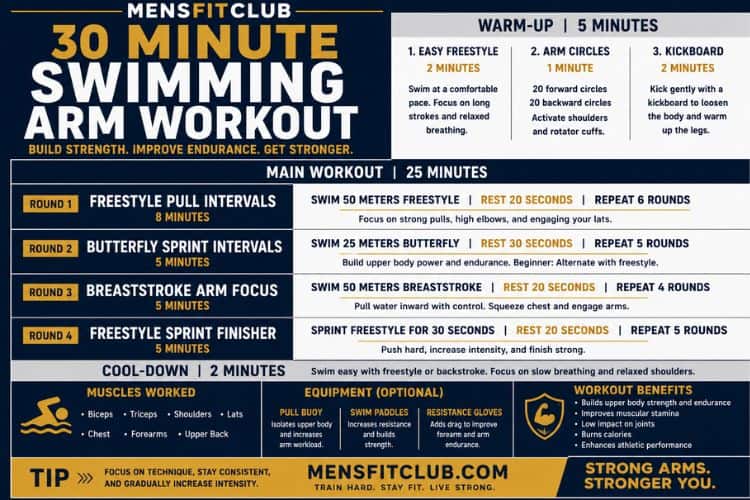
Swimming is one of the best full-body exercises for building lean muscle, improving cardiovascular fitness, and increasing muscular endurance without placing excessive stress on the joints. While swimming naturally works the entire body, your arms and upper body take on a major role during every stroke. A properly structured 30 minute swimming arm workout can help men develop stronger shoulders, bigger biceps and triceps, improved grip strength, and better swimming performance while also burning calories and boosting endurance.
Whether you are training in a lap pool, preparing for triathlons, trying to improve your freestyle speed, or simply looking for a low-impact arm workout, swimming provides an excellent solution. Unlike traditional gym workouts that isolate muscles with machines and dumbbells, swimming challenges your muscles continuously through resistance created by water. Since water provides roughly 12 times more resistance than air, every pull, stroke, and movement forces your arm muscles to work harder.
This guide will walk you through the benefits of swimming for arm development, the muscles involved, how to structure a 30 minute swimming arm workout, and tips to maximize results for strength and endurance.
Why Swimming Is an Excellent Arm Workout
Many men underestimate how effective swimming can be for upper-body training. While lifting weights remains a proven method for muscle growth, swimming introduces unique resistance that builds muscular endurance, mobility, and functional strength simultaneously.
A swimming arm workout trains multiple muscle groups together, including:
- Biceps
- Triceps
- Deltoids
- Forearms
- Lats
- Upper chest
- Trapezius muscles
- Rotator cuff muscles
Every stroke forces the arms to pull against water resistance while maintaining body balance and coordination. This combination of strength and endurance creates lean muscle definition while reducing stress on the elbows and shoulders.
Benefits of Swimming Arm Workouts
Low-Impact Joint Training
Swimming reduces impact stress on the joints, making it ideal for men recovering from injuries or looking to avoid wear and tear from heavy lifting.
Improved Muscular Endurance
Swimming requires constant movement, which increases muscular stamina and helps the arms perform longer without fatigue.
Better Shoulder Mobility
The repetitive movement patterns in swimming help improve flexibility and shoulder range of motion.
Increased Calorie Burn
A high-intensity swimming workout can burn between 300 and 500 calories in just 30 minutes depending on intensity and body weight.
Full Upper-Body Engagement
Unlike isolation exercises in the gym, swimming uses the arms as part of a connected movement system involving the core, chest, and back.
Muscles Worked During a Swimming Arm Workout
Understanding the muscles activated during swimming helps you structure more effective workouts.
Biceps
The biceps work during the pulling phase of strokes like freestyle and butterfly. Every time you pull water toward your body, the biceps assist in elbow flexion.
Triceps
The triceps become highly active during the pushing phase of the stroke when extending the arms behind the body.
Shoulders
The deltoids stabilize and rotate the arms throughout every swimming motion. Front delts especially work hard during freestyle recovery.
Forearms and Grip
Maintaining hand positioning in the water continuously engages the forearms and grip muscles.
Latissimus Dorsi
The lats generate much of the pulling power during freestyle and butterfly swimming.
Chest Muscles
Breaststroke and butterfly activate the chest muscles significantly during inward pulling movements.
Best Swimming Strokes for Arm Development
Different swimming styles emphasize different muscle groups.
Freestyle
Freestyle is excellent for overall arm endurance and shoulder conditioning. It heavily works the lats, deltoids, and triceps.
Primary Muscles Worked
- Lats
- Shoulders
- Triceps
- Forearms
Butterfly
Butterfly is one of the most demanding swimming strokes for upper-body strength. It develops explosive power and muscular endurance.
Primary Muscles Worked
- Chest
- Shoulders
- Triceps
- Core
Breaststroke
Breaststroke targets the chest, biceps, and shoulders while also improving mobility.
Primary Muscles Worked
- Chest
- Biceps
- Shoulders
Backstroke
Backstroke improves shoulder stability and upper-back strength while reducing pressure on the shoulders.
Primary Muscles Worked
- Rear delts
- Lats
- Traps
- Biceps
30 Minute Swimming Arm Workout Structure
This workout focuses on maximizing arm endurance, upper-body strength, and swimming efficiency in a short amount of time.
Workout Overview
- Duration: 30 minutes
- Goal: Arm strength and endurance
- Skill Level: Beginner to intermediate
- Equipment Optional: Pull buoy, swim paddles
Warm-Up Phase (5 Minutes)
A proper warm-up increases blood flow and prepares the shoulders and arms for exercise.
Easy Freestyle Swim
Swim at a comfortable pace for 2 minutes.
Focus on:
- Long strokes
- Relaxed breathing
- Smooth arm movement
Arm Circles in Water
Perform:
- 20 forward circles
- 20 backward circles
This activates the shoulder joints and rotator cuff muscles.
Kickboard Warm-Up Swimming Arm Workout
Hold a kickboard and kick gently for 1 minute to loosen the body while resting the arms.
Main 30 Minute Swimming Arm Workout
Round 1: Freestyle Pull Intervals (8 Minutes)
Freestyle pulling develops endurance and upper-body power.
Workout
- Swim 50 meters freestyle
- Rest 20 seconds
- Repeat 6 rounds
Focus
- Pull strongly through the water
- Keep elbows high
- Engage lats during each stroke
Benefits
This improves arm endurance while strengthening the shoulders and triceps.
Round 2: Butterfly Sprint Intervals (5 Minutes)
Butterfly activates nearly every upper-body muscle.
Workout
- Swim 25 meters butterfly
- Rest 30 seconds
- Repeat 5 rounds
Beginner Option
Alternate butterfly with freestyle if needed.
Benefits
This round develops explosive upper-body power and muscular endurance.
Round 3: Breaststroke Arm Focus (5 Minutes)
Breaststroke emphasizes chest and bicep activation.
Workout
- Swim 50 meters breaststroke
- Rest 20 seconds
- Repeat 4 rounds
Focus
- Pull water forcefully inward
- Squeeze chest muscles
- Maintain controlled movements
Round 4: Freestyle Sprint Finisher (5 Minutes)
High-intensity sprint swimming maximizes muscle fatigue and calorie burn.
Workout
- Sprint freestyle for 30 seconds
- Rest 30 seconds
- Repeat 5 rounds
Benefits
This increases:
- Arm endurance
- Cardiovascular fitness
- Calorie expenditure
Cool-Down (2 Minutes)
Finish with easy backstroke or freestyle swimming.
Focus on:
- Slow breathing
- Relaxed shoulders
- Stretching movements in water
Swimming Equipment for Better Arm Workouts
Adding simple swimming tools can increase resistance and improve upper-body training.
Swim Paddles
Swim paddles increase surface area and force the arms to work harder.
Benefits
- Builds pulling strength
- Increases shoulder endurance
- Enhances water feel
Pull Buoy
A pull buoy isolates the upper body by keeping the legs afloat.
Benefits
- Places more workload on the arms
- Improves stroke mechanics
- Strengthens shoulders and lats
Resistance Gloves
Water resistance gloves create additional drag during swimming.
Benefits
- Improves forearm activation
- Builds muscular endurance
- Enhances arm strength
How Swimming Builds Lean Muscle
Swimming typically develops lean, athletic muscle rather than bulky mass. The continuous resistance from water challenges slow-twitch muscle fibers responsible for endurance and muscle tone.
For men looking to combine muscle growth with conditioning, swimming is highly effective because it:
- Increases time under tension
- Improves blood circulation
- Reduces joint strain
- Enhances recovery between strength sessions
Combining swimming with gym training can produce excellent results for physique and performance.
Swimming Arm Workout for Beginners
If you are new to swimming workouts, start slowly and prioritize technique over speed.
Beginner Tips
Focus on Stroke Quality
Efficient strokes prevent shoulder fatigue and improve performance.
Use Short Intervals
Start with:
- 25-meter swims
- Longer rest periods
- Moderate intensity
Practice Breathing
Controlled breathing improves endurance and reduces early fatigue.
Avoid Overtraining
Swimming can place heavy demands on the shoulders. Allow proper recovery between sessions.
Advanced Swimming Arm Workout Training Tips
Experienced swimmers can increase intensity using several methods.
Add Resistance Tools
Using paddles and drag equipment increases muscular workload.
Reduce Rest Periods
Shorter recovery times improve conditioning and endurance.
Increase Sprint Volume
Adding more sprint intervals increases calorie burn and upper-body fatigue.
Combine Strokes
Switching between freestyle, butterfly, and breaststroke challenges muscles differently.
Common Swimming Arm Workout Mistakes
Avoiding these mistakes helps improve results and reduces injury risk.
Overusing the Shoulders
Many swimmers rely too heavily on shoulder muscles instead of engaging the lats and core.
Solution
Focus on pulling from the back muscles during freestyle.
Poor Elbow Position
Dropping the elbows reduces pulling power.
Solution
Maintain a high elbow during the underwater pull phase.
Swimming Too Fast Too Soon
Starting at maximum intensity causes premature fatigue.
Solution
Gradually increase speed during the workout.
Ignoring Recovery
Swimming is demanding on the shoulders and elbows.
Solution
Include mobility work and rest days.
Nutrition Tips for Swimming Arm Workout Performance
Proper nutrition improves performance and muscle recovery after swimming workouts.
Pre-Swimming Arm Workout Nutrition
Consume:
- Complex carbohydrates
- Lean protein
- Hydration
Examples:
- Oatmeal with fruit
- Greek yogurt
- Banana and peanut butter
Post-Swimming Arm Workout Recovery
After swimming, focus on:
- Protein for muscle repair
- Carbohydrates for glycogen recovery
- Electrolytes and water
Examples:
- Protein shake
- Chicken and rice
- Eggs and sweet potatoes
Weekly Swimming Arm Workout Schedule
Here is a simple weekly structure for improving arm endurance and strength.
Monday
30 minute swimming arm workout
Tuesday
Strength training or rest
Wednesday
Swimming endurance workout
Thursday
Upper-body gym workout
Friday
30 minute swimming sprint workout
Saturday
Recovery swim or mobility work
Sunday
Rest day
Can Swimming Replace Arm Day Workout at the Gym?
Swimming can absolutely improve arm strength and muscular endurance, but whether it can fully replace gym training depends on your goals.
Swimming Is Best For
- Lean muscle development
- Athletic conditioning
- Joint-friendly exercise
- Endurance training
- Fat loss
Weight Training Is Better For
- Maximum muscle growth
- Heavy strength gains
- Progressive overload
- Isolation training
Many athletes combine swimming with resistance training for balanced performance and physique improvements.
The 30 Minute Swimming Arm Workout
A 30 minute swimming arm workout is one of the most effective ways to improve upper-body endurance, build lean muscle, and increase cardiovascular fitness while protecting the joints. Swimming challenges the arms continuously through natural resistance, helping men develop stronger shoulders, triceps, biceps, and back muscles without the impact associated with traditional gym workouts.
Whether your goal is fat loss, athletic performance, better swimming ability, or stronger arms, incorporating structured swimming workouts into your weekly routine can deliver excellent results. By combining freestyle intervals, butterfly sprints, breaststroke training, and sprint finishes, you can create a powerful upper-body workout that improves both strength and conditioning in only half an hour.
Consistency, proper technique, recovery, and progressive intensity will help maximize results over time. Stick with the workout, focus on clean strokes, and gradually challenge yourself with faster intervals and resistance tools for continued arm development and overall fitness progress.
Improve your upper-body strength and endurance with swimming-focused training routines from MensFitClub. If you enjoyed this 30 minute swimming arm workout, check out related fitness guides including the 30 Minute Bodyweight Circuit Workout for full-body endurance, the Best Bodyweight HIIT Workout for fat-burning conditioning, and the 45 Minute Bodyweight Cardio Circuit Workout for cardiovascular training. You can also build upper-body stamina with the 45 Minute Bodyweight Arm Workout or improve athletic conditioning with the 60 Minute Full Body Bodyweight Workout. These workouts pair perfectly with swim training to help develop stronger arms, better endurance, and total-body fitness.


Most Recommended

Subscribe to our Newsletter
Stay up to date on the latest men’s health, fitness and lifestyle trends and tips.
About Us
Men’s Fit Club was started with the goal of empowering men to get the most out of their lives. This meant going beyond exercise and diet tips to really address the broad range of issues that men face on a daily basis – topics like recreation, finding love, sexual health and even sound fashion advice.
Quick Links
© COPYRIGHT MEN'S FIT CLUB 2026. All Rights Reserved