

30-Minute Lower Body Dumbbell Workout for Strength


30 Minute Lower Body Strength Workout (Build Muscle & Power)

5 Shoulder Workouts with Dumbbells: Guide to Stronger Shoulders
45-Minute Full Body Calisthenics Workout You Can Do Anywhere
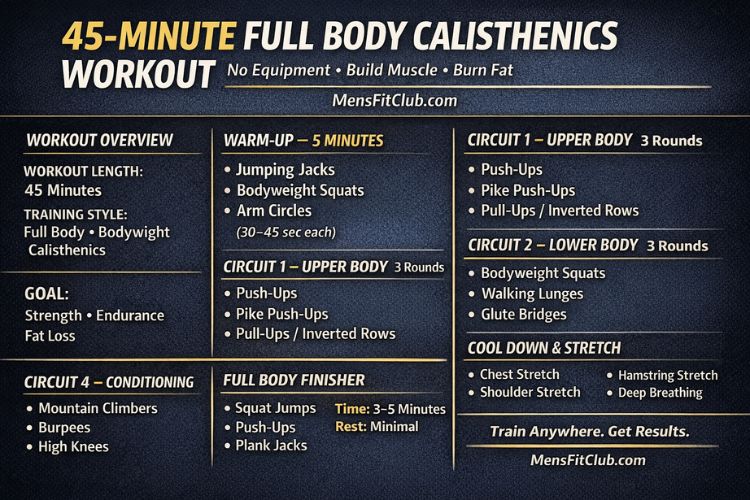
A 45 minute calisthenics full body workout is one of the most effective ways to build muscle, burn fat, and improve athletic performance using nothing but your bodyweight. Calisthenics training has stood the test of time because it delivers real results without the need for expensive gym equipment. Whether your goal is lean muscle, functional strength, endurance, or fat loss, a structured full body calisthenics routine can help you achieve it.
This guide breaks down everything you need to know about performing a 45 minute full body calisthenics workout, including benefits, workout structure, exercise selection, progression strategies, and recovery tips. If you are looking for a challenging yet efficient bodyweight workout for men, this routine is designed to push your limits and deliver results.
Why Choose a 45 Minute Full Body Calisthenics Workout?
A 45 minute session provides the perfect balance between intensity and volume. It is long enough to stimulate muscle growth and cardiovascular conditioning, yet short enough to fit into a busy schedule.
Calisthenics workouts emphasize natural movement patterns, joint health, and total-body coordination. Instead of isolating muscles with machines, calisthenics trains your body as a single unit. This leads to better athletic performance, improved posture, and long-term sustainability.
A full body calisthenics workout also allows you to train more frequently without excessive fatigue. Because you are using bodyweight rather than maximal external loads, recovery is faster and injury risk is lower when performed correctly.
Benefits of a 45 Minute Calisthenics Workout
A well-designed calisthenics workout offers benefits that go far beyond aesthetics. Training for 45 minutes allows you to fully activate every major muscle group while maintaining intensity.
Calisthenics improves muscular endurance by keeping your muscles under tension for extended periods. Exercises like push-ups, squats, lunges, and planks challenge both strength and stamina.
Another major benefit is fat loss. A full body calisthenics routine keeps your heart rate elevated, turning the workout into a powerful calorie-burning session. When paired with proper nutrition, this type of training can significantly improve body composition.
Calisthenics also enhances mobility and flexibility. Many bodyweight movements require a full range of motion, which helps maintain joint health and reduce stiffness over time.
Who Is This Workout For?
This 45 minute calisthenics full body workout is suitable for a wide range of fitness levels. Beginners can modify movements or reduce repetitions, while advanced athletes can increase difficulty with tempo changes or advanced variations.
Men who want to build lean muscle without bulking excessively will find calisthenics ideal. It is also perfect for those training at home, traveling, or looking to reduce reliance on gym equipment.
If your goal is functional strength, athletic performance, or overall conditioning, calisthenics training should be a staple in your program.
How the 45 Minute Calisthenics Workout Is Structured
A proper calisthenics workout should be organized into clear phases. This ensures optimal performance, injury prevention, and maximum results.
Warm-Up Phase (5–7 Minutes)
The warm-up prepares your joints, muscles, and nervous system for intense movement. Dynamic stretches and mobility drills increase blood flow and reduce injury risk.
During this phase, focus on activating your shoulders, hips, core, and ankles. Movements should be controlled and progressive, gradually increasing intensity.
Strength and Conditioning Phase (30–35 Minutes)
This is the core of the workout. Exercises are performed in circuits to maximize efficiency and maintain a high heart rate.
Each circuit targets multiple muscle groups, ensuring full body engagement. Rest periods are short to keep intensity high and promote cardiovascular conditioning.
Finisher and Cool-Down Phase (5–8 Minutes)
The finisher pushes your endurance to the limit, while the cool-down helps your body recover. Stretching and breathing exercises reduce muscle soreness and improve flexibility.
45 Minute Full Body Calisthenics Workout Routine
Below is a structured 45 minute calisthenics workout plan designed for strength, endurance, and fat loss.
Warm-Up Circuit
Perform each movement for 30–45 seconds with minimal rest.
Arm circles loosen the shoulders and improve upper body mobility. Jumping jacks elevate the heart rate and warm the entire body. Hip circles activate the hips and improve lower body range of motion. Bodyweight squats prepare the legs and glutes for more demanding exercises. Inchworms stretch the hamstrings and activate the core.
This warm-up should leave you lightly sweating and ready to train.
Circuit 1: Upper Body Strength
This circuit focuses on the chest, shoulders, back, and arms.
Push-Ups
Push-ups are a foundational calisthenics movement that builds chest, shoulder, and triceps strength. Focus on controlled repetitions and full range of motion.
Pull-Ups or Inverted Rows
Pull-ups target the upper back and biceps, balancing the pushing movements. If pull-ups are too challenging, inverted rows provide an effective alternative.
Pike Push-Ups
Pike push-ups emphasize the shoulders and upper chest while improving shoulder stability.
Complete this circuit for three rounds, resting 60 seconds between rounds.
Circuit 2: Lower Body Strength
Lower body exercises in calisthenics develop powerful legs and glutes without heavy weights.
Bodyweight Squats Full Body Calisthenics Workout
Squats build strength in the quadriceps, hamstrings, and glutes. Maintain proper posture and depth throughout the movement.
Walking Lunges
Lunges improve unilateral strength, balance, and coordination. Take controlled steps and keep your torso upright.
Glute Bridges Full Body Calisthenics Workout
Glute bridges activate the posterior chain and protect the lower back. Focus on squeezing the glutes at the top of each repetition.
Perform three rounds of this circuit with short rest periods to maintain intensity.
Circuit 3: Core and Stability
A strong core is essential for calisthenics performance.
Plank Holds
Planks develop deep core stability and improve posture. Keep your body in a straight line and engage your core throughout.
Bicycle Crunches Full Body Calisthenics Workout
This movement targets the obliques and improves rotational strength.
Leg Raises
Leg raises challenge the lower abdominal muscles and improve hip flexor strength.
Complete three rounds with minimal rest between exercises.
Circuit 4: Conditioning and Endurance
This circuit increases cardiovascular demand and burns calories.
Mountain Climbers
Mountain climbers elevate heart rate while engaging the core and shoulders.
Burpees Full Body Calisthenics Workout
Burpees are a full body conditioning exercise that builds power and endurance.
High Knees
High knees improve speed, coordination, and cardiovascular fitness.
Push through fatigue during this circuit for maximum metabolic benefit.
Finisher: Full Body Burnout
The finisher is designed to exhaust your muscles and boost calorie burn.
Perform squat jumps, push-ups, and plank jacks back-to-back for time. Focus on maintaining proper form even as fatigue sets in.
This final push separates average workouts from exceptional ones.
Cool-Down and Stretching
Cooling down is critical for recovery. Focus on deep breathing and static stretches for the chest, shoulders, hips, hamstrings, and calves.
Stretching improves flexibility, reduces soreness, and prepares your body for future workouts.
How Often Should You Do a Full Body Calisthenics Workout?
A 45 minute full body calisthenics workout can be performed three to five times per week depending on recovery and intensity.
Beginners should start with three sessions per week, allowing rest days between workouts. Advanced athletes can increase frequency or intensity as their conditioning improves.
Listening to your body is essential. Adequate rest ensures continued progress and injury prevention.
Progression Strategies for Calisthenics Training
Progression is key to long-term results. As exercises become easier, increase repetitions, slow down the tempo, or move to more advanced variations.
For example, progress from standard push-ups to decline push-ups or archer push-ups. Transition from squats to pistol squat progressions. These changes keep workouts challenging and prevent plateaus.
Tracking your workouts helps ensure consistent improvement over time.
Nutrition Tips to Support Full Body Calisthenics Workouts
Training alone is not enough. Proper nutrition fuels performance and recovery.
Consume sufficient protein to support muscle repair and growth. Balanced carbohydrates provide energy for intense workouts, while healthy fats support hormone function.
Staying hydrated improves endurance and recovery, especially during longer calisthenics sessions.
Common Mistakes to Avoid in Full Body Calisthenics Workouts
One common mistake is rushing through exercises with poor form. Quality movement always comes before quantity.
Another mistake is neglecting recovery. Even bodyweight training requires adequate rest to prevent overuse injuries.
Finally, avoid skipping warm-ups and cool-downs. These phases are essential for performance and longevity.
Is a 45 Minute Full Body Calisthenics Workout Enough?
A 45 minute calisthenics full body workout is more than enough to build strength, improve conditioning, and transform your physique when performed consistently.
This training style proves that you do not need heavy equipment to achieve impressive results. With dedication, proper progression, and smart programming, calisthenics can become one of the most effective training methods in your fitness routine.
If you are looking for a sustainable, challenging, and results-driven workout, this full body calisthenics routine deserves a permanent place in your training plan.


Most Recommended

Subscribe to our Newsletter
Stay up to date on the latest men’s health, fitness and lifestyle trends and tips.
About Us
Men’s Fit Club was started with the goal of empowering men to get the most out of their lives. This meant going beyond exercise and diet tips to really address the broad range of issues that men face on a daily basis – topics like recreation, finding love, sexual health and even sound fashion advice.
Quick Links
© COPYRIGHT MEN'S FIT CLUB 2026. All Rights Reserved