
Kettlebell Mobility Flow for Men Over 40: A 20-Minute Routine
Dumbbell Strength Standards for Men Benchmarks by Exercise

Skin Scents for Men What They Are and How to Wear Them
Thanksgiving Morning Workout a 30-Minute Full-Body Plan
Thanksgiving morning has a rhythm of its own. The kitchen is busy, the schedule fills quickly, and a large meal is usually waiting later in the day. A short workout can help you begin the holiday feeling energized, focused, and accomplished before the celebrations take over. This Thanksgiving morning workout is a practical 30-minute full-body routine that requires little space and no equipment, making it easy to complete at home, in a hotel room, or while visiting family.
The goal is not to “earn” Thanksgiving dinner or punish yourself for enjoying favorite foods. One workout cannot cancel a meal, and a holiday meal does not erase your progress. Instead, this session is about maintaining a healthy routine, improving your mood, moving your major muscle groups, and creating positive momentum for the day. It combines strength, conditioning, mobility, and core work in a format that can be adjusted for nearly any fitness level.
You can perform the workout alone before everyone wakes up or turn it into a family-friendly holiday challenge. All you need is comfortable clothing, supportive shoes, water, and about 30 minutes. If you have dumbbells, optional upgrades are included, but the basic plan works well with body weight alone.
Why Do a Thanksgiving Morning Workout?
A holiday workout offers benefits beyond calorie burn. Thanksgiving often involves travel, prolonged sitting, disrupted sleep, and a busy schedule. Moving early increases circulation, loosens stiff joints, trains major muscle groups, and may improve mood and focus. It also removes the pressure to exercise after cooking and social plans begin. A short session lets you protect the habit without allowing fitness to dominate the holiday.
Exercise Without Food Guilt
Thanksgiving dinner is meant to be enjoyed. Train because movement supports strength, energy, mobility, and long-term health—not to erase calories. Eat the holiday foods you enjoy, notice comfortable fullness, and return to your usual habits afterward. One meal matters far less than the patterns you follow over time.
Thanksgiving Morning Workout Overview
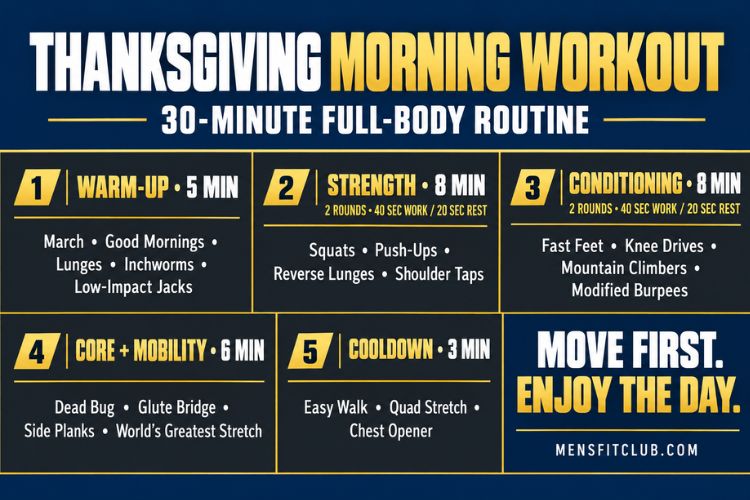
This routine takes approximately 30 minutes and uses a simple circuit format. You will start with five minutes of dynamic movement, complete three full-body workout blocks, and finish with a brief cooldown. The work periods are long enough to raise your heart rate but short enough to maintain good technique.
The session follows this schedule:
- 5-minute dynamic warm-up
- 8-minute strength circuit
- 8-minute conditioning circuit
- 6-minute core and mobility circuit
- 3-minute cooldown
During the strength and conditioning blocks, work for 40 seconds and transition or rest for 20 seconds. Complete two rounds of each four-exercise circuit. For the final block, perform each movement for 40 seconds, take 20 seconds to change positions, and complete one round. Keep water nearby and add more recovery whenever your form begins to break down.
Aim for a moderate-to-hard effort rather than an all-out sprint. On a scale from one to ten, most working intervals should feel like a six or seven. You should be breathing harder but still able to say a short sentence. Experienced trainees can approach an eight during the last few intervals, while beginners may stay closer to a five or six.
Five-Minute Dynamic Warm-Up For Thanksgiving Morning Workout
Morning joints and muscles may feel stiff, especially after travel or limited sleep. Perform each movement for approximately 60 seconds, moving continuously but with control.
March in Place With Arm Swings
March with a tall chest, comfortable knee lift, and natural arm swing. Gradually increase the pace, progressing to a light jog only if desired.
Bodyweight Good Mornings Thanksgiving Workout
With soft knees and a neutral spine, push your hips back until you feel tension in your hamstrings, then stand tall. Keep the movement slow and controlled.
Alternating Reverse Lunges With Reach
Step backward into a comfortable lunge while reaching overhead. Return to standing and switch sides. Shorten the step or use less depth if needed.
Inchworm Walkouts
Hinge forward, walk your hands into a high plank, pause, and return to standing. Bend your knees as needed or use a countertop for an elevated version.
Low-Impact Jumping Jacks
Step side to side while raising your arms overhead. Gradually pick up the pace, or use traditional jumping jacks if impact feels comfortable.
Block One: Full-Body Strength Circuit Thanksgiving Morning Workout
Set a timer for eight minutes. Perform each exercise for 40 seconds, rest or transition for 20 seconds, and complete two rounds. Use steady repetitions with excellent form. The objective is to create muscular tension, not to race through sloppy reps.
Bodyweight Squat
Stand with your feet around shoulder-width apart and your toes turned slightly outward. Brace your midsection, sit your hips down and back, and allow your knees to track in the same direction as your toes. Descend only as far as you can while keeping your feet planted and your spine controlled. Push the floor away to stand.
To make the exercise easier, squat to a sturdy chair and stand back up. To make it harder, pause for two seconds at the bottom, perform one-and-a-half repetitions, or hold a dumbbell at your chest.
Push-Up
Place your hands slightly wider than shoulder width and form a straight line from your head to your heels. Lower your chest with your elbows angled roughly 30 to 45 degrees from your body, then press the floor away. Keep your hips from sagging and finish each repetition with control.
Use a countertop, bench, or sturdy table for an incline push-up if the floor version is too difficult. Experienced trainees can use a slower lowering phase, add a pause near the floor, or elevate their feet.
Alternating Reverse Lunge Thanksgiving Morning Workout
From a tall stance, step one leg backward and lower until the front thigh approaches parallel to the floor, or as low as comfort allows. Keep most of your pressure through the front foot and push through that leg to stand. Alternate sides with each repetition. Holding onto a chair is a sensible option if balance is limited.
Plank Shoulder Tap
Begin in a high plank with your hands under your shoulders and your feet slightly wider than usual. Brace your core, lift one hand, and tap the opposite shoulder. Replace the hand and switch sides while resisting hip rotation. Move slowly enough to keep your torso stable. Perform the movement from your knees or with your hands elevated to reduce the challenge.
Block Two: Thanksgiving Conditioning Circuit
The second eight-minute block raises your heart rate and adds an athletic element to the routine. Use the same 40-seconds-on, 20-seconds-off format for two rounds. Choose low-impact variations if you are training on a hard floor, exercising near sleeping guests, or managing sensitive knees or ankles.
Fast Feet or Quick March
Stand in an athletic position with soft knees and take short, quick steps in place. Stay light on your feet and keep your chest up. For a low-impact version, march rapidly and drive your arms. The goal is to increase cadence, not to bounce as high as possible.
Squat to Knee Drive Thanksgiving Morning Workout
Perform a controlled squat. As you stand, drive one knee toward your chest and rotate your torso slightly toward it. Squat again and switch sides. This movement trains the legs while engaging the core and challenging coordination. Eliminate the rotation if it causes discomfort.
Mountain Climber
Start in a high plank and bring one knee toward your chest, then switch legs. Keep your shoulders above your hands and avoid lifting your hips excessively. Run the knees quickly only if you can maintain control. A slower version is still effective. You can also place your hands on a couch, bench, or counter to reduce wrist pressure and overall intensity.
Modified Burpee or Full Burpee Thanksgiving Morning Workout
For the modified version, squat down, place your hands on a sturdy elevated surface, step one foot back at a time into a plank, step forward, and stand tall. For a full burpee, place your hands on the floor, jump or step into a plank, return your feet forward, and stand or jump. A push-up is optional. Select the variation that allows consistent movement without losing spinal control.
Block Three: Core and Mobility Finisher
The final six-minute block combines trunk strength with mobility. Perform the six exercises once for 40 seconds each and allow 20 seconds to transition. This portion should feel controlled and restorative after the faster conditioning work.
Dead Bug
Lie on your back with your knees bent to 90 degrees and your arms extended toward the ceiling. Gently press your lower back toward the floor. Slowly extend one leg and the opposite arm without allowing your back to arch, then return and switch sides. Reduce the range of motion if maintaining contact with the floor becomes difficult.
Glute Bridge
Remain on your back with your feet planted close to your hips. Brace your core, squeeze your glutes, and lift your hips until your body forms a straight line from shoulders to knees. Pause briefly at the top, then lower with control. Avoid overextending your lower back.
Side Plank Right
Place your right forearm on the floor with your elbow under your shoulder. Stack or stagger your feet and lift your hips, creating a straight line through your body. Keep your chest facing forward. Bend your bottom knee and place it on the floor for additional support.
Side Plank Left
Repeat the side plank on your left side. Focus on pushing the floor away and maintaining steady breathing rather than holding your breath. Stop if you feel pinching in the shoulder.
World’s Greatest Stretch
From a high plank, step your right foot outside your right hand. Keep the left hand planted and rotate your right arm toward the ceiling. Return your hand to the floor, step back, and switch sides. Use a shorter stance or elevate your hands if needed.
Child’s Pose to Cobra Flow
Sit your hips toward your heels with your arms extended, then glide forward and gently lift your chest. Keep the movement comfortable and avoid forcing spinal extension. Move slowly between positions while taking full breaths.
Three-Minute Cooldown
Walk slowly around the room for about one minute and allow your breathing to settle. Spend the next minute in a relaxed standing quad stretch, switching sides halfway through. Finish with a gentle chest and shoulder stretch while breathing slowly through your nose.
The cooldown does not need to be elaborate. Its purpose is to create a gradual transition from training to the rest of your day. If you have additional time, add a calf stretch, hip-flexor stretch, or easy walk outside.
Optional Dumbbell Upgrades
To add resistance without changing the timing, use goblet squats, loaded reverse lunges, dumbbell floor presses, and plank dumbbell drags. Select a load you can control for the entire interval with two or three good repetitions still available. For a quiet, low-impact circuit, use a loaded march and dumbbell Romanian deadlifts instead of fast feet and burpees.
How to Modify the Workout for Your Fitness Level
The best version of this holiday workout is the one you can complete safely and enjoy. Adjusting the routine is not a sign that you are doing less; it is how you match training stress to your current ability.
Beginner Thanksgiving Morning Workout
Beginners can use 30 seconds of work followed by 30 seconds of rest. Complete one round of each main circuit instead of two, then repeat a favorite block only if energy and technique remain strong. Use chair squats, countertop push-ups, supported reverse lunges, elevated mountain climbers, and step-back burpees.
Keep your effort around five or six out of ten. The workout should leave you feeling better, not exhausted for the rest of the holiday. A 15- to 20-minute modified session still counts as a successful workout.
Advanced Thanksgiving Workout
Experienced trainees can use 45 seconds of work and 15 seconds of transition time. Add squat jumps, strict push-ups, alternating jumping lunges, and full burpees only if those movements are already part of your training. Another option is to wear a weighted vest or use dumbbells during the strength circuit.
Avoid turning every interval into an uncontrolled sprint. Maintain consistent output from the first round to the final round. Quality volume generally creates a better session than starting too aggressively and struggling through the finish.
Modifications for Men Over 50 Thanksgiving Morning Workout
Men over 50 can perform the same fundamental movement patterns while controlling impact, range of motion, and speed. Take extra time warming up, use a chair for squats and balance support, elevate push-ups and mountain climbers, and choose step-back burpees without a jump. Longer transitions of 30 to 40 seconds may be appropriate.
Joint-friendly does not mean effortless. You can build meaningful strength by slowing the lowering phase of each repetition, pausing in stable positions, and using a range of motion that feels strong and pain-free. If you have a cardiovascular condition, recent injury, balance problems, or medical restrictions, consult an appropriate healthcare professional before starting a new high-intensity routine.
Food, Hydration, and Activity on Thanksgiving
If you normally exercise before breakfast and feel good doing so, water may be enough for this short session. Otherwise, have a small, easy-to-digest snack 30 to 90 minutes beforehand, such as a banana, Greek yogurt, toast with an egg, or a modest protein shake. Avoid an unusually rich meal immediately before the circuit and drink water when you wake up.
If dinner is several hours away, eat a normal protein-rich breakfast afterward rather than trying to “save” every calorie. Later, a relaxed family walk can break up prolonged sitting and help you feel less stiff. Remember that neither the workout nor the walk needs to compensate for dinner; both are simply useful parts of an active day.
Common Thanksgiving Morning Workout Mistakes
Avoid doing far more than your body is prepared for. High-repetition holiday challenges can produce excessive soreness when the movements or volume are unfamiliar. Use manageable work periods, stop an interval when technique deteriorates, and choose low-impact variations when appropriate. Do not judge success only by sweat or a fitness tracker’s estimated calorie burn. Movement quality, consistent effort, and finishing with energy for the holiday are better measures.
If the morning becomes too busy, complete one circuit, take a walk, or return to your normal program the next day. Flexible consistency matters more than perfect adherence on a holiday.
Related MensFitClub Workouts
Keep your holiday training flexible with MensFitClub’s 30 Minute Bodyweight Morning Workout or use the 15 Minute Full Body Bodyweight Workout when Thanksgiving preparations leave little time. If you are visiting family, the 25 Minute Hotel Room Bodyweight Workout offers a travel-friendly alternative. You can also explore this 30 Minute No Equipment Full Body Workout for more bodyweight exercise ideas, or try the 30 Minute Full Body Dumbbell Complex when you have access to weights and want a more challenging strength-and-conditioning session.
Frequently Asked Questions About Thanksgiving Morning Workouts
How long should a Thanksgiving workout be?
For most people, 20 to 30 minutes is enough to train the full body and raise the heart rate. One round of each circuit creates an effective 15-minute option.
Should I work out before or after Thanksgiving dinner?
Morning is usually practical because it avoids conflicts with cooking and family plans. If you train after dinner, keep it gentle or allow adequate time for digestion.
Can this workout burn off Thanksgiving dinner?
No. Long-term body composition reflects consistent nutrition and training habits, not a single workout or meal. Enjoy dinner without using exercise as punishment.
Can I do this workout with my family?
Yes. Offer easier and harder variations, keep the atmosphere supportive, and allow each person to rest as needed.
What if I only have 10 minutes?
Warm up for two minutes, then perform squats, incline push-ups, reverse lunges, and low-impact jumping jacks for 40 seconds each with 20-second transitions. Complete two rounds.
Start Thanksgiving Morning With Strength and Energy Workout
A Thanksgiving morning workout does not need special equipment, a gym, or an hour of free time. This 30-minute routine trains the legs, chest, shoulders, core, and cardiovascular system with movements that can be scaled for beginners, experienced athletes, and older adults. It is challenging enough to feel productive but flexible enough to fit a busy holiday.
Begin with the warm-up, select variations that match your ability, and finish feeling energized rather than depleted. Then enjoy the meal, the people, and the traditions that make the day meaningful. Fitness should support your life—including holidays—not prevent you from participating in it.


Most Recommended

Subscribe to our Newsletter
Stay up to date on the latest men’s health, fitness and lifestyle trends and tips.
About Us
Men’s Fit Club was started with the goal of empowering men to get the most out of their lives. This meant going beyond exercise and diet tips to really address the broad range of issues that men face on a daily basis – topics like recreation, finding love, sexual health and even sound fashion advice.
Quick Links
© COPYRIGHT MEN'S FIT CLUB 2026. All Rights Reserved