


High Protein Beef and Pumpkin Chili: A Hearty Recipe
When to Reduce Sets Reps or Weight During a Workout
11-Minute HIIT Workout for Improving VO₂ Max
An effective cardio workout does not always require an hour at the gym. When time is limited, a short session of high-intensity interval training can help you develop aerobic fitness without taking over your schedule. This 11 minute HIIT workout for improving VO₂ max uses repeatable hard efforts, active recovery, and a simple structure that works on a stationary bike, rowing machine, or suitable running route.
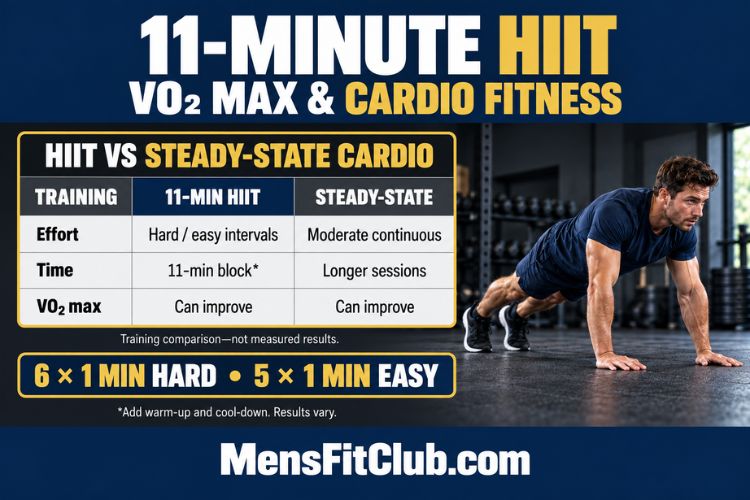
The goal is to challenge your cardiovascular system while maintaining enough control to finish every interval well. You will alternate one minute of hard exercise with one minute of easy movement, completing six hard efforts within an 11-minute interval block. Warm-up and cool-down are additional, making the complete session approximately 20–25 minutes.
That distinction matters. Eleven minutes describes the main workout, rather than permission to begin sprinting without preparation. Used consistently alongside easier aerobic exercise and strength training, this routine offers a practical starting point for men who want better conditioning, improved stamina, and a manageable approach to harder cardio.
What Is VO₂ Max, and Why Does It Matter?
VO₂ max is the maximum rate at which your body can take in and use oxygen during demanding exercise. It reflects the combined work of your lungs, heart, circulation, and exercising muscles. You will often see it expressed as milliliters of oxygen per kilogram of body weight per minute, abbreviated mL/kg/min.
In practical terms, aerobic fitness influences how comfortably you can sustain activities such as running, cycling, hiking, and climbing stairs. A higher VO₂ max can expand your capacity for these tasks, although performance also depends on movement efficiency, muscular strength, pacing, and the intensity you can sustain below your maximum.
VO₂ Max Is Different From Heart Rate
Heart rate measures how often your heart beats. VO₂ max measures oxygen use. They are related during exercise, but a high heart-rate reading does not prove that your oxygen consumption has reached its maximum. Heat, dehydration, stress, medications, and fatigue can influence your pulse independently of the training benefit.
This is especially important during short intervals. Heart rate takes time to respond when you accelerate, so it may rise substantially only near the end of a one-minute effort. Trying to force an immediate target reading can encourage an unnecessarily fast start. Use repeatable effort and stable technique as your primary guides.
Improving Fitness Requires More Than a Single Hard Session
One challenging workout creates a training stimulus; repeated sessions and recovery allow adaptation. Your starting fitness, exercise history, consistency, and total weekly activity all influence the outcome. A brief interval routine can contribute to improvement, but it cannot guarantee a particular increase in VO₂ max or replace every other form of exercise.
Can an 11 Minute HIIT Workout Improve VO₂ Max?
Research supports low-volume HIIT as a time-efficient way to improve aerobic fitness. A meta-analysis of randomized trials found benefits from short intervals and low amounts of hard exercise. It also found that longer intervals and greater training volumes generally produced larger VO₂ max improvements. This supports short sessions as a useful option, while keeping expectations realistic.
The workout below is a practical coaching template, not a protocol proven in a trial to deliver a specific result. Its six minutes of hard work can provide a meaningful challenge for someone beginning structured interval training. For an experienced endurance athlete, the same dose may be more useful for maintaining consistency during a busy week than for maximizing aerobic development.
Why Active Recovery Helps
Easy movement between efforts gives you a chance to restore control without ending the session. On a bike, keep pedaling lightly. When running, walk or jog slowly. On a rower, reduce stroke rate and pressure. The recovery should feel substantially easier than the work interval, allowing you to approach the next repetition with useful energy.
Why Repeatability Matters More Than Exhaustion
Starting with an all-out sprint often makes later intervals slower and less controlled. For this session, choose an intensity you can repeat six times. The last effort should be challenging, but it should still resemble the first in technique and output. Finishing with controlled fatigue makes progression easier to judge.
Who Should Use This Short 11 Minute HIIT Workout?
This routine suits generally healthy adults who already tolerate moderate cardio and want to introduce harder intervals. It can work well for busy men, recreational lifters, and returning exercisers who have rebuilt a basic activity habit. It is especially convenient when equipment or scheduling makes longer cardio sessions difficult.
If you are currently inactive, begin with comfortable walking, cycling, or another manageable aerobic activity before attempting the full version. You can also use the beginner modification later in this article. The aim is to establish tolerance and consistency before asking your body to sustain repeated hard efforts.
People with known cardiovascular or respiratory conditions, concerning exercise symptoms, or medical restrictions should discuss vigorous exercise with their clinician. Stop exercising if you develop chest pain, faintness, or unusual breathlessness. Hard breathing during an interval is expected; symptoms that feel abnormal for you deserve attention.
Choose the Best Exercise for Your Intervals
For improving aerobic fitness, select a movement that engages substantial muscle mass and lets you adjust intensity smoothly. The best option is usually one you already perform confidently. A simple cardio movement allows the heart and lungs to receive a strong challenge without unfamiliar technique becoming the main limitation.
Stationary Bike: A Practical Starting Option
A stationary bike allows immediate transitions between hard and easy pedaling with relatively little impact. Adjust the seat so your knee remains slightly bent at the bottom of the pedal stroke. Use enough resistance to feel productive pressure, but avoid a setting so heavy that every repetition becomes a slow grinding effort.
During hard intervals, increase cadence, resistance, or both while keeping your upper body relaxed. During recovery, lower the workload substantially. If your thighs fail before your breathing becomes demanding, try a little less resistance and a slightly faster, controlled cadence.
Running: Useful When You Already Run Comfortably
Running intervals work well on a clear, predictable route. Choose level ground or a gentle incline, and avoid traffic, slippery surfaces, and sharp turns. Run fast enough to feel challenged while preserving a natural stride. These are controlled hard efforts, not maximum-speed sprints.
If using a treadmill, account for belt acceleration and deceleration. Do not jump onto the side rails to create instant recovery. A bike may be more convenient when treadmill transitions take too long or feel unsafe. Walking briskly uphill can also provide a useful alternative, though it may function as moderate intervals rather than HIIT.
Rowing: Effective With Established Technique
A rowing machine provides a whole-body option, but technique matters. Drive with your legs, let your torso follow, and finish with your arms. Reverse that sequence smoothly during the return. Increase effort without rushing the recovery phase or rounding your back as fatigue builds.
Equipment-Free Options Need Careful Expectations
Fast marching, controlled high knees, and low-impact step jacks can create a challenging home session. However, their aerobic demand varies considerably between people. If balance, coordination, or local muscle fatigue stops you before breathing becomes challenging, choose a different movement. A tiring bodyweight circuit is not automatically a targeted VO₂ max workout.
Warm Up Before Starting the 11-Minute Block
Allow approximately five to eight minutes for preparation, extending it if you still feel stiff or unready. Begin with easy movement in your chosen activity. Gradually increase the pace until you feel warmer and your breathing rises slightly. The warm-up should leave you prepared rather than tired.
During the final two minutes, include two or three brief accelerations of roughly 10–15 seconds, returning to easy movement between them. These accelerations should be brisk and controlled, not maximal. They give you a chance to check how the equipment, surface, and your body feel before the main block.
For running, a few comfortable ankle movements and gentle marching steps can help you settle into your stride. For rowing or cycling, spend time rehearsing the exact movement. If the warm-up feels unusually difficult, reduce the session intensity or choose easy cardio that day.
The 11 Minute HIIT Workout for Improving VO₂ Max
Set a timer for alternating one-minute periods. Complete a hard interval first, then an easy interval, repeating until you have performed six hard efforts. Because there is no scheduled recovery inside the block after the sixth effort, the main workout totals exactly 11 minutes. Begin your cool-down immediately afterward.
Minutes 0–3: Establish a Sustainable Effort
From 0:00 to 1:00, perform your first hard interval. Increase effort smoothly during the opening seconds and settle into a pace that feels demanding but repeatable. Aim for approximately seven to eight out of ten on a perceived-effort scale, where ten represents your maximum effort.
From 1:00 to 2:00, move easily. Bring the effort down to approximately two or three out of ten. From 2:00 to 3:00, complete your second hard interval at a similar output. Resist the urge to accelerate simply because the first repetition felt manageable; fatigue will accumulate as the workout continues.
Minutes 3–7: Keep the Middle Intervals Consistent
From 3:00 to 4:00, recover actively. From 4:00 to 5:00, complete your third hard effort. Return to easy movement from 5:00 to 6:00, then perform your fourth hard interval from 6:00 to 7:00. Keep shoulders relaxed and technique steady as breathing becomes more demanding.
These middle repetitions reveal whether you chose the right pace. If you can maintain output without struggling to control the movement, continue. If speed or power drops dramatically, reduce intensity slightly. The goal is sustained quality across the session, not defending an overly ambitious opening pace.
Minutes 7–11: Finish With Control
Recover from 7:00 to 8:00, then perform your fifth hard interval from 8:00 to 9:00. Move easily from 9:00 to 10:00. Complete the sixth and final hard effort from 10:00 to 11:00, maintaining your technique and approximately the same output you used earlier.
Do not turn the final repetition into a desperate sprint. Finish feeling that you worked hard and could still control the movement. Across the block, you have completed six one-minute hard intervals and five one-minute recovery intervals: six minutes of work plus five minutes of recovery.
How Hard Should the 11 Minute HIIT Workout Intervals Feel?
For most participants, the hard intervals should feel around eight out of ten once the session is established. You should be breathing strongly and able to speak only a few words comfortably. An inexperienced interval trainee can start closer to seven and gradually learn what a repeatable harder effort feels like.
Use Perceived Effort Before Chasing Numbers
Perceived effort combines breathing, muscular demand, and your overall sense of difficulty. It is useful when heart-rate readings lag or equipment displays vary. Your recovery periods should create an obvious contrast with the work intervals, even though breathing may remain elevated for part of the recovery minute.
Avoid treating a percentage of maximum heart rate as a mandatory target for every repetition. Age-based formulas are estimates, and individual responses differ. Medications can also change heart-rate behavior. If you already use clinician-prescribed exercise targets, follow those rather than replacing them with a generic interval rule.
Track Output Without Letting It Dictate Every Decision
Bike watts, running pace, or rowing split times can help you compare repetitions. Choose an initial output you can sustain across all six efforts. If the later intervals decline substantially, you probably started too aggressively, recovered too hard, or needed a lighter training day.
Cool Down After the Final Interval
Continue easy movement for approximately four to six minutes after the 11-minute block. Gradually reduce the pace as breathing settles. On a bike, pedal lightly; after running, walk; after rowing, take easy strokes before standing. Add more time if you need it to feel comfortable.
Gentle mobility can follow, but it is optional. There is no need to force deep stretching while you are still breathing heavily. The complete workout will commonly take around 20–25 minutes, depending on your preparation and recovery needs. Plan for that full duration rather than treating the interval timer as your entire appointment.
A Four-Week Progression for Better Aerobic Fitness
Begin with two interval sessions per week on nonconsecutive days. Leave at least one day between them, and more when your legs or overall energy have not recovered. Keep the main block at 11 minutes while gradually improving execution. Increasing every variable simultaneously makes the session harder to evaluate.
Week 1: Learn 11 Minute HIIT Workout Format
Use conservative hard efforts and concentrate on clean transitions. Complete both sessions with similar output across repetitions. Record the exercise, resistance or pace, and your overall effort. If the full minute feels too demanding, use the beginner variation rather than forcing the prescribed duration.
Week 2: Improve Consistency
Keep the same timing and aim for steadier performance. Notice whether your breathing becomes more manageable during recovery and whether the final effort stays close to the first. If week one was clearly comfortable, make a small adjustment to pace or resistance without turning the workout into an all-out session.
Week 3: Add a Modest 11 Minute HIIT Workout Challenge
When both previous sessions were well controlled and recovery has been good, increase one variable slightly. On a bike, add a little resistance or power. When running, use a modest pace increase. On a rower, improve the split through effective strokes. Avoid changing exercise mode and intensity at the same time.
Week 4: Consolidate and Review
Repeat the improved workload and assess how you feel afterward. Better output at similar effort, more consistent repetitions, or easier recovery can indicate useful progress. None of those alone proves a measured VO₂ max increase, but they help you decide whether the current routine remains appropriate.
Beginner and Low-Impact 11 Minute HIIT Workout Modifications
Keep the 11-minute timer, but shorten each hard effort to 30 seconds. Perform the first 30 seconds of each scheduled work minute briskly, then move easily for the remaining 30 seconds. Keep the five intervening recovery minutes easy. This produces three minutes of harder work within the same block.
After several comfortable sessions, increase the hard portions to 40 seconds and then 45 seconds before attempting full minutes. Progress when technique, breathing control, and between-session recovery support it. There is no requirement to move through these stages on a fixed weekly schedule.
For men over 40 or 50, age alone does not determine the right version. Current fitness, joint tolerance, health history, and recent activity matter more. Cycling often makes intensity easier to control with less impact, while a longer warm-up may improve comfort. Choose the option you can repeat consistently.
Combine 11 Minute HIIT Workout With Strength Training and Easy Cardio
A balanced week might include this workout on Tuesday and Saturday, strength training on Monday and Thursday, and comfortable walking or cycling on other days. Adjust the arrangement to your recovery and priorities. Two short interval sessions provide only 12 minutes of hard work per week, so they should complement broader activity.
If strength is your main goal and you combine workouts, perform demanding lifting first or separate the sessions when possible. Avoid placing hard running intervals immediately before heavy lower-body training if they leave your legs fatigued. Cycling may be easier to accommodate, but it still creates a recovery demand.
Easy aerobic sessions build consistency without requiring the same level of effort. Use a pace that allows comfortable conversation, and build duration gradually. A short HIIT block works best when it is part of an activity pattern you can maintain, rather than your only movement between long periods of sitting.
Common 11 Minute HIIT Workout Mistakes That Reduce Workout Quality
The first mistake is skipping preparation because the workout is brief. The second is sprinting the opening repetition and spending the rest of the session struggling. Both make the routine harder to repeat. Warm up properly and judge success by the quality of all six efforts.
Another mistake is making recovery too intense. Active recovery should help restore your ability to work, not become a second competition. Also avoid switching among complex exercises during the block. Equipment changes and coordination demands can interrupt the aerobic stimulus and make your performance difficult to compare.
Finally, do not add HIIT every day because each session is short. Intensity still contributes to fatigue. If sleep worsens, legs remain heavy, or performance repeatedly declines, reduce the workload and review your weekly schedule. A recoverable routine is more useful than a demanding plan you frequently abandon.
How to Track Improvements Without Obsessing Over VO₂ Max
Record the workout mode, interval output, perceived effort, and any unusual fatigue. Compare sessions performed under broadly similar conditions. Being able to cycle at higher power or maintain a faster running pace at the same perceived effort can reflect improved fitness, though technique and familiarity also contribute.
Watch-based VO₂ max estimates are useful as trends, not precise laboratory measurements. Changes in terrain, weather, device fit, or the exercise mode can affect estimates. A laboratory exercise test with respiratory gas measurement provides a more direct assessment of oxygen consumption when accurate testing is needed.
Give the routine several consistent weeks before judging it. If progress stalls and your recovery is good, you may eventually benefit from longer intervals or more overall aerobic work. Extend the program thoughtfully rather than assuming an 11-minute block must remain your only interval format forever.
Frequently Asked Questions About the 11 Minute HIIT Workout
Is Eleven Minutes Enough for a Complete Workout?
Eleven minutes is the main interval block. With warm-up and cool-down, the complete session usually takes approximately 20–25 minutes. It can be a useful short cardio session, but it does not cover every fitness need or provide all the aerobic activity you may want across a week.
Can I Do This 11 Minute HIIT Workout Every Day?
Start with two nonconsecutive sessions per week. Use easier activity between them, and adjust based on recovery. Daily hard intervals are unnecessary for this plan and may interfere with strength training or other exercise. Consistent, well-executed sessions matter more than squeezing hard work into every day.
Will This Workout Improve VO₂ Max in Four Weeks?
Some people improve aerobic fitness within several weeks, but the size and timing of changes vary. This exact routine does not carry a guaranteed result. Four weeks provides a useful period for learning the workout and reviewing performance; continued training may be needed for meaningful measurable changes.
Is It Better Than Longer Cardio?
It offers a convenient way to include harder exercise when time is limited. Longer easy sessions and longer interval workouts serve useful purposes too. Choose a mix that suits your goals and schedule. For maximizing VO₂ max, a brief session may eventually need to become part of a larger aerobic program.
Build Better Conditioning One Repeatable 11 Minute HIIT Workout Session at a Time
This 11 minute HIIT workout for improving VO₂ max gives you a clear structure: warm up, complete six controlled hard efforts separated by easy movement, and cool down. Choose a familiar activity, keep the work repeatable, and progress only when the current session feels manageable.
The most useful result is a routine you can sustain. Combine it with strength training, easier cardio, and adequate recovery, then track how your performance develops. Over time, those consistent training habits can support stronger aerobic fitness and greater confidence during demanding activity.
To complement this 11 minute HIIT workout for improving VO₂ max, explore our VO₂ Max HIIT Workout for additional interval formats and our Cardiovascular Activity Guide for running and cycling options. For continued progression, follow the 4 Week HIIT Workout Training Plan, try the equipment-free 10 Minute HIIT Workout on busy days, or explore Low Impact Cardio Workouts for Men for alternatives with less jumping.


Most Recommended

Subscribe to our Newsletter
Stay up to date on the latest men’s health, fitness and lifestyle trends and tips.
About Us
Men’s Fit Club was started with the goal of empowering men to get the most out of their lives. This meant going beyond exercise and diet tips to really address the broad range of issues that men face on a daily basis – topics like recreation, finding love, sexual health and even sound fashion advice.
Quick Links
© COPYRIGHT MEN'S FIT CLUB 2026. All Rights Reserved