


High Protein Beef and Pumpkin Chili: A Hearty Recipe
When to Reduce Sets Reps or Weight During a Workout
When to Reduce Sets Reps or Weight During a Workout
You start a workout expecting to complete every set on your program. Then your usual weight feels unusually heavy, your repetitions drop, or your technique begins to change. Should you push through, use lighter dumbbells, perform fewer reps, or remove a set? Knowing when to reduce sets, reps, or weight during a workout helps you make that decision without turning every difficult session into an emergency.
An effective training plan gives you direction, but your performance supplies feedback. Sleep, recent training, food intake, stress, and exercise order can influence what you can do today. Adjusting a workout does not automatically mean you are losing strength or abandoning progressive overload. It can help you preserve useful training while avoiding repetitions that no longer match the purpose of the session.
The central principle is straightforward: reduce weight when the load prevents the intended movement, reduce reps when quality deteriorates within a set, and reduce sets when additional work is becoming unproductive. Sometimes you need a combination. Sometimes you need to stop. This guide explains how to choose an adjustment and return to normal training afterward.
Why Weight Workout Adjustments Belong in a Strength Training
Progressive overload means increasing training demands over time as your ability improves. It does not require heavier weights or more repetitions every workout. A productive program includes challenging sessions, manageable sessions, and occasional adjustments when your performance does not support the original prescription.
Consider a lifter scheduled for three sets of eight dumbbell presses. On a good day, all three sets feel controlled. After a poor night of sleep, the first set requires much more effort. Forcing identical numbers might turn the remaining sets into awkward repetitions with shortened movement. A small adjustment can preserve the exercise and its intended effort level.
The American College of Sports Medicine’s 2026 guidance emphasizes individualizing resistance training and maintaining consistency. Its evidence review also found that training to momentary muscle failure did not consistently improve outcomes for the average healthy adult. You do not need to prove your commitment by exhausting every set.
Understand the Difference Between Load and Volume
Weight, or load, is the resistance used for an exercise. Reps are the number of repetitions in a set. Sets determine how many separate bouts you perform. All three contribute to training demands, but changing each variable affects the workout differently.
Reducing weight usually makes each repetition easier. Reducing reps limits how far you push an individual set. Reducing sets lowers the total amount of work. The best choice depends on whether the problem appears immediately, develops near the end of a set, or accumulates across the session.
Check Your Warm-Up Before Changing the Weight in Your Workout
Your warm-up is the first opportunity to evaluate readiness. Start with easy movement, then perform progressively heavier practice sets for your first major exercise. These sets should prepare you without creating substantial fatigue. Notice your balance, movement control, and how familiar loads feel.
One stiff repetition does not necessarily mean the entire workout needs changing. You may feel better after additional gentle movement and another practice set. However, if ordinary warm-up loads repeatedly feel unusually difficult, use that information before selecting your first working weight.
Establish Today’s Starting Point
Compare today’s movement with your own normal performance, not someone else’s workout. If your usual warm-up is smooth but today requires grinding effort, start conservatively. You can increase the load later if your performance improves.
A practical approach is to choose a first working set that leaves a few good repetitions available. If it feels appropriate, continue. If it immediately exceeds the planned difficulty, adjust before the second set. This avoids using the opening set as an unplanned maximum-effort test.
When to Reduce Weight During a Workout
Reduce weight when the resistance is too demanding for the intended reps, effort, or technique. The clearest signal is difficulty controlling the exercise early in the set. If the first few repetitions already require substantial compensation, lowering the load usually makes more sense than repeatedly attempting the same weight.
Suppose your program calls for eight to ten goblet squats. You reach four repetitions before losing your usual balance and control. If the problem is excessive resistance rather than pain, a lighter kettlebell may let you complete the intended movement and repetition range.
Your Technique Changes Before the Target Reps
Technique varies between individuals, but fatigue should not force a major departure from the movement you intended. Examples include using a large torso swing during curls, turning a controlled row into a full-body heave, or losing stable footing during a squat.
First check your setup. An incorrect seat position, rushed start, or unfamiliar grip can create problems unrelated to weight. If the setup is sound and the same breakdown continues, lower the resistance. Avoid treating repeated compensations as successful repetitions simply because the weight moved.
The First Weight Working Set Is Much Harder Than Planned
If a set intended to leave two or three repetitions available becomes an all-out effort, the load may be too high today. Reduce it for subsequent sets instead of assuming you must repeat that effort to make the workout count.
For illustration, a small reduction of roughly 5–10 percent may be enough to restore control. This is a coaching starting point, not a universal threshold. Equipment increments, exercise choice, and the size of the mismatch matter. Use the reduction necessary to produce appropriate repetitions rather than chasing an exact percentage.
A Recent Weight Workout Increase Was Too Large
Sometimes the issue is progression rather than fatigue. Moving from one pair of dumbbells to the next can represent a substantial increase, especially for shoulder presses, lateral raises, and curls. A load that worked on one exercise may overwhelm another.
Return to the previous weight and build repetitions within your programmed range. Alternatively, use smaller increments if available. You do not need to accept poor movement simply because the next dumbbell is the only heavier option on the rack.
When to Reduce Reps During a Weight Workout
Reduce reps when the weight remains suitable but later repetitions would exceed the intended effort or movement quality. This often happens after a strong opening set. Keeping the load and stopping earlier can preserve useful practice without turning every set into a struggle.
For example, your plan may prescribe three sets of eight to twelve rows. You complete twelve controlled reps initially, then ten on the second set and nine on the third. If those sets remain within the planned range and effort, no additional adjustment may be needed. A rep range already allows flexibility.
You Reach the Planned Effort Earlier Than Expected
Repetitions in reserve, commonly called RIR, estimates how many additional repetitions you could complete before reaching failure. If the plan asks for two reps in reserve, stop when you believe approximately two more good repetitions remain, even if you are short of your hoped-for number.
Treat this estimate as a useful guide rather than an exact measurement. Research shows that people are imperfect at predicting how close they are to failure. Combine your estimate with movement control, previous sets, and experience with the exercise.
Your Weight Workout Goal Is Power or Technical Practice
Power training requires attention to movement speed and execution. If jumps lose their usual height or an explosive lift becomes slow and labored, continuing to chase repetitions can change the purpose of the set.
Stop earlier, recover, and reassess the next set. If performance remains poor, reduce the load or remove remaining sets. The same principle applies when practicing a new exercise: several attentive repetitions can be more useful than a longer set performed after concentration and coordination fade.
You Want to Preserve a Strength-Focused Load
For a strength-focused workout, keeping a manageable heavy load while reducing repetitions may fit the session better than substantially lowering the weight. A planned set of five might become a controlled set of three if the final repetitions would require excessive effort.
This option applies only when the remaining repetitions are technically sound and the load is appropriate. If you cannot control even the early reps, keeping the weight defeats the purpose. Also check the program’s intent: reducing reps is a temporary adjustment, not permission to convert every moderate-rep workout into heavy singles.
When to Reduce Sets During a Weight Workout
Reduce sets when you have already completed meaningful work but additional sets are producing diminishing quality or excessive fatigue. This is especially useful when the first sets go well and performance declines later despite reasonable recovery between efforts.
Imagine completing three solid sets of split squats when your plan includes four. By the third set, your balance requires more attention, your repetitions drop sharply, and you still have other exercises to perform. Omitting the fourth set may be the most sensible way to manage the session.
Performance Continues Falling After Longer Rest
Some repetition loss is expected across hard sets. The concern is a large, unusual decline that does not improve when you extend the rest interval. If your first set is comfortable but later sets become short, uncontrolled efforts, more sets may add fatigue without delivering the intended work.
Before removing a set, consider whether you rested long enough. If adequate rest does not restore useful performance, end that exercise. You can evaluate another movement separately rather than automatically canceling everything that remains.
Your Weight Workout Session Contains Too Much Overlapping Work
Exercises do not operate in isolation. Bench presses, incline presses, and overhead presses all involve overlapping muscle groups. A high number of demanding sets early in the workout can compromise later exercises, even when each item looks reasonable on paper.
If fatigue accumulates, remove an accessory set or an overlapping exercise before sacrificing every priority movement. Over time, repeated problems may indicate that the program itself needs less volume or a different exercise order.
You Need to Fit the Workout Into Less Time
When time runs short, reduce sets deliberately instead of rushing heavy repetitions and eliminating all recovery. Complete the highest-priority exercises, then shorten accessories. Two focused sets with adequate rest may fit the situation better than four hurried sets.
For example, during a shortened full-body session, keep your main squat, push, and pull work, then trim optional arm exercises. Record the reduced session so you can understand weekly volume. A time adjustment should create a realistic workout, not a race against the clock.
Try More Rest Before Reducing Weight Workout Training Demands
A difficult set does not always mean you selected too much weight or programmed too much volume. Sometimes you started the next set before recovering sufficiently. This is common with supersets, busy gym sessions, and workouts built around short rest intervals.
As a practical starting point, allow roughly two to three minutes between demanding compound sets, and longer when heavy strength work requires it. Less demanding accessory exercises may need less recovery. Your ability to repeat controlled work matters more than following a timer mechanically.
Separate Muscular Fatigue From Breathlessness
If your breathing is still elevated from lunges or a circuit, another short rest may help you perform the next exercise better. Breathlessness can limit a set even when the target muscles could handle more work after recovery.
However, unusual shortness of breath is different from expected exertion. Do not assume every breathing problem will resolve by changing the training plan. When symptoms feel abnormal or concerning, stop and evaluate the situation rather than treating them as a programming issue.
How to Choose the Right Weight Workout Adjustment
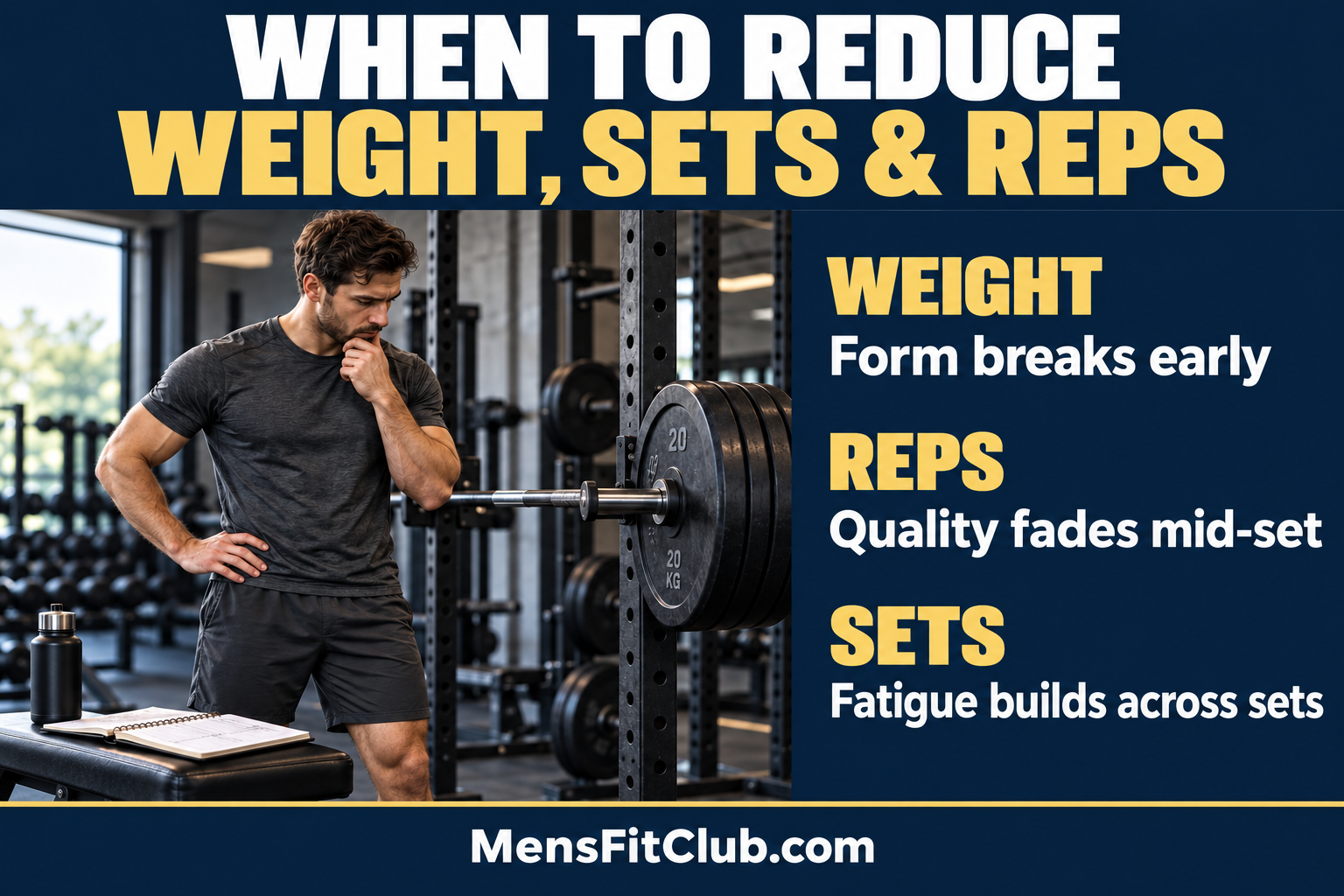
Ask where the problem begins. If you struggle from the first repetition, reduce weight. If the early reps look good but quality declines near the end, reduce reps. If individual sets remain acceptable but repeated efforts become increasingly poor, reduce sets.
Then ask what the exercise is supposed to accomplish. A strength exercise may benefit from retaining a controlled load and doing fewer reps. A muscle-building exercise may work better with a slightly lighter load that keeps you within the intended repetition range. A power exercise may need shorter sets to preserve speed.
Change One Variable and Reassess
When ordinary fatigue is the issue, start with one adjustment. Rest longer, lower the load, stop the next set earlier, or remove a final set. Check whether the change restores appropriate effort and technique before making another adjustment.
There is no requirement to change only one variable if performance remains poor. You might reduce the weight and remove a set during an unusually demanding day. The purpose is to make a useful decision, not to follow a rigid troubleshooting ritual.
Account for Fixed Weights at Home
If you own only one pair of dumbbells, reducing weight may not be possible. Choose an easier version of the movement, perform fewer controlled repetitions, or finish the exercise sooner. For example, replace a demanding floor push-up with an incline push-up using a stable elevated surface. With a fixed kettlebell, shorter sets and longer recovery may help when ordinary fatigue is the limitation. Avoid making the movement faster or using momentum simply to reach the written target. If the available equipment is too heavy for even a few controlled repetitions, select a different exercise rather than forcing the original one.
Practical Examples for Common Weight Workout Exercises
Squats and Deadlifts
Suppose you planned three sets of five squats, but the first set feels much harder than expected. After checking your setup and taking sufficient rest, reduce the load for the remaining sets if the original weight does not allow controlled movement.
For deadlifts, fatigue can change your starting position between repetitions. End the set when you can no longer recreate a stable setup. If a lighter load restores the movement, continue conservatively. If control remains poor, finish the exercise rather than accumulating more attempts.
Dumbbell Presses and Rows
If dumbbell presses feel good for eight reps but the ninth requires an exaggerated change in position, stop at eight. You may not need lighter dumbbells if eight repetitions fit the program and leave an appropriate margin.
If rows become uncontrolled from the beginning, use lighter dumbbells or a more supported variation. When several good sets have already been completed and fatigue keeps escalating, omit the final set. Match the change to the pattern rather than applying one rule to every upper-body exercise.
Lunges, Split Squats, and Single-Leg Exercises
Single-leg exercises challenge balance as well as strength. If you repeatedly lose stability, check your stance and consider external support before assuming the working muscles need less resistance. A supported split squat may allow better execution.
When fatigue clearly causes the instability, reduce weight or repetitions. Do not add extra reps on the stronger side merely to compensate for a weaker side’s difficult set. Choose a manageable prescription for both sides and track any persistent difference.
When Reducing Weight Workout Is Not Enough
Normal muscular effort may include fatigue, temporary burning, and slower repetitions. Sharp pain, sudden pain, or pain that changes your movement is a different signal. Stop the provoking exercise instead of repeatedly testing whether lighter weight makes it tolerable.
Persistent or recurring symptoms deserve professional assessment. Chest pain, fainting, or severe unusual breathlessness require stopping the workout and seeking urgent medical help. No set, repetition target, or weekly training goal takes priority over responding appropriately to those symptoms.
Avoid Using Soreness as the Only Readiness Test
Mild muscle soreness does not automatically require canceling training. Evaluate whether you can move comfortably and perform the intended exercise with control. A gradual warm-up can help you make that judgment.
If soreness substantially limits movement or makes normal tasks difficult, choose a less demanding session or allow more recovery. Do not diagnose the cause of significant pain from a workout log. Training adjustments manage workload; they do not replace assessment of an injury.
What Repeated Reductions Tell You About Recovery
One adjusted workout is usually a data point. Several sessions with unusually heavy warm-ups, falling repetitions, and poor tolerance for normal volume deserve a broader review. Check sleep, meal timing, recent workload, and the amount of demanding exercise outside your lifting program.
An aggressive calorie deficit, added running, or a physically demanding week can make an unchanged strength plan harder to sustain. You may need to reduce planned volume temporarily. Review patterns across exercises and days rather than blaming motivation for every decline.
Consider a Deload When Fatigue Persists
A deload is a planned period of reduced training demands. It may involve fewer sets, lighter loads, greater distance from failure, or a combination. It differs from a single-session adjustment because you intentionally reduce stress across multiple workouts.
There is no universal deload calendar that every lifter must follow. If repeated performance declines persist, consider a short easier period and review the program. Ongoing unexplained fatigue or symptoms outside training may also warrant a conversation with a healthcare professional.
How to Return to Your Normal Sets, Reps, and Weight
At the next session, warm up and assess performance again. If movement and effort return to normal, resume the usual prescription. If not, keep the adjustment or revise the plan. Avoid immediately adding extra work to repay a set you skipped previously.
Log the exercise, load, repetitions, sets, and reason for the change. A note such as “reduced press weight after unexpectedly hard first set” provides useful context. That record helps distinguish isolated difficult days from a repeated mismatch between the program and your recovery.
Keep Progress Focused on Consistent Performance During Weight Workout
Increase demands after you can repeat the current prescription with appropriate technique and effort. Progress may mean another repetition, a small weight increase, or better control at the same load. It does not always mean adding more of everything.
Knowing when to reduce sets, reps, or weight during a workout makes training more responsive. Choose the smallest useful adjustment, protect the purpose of the session, and use repeated patterns to improve your program. Sustainable progress comes from challenging work you can perform consistently and recover from.
To put these workout adjustments into practice, explore our Progressive Overload Strength Training Program for guidance on balancing load, volume, and recovery. New lifters can start with Progressive Overload Workout for Beginners, while home trainees can follow our Complete Progressive Overload Dumbbell Workout. For planned reductions in training demands, see the 8 Week Barbell Progressive Overload Program. Our Power Strength Training After 50 Sets and Reps also explains when to stop sets as movement speed or technique declines.


Most Recommended

Subscribe to our Newsletter
Stay up to date on the latest men’s health, fitness and lifestyle trends and tips.
About Us
Men’s Fit Club was started with the goal of empowering men to get the most out of their lives. This meant going beyond exercise and diet tips to really address the broad range of issues that men face on a daily basis – topics like recreation, finding love, sexual health and even sound fashion advice.
Quick Links
© COPYRIGHT MEN'S FIT CLUB 2026. All Rights Reserved