

High Protein Beef and Pumpkin Chili: A Hearty Recipe
When to Reduce Sets Reps or Weight During a Workout
30-Minute Lunch Break Dumbbell Workout for Full-Body Strength
A packed workday can make exercise feel like another appointment you cannot fit into your calendar. Early mornings disappear into commuting and family responsibilities, while evenings fill with errands, meals, and unfinished work. A 30-minute lunch break dumbbell workout creates a practical opportunity to train before the afternoon begins. With a pair of dumbbells, a little floor space, and a clear plan, you can work your major muscle groups without spending an hour at the gym.
The goal is a productive strength session that fits your day. You do not need complicated combinations, exhausting finishers, or a different exercise every minute. This routine uses familiar movements, manageable repetition targets, and scheduled recovery. You will squat, hinge, push, pull, and train your trunk while keeping the session organized enough to finish on time.
Whether you work from home, have access to a workplace fitness room, or visit a nearby gym, the following lunch break dumbbell workout offers a repeatable starting point. It includes preparation, exercise instructions, beginner modifications, and a progression strategy you can follow for several weeks.
Why a Lunch Break Dumbbell Workout Makes Sense
The most useful workout schedule is one you can repeat. Training at lunch gives exercise a defined place in your day, which may be easier to maintain than hoping you will have energy after work. A scheduled session also encourages preparation: your weights are ready, your clothes are packed, and your next exercise is already decided.
Dumbbells make this approach convenient because they support several movement patterns without requiring a large equipment setup. You can train your legs, back, chest, and shoulders in one small area. Changing between movements usually takes less time than moving across a busy gym to find different machines.
Build a Weekly Strength Habit
The CDC recommends muscle-strengthening activity involving all major muscle groups on at least two days each week, alongside aerobic activity. Two or three lunch sessions can help you establish the strength portion of that broader routine. Walking and other aerobic exercise still have a separate place in your week.
A short session works best when it is challenging enough to matter and realistic enough to repeat. Beginners can develop confidence with the exercises, while more experienced lifters can use the routine as a compact training option during demanding weeks.
Break Up Time Spent Sitting
A lunch workout gives you a reason to stand, move, and change positions after several hours at a desk. Squats and hinges move the hips and knees, while rows and presses train the upper body. This does not mean one workout cancels out every hour of sitting or automatically corrects posture.
Continue taking brief movement breaks during the rest of your day. Standing between calls, walking to refill your water, and changing your working position can complement your training without requiring another formal session.
What You Need Before Starting Lunch Break Dumbbell Workout
Use a clear area with enough room to lie down, extend your arms, and step backward safely. You need a pair of dumbbells and a timer. A mat makes the floor press more comfortable, and a second, lighter pair of weights is helpful for shoulder presses. No bench is required.
Wear clothing that allows you to squat and reach comfortably. Choose stable footwear and keep bags, cables, and office furniture outside your exercise area. At a workplace, use an appropriate permitted space where lifting will not interrupt other people or block walkways.
Choose Dumbbells for Each Movement
The right weight depends on the exercise and your current ability. A load that feels appropriate for Romanian deadlifts may be too heavy for overhead presses. Whenever possible, adjust the dumbbells between blocks instead of forcing one weight to suit every movement.
Choose a load that lets you finish the target repetitions with controlled technique and approximately two or three repetitions remaining. You should feel challenged near the end of a set without grinding through the final repetition. If you cannot maintain your position, shorten the set or reduce the weight.
When only one pair is available, choose conservatively enough for the more demanding upper-body exercise. Lower-body movements may feel easier, but consistency and clean repetitions provide a better starting point than compensating with awkward technique.
Allow Time for Food and Changing With Lunch Break Dumbbell Workout
The workout itself takes 30 minutes, including its warm-up and cooldown. Changing clothes, traveling, showering, and eating require additional time. A 30-minute lunch allowance may therefore call for the shorter version later in this article, especially if you exercise away from your workplace.
Pack your meal in advance when possible. Avoid starting immediately after a large lunch if that leaves you uncomfortable. Some people prefer a small snack beforehand and their main meal afterward; others train before eating. Choose the arrangement that supports comfortable movement and a manageable schedule.
The 30-Minute Lunch Break Dumbbell Workout Schedule
The session contains a five-minute warm-up, three seven-minute strength blocks, and a four-minute cooldown. That adds up to exactly 30 minutes. Start each strength block with the appropriate dumbbells beside you so changing exercises stays straightforward.
Each seven-minute block contains three two-minute rounds followed by one minute of recovery and setup. Within each round, perform the first exercise during the first minute and the second exercise during the next minute. Complete only the prescribed repetitions, then rest for the time remaining in that minute.
The timer organizes the workout; it does not dictate repetition speed. If your set takes 30 seconds, you have about 30 seconds left to recover. If you cannot complete a comfortable set and recover adequately, reduce the repetitions. Never rush through a movement simply to catch the next beep.
Minutes 0–5: Warm Up
Begin with one minute of comfortable marching or walking. Gradually move your arms and let your breathing increase slightly. During the second minute, perform easy bodyweight squats, pausing between repetitions as needed. Use a depth that feels comfortable and maintain contact through your whole foot.
Spend the third minute practicing unloaded hip hinges. Soften your knees and move your hips backward while keeping your torso controlled. Use the fourth minute for gentle shoulder circles, arm reaches, and a few wall push-ups. Finish with light practice repetitions of the squat and row before starting the working sets.
These five minutes should help you feel ready without creating fatigue. If you need more preparation because you feel stiff or are returning after a break, extend the warm-up and remove a strength round. Keep the overall session within your available time.
Block One: Goblet Squat and Bent-Over Dumbbell Row
From minute five to minute eleven, alternate goblet squats and bent-over rows for three rounds. Perform eight to ten goblet squats in the first minute of each round and eight to ten rows in the second. Minute eleven to twelve is for recovery and preparing the next block.
This pairing trains the legs and upper back early in the session. Keep both movements controlled, and choose a row weight that lets you maintain the hinge position comfortably.
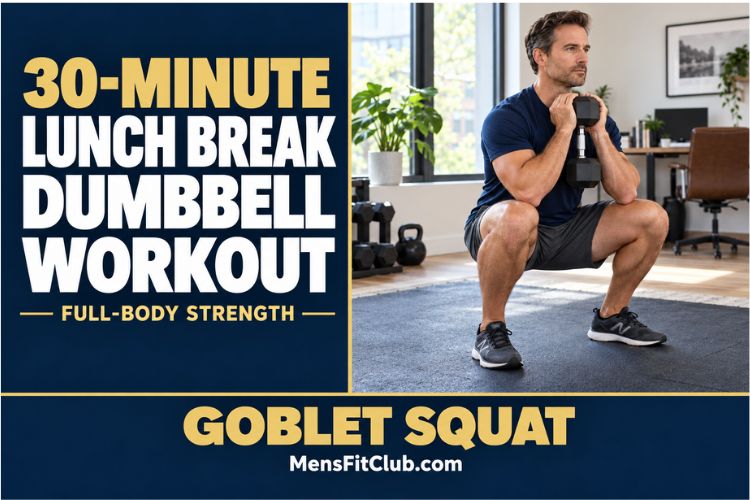
Goblet Squat Technique Lunch Break Dumbbell Workout
Hold one dumbbell vertically in front of your chest with a secure two-handed grip. Stand with your feet in a comfortable position, usually around shoulder width. Brace your trunk gently, then bend at the hips and knees to lower into the squat.
Keep your knees moving in a direction that follows your toes. Descend only as far as you can maintain balance and control. Stand by pushing through your feet, and finish tall without leaning backward. A comfortable squat depth matters more than copying someone else’s range of motion.
If holding the weight is awkward, begin with bodyweight squats. A stable chair placed behind you can provide a depth target, provided it will not slide. Touch it lightly and stand; avoid dropping onto the seat or using unstable rolling office chairs.
Bent-Over Dumbbell Row Lunch Break Workout Technique
Hold the dumbbells at your sides, soften your knees, and hinge your hips backward. Keep your back in a comfortable, stable position and let your arms hang. Pull the dumbbells toward the sides of your lower ribs, then lower them under control.
Avoid lifting your torso to generate momentum. Keep your neck aligned with your upper back and look toward the floor slightly ahead of you. Stop the set if you can no longer hold the hinge without discomfort or excessive movement.
A supported one-arm row is an alternative if a sturdy bench or other suitable support is available. Because each side needs its own set, perform five to six controlled repetitions per side within the row minute. Lower the repetition target if necessary to preserve recovery time.
Block Two: Dumbbell Romanian Deadlift and Floor Press
From minute twelve to minute eighteen, alternate Romanian deadlifts and floor presses for three rounds. Perform eight to ten deadlift repetitions during the first minute and eight to twelve floor presses during the second. Use minute eighteen to nineteen to recover and prepare for the final block.
Practice getting down to the floor and standing again before the session if these transitions are unfamiliar. The time you need to change position is part of each minute; adjust your repetition targets accordingly.
Dumbbell Romanian Deadlift Lunch Break Workout Technique
Stand with a dumbbell in each hand in front of your thighs. Keep a slight bend in your knees and move your hips backward. Let the dumbbells travel close to your legs as your torso inclines forward. Lower until you reach a comfortable hamstring stretch or the limit of your controlled hinge.
There is no requirement to reach the floor. Your available range may end around the knees or mid-shins, depending on your proportions and mobility. Stand by bringing your hips forward, keeping the weights close and your trunk steady.
Avoid turning the movement into a deep squat or reaching farther by rounding your back. If the two-dumbbell version feels difficult to control, hold one lighter weight with both hands or return to unloaded hinges while you learn the pattern.
Dumbbell Floor Press Technique
Sit down with the dumbbells close to your body and position yourself on your back carefully. Bend your knees and place your feet on the floor. Hold the dumbbells above your chest with palms facing forward or turned slightly toward one another.
Lower the weights until your upper arms gently contact the floor, then press upward. Keep your elbows at a comfortable angle rather than flaring them directly sideways. Maintain control at the bottom and avoid bouncing your arms against the ground.
Finish the set by bringing the weights down safely before sitting up. If floor transitions are unsuitable for your space or ability, use controlled wall push-ups instead. Keep the same minute structure and choose a difficulty that allows a challenging, comfortable set.
Block Three: Dumbbell Overhead Press and Suitcase Hold
From minute nineteen to minute twenty-five, alternate overhead presses and suitcase holds for three rounds. Complete six to ten presses during the first minute. During the second, hold one dumbbell at your side for 15 to 20 seconds, switch hands safely, and repeat on the other side.
Use minute twenty-five to twenty-six to put the weights away and let your breathing settle. This final block adds shoulder work and a trunk stability exercise without requiring jumping or rapid movement.
Dumbbell Overhead Press Lunch Break Workout Technique
Stand with your feet comfortably apart and hold the weights around shoulder height. Keep your ribs positioned over your pelvis and your knees relaxed. Press upward through a comfortable range, then lower the dumbbells slowly to the starting position.
Use a lighter load if you need to lean backward to complete the repetition. The press should come from your shoulders and arms without a leg drive. A neutral grip, with palms facing each other, may feel more comfortable for some lifters.
If pressing overhead causes pain, omit it. Repeat the floor press or perform wall push-ups if those are comfortable. Do not repeatedly test a painful position during a timed workout; persistent symptoms deserve individual assessment.
Suitcase Hold Technique
Hold one dumbbell beside your thigh and stand tall. Keep your shoulders approximately level and resist leaning toward or away from the weight. Breathe normally as you maintain the position. Switch hands using a controlled transfer or set the dumbbell down before changing sides.
Use a weight you can hold securely without twisting or excessive gripping strain. This exercise challenges your trunk to resist sideways bending. If you have enough clear space, slow suitcase carries are an optional alternative, but a stationary hold works well in a small room.
Minutes 26–30: Cool Down and Reset
Walk slowly or march gently for approximately two minutes while your breathing settles. Spend the remaining time on comfortable, easy movements for the shoulders, chest, hips, and legs. Keep any stretches gentle and avoid forcing a position to reach a particular range.
Check that your exercise area is tidy, drink according to thirst, and move into your normal lunch routine. The cooldown provides a gradual transition back to work; it does not guarantee that you will avoid soreness. If you regularly need more time to recover before returning to your desk, reduce the workout intensity.
Beginner Modifications for the Lunch Break Dumbbell Workout
For your first few sessions, complete two rounds per block and use the third round’s time as additional recovery. Keep the seven-minute block lengths unchanged so the session still fits the same schedule. Use six to eight repetitions for most movements and lighter weights while learning the transitions.
You can also perform the squat and hinge without weight. Familiarity with the exercises is more valuable initially than making every set difficult. Once you can complete the routine comfortably with consistent technique, add the third round before considering a heavier load.
Adjust for Men Over 40 or 50
Age alone does not determine which dumbbells you should use. Training experience, joint comfort, recovery, and current fitness are more useful guides. An experienced lifter over 50 may need substantial resistance, while a younger beginner may benefit from very light weights.
Start with conservative effort if you are returning after inactivity. Keep extra repetitions in reserve, use comfortable ranges of motion, and allow recovery days between full-body sessions. Stop for sharp pain, dizziness, chest discomfort, or unusual breathlessness rather than trying to finish the timer.
How to Progress Over Four Weeks
During week one, learn the movements and establish appropriate weights. Record the load and repetitions for each exercise, noting whether you had enough recovery between minutes. Aim for consistency across the three rounds rather than a particularly hard opening set.
In week two, add one repetition to sets that felt manageable, staying within the prescribed range. During week three, maintain those repetitions and look for smoother technique and more consistent recovery. Progress is easier to evaluate when you repeat the same exercises.
In week four, consider the smallest available weight increase for an exercise if every round reaches the top of its range with good control and repetitions remaining. Return to the lower end of the repetition range after increasing the load. Other exercises can stay at their existing weights.
Keep the Timer Fixed
The easiest way to preserve the lunch schedule is to progress through load, repetitions, and movement quality. Adding extra rounds changes the session length and may make your plan harder to maintain. Removing rest can also turn a strength workout into a rushed conditioning session.
If the new weight prevents adequate recovery, use the previous load again. You do not have to progress every exercise every week. Poor sleep, demanding workdays, and other training can justify repeating an easier session.
Weekly Scheduling, Lunch, and Recovery
Start with two nonconsecutive sessions, such as Monday and Thursday. If recovery is comfortable and this is your main strength routine, a Monday, Wednesday, and Friday schedule is another option. Avoid adding three lunch workouts on top of an already demanding lifting program without adjusting your total workload.
On other days, walking can provide a useful change of pace. Build your wider activity schedule around your goals and available time. This session is a practical strength foundation, but it may need additional exercises or volume if you later pursue more advanced muscle-building or strength goals.
After training, eat a meal that includes a protein source, carbohydrates, and produce. Chicken with rice and vegetables, a bean bowl, or a sandwich with yogurt are straightforward choices. Your overall daily eating pattern matters more than finding a special lunch-break supplement.
Common Mistakes That Make Short Workouts Less Effective
The biggest mistake is racing through repetitions because the session is brief. Control the lowering phase, maintain a stable position, and stop before technique deteriorates. The timer should help you organize effort and rest, not pressure you into unsafe speed.
Another mistake is choosing weights based on what you can lift once rather than what you can repeat across three rounds. Start conservatively and build from completed sessions. Keep equipment ready, silence unnecessary notifications, and avoid adding exercises that interfere with the planned schedule.
Finally, do not judge success by sweat alone. Room temperature, clothing, and individual differences affect how much you perspire. Record your repetitions, weights, and consistency instead. Those measures give you a clearer picture of whether your training is developing.
Frequently Asked Questions About Lunch Break Dumbbell Workouts
Can a 30-Minute Dumbbell Workout Build Muscle?
It can support muscle growth when the sets provide sufficient challenge, your weekly training volume is appropriate, and recovery and nutrition support your goals. Beginners may find this routine particularly useful. More experienced lifters may eventually need additional volume or a more specialized program.
What If My Entire Lunch Break Is Only 30 Minutes?
Use a 20-minute version and reserve the remaining time for changing and eating. Use a three-minute warm-up, perform two two-minute rounds per strength block with one minute for recovery and transitions after each block, and finish with a two-minute cooldown. This totals twenty minutes. If three minutes does not provide enough preparation, extend the warm-up and remove a working round.
Can I Do This Workout Every Day?
Daily full-body lifting is unnecessary for this plan. Begin with two or three nonconsecutive sessions and observe how you recover. Walking or gentle movement on the other days lets you maintain a lunchtime activity habit while giving the trained muscles a break.
Is This a Fat-Loss Workout?
It can contribute to a weight-management plan, but a 30-minute session does not guarantee fat loss. Changes in body weight depend on your overall eating pattern, activity, and consistency. Use strength training to develop physical capacity while managing those broader habits.
Make Your Lunch Break a Consistent Training Opportunity
A 30-minute lunch break dumbbell workout gives busy men a clear, repeatable way to train. Prepare your equipment, follow the five-minute warm-up, complete the three strength blocks, and finish with the cooldown. Adjust the repetitions and loads to your ability, then repeat the session consistently.
You do not need every workout to set a record. Completing controlled sets, recovering well, and gradually increasing the challenge creates a routine you can sustain. Put the next session on your calendar and let your lunch break become a dependable part of your strength-training week.
More Dumbbell Workouts for Busy Men
Make your 30-minute lunch break dumbbell workout part of a consistent routine with our Full Body Dumbbell Workout Plan For Beginners and Dumbbell Strength Workout. For weekly structure, explore the 3 Day Full Body Workout Plan With Dumbbells. When your lunch break is shorter, try our 15 Minute Full Body Dumbbell Workout, or explore the 30 Minute Dumbbell Density Workout For Muscle Gain for another time-efficient training option.


Most Recommended

Subscribe to our Newsletter
Stay up to date on the latest men’s health, fitness and lifestyle trends and tips.
About Us
Men’s Fit Club was started with the goal of empowering men to get the most out of their lives. This meant going beyond exercise and diet tips to really address the broad range of issues that men face on a daily basis – topics like recreation, finding love, sexual health and even sound fashion advice.
Quick Links
© COPYRIGHT MEN'S FIT CLUB 2026. All Rights Reserved