
Chipper CrossFit Workout: Best Full-Body WOD Guide
30 Day HIIT Workout Challenge for Total Body Fitness
CrossFit Couplet Workout: Best Two-Movement WODs
45 Minute At Home HIIT Workout for Full Body Fitness
Chipper CrossFit Workout: Best Full-Body WOD Guide
A chipper CrossFit workout is one of the most challenging and rewarding ways to test your strength, muscular endurance, cardiovascular conditioning, and mental toughness in a single training session. Unlike traditional workouts where you repeat several rounds of the same exercises, a CrossFit chipper usually gives you a long list of movements and repetitions that you work through once from beginning to end.
The goal is simple: start at the top of the workout and keep moving until every repetition is completed. That simple structure can become extremely demanding when the workout combines exercises such as pull-ups, kettlebell swings, box jumps, burpees, deadlifts, rowing, thrusters, and double-unders.
Chipper workouts can also be scaled for almost any fitness level. Beginners can reduce repetitions, loads, and movement complexity, while experienced CrossFit athletes can increase the difficulty with heavier weights and more advanced gymnastics movements.
This guide explains how chipper CrossFit workouts work, their benefits, how to pace them, and several WOD examples you can use for your next training session.
What Is a Chipper CrossFit Workout?
A chipper is a workout consisting of multiple exercises that are generally completed sequentially. Instead of performing three or four exercises for several rounds, you “chip away” at a larger workload until everything is finished.
A basic chipper might look like this:
50 air squats
40 kettlebell swings
30 box jumps
20 push-ups
10 burpees
You complete all 50 air squats before moving to the kettlebell swings. Once all 40 swings are finished, you move to the box jumps and continue through the workout.
Most chippers are performed for time, meaning the objective is to finish the prescribed work as efficiently as possible while maintaining good movement quality.
However, finishing quickly should never come at the expense of technique. The best chipper strategy balances speed, sustainable effort, and movement quality.
Why Is It Called a Chipper Workout?
The name comes from the idea of gradually “chipping away” at a large amount of work.
When you first look at a workout containing hundreds of repetitions, the total volume can appear intimidating. Instead of thinking about the entire workout, you focus on completing one movement and one manageable set at a time.
This structure creates both a physical and psychological challenge.
Your muscles become increasingly fatigued as you progress, while mentally you must continue working through the remaining exercises. Learning to stay composed when tired is one reason chipper workouts are popular for building work capacity.
Benefits of Chipper CrossFit Workouts
Chippers can provide several training benefits because they combine strength movements, gymnastics exercises, and cardiovascular conditioning.
Full-Body Conditioning
A properly designed chipper can train nearly every major muscle group.
For example, squats and lunges target the lower body, pull-ups and rows challenge the back, push-ups and presses work the upper body, and exercises such as burpees and rowing increase cardiovascular demand.
Instead of isolating one muscle group, you develop the ability to perform different movement patterns while fatigued.
Improved Muscular Endurance
High-repetition exercises require your muscles to repeatedly produce force.
Completing 40 kettlebell swings followed by 30 goblet squats and 20 push-ups creates a very different challenge from performing a few heavy repetitions with long rest periods.
Over time, properly programmed high-repetition training can improve muscular endurance and your ability to sustain repeated efforts.
Cardiovascular Fitness
Many chippers include running, rowing, cycling, jump rope, burpees, or box jumps.
These movements elevate your heart rate and turn the session into a substantial conditioning workout.
The combination of resistance exercises and cardio movements also forces your cardiovascular system to adapt as you transition between different types of work.
Mental Toughness and Pacing
A chipper requires patience.
Starting too aggressively can leave you exhausted halfway through the workout. Moving too slowly may prevent you from achieving the intended conditioning stimulus.
Successful athletes learn to select a pace they can sustain throughout most of the WOD.
That ability to manage effort is useful in CrossFit workouts ranging from AMRAPs and EMOMs to longer endurance sessions.
How to Do a Chipper CrossFit Workout
Before starting, read through the entire workout.
Identify movements that could become limiting factors. If you can comfortably perform 50 air squats but struggle after eight pull-ups, the pull-ups require a more conservative strategy.
Also prepare all equipment before starting.
Position your barbell, dumbbells, kettlebell, box, jump rope, and other equipment so transitions are safe and efficient.
Warm up thoroughly and practice the technical movements with lighter resistance before beginning the timed workout.
Chipper CrossFit Workout Warm-Up
Spend approximately 8–12 minutes gradually preparing your body.
Start with several minutes of easy rowing, cycling, jogging, or jump rope to increase body temperature.
Then perform dynamic movements such as bodyweight squats, walking lunges, arm circles, hip hinges, inchworms, and shoulder mobility exercises.
Finish with movement-specific preparation.
If your workout includes deadlifts, gradually build toward your workout weight. Includes pull-ups, perform several controlled practice repetitions. If you are doing box jumps, practice a few low-volume jumps before beginning.
You should feel warm and prepared rather than exhausted.
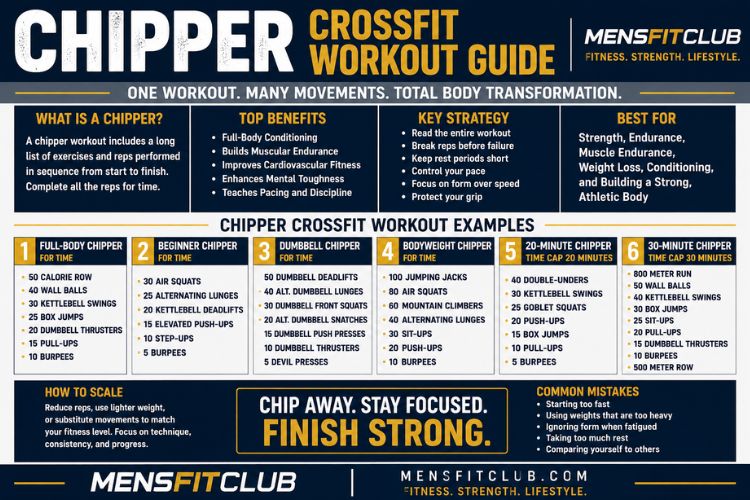
Full-Body Chipper CrossFit Workout
Try this full-body chipper for time:
50 calorie row
40 wall balls
30 kettlebell swings
25 box jumps
20 dumbbell thrusters
15 pull-ups
10 burpees
This workout combines cardiovascular conditioning with lower-body strength, pulling strength, explosive movement, and full-body muscular endurance.
How to Pace This Chipper
The row should feel controlled rather than like a sprint.
The objective is to leave the rowing machine ready to continue working.
Break the wall balls and kettlebell swings into manageable sets before reaching failure. For example, instead of attempting 40 wall balls without stopping, you could perform sets of 10 with brief recovery periods.
Use the same approach for thrusters and pull-ups.
Short, planned breaks are generally better than pushing to failure and needing a long recovery.
Beginner Chipper CrossFit Workout
Beginners do not need hundreds of repetitions to experience the benefits of chipper training.
Try:
30 air squats
25 alternating reverse lunges
20 kettlebell deadlifts
15 elevated push-ups
10 step-ups
5 burpees
Complete each movement before progressing to the next.
Rest whenever necessary and prioritize controlled repetitions.
Beginners can also use a 15- to 20-minute time cap. If you reach the cap before completing the workout, record where you finished and use that information to measure progress later.
Dumbbell Chipper CrossFit Workout
Dumbbells make it possible to create a highly effective chipper without needing an extensive CrossFit gym setup.
For time:
50 dumbbell deadlifts
40 alternating dumbbell reverse lunges
30 dumbbell front squats
20 alternating dumbbell snatches
15 dumbbell push presses
10 dumbbell thrusters
5 devil presses
Choose weights that allow you to perform repeated sets with consistent technique.
The goal is not to use the heaviest dumbbells available. A chipper is primarily about completing a substantial amount of work efficiently.
Bodyweight Chipper CrossFit Workout
You can also perform a chipper without weights.
Try:
100 jumping jacks
80 air squats
60 mountain climbers
40 alternating lunges
30 sit-ups
20 push-ups
10 burpees
This makes an excellent home or travel workout because very little space is required.
For lower-impact training, replace jumping jacks with fast step jacks and burpees with controlled squat thrusts.
20-Minute CrossFit Chipper Workout
If you are short on time, try this compact workout:
40 double-unders
30 kettlebell swings
25 goblet squats
20 push-ups
15 box jumps
10 pull-ups
5 burpees
Set a 20-minute time cap.
Your objective is to complete the entire workout within the time limit while maintaining proper technique.
If double-unders are currently too difficult, substitute single-unders. A common scaling approach is to use approximately twice as many single-unders, although the exact substitution should reflect your ability and the intended workout stimulus.
30-Minute CrossFit Chipper Workout
For a longer conditioning challenge, try:
800-meter run
50 wall balls
40 kettlebell swings
30 box jumps
25 sit-ups
20 pull-ups
15 dumbbell thrusters
10 burpees
500-meter row
Set approximately a 30-minute time cap depending on your fitness level.
This workout begins and finishes with cardiovascular work while placing resistance and bodyweight exercises in the middle.
The biggest mistake is attacking the opening run too aggressively.
Use a sustainable pace that allows you to immediately begin the wall balls.
CrossFit Chipper Workout With Barbell
Experienced athletes looking for a strength-conditioning challenge can incorporate barbell movements.
For time:
30 deadlifts
25 hang power cleans
20 front squats
15 push presses
10 thrusters
5 clean and jerks
The weight should be manageable across all exercises.
Remember that a weight that feels easy for deadlifts may become extremely challenging during thrusters.
Select the load based primarily on the most difficult movement rather than the easiest movement.
Athletes who are not proficient with Olympic lifting movements should practice them separately before adding them to a high-fatigue timed workout.
How Heavy Should You Go During a Chipper?
Choosing the correct weight is critical.
The resistance should challenge you without causing technique to deteriorate.
If the workout requires 30 thrusters and your chosen weight forces you to perform singles from the beginning, the load may be too heavy unless that is specifically the intended stimulus.
For general conditioning, select weights that allow multiple controlled repetitions before taking short breaks.
Beginners should prioritize movement mechanics and consistency over leaderboard times.
Best Strategy for Chipper CrossFit Workouts
Chippers reward athletes who understand pacing.
Break Reps Before Failure
Suppose you have 40 pull-ups.
You might technically be able to perform 15 unbroken, but doing so could exhaust your grip and dramatically slow the remaining repetitions.
Instead, you could use controlled sets such as:
8-8-8-8-8
or:
10-10-5-5-5-5.
The exact strategy depends on your ability.
The principle is to stop before your form and performance collapse.
Keep Rest Periods Short
Rest is sometimes necessary, but avoid allowing short breaks to become extended recovery periods.
Take several controlled breaths and return to work.
Control Your Transitions
Transitions can consume a surprising amount of time.
Prepare your equipment beforehand and move deliberately from one exercise to the next.
You do not necessarily need to sprint between stations. Simply avoid unnecessary delays.
Protect Your Grip
Pull-ups, deadlifts, kettlebell swings, dumbbell snatches, and rowing can all fatigue your grip.
When several grip-intensive movements appear in the same chipper, breaking sets early can prevent your forearms from becoming the limiting factor.
Common Chipper Workout Mistakes
One of the most common mistakes is treating the first exercise like an independent competition.
You may feel great during the opening 50 calories on the rower, but sprinting them could negatively affect the next 15 minutes of training.
Another mistake is selecting excessive resistance.
A chipper is not normally the ideal place to test a one-repetition maximum. Heavy loads combined with fatigue can increase the likelihood of poor technique.
Athletes also sometimes ignore movement standards as they become tired.
A repetition only helps if it is performed correctly. Maintain appropriate range of motion and control throughout the workout.
Finally, avoid comparing your performance blindly with advanced athletes. Scaling is a fundamental part of effective CrossFit training.
How to Scale a CrossFit Chipper
There are several ways to modify a chipper without losing its overall training effect.
You can reduce repetitions. For example, change 50 reps to 30.
You can decrease the resistance.
You can substitute technically demanding exercises. Pull-ups could become ring rows, box jumps could become step-ups, and double-unders could become single-unders.
You can also shorten running or rowing distances.
Scaling should make the workout achievable while preserving the intended combination of conditioning, strength, and muscular endurance.
How Often Should You Do Chipper Workouts?
For many recreational athletes, one chipper workout per week can be enough when combined with strength training, skill development, mobility work, and other conditioning sessions.
More experienced CrossFit athletes may perform them more frequently depending on their overall program.
The appropriate frequency depends on training volume, workout intensity, recovery ability, sleep, nutrition, and other physical activity.
Avoid turning every workout into a maximum-effort chipper.
Variation in intensity and training style can help create a more balanced program.
Chipper vs AMRAP CrossFit Workout
A chipper and AMRAP can contain similar exercises but have different structures.
In an AMRAP, you complete as many rounds or repetitions as possible within a fixed period.
For example:
10 squats
10 push-ups
10 kettlebell swings
AMRAP for 15 minutes.
You continuously repeat those exercises until time expires.
In a chipper, you usually complete a larger prescribed workload once.
For example:
50 squats
40 kettlebell swings
30 push-ups
20 box jumps
10 burpees.
Both can improve conditioning, but the pacing strategies are different.
Chipper vs EMOM Workout
An EMOM, or Every Minute on the Minute workout, assigns work to specific minute intervals.
You might perform 10 kettlebell swings at the beginning of minute one, 10 burpees at the beginning of minute two, and repeat.
A chipper gives you more freedom regarding when you work and rest.
This means pacing decisions become part of the challenge.
Recovery After a Chipper CrossFit Workout
After completing a demanding chipper, spend several minutes gradually reducing your heart rate.
Easy walking or cycling can help transition from intense exercise to recovery.
Hydration and adequate nutrition are also important, particularly after long or high-volume sessions.
Consume meals containing sufficient protein, carbohydrates, healthy fats, and micronutrient-rich foods based on your overall nutritional requirements.
Sleep is equally important.
High-volume CrossFit workouts create significant fatigue, and adequate recovery allows your body to adapt before the next challenging session.
Example Weekly CrossFit Training Schedule
A balanced week could look like:
Monday: Strength training + short conditioning workout
Tuesday: Gymnastics skills + moderate AMRAP
Wednesday: Mobility or active recovery
Thursday: Olympic lifting + intervals
Friday: Full-body chipper CrossFit workout
Saturday: Easy cardio or technique work
Sunday: Rest
This is only an example. Your schedule should reflect your experience, recovery capacity, goals, and available training time.
Frequently Asked Questions About Chipper CrossFit Workouts
Are Chipper Workouts Good for Beginners?
Yes. Chippers can be beginner-friendly when repetitions, weights, and exercise complexity are appropriately scaled.
A beginner chipper may contain only five or six basic movements and approximately 100 total repetitions, while an advanced workout might contain several hundred repetitions.
How Long Should a Chipper Workout Take?
Chippers vary significantly.
A short workout might take 10–15 minutes, while longer versions may require 30–45 minutes or more.
Rather than automatically making a chipper extremely long, choose a duration appropriate for your training goal.
Can Chipper Workouts Build Muscle?
Chipper workouts can provide a muscular stimulus, particularly when resistance exercises are included, but they should not necessarily replace structured strength and hypertrophy training if maximizing muscle growth is your primary objective.
Exercises such as squats, presses, lunges, deadlifts, pull-ups, and kettlebell movements can complement a comprehensive muscle-building program.
Can You Do a Chipper Workout at Home?
Absolutely.
Bodyweight movements such as squats, push-ups, lunges, sit-ups, mountain climbers, and burpees can create an effective home chipper.
Adding one pair of dumbbells or a kettlebell provides even more exercise options.
What Is a Good Chipper Workout for Beginners?
A simple option is:
30 air squats
25 reverse lunges
20 sit-ups
15 elevated push-ups
10 step-ups
5 burpees.
Focus on completing every repetition with controlled technique rather than racing against the clock.
Final Thoughts on Chipper CrossFit Workouts
A chipper CrossFit workout provides a straightforward but demanding way to challenge full-body strength, cardiovascular conditioning, muscular endurance, and pacing.
The format can be adapted to virtually any environment. You can create a bodyweight chipper at home, use dumbbells or kettlebells for a garage-gym workout, or combine barbells, rowing, gymnastics, and box jumps for a more advanced CrossFit WOD.
The key is intelligent programming.
Choose exercises you can perform safely, select appropriate weights, break high-repetition movements into manageable sets, and resist the temptation to sprint through the beginning of the workout.
Most importantly, remember what makes the format unique: you do not have to conquer the entire workout at once.
You simply keep chipping away, one repetition and one movement at a time.
Want to add more variety to your CrossFit training? Explore this 45 Minute Full Body CrossFit Workout for a complete strength and conditioning session, or use this CrossFit Workout Plan to build a more structured weekly routine. If you enjoy the kettlebell swings commonly used in a chipper CrossFit workout, try these CrossFit Kettlebell Workouts to develop strength, power, and endurance. You can also mix up your conditioning with these CrossFit Workouts at Home or improve your cardio and double-under skills with this CrossFit Jump Rope Workout. Together, these workouts complement a chipper WOD by helping you develop the strength, stamina, conditioning, and movement skills needed to keep chipping away at high-rep workouts.


Most Recommended

Subscribe to our Newsletter
Stay up to date on the latest men’s health, fitness and lifestyle trends and tips.
About Us
Men’s Fit Club was started with the goal of empowering men to get the most out of their lives. This meant going beyond exercise and diet tips to really address the broad range of issues that men face on a daily basis – topics like recreation, finding love, sexual health and even sound fashion advice.
Quick Links
© COPYRIGHT MEN'S FIT CLUB 2026. All Rights Reserved