
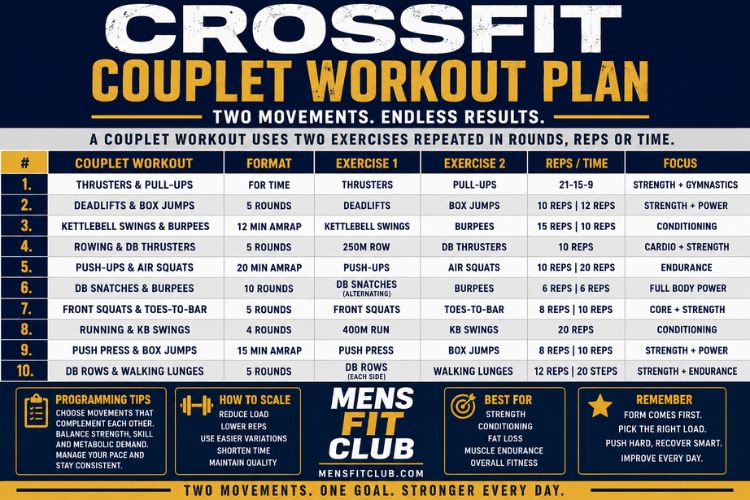
CrossFit Couplet Workout: Best Two-Movement WODs
45 Minute At Home HIIT Workout for Full Body Fitness
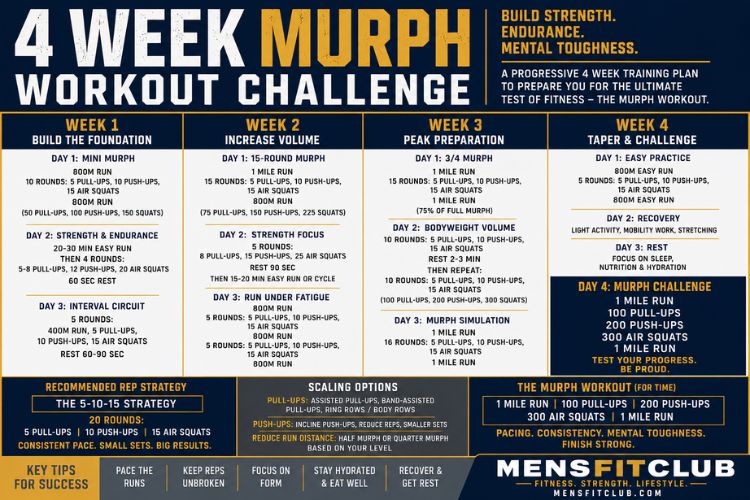
4 Week Murph Workout Challenge A Complete Training Plan
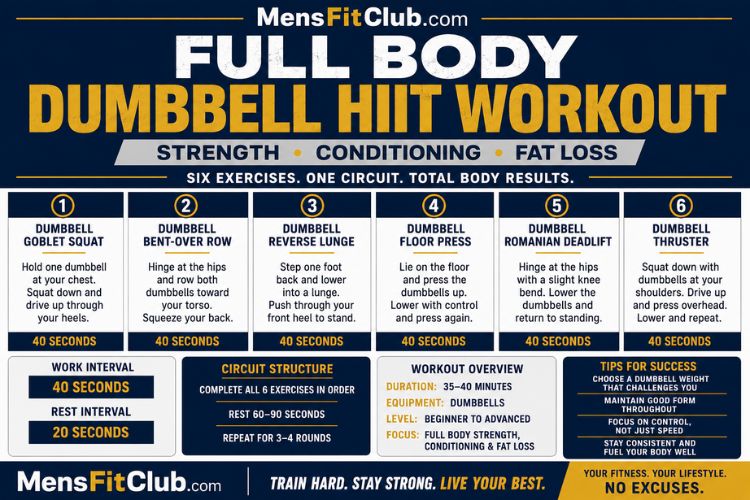
Full Body HIIT Routine With Dumbbells (Build Muscle + Burn Fat)
45 Minute At Home HIIT Workout for Full Body Fitness
A 45 minute at home HIIT workout is an efficient way to combine cardiovascular conditioning, muscular endurance, strength, and calorie-burning exercise without traveling to a gym. High-intensity interval training (HIIT) alternates challenging periods of exercise with controlled recovery periods, allowing you to complete a demanding full-body workout in a relatively short amount of time.
The biggest advantage of doing HIIT at home is simplicity. You do not need complicated exercise machines, a large workout area, or an expensive collection of equipment. With exercises such as squats, push-ups, lunges, mountain climbers, jumping jacks, and planks, you can train virtually every major muscle group using your own body weight.
This 45 minute home HIIT workout combines a structured warm-up, full-body strength intervals, cardio exercises, core training, and a final conditioning circuit. The routine can also be modified for beginners or made more challenging for experienced exercisers.
What Is a 45 Minute At Home HIIT Workout?
A 45 minute at home HIIT workout uses intervals of relatively intense exercise followed by shorter recovery periods. Instead of performing continuous moderate-intensity cardio for the entire workout, HIIT repeatedly challenges you to increase your effort before allowing a brief recovery.
For example, you might perform bodyweight squats for 40 seconds and then recover for 20 seconds before moving to push-ups. The same pattern continues through several exercises.
The intensity of each interval should be challenging but controlled. You do not necessarily need to exercise at your absolute maximum effort during every interval. Maintaining good technique is more important than completing additional repetitions with poor form.
A well-designed 45-minute session should also include enough variety to distribute the workload across different muscle groups rather than repeatedly stressing the same joints and muscles.
Benefits of a 45 Minute Home HIIT Workout
HIIT is popular because it allows strength and cardiovascular exercises to be combined into one training session. A 45-minute format provides enough time to train the entire body while still being practical for a busy schedule.
Improve Cardiovascular Fitness
Exercises such as jumping jacks, mountain climbers, high knees, skaters, and squat jumps quickly increase your heart rate. Repeated work and recovery intervals challenge your cardiovascular system to adapt to changing levels of exercise intensity.
Over time, consistently performing cardiovascular training may improve your ability to tolerate demanding workouts and everyday physical activities.
Build Muscular Endurance
Bodyweight HIIT exercises require your muscles to repeatedly produce force while fatigue gradually increases.
Squats and lunges train the lower body, while push-ups target the chest, shoulders, and triceps. Planks and mountain climbers challenge the abdominal muscles and surrounding core musculature.
The result is a workout that develops muscular endurance alongside cardiovascular conditioning.
Train Home HIIT Workout Without Gym Equipment
One of the most useful features of this workout is that it requires little or no equipment.
A small open space is usually enough. A workout mat may make floor exercises more comfortable, but it is optional.
That makes this routine useful for home training, hotel workouts, or days when getting to the gym is inconvenient.
Work the Entire Body
This 45 minute full body HIIT workout at home includes movements for your legs, upper body, core, and cardiovascular system.
Instead of spending an entire session training only one muscle group, you can perform movements that recruit multiple muscles at the same time.
Compound bodyweight exercises are particularly useful for this approach because they allow you to accomplish more work during each interval.
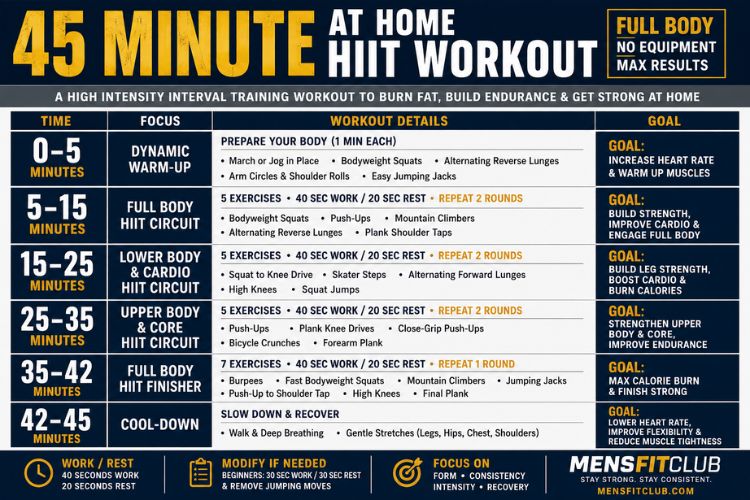
45 Minute At Home HIIT Workout Overview
The workout is divided into several sections so you can gradually increase the intensity before finishing with a challenging conditioning circuit.
0–5 minutes: Dynamic warm-up
5–15 minutes: Full-body HIIT circuit
15–25 minutes: Lower-body and cardio circuit
25–35 minutes: Upper-body and core circuit
35–42 minutes: Full-body HIIT finisher
42–45 minutes: Cool-down
For most working intervals, use approximately 40 seconds of exercise followed by 20 seconds of recovery.
Beginners can modify the structure to approximately 30 seconds of exercise and 30 seconds of recovery.
Minutes 0–5: Dynamic Home HIIT Workout Warm-Up
Never underestimate the importance of preparing your body before beginning high-intensity exercise. The goal of the warm-up is to gradually increase your heart rate while preparing your muscles and joints for the movements ahead.
Minute 1: March or Jog in Place
Begin with a comfortable march in place. Gradually increase your pace until you are jogging lightly if that feels appropriate.
Keep your posture upright and allow your arms to move naturally.
Minute 2: Bodyweight Squats
Stand with your feet approximately shoulder-width apart.
Push your hips backward and bend your knees while lowering yourself into a comfortable squat. Drive through your feet to return to standing.
Perform controlled repetitions rather than trying to move as quickly as possible.
Minute 3: Alternating Reverse Lunges
Step one foot backward and lower your body until both knees are comfortably bent. Push through your front foot and return to standing before switching sides.
Reverse lunges help prepare your legs and hips for the lower-body exercises later in the workout.
Minute 4: Arm Circles and Shoulder Movement
Perform controlled arm circles in both directions before adding gentle shoulder rolls.
You can also include alternating arm swings across the front of your body.
Minute 5: Easy Jumping Jacks Home HIIT Workout
Finish the warm-up with approximately one minute of controlled jumping jacks.
If jumping is uncomfortable, perform step jacks by stepping one foot sideways at a time while raising your arms.
You should now feel warm and prepared rather than exhausted.
Minutes 5–15: Full Body Home HIIT Workout Circuit
The first working circuit introduces several fundamental bodyweight exercises.
Perform each exercise for approximately 40 seconds followed by 20 seconds of recovery. Complete the five exercises twice.
1. Bodyweight Squats
Bodyweight squats target your quadriceps, hamstrings, glutes, and core.
Keep your chest upright as you descend. Lower only as far as you can while maintaining good control, then drive through your feet to return to standing.
2. Push-Ups
Push-ups primarily target the chest, shoulders, and triceps while requiring considerable core stability.
Maintain a straight line through your torso and lower yourself under control.
If standard push-ups are too difficult, perform them with your hands elevated on a sturdy surface.
3. Mountain Climbers
Begin in a high plank position.
Alternately drive your knees toward your torso while keeping your shoulders positioned over your hands.
Move at a pace that allows you to maintain a stable core.
4. Alternating Reverse Lunges Home HIIT Workout
Step backward into a lunge and return to the starting position before alternating legs.
Avoid rushing the movement. Focus on balance and controlled repetitions.
5. Plank Shoulder Taps
Begin in a high plank position with your feet slightly wider than normal.
Lift one hand and tap the opposite shoulder. Return your hand to the floor before repeating on the other side.
Try to prevent excessive rotation through your hips.
Complete the entire circuit twice.
Minutes 15–25: Lower Body and Cardio Home HIIT Workout Circuit
The second circuit increases the emphasis on your legs while incorporating cardiovascular movements.
Again, perform approximately 40 seconds of work followed by 20 seconds of rest and complete two rounds.
1. Squat to Knee Drive
Perform a normal bodyweight squat.
As you return to standing, drive one knee upward toward your torso. Perform another squat and switch knees.
This combines lower-body strength with balance and core engagement.
2. Skater Steps
Step laterally from one side to the other while allowing the opposite leg to travel behind your body.
More advanced exercisers can turn the movement into a lateral jump.
Beginners should keep it low impact by stepping instead.
3. Alternating Forward Lunges
Step forward and lower yourself into a controlled lunge before pushing through your front foot and returning to the starting position.
Alternate legs throughout the interval.
4. High Knees Home HIIT Workout
Run or march in place while driving your knees upward.
Keep your torso tall rather than leaning backward.
Increase the speed only if you can maintain control.
5. Squat Jumps
Lower yourself into a partial squat and then jump vertically.
Land softly with your knees slightly bent before immediately preparing for the next repetition.
For a low-impact alternative, perform fast bodyweight squats without jumping.
Minutes 25–35: Upper Body and Core HIIT Circuit
Your legs have already completed considerable work, so the next circuit shifts more attention toward your upper body and core.
Perform each exercise for 40 seconds with 20 seconds of recovery. Complete two rounds.
1. Push-Ups
Return to standard or modified push-ups.
Because you are already fatigued, prioritize proper technique over speed.
Stop the interval early if your form begins to deteriorate significantly.
2. Plank Knee Drives
Begin in a high plank.
Slowly drive one knee toward your chest before returning your foot to the floor and switching sides.
Compared with fast mountain climbers, this version emphasizes abdominal control.
3. Close-Grip Push-Ups
Place your hands slightly narrower than during regular push-ups.
Keep your elbows relatively close to your torso as you lower yourself.
This variation increases the contribution from your triceps.
If necessary, perform the exercise with your hands elevated.
4. Bicycle Crunches
Lie on your back with your hands lightly positioned near your head.
Bring one knee toward your torso while rotating your opposite shoulder toward it. Switch sides in a controlled rhythm.
Avoid pulling your head forward with your hands.
5. Forearm Plank
Position your elbows beneath your shoulders and extend your legs behind you.
Brace your abdominal muscles and maintain a straight body position.
If 40 seconds becomes too difficult, briefly lower your knees before continuing.
Minutes 35–42: Full Body HIIT Finisher
The final seven-minute section is designed to provide a challenging finish.
At this stage, fatigue will already be noticeable, so adjust your speed as necessary.
Exercise 1: Burpees
Begin standing, place your hands on the floor, and move your feet backward into a plank.
Return your feet toward your hands and stand.
Advanced exercisers can add a jump at the top.
Beginners can step backward and forward instead of jumping.
Exercise 2: Fast Bodyweight Squats
Perform controlled squats at a slightly faster pace.
Your goal is continuous movement rather than maximum speed.
Exercise 3: Mountain Climbers
Return to a high plank and alternate knee drives.
Keep your abdominal muscles engaged and avoid allowing your hips to rise excessively.
Exercise 4: Jumping Jacks
Perform jumping jacks at a sustainable pace.
Use step jacks if you want a low-impact alternative.
Exercise 5: Push-Up to Shoulder Tap
Perform one push-up.
At the top, tap your opposite shoulder with each hand before beginning the next repetition.
This movement combines chest, shoulder, triceps, and core training.
Exercise 6: High Knees
Perform another cardiovascular interval with high knees.
Use an energetic march if you need to reduce the impact.
Exercise 7: Final Plank
Finish the working portion of the workout with a plank.
Concentrate on maintaining controlled breathing and good body alignment until the interval finishes.
Minutes 42–45: Cool-Down
After completing your final interval, avoid immediately sitting or lying down unless you need to for safety.
Spend approximately three minutes gradually lowering the intensity.
Walk slowly around your workout area while taking controlled breaths. Follow this with gentle stretches for your quadriceps, hamstrings, hips, chest, and shoulders.
The cool-down should feel comfortable rather than aggressive.
Beginner 45 Minute At Home HIIT Workout Modifications
HIIT should always be adjusted to match your current fitness level.
If you are new to high-intensity training, begin with approximately 30 seconds of exercise followed by 30 seconds of recovery.
You can also eliminate most jumping exercises.
Replace jump squats with normal squats, high knees with marching, jumping jacks with step jacks, and burpees with step-back burpees.
These substitutions reduce impact while preserving the overall structure of the workout.
It is also perfectly reasonable to take additional recovery time between circuits.
Completing the entire workout with good technique is more valuable than trying to match an interval structure that is currently too difficult.
Advanced 45 Minute At Home HIIT Workout Modifications
Experienced exercisers can make the routine considerably more difficult without changing the exercises.
One option is increasing the working intervals to approximately 45–50 seconds while reducing recovery to 10–15 seconds.
You can also increase movement speed, provided your technique remains consistent.
Advanced trainees may replace bodyweight squats with squat jumps, step skaters with lateral bounds, regular mountain climbers with faster variations, and standard burpees with burpee jumps.
Another option is adding dumbbells to squats and lunges if suitable equipment is available.
How Many Calories Does a 45 Minute HIIT Workout Burn?
There is no single accurate calorie number for every person completing a 45 minute HIIT workout.
Energy expenditure depends on factors including body size, age, biological sex, fitness level, exercise selection, workout intensity, rest periods, and individual physiology.
Rather than choosing a workout solely according to an estimated calorie number, concentrate on consistency and progressive improvement.
As your fitness improves, you may be able to complete more repetitions, use more demanding exercise variations, or maintain higher-quality movement throughout the workout.
How Often Should You Do a 45 Minute At Home HIIT Workout?
More HIIT is not automatically better.
Because high-intensity exercise can be demanding, adequate recovery is important. Many people can start with approximately two HIIT sessions per week and adjust their training frequency based on their experience, goals, and recovery.
Other training days can include strength training, walking, moderate cardiovascular exercise, mobility work, or rest.
Beginners should be particularly cautious about suddenly performing intense HIIT sessions every day.
Allow your body time to adapt.
Can You Lose Weight With At Home HIIT Workouts?
HIIT can contribute to a weight-management program because it provides vigorous physical activity and increases overall energy expenditure.
However, exercise is only one component of fat loss.
Your overall calorie intake, dietary habits, sleep, stress management, daily activity, and training consistency also influence long-term results.
Instead of viewing a 45 minute HIIT workout as a shortcut, use it as part of a sustainable fitness routine.
Combining regular training with a nutritious eating pattern and sufficient recovery generally provides a more realistic approach than relying on extreme workout programs.
Tips for Getting Better Results From Home HIIT
Prioritize Exercise Form
Performing more repetitions is not useful if your technique deteriorates.
During squats, keep your knees tracking comfortably with your feet. During push-ups and planks, maintain core tension. During jumping movements, focus on controlled landings.
Progress Gradually
Your first workout does not need to be your hardest.
Begin at a manageable intensity and gradually increase the challenge as your conditioning improves.
Progress could involve completing additional repetitions, taking slightly shorter recovery periods, choosing harder variations, or eventually adding resistance.
Create Enough Workout Space
Before beginning, remove furniture, cables, rugs, and other objects that could interfere with movement.
You should have enough space to perform lunges, planks, jumping jacks, and lateral movements safely.
Keep Water Nearby
Have water available and hydrate according to your needs.
This is particularly important when exercising in a warm environment.
Wear Supportive Footwear When Appropriate
If you are performing jumping exercises on a hard floor, appropriate footwear can improve comfort and stability.
Some people prefer barefoot training for certain low-impact movements, but your training environment and exercise selection should determine what is appropriate.
Sample Weekly Schedule With Home HIIT
A balanced weekly routine could include this 45 minute at home HIIT workout two or three times while using lower-intensity activities or strength training on other days.
For example, Monday could be the 45-minute HIIT routine, Tuesday could involve walking and mobility, Wednesday could focus on strength training, Thursday could be recovery or light activity, Friday could repeat the HIIT workout, Saturday could include moderate cardio or recreational activity, and Sunday could be used for recovery.
The exact schedule should reflect your fitness level and goals.
If your performance continually declines, soreness remains unusually high, or you feel consistently exhausted, additional recovery may be beneficial.
Frequently Asked Questions About 45 Minute At Home HIIT Workouts
Is 45 Minutes Too Long for HIIT?
It depends on how the workout is structured.
Performing 45 continuous minutes at near-maximal intensity would be extremely demanding for most people. However, a 45-minute session that includes a warm-up, recovery intervals, different circuits, and a cool-down is different.
The actual high-intensity work represents only part of the total workout.
Can Beginners Do This Workout?
Yes, but beginners should modify the intervals and exercises.
Start with 30 seconds of work and 30 seconds of recovery, remove jumping exercises, and take additional rest whenever necessary.
Do I Need Equipment?
No.
This particular workout can be performed entirely with bodyweight exercises. A workout mat is optional.
Can I Do Home HIIT Every Day?
Daily high-intensity exercise is unnecessary for most recreational exercisers.
Your muscles and cardiovascular system need opportunities to recover. Combining HIIT with strength training, walking, mobility work, and rest can produce a more balanced routine.
What If I Cannot Do Burpees?
Replace burpees with squat-to-reach movements, step-back burpees, fast squats, or another full-body movement that matches your ability.
There is no requirement to perform a specific exercise for HIIT to be effective.
Can I Add Dumbbells?
Yes.
If you have dumbbells and sufficient training experience, they can be incorporated into squats, lunges, thrusters, rows, or other appropriate exercises.
However, avoid adding resistance simply to make the workout harder. Maintain proper technique and choose weights you can control throughout the interval.
Final Thoughts on the 45 Minute At Home HIIT Workout
A 45 minute at home HIIT workout provides a practical way to train your entire body without relying on a commercial gym or complicated equipment. By combining squats, lunges, push-ups, planks, mountain climbers, jumping jacks, and other bodyweight exercises, you can simultaneously challenge your muscular endurance and cardiovascular fitness.
The key is adjusting the intensity to your ability.
Beginners can use longer recovery periods and low-impact exercise variations, while experienced trainees can increase the work-to-rest ratio or introduce more challenging movements.
Most importantly, consistency matters more than making every workout as difficult as possible. Use this 45-minute routine as part of a balanced training schedule, progress gradually, prioritize good exercise technique, and give your body enough time to recover between demanding sessions.
Whether your goal is improving conditioning, increasing muscular endurance, supporting fat loss, or simply exercising more consistently without leaving home, this 45 minute full body HIIT workout at home can provide a simple and adaptable foundation for your weekly fitness routine.
Want to keep progressing with your home HIIT training? MensFitClub has several workouts you can rotate into your weekly schedule. Start with this At-Home HIIT Workout Program for another complete home-training option, or explore these HIIT Workouts At Home For Men for additional bodyweight routines. On days when you have less time, try this 30-minute full body HIIT workout. Beginners can build their conditioning with these HIIT Workouts For Beginners, while anyone wanting more resistance can progress to this 45-Minute HIIT Workout With Dumbbells. These related workouts give you several ways to vary intensity, duration, and resistance while keeping your HIIT training consistent.


Most Recommended

Subscribe to our Newsletter
Stay up to date on the latest men’s health, fitness and lifestyle trends and tips.
About Us
Men’s Fit Club was started with the goal of empowering men to get the most out of their lives. This meant going beyond exercise and diet tips to really address the broad range of issues that men face on a daily basis – topics like recreation, finding love, sexual health and even sound fashion advice.
Quick Links
© COPYRIGHT MEN'S FIT CLUB 2026. All Rights Reserved