
30 Day HIIT Workout Challenge for Total Body Fitness
CrossFit Couplet Workout: Best Two-Movement WODs
45 Minute At Home HIIT Workout for Full Body Fitness
4 Week Murph Workout Challenge A Complete Training Plan
CrossFit Couplet Workout: Best Two-Movement WODs
A CrossFit couplet workout is one of the simplest yet most demanding ways to structure a workout of the day (WOD). Instead of combining a long list of exercises, a couplet uses only two movements, typically repeated for multiple rounds, repetitions, or a specific amount of time. The concept sounds straightforward, but pairing two effective exercises can produce a challenging workout that develops strength, conditioning, muscular endurance, power, and mental toughness.
CrossFit couplets are popular because they eliminate unnecessary complexity. You do not need to remember six or seven exercises while trying to maintain intensity. You simply move back and forth between two movements while managing your pace, breathing, technique, and fatigue.
Whether you’re looking for a short conditioning session, an intense finisher, or a complete WOD, learning how to program a CrossFit couplet workout can give you countless training options. This guide explains how couplets work, how to choose complementary movements, how to scale them, and provides several CrossFit couplet workout examples for different fitness levels.
What Is a CrossFit Couplet Workout?
A CrossFit couplet is a workout consisting primarily of two exercises performed repeatedly according to a predetermined structure. The movements can come from weightlifting, gymnastics, bodyweight training, cardiovascular conditioning, or combinations of these categories.
For example, a basic couplet could combine thrusters and pull-ups. You perform the prescribed number of thrusters, immediately move to pull-ups, and continue alternating between the two exercises until the workout is completed.
Couplets can be programmed using several formats, including rounds for time, AMRAPs, EMOMs, descending repetition schemes, ascending ladders, or fixed intervals.
The simplicity of the structure allows athletes to concentrate on movement quality and intensity rather than constantly transitioning between different exercises.
Why CrossFit Couplet Workouts Are So Effective
Two exercises may not sound like enough for a serious workout, but exercise selection and programming make the difference. When appropriately designed, a couplet can challenge several physical qualities simultaneously.
For example, combining a moderately heavy barbell movement with a bodyweight gymnastics exercise forces the athlete to alternate between different muscular and energy-system demands. Pairing rowing with burpees can create a cardiovascular challenge, while deadlifts paired with box jumps combine strength and explosive power.
The limited number of movements can also reduce transition time. Less time changing equipment means more time performing productive work.
High Training Density
Training density refers to the amount of work performed within a specific period. CrossFit couplets can create extremely high training density because transitions between exercises are usually short.
An athlete performing kettlebell swings and burpees, for example, can transition almost immediately between movements.
This creates sustained cardiovascular and muscular demand.
Easy to Track Progress
Couplet workouts provide straightforward performance benchmarks. You can record your completion time, total rounds, repetitions, or weights and repeat the workout several weeks later.
Improving from seven rounds to eight rounds during a 12-minute AMRAP provides a clear indication that your work capacity has improved.
Simple to Scale
Nearly every CrossFit couplet can be adjusted for different fitness levels.
You can decrease the weight, reduce repetitions, substitute movements, lower box height, use assisted pull-ups, or shorten the workout.
The objective is to preserve the intended training stimulus while selecting exercises you can perform safely and consistently.
How to Build a CrossFit Couplet Workout
Programming an effective couplet requires more than randomly selecting two exercises. The movements should create a specific training stimulus.
Several pairing strategies work particularly well.
Weightlifting Plus Gymnastics
Combining a weighted exercise with a gymnastics movement is one of the classic approaches to CrossFit couplet programming.
Examples include:
Thrusters + pull-ups
Deadlifts + handstand push-ups
Front squats + toes-to-bar
Dumbbell snatches + push-ups
Clean and jerks + burpees
The weighted exercise creates external resistance while the gymnastics movement requires control of your bodyweight.
Strength Plus Cardio
Another effective approach combines resistance training with cardiovascular conditioning.
Examples include:
Deadlifts + rowing
Kettlebell swings + running
Dumbbell thrusters + bike calories
Front squats + jump rope
Sandbag carries + burpees
These workouts can create substantial cardiovascular demand while maintaining a meaningful strength component.
Upper Body Plus Lower Body
Pairing exercises that emphasize different muscle groups can help maintain workout intensity because one region gets partial recovery while another works.
Examples include:
Push-ups + air squats
Pull-ups + walking lunges
Push press + box jumps
Dips + goblet squats
Dumbbell rows + reverse lunges
This format can work particularly well for longer AMRAP workouts.
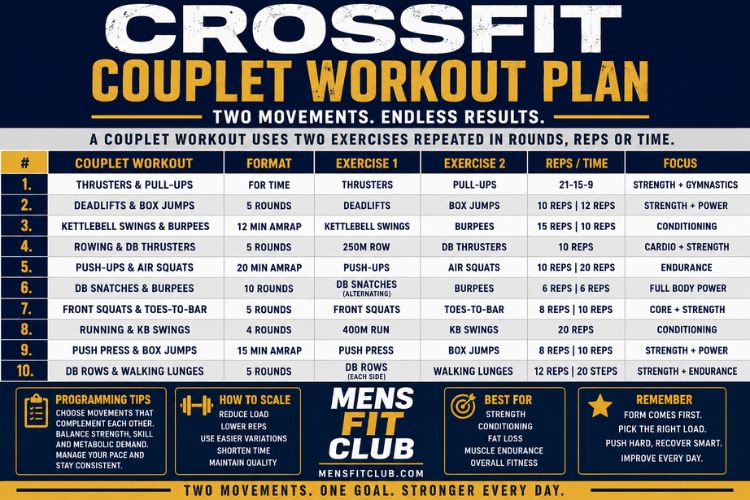
CrossFit Couplet Workout #1: Thrusters and Pull-Ups
Few combinations represent CrossFit-style training better than thrusters and pull-ups.
Perform:
21 thrusters
21 pull-ups
15 thrusters
15 pull-ups
9 thrusters
9 pull-ups
Complete the workout for time.
Select a thruster weight that allows you to perform multiple repetitions while maintaining good technique.
Thrusters combine a front squat with an overhead press, creating substantial demand on the legs, shoulders, core, and cardiovascular system. Pull-ups challenge the back, arms, grip, and upper-body pulling strength.
The opposing movement patterns make this an efficient full-body couplet.
Beginners can reduce the thruster weight and substitute jumping pull-ups, ring rows, or assisted pull-ups.
CrossFit Couplet Workout #2: Deadlifts and Box Jumps
This couplet combines strength with explosive lower-body movement.
Complete 5 rounds for time:
10 deadlifts
12 box jumps
Rest only as needed.
Choose a moderate deadlift load that allows technically controlled repetitions even as fatigue increases.
The deadlift develops the posterior chain, including the glutes, hamstrings, spinal erectors, and upper back. Box jumps require explosive hip extension and coordination.
Because both movements challenge the lower body, pacing becomes important.
If jumping becomes unsafe as fatigue increases, substitute controlled box step-ups.
CrossFit Couplet Workout #3: Kettlebell Swings and Burpees
If you want a minimalist conditioning workout, this couplet requires very little equipment.
Complete a 12-minute AMRAP:
15 kettlebell swings
10 burpees
Continue alternating exercises for the entire 12 minutes.
Record your completed rounds and additional repetitions.
Kettlebell swings develop hip power and posterior-chain endurance, while burpees challenge the entire body and rapidly increase heart rate.
Beginners can use a lighter kettlebell and perform elevated burpees using a bench or box.
CrossFit Couplet Workout #4: Rowing and Dumbbell Thrusters
This workout combines cardiovascular conditioning with a full-body resistance exercise.
Complete 5 rounds:
250-meter row
10 dumbbell thrusters
Your goal is to maintain a sustainable pace throughout all five rounds.
Avoid sprinting the first rowing interval unless you know you can maintain similar performance later.
During the thrusters, select dumbbells that allow consistent movement without compromising squat depth, spinal position, or overhead control.
CrossFit Couplet Workout #5: Push-Ups and Air Squats
CrossFit couplets do not require expensive equipment.
Try this bodyweight workout:
20-minute AMRAP:
10 push-ups
20 air squats
Continue alternating movements while maintaining technically sound repetitions.
Because neither movement requires equipment, this workout can be performed at home, outdoors, or while traveling.
More advanced athletes can increase the repetitions or use variations such as deficit push-ups and jumping squats. Beginners can perform elevated push-ups and reduce the squat repetitions.
CrossFit Couplet Workout #6: Dumbbell Snatches and Burpees
Complete 10 rounds for time:
6 alternating dumbbell snatches
6 burpees
This creates a short but potentially intense metabolic conditioning session.
Alternate arms during the dumbbell snatches and focus on producing power through the hips rather than attempting to lift primarily with the shoulder.
Maintain a steady burpee rhythm rather than starting at an unsustainable sprint.
CrossFit Couplet Workout #7: Front Squats and Toes-to-Bar
For athletes with adequate gymnastics ability, this combination creates a significant challenge for the core.
Complete 5 rounds:
8 front squats
10 toes-to-bar
The front squat requires substantial trunk stability while toes-to-bar challenge abdominal strength, grip, shoulder control, and coordination.
Because both movements tax the core, fatigue can accumulate quickly.
Athletes unable to perform toes-to-bar consistently can substitute hanging knee raises or another appropriate regression.
CrossFit Couplet Workout #8: Running and Kettlebell Swings
For a conditioning-focused session, complete 4 rounds for time:
400-meter run
20 kettlebell swings
This workout alternates cardiovascular conditioning with explosive hip extension.
The biggest programming mistake is running the first 400 meters too aggressively. Aim for a pace that allows you to transition directly into the kettlebell swings without requiring an extended recovery period.
CrossFit Couplet Workout #9: Push Press and Box Jumps
Complete a 15-minute AMRAP:
8 push presses
10 box jumps
The push press develops overhead strength and power, while box jumps develop lower-body explosiveness.
Choose a moderate barbell weight that you can control overhead even when breathing heavily.
Step down from the box when appropriate to reduce unnecessary impact and maintain control.
CrossFit Couplet Workout #10: Dumbbell Rows and Walking Lunges
Not every couplet needs to become an all-out sprint.
Complete 5 rounds:
12 dumbbell rows per side
20 walking lunge steps
This workout emphasizes upper-body pulling strength, unilateral lower-body training, grip strength, and muscular endurance.
Use controlled repetitions and prioritize range of motion over speed.
CrossFit Couplet AMRAP Workout
AMRAP stands for as many rounds or repetitions as possible within a predetermined time.
A simple example is:
15-minute AMRAP:
10 kettlebell swings
8 push-ups
Your objective is to accumulate as much quality work as possible during the 15 minutes.
The key is pacing. Going too hard during the first two minutes can dramatically reduce performance later.
Choose a pace you believe you can maintain for most of the workout.
CrossFit Couplet EMOM Workout
EMOM means every minute on the minute.
Try this 16-minute alternating EMOM:
Minute 1: 10 dumbbell thrusters
Minute 2: 8–12 pull-ups
Repeat for eight total rounds of each exercise.
Ideally, complete the prescribed work with enough time remaining in each minute to recover before the next interval.
If every minute requires nearly 60 seconds of work, reduce the repetitions or load.
CrossFit Couplet Ladder Workout
Ladders gradually increase or decrease repetitions.
Try this ascending ladder:
2 kettlebell swings + 2 burpees
4 kettlebell swings + 4 burpees
6 kettlebell swings + 6 burpees
8 kettlebell swings + 8 burpees
Continue adding two repetitions to each movement for 12 minutes.
Ascending ladders become increasingly difficult because the workload grows as fatigue accumulates.
Another option is a descending ladder such as 10-9-8-7-6-5-4-3-2-1.
How Long Should a CrossFit Couplet Workout Be?
There is no single ideal duration.
Short couplets may last approximately 5–10 minutes and emphasize high intensity. Moderate workouts may last 10–20 minutes, while longer couplets can extend beyond 20 minutes and require more deliberate pacing.
Your training goal should determine the duration.
Short workouts generally allow greater intensity. Longer workouts require more aerobic endurance and pacing.
Beginners should not assume that longer automatically means better. A well-designed 10-minute couplet can provide substantial training stimulus.
How to Choose the Right Weight
Choosing appropriate resistance is essential for maintaining workout quality.
A common mistake is selecting a load based on what you can lift for a few repetitions while fresh rather than what you can manage repeatedly during conditioning.
For most couplet workouts, use a weight that allows several technically sound repetitions before you need to rest.
If the workout prescribes 10 thrusters per round but you are forced into single repetitions immediately, the weight may be too heavy for the intended stimulus.
Scaling the load is not a failure. It is part of effective training.
How to Pace CrossFit Couplet Workouts
Pacing often determines whether a couplet feels challenging but controlled or turns into an early burnout.
Start slightly slower than your maximum possible pace.
During longer workouts, establish a repeatable rhythm. Instead of performing 20 repetitions unbroken in round one and struggling through sets of three later, intentionally divide the work.
For example, you might perform 15 kettlebell swings as 8 + 7 with a very short break.
Predictable breaks can help maintain performance.
Transitions matter as well. Avoid unnecessary walking around, adjusting equipment, or taking long breaks between movements.
Scaling CrossFit Couplet Workouts for Beginners
Beginners can perform many couplets by adjusting four variables: load, repetitions, movement difficulty, and duration.
For example, instead of:
21-15-9 thrusters and pull-ups
A beginner could perform:
12-9-6 light dumbbell thrusters and ring rows.
Similarly, box jumps can become step-ups, toes-to-bar can become hanging knee raises, and standard push-ups can become elevated push-ups.
Scaling should allow the athlete to practice quality movement while experiencing the intended conditioning challenge.
CrossFit Couplet Workout for Muscle Building
Couplets can also complement hypertrophy-oriented training when resistance and repetition ranges are programmed appropriately.
Try 5 rounds:
10 dumbbell bench presses
12 goblet squats
Rest approximately 60–90 seconds between rounds.
Use challenging but controlled resistance and avoid turning every repetition into a race.
Another option is:
8 dumbbell Romanian deadlifts
10 dumbbell shoulder presses
for 4–5 rounds.
These combinations create muscular fatigue while maintaining relatively high training density.
CrossFit Couplet Workout for Fat Loss and Conditioning
High-intensity couplets can increase energy expenditure and improve conditioning, but fat loss ultimately depends heavily on overall energy balance, nutrition, sleep, activity, and consistency.
A conditioning-focused couplet might include:
12-minute AMRAP:
12 kettlebell swings
8 burpees
Another option is:
15-minute AMRAP:
200-meter run
12 air squats
These workouts can complement a broader strength and nutrition program.
Avoid assuming that more intensity automatically produces faster fat loss. Recovery and sustainable weekly training matter.
Common CrossFit Couplet Workout Mistakes
One of the biggest mistakes is pairing exercises without considering overlapping fatigue.
Combining two movements that heavily challenge the same muscles can be appropriate, but it may require lower repetitions or more conservative loading.
Another mistake is sacrificing technique for speed. Completing a workout 30 seconds faster provides little benefit if movement quality deteriorates significantly.
Using excessive resistance is another common problem. Couplets are frequently designed around continuous or repeated work rather than maximal strength.
Finally, avoid treating every workout as a competition. Some sessions should emphasize technique, pacing, or moderate conditioning.
How Often Should You Perform CrossFit Couplets?
Couplets can be incorporated into training several times per week depending on your overall program.
For example, someone training four days per week might use one short couplet after strength training and one longer conditioning couplet on another day.
The important factor is managing total training stress.
If Monday includes heavy deadlifts and a posterior-chain-intensive couplet, performing another demanding deadlift workout Tuesday may compromise recovery.
Rotate movement patterns and intensity throughout the week.
Sample Weekly CrossFit Couplet Workout Schedule
A simple four-day schedule could look like this:
Monday: Thrusters + pull-ups, 21-15-9
Tuesday: Kettlebell swings + burpees, 12-minute AMRAP
Thursday: Deadlifts + box jumps, 5 rounds
Saturday: 400-meter run + 20 kettlebell swings, 4 rounds
Wednesday, Friday, and Sunday can include rest, mobility, easy cardiovascular activity, or other training depending on your overall program.
This schedule is only an example. Volume and intensity should match your experience and recovery ability.
Frequently Asked Questions About CrossFit Couplet Workouts
What does couplet mean in CrossFit?
A couplet is a workout built primarily around two movements. Athletes alternate between those exercises using a format such as rounds for time, AMRAP, EMOM, or a repetition ladder.
Are CrossFit couplets good for beginners?
Yes. Their simplicity can make couplets particularly accessible for beginners when the movements, repetitions, and loads are appropriately scaled.
Can a CrossFit couplet build muscle?
It can contribute to muscle development when resistance, repetitions, total volume, nutrition, and progressive overload are appropriate. However, traditional strength and hypertrophy training may still be necessary when maximizing muscle growth is the primary goal.
Can I do Couplet workouts at home?
Absolutely. Bodyweight combinations such as push-ups and squats, burpees and lunges, or mountain climbers and push-ups require little or no equipment.
A pair of dumbbells or a kettlebell can dramatically expand your options.
How many exercises are in a couplet?
Two primary exercises. Additional warm-up or accessory movements can still be performed separately, but the main WOD revolves around two movements.
Should every couplet be performed for time?
No. Couplets can use AMRAPs, EMOMs, intervals, ladders, fixed rounds, controlled strength circuits, or other formats.
Final Thoughts on CrossFit Couplet Workouts
The CrossFit couplet workout proves that effective training does not have to be complicated. Two carefully selected exercises can create a demanding workout that develops strength, power, cardiovascular fitness, muscular endurance, coordination, and overall work capacity.
Thrusters and pull-ups provide a classic strength-and-gymnastics combination. Kettlebell swings and burpees create a simple conditioning challenge. Deadlifts and box jumps combine strength with explosiveness, while push-ups and air squats provide a completely equipment-free option.
The most important factor is not simply how hard you can push. Choose movements you can perform safely, scale loads and repetitions appropriately, and maintain sound technique as fatigue develops.
Start with one of the CrossFit couplet workouts above, record your performance, and repeat it later under similar conditions. Over time, improvements in repetitions, completion time, movement quality, or load can provide a simple way to measure progress.
Whether you have five minutes or twenty, access to a fully equipped CrossFit gym or only a small training area at home, a well-designed two-movement couplet can deliver an efficient and highly adaptable workout.
Want to expand your CrossFit couplet workout into a more complete training routine? Start with the CrossFit Workout Plan to learn how strength, MetCon, AMRAP, and EMOM training can fit together. For a longer conditioning session, try this 45-Minute Full Body CrossFit Workout, which combines strength work with metabolic conditioning. If you prefer training outside the box, these CrossFit Workouts at Home include classic WOD formats such as Fran and Cindy. Beginners can build their fitness foundation with this Beginner Workout Plan for Men, while athletes looking for more CrossFit ideas can explore this complete guide to CrossFit Workouts.


Most Recommended

Subscribe to our Newsletter
Stay up to date on the latest men’s health, fitness and lifestyle trends and tips.
About Us
Men’s Fit Club was started with the goal of empowering men to get the most out of their lives. This meant going beyond exercise and diet tips to really address the broad range of issues that men face on a daily basis – topics like recreation, finding love, sexual health and even sound fashion advice.
Quick Links
© COPYRIGHT MEN'S FIT CLUB 2026. All Rights Reserved