
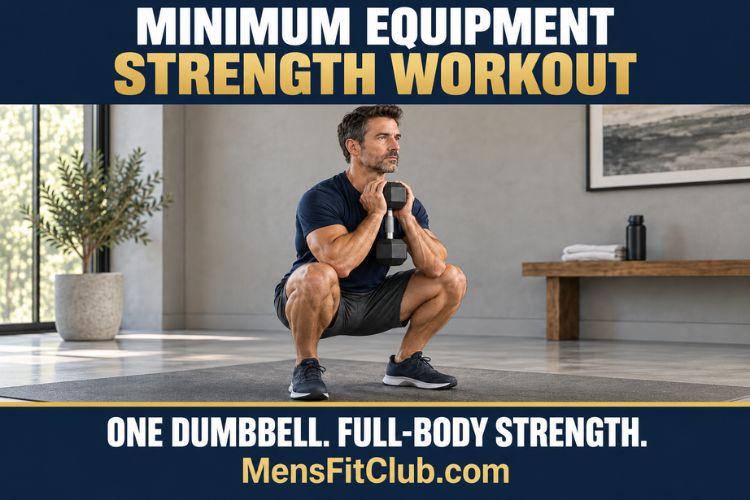
Minimum Equipment Strength Workout for Full-Body
Strength Training After 50: Build Muscle and Stay Strong

How Many Hard Sets Per Muscle Group Per Week?
Minimum Equipment Strength Workout for Full-Body
A minimum equipment strength workout makes consistent training possible without turning your home into a gym. With one pair of dumbbells, a clear patch of floor, and a repeatable plan, you can train your legs, chest, back, shoulders, and core. You do not need a different machine for every muscle. You need exercises that challenge you, enough recovery between sets, and a way to make the work gradually harder.
This approach suits busy men, home exercisers, and anyone who wants a straightforward strength routine. It also removes a common obstacle: waiting for the perfect setup before getting started. A small equipment collection can support productive training when you choose movements carefully and track your progress.
The following guide explains what equipment to use, how to perform a complete full-body workout, and how to progress over six weeks. The goal is a routine you can repeat and adapt, with clear instructions instead of unnecessary complexity.
What Is a Minimum Equipment Strength Workout?
A minimum equipment strength workout uses a small selection of tools to train the major muscle groups. In this plan, the standard setup is a pair of dumbbells and floor space. An exercise mat is optional. You do not need a weight bench, squat rack, cable station, or treadmill.
The workout covers five useful movement categories: squatting, hinging at the hips, pushing, pulling, and stabilizing the trunk. These categories help you organize training around what your body does, rather than around the equipment available.
Minimal equipment does not automatically mean an easy workout. A split squat with moderate dumbbells can challenge your legs considerably. A controlled push-up can provide demanding upper-body work. The important question is whether the exercise and resistance match your current ability.
What This Approach Can and Cannot Do
You can improve general strength, build muscle, and become more capable at familiar movements with a compact setup. Beginners often have substantial room to progress before needing heavier equipment.
However, equipment eventually sets limits. If your heaviest dumbbells no longer challenge your legs or back within a practical repetition range, buying heavier weights may be more useful than adding endless repetitions. Someone pursuing a maximal barbell squat will also need to practice barbell squatting. Choose equipment that supports your goals as they develop.
The Best Equipment for This Full-Body Workout
A pair of adjustable dumbbells is a practical starting point because different exercises require different loads. Your Romanian deadlift may need more resistance than your overhead press. Adjustable weights let you make those changes without storing several pairs.
Fixed dumbbells also work. If you already own a pair, start there and adjust the exercise variation when necessary. Before purchasing anything else, learn which movements your existing weights make challenging and which ones they make too easy.
Can You Use Only One Dumbbell?
Yes. Hold one dumbbell at your chest for squats, use it for single-arm rows, and perform presses one side at a time. For Romanian deadlifts, hold the dumbbell securely with both hands if its design allows, or use a kickstand stance to emphasize one leg.
Training one side at a time lengthens the session, so allow extra time. Begin with the less capable side and match its repetitions on the other side. Use controlled positioning rather than leaning or twisting to move the weight.
Is a Resistance Band Necessary?
A resistance band is optional. It can add exercise choices, particularly for pulling movements, but the main workout does not require one. If you use an anchored band, follow its attachment instructions and inspect the band and anchor before training.
Keep the floor clear and make sure adjustable dumbbell plates or selectors are secure. Avoid using lightweight chairs, unstable furniture, or improvised overhead supports as exercise equipment.
How Often Should You Train?
Start with two full-body sessions per week on nonconsecutive days. Monday and Thursday is one practical schedule. This gives you repeated practice while leaving recovery time between workouts.
If you recover comfortably and want another session, train three nonconsecutive days, such as Monday, Wednesday, and Friday. You do not need to increase frequency simply because the equipment is limited. Progress depends on the quality of training and recovery, not how many days your dumbbells leave the cupboard.
How Long Does the Workout Take?
Allow approximately 40–55 minutes for the full three-set version, including a warm-up. Your pace, rest requirements, and time spent changing weights will affect the total.
A two-set version may take around 30–40 minutes. These are estimates, not deadlines. If you need another minute before a demanding set, take it. Turning every session into a race can reduce the quality of the strength work.
Warm Up Before Your Minimum Equipment Workout
Spend five to eight minutes preparing for the session. Begin with easy marching or walking, then practice a few comfortable bodyweight squats, hip hinges, and arm movements. Gradually move through the positions you will use during the workout.
Next, perform one or two lighter practice sets for your first squat and hinge exercise. Before pressing or rowing, rehearse those movements with less resistance as needed. Warm-up sets prepare you for the working sets and do not count toward the prescribed total.
Use the Warm-Up to Check Readiness
Notice whether movements feel normal, stiff, or unusually difficult. Mild stiffness that eases with movement may simply call for a slower start. Sharp pain, dizziness, or symptoms that worsen as you continue are reasons to stop.
If a familiar weight feels unusually heavy, reduce the load or perform fewer working sets that day. A minimum equipment plan should be flexible enough to accommodate everyday changes in energy and recovery.
The Complete Minimum Equipment Strength Workout
Perform the exercises below in order. Start with two working sets of each exercise while learning the routine. Once the workload feels manageable, use three sets for the first five movements and two sets for the final core exercise.
For most sets, finish when you believe you could complete another two clean repetitions. This is a practical effort target, not an exact measurement. Stop sooner if your technique deteriorates. Rest about two minutes between demanding sets, extending to three minutes when necessary. Core sets may require only 45–90 seconds.
1. Goblet Squat: 2–3 Sets of 8–12 Repetitions
Hold one dumbbell close to your chest with both hands. Stand with your feet in a comfortable stance, brace your trunk, and lower into a squat. Let your knees bend in line with your feet while keeping your whole foot grounded. Stand up smoothly.
Use a depth you can control without pain or losing balance. Your stance and depth do not need to look identical to someone else’s. Avoid forcing a deeper position by collapsing your posture or lifting your heels.
If the dumbbell becomes difficult to hold before your legs are challenged, try holding two dumbbells at your sides. As you gain experience, a split squat can provide a stronger leg challenge with limited weight.
2. Dumbbell Romanian Deadlift: 2–3 Sets of 8–12 Repetitions
Stand tall with a dumbbell in each hand, arms in front of your thighs. Soften your knees and push your hips backward. Keep the weights near your legs as your torso inclines, then stand by bringing your hips forward.
Lower only as far as you can maintain control of your trunk and feel tension through the back of your thighs. The dumbbells do not need to touch the floor. Avoid repeatedly bending your knees until the movement becomes another squat.
Begin with a conservative load while learning the hinge. If holding the weights becomes the limiting factor, pause and reset between repetitions or reduce the load. Do not rush the movement to get around a weakening grip.
3. Push-Up or Dumbbell Floor Press: 2–3 Sets of 6–12 Repetitions
Choose one pressing movement for the session. For push-ups, place your hands slightly wider than shoulder width and maintain a firm line through your trunk. Lower under control and press back up without letting your hips sag.
If floor push-ups are too challenging, place your hands on a secure, immovable raised surface. Choose a height that allows the target repetitions with control. If regular push-ups are easy, a pause near the bottom can make them more demanding.
For the floor press, lie on your back with knees bent and feet grounded. Press the dumbbells upward, then lower until your upper arms gently contact the floor. Keep your wrists comfortably aligned and avoid bouncing. Use weights you can safely position and set down without assistance.
4. One-Arm Dumbbell Row: 2–3 Sets of 8–15 Repetitions Per Side
Take a staggered stance and hinge at your hips. Rest your free hand on your front thigh for support. Hold the dumbbell in the other hand and pull your elbow toward your hip, then lower the weight under control.
Keep your torso reasonably still. Avoid rotating your entire body to lift the dumbbell or jerking the weight upward. Let your shoulder blade move naturally as your arm reaches and pulls.
Complete both sides, then take your full rest period. If maintaining the hinged position becomes difficult, use a secure support surface or reduce the weight. The goal is to challenge your pulling muscles without turning every repetition into a lower-back endurance test.
5. Standing Dumbbell Overhead Press: 2–3 Sets of 6–10 Repetitions
Stand with a comfortable stance and bring the dumbbells to shoulder height. Tighten your trunk and press upward through a comfortable path. Lower slowly to the starting position.
Avoid leaning backward to finish the repetition. If the weights only move when you arch significantly or drive with your legs, reduce the load. A neutral grip, with palms facing each other, may feel more comfortable.
If overhead pressing causes discomfort, omit it and keep a comfortable horizontal pressing variation while you address the issue. Do not force an overhead position simply to complete the exercise list. Persistent pain deserves individualized assessment.
6. Suitcase Hold or Dead Bug: 2 Sets
For the suitcase hold, stand tall with one dumbbell at your side for 20–40 seconds. Keep your shoulders reasonably level and resist leaning toward or away from the weight. Switch sides and repeat.
Choose a weight that lets you breathe while maintaining posture. If your grip fails before your trunk feels challenged, shorten the hold or use the dead bug instead.
For dead bugs, lie on your back with your arms raised and hips and knees bent. Slowly extend the opposite arm and leg through a range you can control, return, and alternate sides. Perform 6–10 repetitions per side without rushing or allowing your back to arch excessively.
How to Choose the Right Dumbbell Weight For Equipment Strength Workout
Use your first sessions to find a suitable load for each movement. The right weight allows the bottom of the repetition range with steady technique while leaving a little capacity for more.
For example, if the prescription is 8–12 repetitions and you cannot complete eight without compensating, use less resistance. If you finish 12 and could easily perform several more, increase the load when possible.
Different Exercises Need Different Loads
Do not expect one dumbbell setting to suit every exercise. Your legs and hips will often handle more resistance than your shoulders. Change the load when needed, even if this adds a few minutes.
With fixed weights, adapt the movement instead. Use bodyweight push-ups for chest work, hold one dumbbell for overhead pressing, or use split squats when ordinary squats become too easy. Keep exercise choices consistent long enough to evaluate improvement.
A Six-Week Equipment Strength Workout Progression Plan
Progressive overload means increasing the training challenge over time. Adding weight is one method, but completing more controlled repetitions with the same load also demonstrates progress.
Record your exercise, weight, repetitions, and working sets after each session. Include a short note when something affects performance, such as poor sleep or a shortened workout. This makes your training decisions more useful than relying on memory.
Weeks 1–2: Establish Technique and Consistency
Train twice weekly with two working sets per exercise. Use comfortable loads and finish most sets with roughly three repetitions available. Learn how to set up safely and move consistently.
Choose repeatable exercise variations during this phase. Replacing every movement each session makes it difficult to tell whether you are improving. Your main goal is to complete four manageable workouts and establish starting numbers.
Weeks 3–4: Build Repetitions: Equipment Strength Workout
Continue twice weekly, adding repetitions within the prescribed ranges when you can maintain control. If recovery is good, add a third set to the first two exercises, then gradually to the remaining main movements.
Increase volume gradually rather than adding sets and an extra training day together. If soreness or fatigue begins interfering with your next session, keep the earlier workload until it feels manageable.
Weeks 5–6: Increase Resistance Where Appropriate
When you reach the top of a repetition range across all working sets with capacity remaining, increase the weight by the smallest practical amount. Your repetitions may return toward the bottom of the range.
For example, after completing three controlled sets of 12 goblet squats, increase the dumbbell load and aim for sets of eight or nine. Build upward again. If the available weight jump is too large, keep the current load until you can manage the transition cleanly.
How to Progress When Your Equipment Strength Workout Weights Are Limited
Limited weights require thoughtful exercise selection. For legs, use a stationary split squat or kickstand Romanian deadlift to put more demand on one side. Begin with lighter resistance because balance and positioning add difficulty.
You can also add a brief pause or use a more controlled lowering phase. These adjustments change the challenge, so record them and compare like with like. A paused squat and a regular squat are different versions of the exercise.
Know When to Buy Heavier Weights
If you need very high repetitions to make every set challenging, heavier equipment may make training more efficient. Extra sets are not always the best answer, particularly when time is limited.
You do not need to purchase everything at once. Add resistance when your training log shows a clear need. This keeps the setup minimal while allowing your program to grow with your strength.
Adjusting the Equipment Strength Workout for Busy Days
On a busy day, perform two sets each of the squat, Romanian deadlift, push-up or floor press, and row. This shortened version covers the main lower-body and upper-body patterns.
You can alternate a squat set with a row set, or a hinge set with a pressing set, while allowing adequate recovery before repeating the same movement. Rest longer if breathing or general fatigue begins limiting your repetitions.
Keep the Strength Work Measurable
A short session still benefits from consistent technique and recorded numbers. Avoid adding random exercises simply because you have a few minutes left.
If your schedule remains crowded, use the abbreviated version as your regular plan for a while. A realistic routine completed consistently is easier to progress than an ambitious routine you rarely finish.
Common Minimum Equipment Strength Workout Mistakes
One common mistake is using the same light weight forever without adjusting repetitions or exercise difficulty. Completing familiar movements is useful, but strength training needs an appropriate challenge.
Another mistake is cutting rest periods until every exercise becomes a conditioning drill. You can breathe hard during strength training, but exhaustion should not be the only sign of a productive workout. Give yourself enough recovery to perform the next set well.
Avoid Chasing Soreness and Constant Variety
Soreness is not a scorecard for workout quality. Track performance, control, and consistency instead. Severe soreness that repeatedly disrupts daily life or the next session may mean you progressed too quickly.
Likewise, keep the main exercises stable for several weeks. Small adjustments are useful when equipment or comfort requires them, but constant changes make progress harder to assess.
Recovery Between Equipment Strength Workouts
Leave at least one day between full-body sessions when starting this plan. Easy walking and comfortable everyday movement can fit between workouts without adding another demanding session.
Support training with regular meals, adequate protein-containing foods, hydration, and consistent sleep. You do not need a complicated supplement routine to begin. Build the habits that make it easier to arrive at your next session ready to train.
Adjust the Plan When Recovery Falls Behind
If performance declines across several sessions, review your workload and recovery. Reduce working sets temporarily or use lighter loads while maintaining comfortable movement practice.
Men returning after a long break should begin conservatively. If you have an injury, medical condition, or exercise restriction, adapt the plan with an appropriate professional rather than assuming a general routine suits every situation.
Frequently Asked Questions About Minimum Equipment Strength Workout
Can You Build Muscle With Just Dumbbells?
Yes, dumbbells can provide useful resistance for muscle building when exercises are sufficiently challenging and training progresses. The amount of available weight eventually matters, especially for stronger lifters and lower-body exercises.
Is Two Days a Week Enough to Start?
Two full-body sessions are a practical starting schedule. They provide repeated practice without requiring a large weekly time commitment. Add training only when your goals, schedule, and recovery support it.
Do You Need a Bench?
No. Push-ups and floor presses provide horizontal pressing options without a bench. A bench can expand your exercise choices later, but it is not necessary for this routine.
Should Every Set Go to Failure?
No. Finish most sets with a small margin for additional clean repetitions. This keeps the workout manageable and helps preserve technique, particularly when training alone.
Make Your Minimum Equipment Strength Workout a Habit
A productive home strength routine starts with a few well-chosen movements and a schedule you can keep. Use dumbbells to squat, hinge, press, row, and challenge your trunk. Choose manageable loads, rest between sets, and record what you complete.
Follow the plan for six weeks, making gradual adjustments as your ability improves. The equipment can stay simple while your performance moves forward. Start with what you have, repeat the fundamentals, and let measurable progress guide your next step.
Make your minimum equipment strength workout easier to adapt with our Dumbbell Workout Without a Bench, or explore the 45 Minute One Dumbbell Full Body Workout if you have only one weight. For a structured weekly schedule, follow our 3 Day Full Body Workout Plan With Dumbbells. Keep your training challenging with the Progressive Overload Dumbbell Workout, and discover ways to advance bodyweight exercises in our Progressive Overload Calisthenics Without Weights guide.


Most Recommended

Subscribe to our Newsletter
Stay up to date on the latest men’s health, fitness and lifestyle trends and tips.
About Us
Men’s Fit Club was started with the goal of empowering men to get the most out of their lives. This meant going beyond exercise and diet tips to really address the broad range of issues that men face on a daily basis – topics like recreation, finding love, sexual health and even sound fashion advice.
Quick Links
© COPYRIGHT MEN'S FIT CLUB 2026. All Rights Reserved