

Rucking Workout for Men Over 50: Beginner Plan
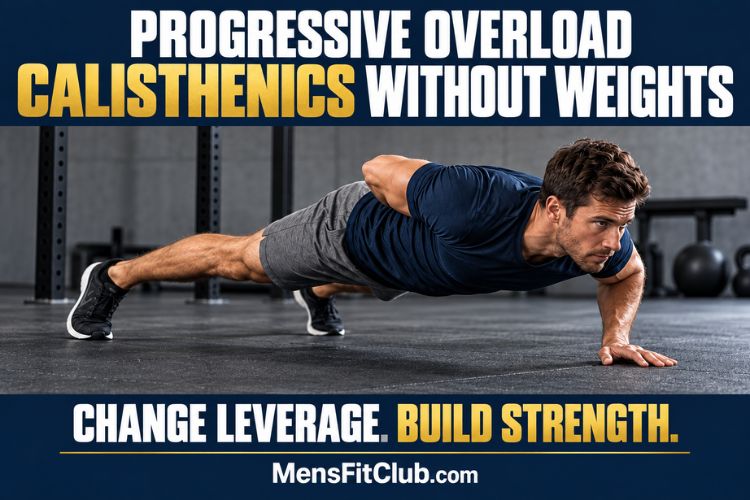
Progressive Overload Calisthenics Without Weights
Upper Body Barbell Giant Set Workout for Muscle Growth
Progressive Overload Calisthenics Without Weights
Progressive overload calisthenics without weights gives you a practical way to build strength when you train at home, outdoors, or while traveling. Your body provides the resistance, while changes in exercise difficulty, repetitions, range of motion, and training volume provide opportunities to progress. You do not need dumbbells or a barbell to make a workout more challenging, but you do need a repeatable plan.
The mistake many people make is repeating the same comfortable routine indefinitely. Ten push-ups, twenty squats, and a short plank might feel productive, yet those numbers eventually become less demanding. Once you adapt, continued improvement usually requires an appropriate increase in the training stimulus. That increase should support your goal rather than simply leave you more exhausted.
This guide explains how to apply progressive overload to bodyweight exercises, choose suitable progressions, and organize a sustainable weekly program. Whether you are beginning calisthenics or returning to training after a break, the objective is straightforward: perform quality work, record it, and make the next challenge slightly more demanding when you are ready.
What Is Progressive Overload in Calisthenics?
Progressive overload means gradually increasing training demands as your ability improves. In weight training, adding resistance is an obvious method. In calisthenics, resistance also changes when you alter leverage, shift more bodyweight onto one limb, reduce assistance, or move through a larger controlled range.
The American College of Sports Medicine recognizes bodyweight exercises and home-based resistance training as effective options for improving strength, muscle size, and physical function. That supports using calisthenics as a serious training method rather than treating it solely as a warm-up. The progression strategies and sample program below are practical applications, not a standardized ACSM calisthenics protocol.
Overload Is Relative to Your Current Ability
A wall push-up may challenge a beginner enough to improve strength. Someone who performs twenty floor push-ups comfortably will need a different stimulus. The exercise name alone does not tell you whether a movement is sufficiently demanding; your execution and remaining capacity matter.
Choose a variation that allows controlled repetitions while making the final few repetitions challenging. For most working sets in this guide, stop when you estimate that another one to three good repetitions would still be possible. This estimate is called repetitions in reserve. Beginners may need practice before judging it accurately.
Progress Does Not Require a Personal Record Every Session
Performance naturally fluctuates with sleep, stress, previous activity, and recovery. Repeating last week’s workout with cleaner technique can be valuable. A single weaker session does not prove that your program has stopped working.
Look for trends across several weeks. More repetitions with the same technique, less assistance at the same repetition count, or successful practice of a harder variation can all indicate progress. Avoid forcing an increase simply because the calendar says another week has passed.
Can You Build Muscle With Progressive overload calisthenics Without Weights?
Bodyweight resistance training can build muscle when exercises challenge the intended muscles and you perform enough recoverable work consistently. Beginners often have many accessible ways to increase difficulty. More experienced trainees may need carefully chosen unilateral movements, demanding leverage positions, and suitable pulling equipment.
However, removing weights does not remove every practical limitation. Lower-body exercises can eventually become difficult to overload without balance, mobility, or very high repetition counts becoming the limiting factor. Pulling exercises also require something safe to pull against if you want substantial resistance through a useful range of motion.
Without Weights Does Not Always Mean Without Equipment
A properly installed pull-up bar, purpose-built suspension trainer, or secure outdoor exercise station can expand your options without adding external weight. These tools let you train your back and arms with progressively harder rows and pull-ups.
If you have only floor space, you can still train pushing movements, legs, hips, and your trunk. Prone arm raises and reverse snow angels provide useful movement practice, but they are not equivalent replacements for challenging rows or pull-ups. Recognizing that difference helps you set realistic expectations for a completely equipment-free routine.
The Best Ways to Apply Progressive overload calisthenics Without Weights
Use one main progression variable at a time. If you simultaneously add repetitions, shorten rest, increase range, and switch exercises, you will struggle to identify what improved. Consistency makes your training log useful and keeps progress manageable.
Add Repetitions Within a Defined Range
Repetition progression is the simplest starting point. Choose a range such as eight to twelve repetitions and keep the exercise variation consistent. If you complete three sets of eight push-ups, your next target might be nine repetitions on the first set while maintaining eight on the remaining sets.
Gradually work toward twelve repetitions across all three sets. You do not need to increase every set at once. A progression from eight, eight, eight to nine, eight, eight is a meaningful improvement when range, rest, and effort remain comparable.
Once you reach the top of the range with good control and the intended repetitions in reserve, consider a slightly harder variation. Reset toward the lower end of the range and repeat the process. This approach is commonly called double progression.
Change Leverage to Increase Resistance: Progressive Overload Calisthenics
Leverage changes how demanding an exercise feels without changing your bodyweight. In push-ups, lowering your hands from a high stable surface toward the floor generally increases the challenge. In bodyweight rows, moving toward a more horizontal body position generally increases resistance.
Make changes small enough that you can maintain technique. Record the height of your push-up surface or your row setup so you can recreate it. A vague note such as “harder push-ups” is less useful than identifying the exact position you used.
Use Unilateral Exercises
Single-leg movements place more demand on each working limb than many two-leg variations. Split squats, supported single-leg squats, single-leg bridges, and single-leg calf raises can extend lower-body progression without weights.
Support is helpful when balance interferes with muscular effort. Lightly holding a stable railing during a single-leg squat can let your legs work harder while reducing unnecessary wobbling. Keep the amount of assistance consistent and avoid pulling yourself through the movement with your supporting arm.
Increase Your Controlled Range of Motion: Progressive Overload Calisthenics
Moving through a larger comfortable range can increase exercise demands. A squat that gradually becomes deeper with control or a split squat that reaches a lower position can represent progress even before repetitions increase.
Establish a consistent, tolerable range before comparing workouts. Do not chase depth by losing balance, forcing a painful joint position, or collapsing your posture. Additional range is useful when you can actively control it, not merely reach it.
Add Sets When Recovery Supports More Work
Adding a working set increases training volume. For example, moving from two sets of split squats to three gives you more opportunities to challenge your legs. This can be useful when current sessions are productive and recovery remains good.
Avoid increasing sets across every exercise simultaneously. Add one set to a priority movement, then monitor performance and soreness over the following sessions. More work becomes counterproductive when it prevents you from completing the next workout effectively.
Use Pauses and Tempo for Specific Purposes: Progressive Overload Calisthenics
A brief pause can remove momentum and make your technique more repeatable. Pausing near the bottom of a push-up or split squat also provides a useful bridge when the next exercise variation is too difficult.
Controlled lowering can help you learn positions, but extremely slow repetitions are not automatically superior for muscle growth. If you change from a normal lowering phase to a three-second descent, record that change and expect your repetition count to decrease. Compare future performance under the same conditions.
Treat Shorter Rest as a Conditioning Progression
Reducing rest can make a workout more demanding, but it often increases cardiovascular strain and fatigue rather than the force required from each repetition. It is useful when muscular endurance or conditioning is your priority.
For strength-focused calisthenics, preserve enough rest to perform strong sets. Start with approximately ninety seconds to three minutes between demanding exercises or sets, extending rest when necessary. Do not interpret heavier breathing alone as evidence that your muscles received a better strength stimulus.
Calisthenics Exercise Progressions for the Whole Body
Build your routine around movement patterns instead of collecting unrelated exercises. Include a push, a pull when equipment permits, a squat or lunge, a hip-focused movement, and trunk training. Calf work can provide an additional lower-leg challenge.
Push-Up Progression for Chest and Triceps: Progressive Overload Calisthenics
Begin with wall push-ups or hands-elevated push-ups on a secure surface. Keep your body aligned, bend your elbows under control, and lower your chest toward the surface. When your chosen repetition range becomes manageable, reduce the hand elevation gradually.
Floor push-ups are the next useful benchmark. Later options include paused push-ups, modest feet elevation, or carefully introduced assisted archer push-ups. These variations change movement demands and muscle emphasis, so they are options rather than a universal ladder everyone must follow.
Pike Push-Up Progression for Shoulders
A pike push-up adds a more overhead-oriented pressing pattern. Raise your hips, keep your hands planted, and bend your elbows while lowering your head toward the floor slightly ahead of your hands. Use a controllable range and keep your neck comfortable.
Start with a position that allows several clean repetitions. Increase your controlled range before considering modest foot elevation. Handstand push-ups are an advanced skill with additional balance and safety requirements; they are not necessary for a productive home strength program.
Squat and Split-Squat Progression for Legs: Progressive Overload Calisthenics
Start with controlled squats to a consistent depth. If needed, use a stable chair as a depth target without dropping onto it. Once bilateral squats become easy, introduce split squats or reverse lunges rather than extending every set indefinitely.
Progress split squats through repetitions, control, and comfortable depth. A supported rear-foot-elevated split squat may provide a later option when you have a secure setup. Supported single-leg squats are another route, but pistol squats should remain optional because they demand substantial mobility and coordination.
Bridge and Hamstring Progression for the Posterior Chain
Use glute bridges to practice hip extension. Keep your ribs controlled and lift your hips without exaggerating your lower-back arch. Progress toward a staggered stance and then a single-leg bridge when you can maintain level hips.
Bridge walkouts can add hamstring demand: begin in a bridge, take small heel steps away from your hips, and return while maintaining control. Use a nonslip surface and a short distance initially. This provides a practical progression, although it does not fully reproduce the loading potential of weighted hip hinges.
Row and Pull-Up Progression for the Back: Progressive Overload Calisthenics
With a rated, securely anchored setup, begin rows at an upright angle and gradually move toward a more horizontal position. Keep your trunk stable and pull your chest toward the handles or bar without jerking.
For pull-ups, use a stable assisted setup that allows controlled practice. Foot assistance can help you perform complete repetitions before attempting unassisted sets. Controlled lowering repetitions are demanding, so begin with low volume and avoid repeated uncontrolled drops. Never improvise hanging exercises from loose furniture or unverified fixtures.
Core and Calf Progressions
Start trunk training with dead bugs, short-lever side planks, or manageable front planks. Progress by extending your limbs, lengthening the lever, or increasing controlled hold time. Once a plank becomes a long endurance task, a harder variation may fit strength goals better than continually adding minutes.
For calf raises, progress from two legs to one while maintaining a controlled rise and lowering phase. Use light balance support and a comfortable range. Record repetitions per side and avoid replacing deliberate movement with bouncing.
A Three-Day Progressive Overload Calisthenics Workout Plan
The following template is a starting point for generally healthy adults. Train on three nonconsecutive days, such as Monday, Wednesday, and Friday. Beginners can start with two sessions and two working sets per exercise before increasing their schedule.
Warm up for five to eight minutes with easy marching, comfortable joint movements, and easier practice sets of your first exercises. Choose variations that suit your current ability. The main session should take roughly thirty-five to fifty minutes, depending on rest and setup.
Workout A: Push, Squat, Pull, and Core
Perform push-ups for three sets of six to twelve repetitions, followed by split squats for three sets of eight to twelve per leg. Complete bodyweight rows for three sets of six to twelve when a safe setup is available. Finish with single-leg or bilateral bridges for two sets of ten to fifteen, then dead bugs for two sets of six to ten controlled repetitions per side.
Start each split-squat set with your weaker leg and match its repetitions on the stronger side. Keep push-up and row setups consistent throughout the session. Rest long enough that breathing and local fatigue do not force a major technique change.
Workout B: Shoulders, Legs, Hamstrings, and Trunk: Progressive Overload Calisthenics
Perform pike push-ups for two or three sets of five to ten repetitions. Follow with reverse lunges for three sets of eight to twelve per leg and assisted pull-ups or rows for three controlled sets using a suitable repetition range. Add bridge walkouts for two sets of four to eight complete out-and-back cycles, then side planks for two holds of fifteen to thirty seconds per side.
Use short walkouts initially and stop before your hips sag. If pike push-ups are too demanding, use an easier pushing variation. Add two sets of calf raises if time and recovery allow, starting with eight to fifteen controlled repetitions per leg or a suitable bilateral version.
Alternate the Workouts Across Weeks
During the first week, perform Workout A, Workout B, and Workout A. During the next week, perform Workout B, Workout A, and Workout B. Continue alternating so neither session dominates the program over time.
If you lack pulling equipment, complete the remaining exercises and add comfortable prone arm raises as movement practice. Understand that this version leaves a substantial pulling-strength gap. Access to a safe outdoor station or properly installed home setup can resolve that limitation without requiring weights.
How to Progress Your Calisthenics Plan Over Eight Weeks
An eight-week structure helps organize practice, but it should not become a rigid deadline. Repeat a phase when needed. Your exercise quality and recovery determine readiness for progression more reliably than the week number.
Weeks One and Two: Establish Your Baseline: Progressive Overload Calisthenics
Choose manageable variations and record every working set. Keep around two or three repetitions in reserve while you learn the movements. Use consistent rest periods and establish a repeatable range of motion.
Your main goal is to discover a sustainable starting workload. If soreness interferes with ordinary activity or the next session, reduce sets or choose easier variations. Avoid testing maximum repetitions across every exercise during this introductory phase.
Weeks Three and Four: Build Repetitions
Add a repetition to one or more sets when the previous performance was controlled and recovery is good. A push-up progression might move from three sets of eight to nine, eight, eight, then nine, nine, eight across successive exposures.
Keep exercise difficulty unchanged during this phase unless your initial choice was clearly too easy. This makes improvements easier to interpret and reduces the temptation to switch movements before you have developed consistent technique.
Weeks Five and Six: Introduce a Small Difficulty Increase
When you reach the upper end of a repetition range on every set with the intended effort, make one modest change. Lower your push-up support slightly, reduce row assistance, or introduce a suitable unilateral progression. Confirm readiness across more than one session when the next step is substantial.
Expect repetitions to decrease after the change. If twelve elevated push-ups become eight at a lower height, that can be appropriate progress. If the new variation permits only awkward partial repetitions, the jump is too large; choose an intermediate step.
Weeks Seven and Eight: Consolidate and Review
Build repetitions within the new variation while keeping your other exercises stable. You may add one set to a priority movement if recovery remains good, but additional volume is optional. Finish the block by comparing equivalent performances in your log.
If several sessions show declining performance alongside persistent fatigue, take an easier week. Reduce working sets and leave more repetitions in reserve. Resume progression once performance and recovery improve rather than trying to compensate with a harder session.
Track Progress Without Confusing Fatigue With Results
Record the exercise variation, surface height or assistance, repetitions for each set, rest duration, and estimated repetitions in reserve. For holds, record the position and duration. A brief note about discomfort or unusually poor sleep can help explain fluctuations.
Total repetitions are useful only when the conditions are comparable. Thirty shallow push-ups cannot be directly compared with twenty controlled full-range repetitions. Similarly, a faster circuit may show improved conditioning without demonstrating increased strength in any individual movement.
Avoid Changing Exercises Too Frequently
Keep your main exercises for several weeks unless they cause discomfort or do not suit your available setup. Repeated practice improves your ability to perform and evaluate them. Constant novelty makes it harder to distinguish improved skill from increased muscular capacity.
Do Not Train Every Set to Failure
Stopping with a small number of good repetitions remaining provides a practical effort target for this program. Repeated failure can make later sets and subsequent sessions harder to manage. End the set when you can no longer maintain the chosen technique, even if you could complete additional distorted repetitions.
Adjust When You Hit a Plateau
Before adding work, check consistency, rest, technique, and recovery. If those factors are stable, change one variable: add a repetition, use a smaller progression step, or add a single set. When fatigue is already high, reducing work temporarily may be more useful than increasing it.
Recovery and Long-Term Bodyweight Strength
Allow recovery between demanding sessions, eat enough to support your goals, include protein-rich foods regularly, and maintain a consistent sleep routine. Avoid judging workout effectiveness by soreness alone. Productive training should gradually improve what you can do, not leave you continually depleted.
Men over forty or fifty can use the same progression principles while selecting joint-tolerant variations and a manageable starting workload. Stable support, smaller increases, and additional recovery days can help make training sustainable. Sharp pain or persistent joint symptoms call for stopping the provoking movement and seeking appropriate assessment.
Progressive overload calisthenics without weights works best as an ongoing practice. Choose a balanced routine, learn the movements, track comparable performances, and increase the challenge when your current workload is genuinely manageable. Your next milestone might be one additional push-up, a deeper controlled split squat, or a row with less assistance. Build those improvements patiently, and bodyweight training becomes a clear, repeatable path toward greater strength.
To support your progressive overload calisthenics routine, explore our Bodyweight Strength Training Guide and Progressive Overload Workout For Beginners for exercise selection and gradual progression methods. Improve your pressing technique with our Push-Up Workout For Beginners, expand your shoulder training with Bodyweight Shoulder Workouts, and explore structured training blocks in our Calisthenics Density Workout For Muscle Gain. Together, these resources complement a practical approach to building strength without weights.


Most Recommended

Subscribe to our Newsletter
Stay up to date on the latest men’s health, fitness and lifestyle trends and tips.
About Us
Men’s Fit Club was started with the goal of empowering men to get the most out of their lives. This meant going beyond exercise and diet tips to really address the broad range of issues that men face on a daily basis – topics like recreation, finding love, sexual health and even sound fashion advice.
Quick Links
© COPYRIGHT MEN'S FIT CLUB 2026. All Rights Reserved