

Bodyweight Bench Press Reps Ratio for the Average Man

30 Day Dumbbell Workout Plan Build To Muscle And Burn Fat

Dumbbell Bench Press vs Barbell Bench Press Which Is Better

30 Day Bodyweight Workout Plan for Beginners at Home
Burpee Box Jump Workout Full-Body Fat-Burning Power Training
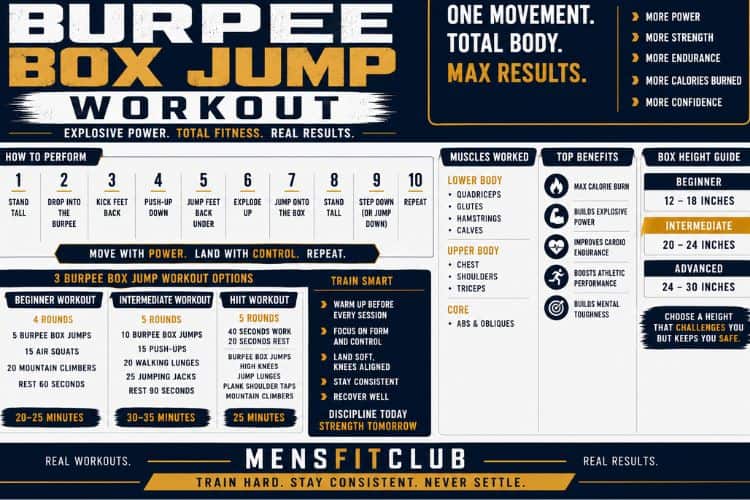
The burpee box jump workout is one of the most effective high-intensity training methods for building explosive athleticism, improving cardiovascular endurance, and torching calories in a short period. Combining two demanding movements—the burpee and the box jump—creates a dynamic exercise that challenges nearly every muscle in the body while pushing your conditioning to a new level.
Athletes, military personnel, fitness enthusiasts, and men seeking total-body performance training often include burpee box jumps in their routines because of their ability to simultaneously train power, speed, agility, and endurance.
Unlike traditional workouts that isolate muscles individually, a burpee box jump workout demands coordinated movement patterns. It forces the body to accelerate, decelerate, jump, absorb force, and repeat at high intensity. This creates an exercise capable of developing real-world athletic fitness.
If your goal is fat loss, conditioning, improved stamina, stronger legs, or increasing workout intensity, a structured burpee box jump workout can become one of the most powerful additions to your routine.
What Is a Burpee Box Jumps Workout?
A burpee box jump combines a standard burpee with an explosive jump onto a plyometric box.
The movement sequence typically follows:
- Start standing
- Drop into squat position
- Place hands on floor
- Kick feet backward
- Perform push-up or chest-to-floor position
- Jump feet back under body
- Explode upward
- Jump onto a box
- Step down or jump down
- Repeat
This movement creates an intense blend of:
- Strength training
- Plyometric exercise
- Cardiovascular conditioning
- Explosive power
- Functional movement
The result is one of the most metabolically demanding exercises available.
Why Burpee Box Jump Workouts Are So Effective
Many exercises train individual qualities.
Running improves endurance.
Squats build strength.
Jumping develops power.
Burpee box jumps combine all these qualities into one movement.
Benefits include:
- Increased calorie burn
- Full-body muscle activation
- Improved cardiovascular fitness
- Explosive lower-body development
- Greater coordination
- Improved athleticism
- Enhanced anaerobic conditioning
- Increased mental toughness
Because multiple muscle groups work simultaneously, heart rate rises rapidly and stays elevated throughout training.
Muscles Worked During Burpee Box Jumps Workout
Burpee box jumps engage nearly every major muscle group.
Lower Body
Quadriceps
The quadriceps extend the knees during takeoff and absorb force during landing.
Glutes
The glute muscles provide hip power and jumping force.
Hamstrings
Hamstrings stabilize and assist in explosive movement.
Calves
Calves create push-off force for jumping and improve explosive movement.
Upper Body
Chest
Chest muscles activate during the push-up portion.
Shoulders
Shoulders stabilize and assist movement during both burpees and jumps.
Triceps
Triceps help extend the arms during push-ups.
Core
Your abdominal muscles work constantly during:
- Stabilization
- Jumping
- Landing
- Transition phases
The core prevents energy leaks and helps maintain efficient movement.
Burpee Box Jumps Workout Benefits for Fat Loss
One reason burpee box jumps remain popular is their incredible calorie-burning potential.
High-intensity compound exercises increase:
- Oxygen consumption
- Heart rate
- Energy expenditure
- Post-workout calorie burn
Many workouts stop burning calories after exercise ends.
Burpee box jump sessions continue creating an elevated metabolic response for hours afterward.
This phenomenon is commonly known as the afterburn effect.
Because the exercise requires both strength and cardio output, energy demands become extremely high.
For men trying to lose body fat without spending hours on a treadmill, this movement offers substantial efficiency.
Burpee Box Jumps Workout Benefits for Athletes
Athletes need power production and rapid force generation.
Burpee box jumps develop:
Vertical power
Explosive jumping increases lower-body force production.
Reactive ability
Athletes learn to absorb force and immediately produce force again.
Conditioning under fatigue
Sports rarely occur in rested situations.
Burpee box jumps train repeated effort under exhaustion.
Coordination
Multiple movement transitions improve athletic body control.
Proper Burpee Box Jumps Workout Technique
Technique determines effectiveness and safety.
Follow these steps:
Step 1: Stand Tall
Position feet shoulder-width apart.
Keep core tight.
Maintain athletic posture.
Step 2: Drop Into Burpee
Lower body into squat position.
Place hands flat.
Kick feet back.
Lower chest.
Step 3: Return Feet Under Body
Jump feet forward aggressively.
Land under hips.
Prepare for upward movement.
Step 4: Explode Upward
Drive through heels.
Swing arms.
Generate maximum force.
Step 5: Jump Onto Box
Land softly.
Keep knees aligned.
Maintain balance.
Stand fully upright.
Step 6: Step Down Carefully
Most coaches recommend stepping down rather than jumping down.
This reduces repetitive impact stress.
Common Burpee Box Jumps Workout Mistakes
Even experienced exercisers make mistakes.
Using Excessive Box Height
Higher boxes are not automatically better.
Choose a box allowing explosive movement while maintaining control.
Landing With Knees Caving In
Allowing knees to collapse inward creates stress on joints.
Focus on:
- Knees tracking over toes
- Controlled landings
Poor Push-Up Form
Avoid sagging hips or partial movement.
Maintain core engagement.
Rushing Repetitions
Fast movement should never sacrifice technique.
Efficiency beats recklessness.
Beginner Burpee Box Jump Workout
Beginners should prioritize learning movement quality.
Workout
Warm-Up: 5 minutes
Round 1:
- 5 burpee box jumps
- 15 air squats
- 20 mountain climbers
- Rest 60 seconds
Repeat:
4 rounds
Cool down:
5 minutes stretching
Total time:
20–25 minutes
Intermediate Burpee Box Jump Conditioning Workout
After movement proficiency improves, increase volume.
Workout
Perform:
10 Burpee Box Jumps
15 Push-ups
20 Walking Lunges
25 Jumping Jacks
Rest:
90 seconds
Complete:
5 rounds
Total time:
30–35 minutes
This routine improves endurance while increasing calorie expenditure.
Advanced Burpee Box Jump Workout
Advanced athletes can challenge themselves with higher workloads.
40 Minute Challenge
Minute 1:
12 Burpee Box Jumps
Minute 2:
15 Kettlebell Swings
Minute 3:
20 Jump Squats
Minute 4:
15 Push-Ups
Minute 5:
Rest
Repeat:
8 rounds
Total:
40 minutes
This workout rapidly elevates heart rate and pushes conditioning capacity.
Burpee Box Jump HIIT Workout
HIIT training pairs perfectly with burpee box jumps.
Interval Structure
Work:
40 seconds
Rest:
20 seconds
Exercises:
Burpee Box Jumps
High Knees
Jump Lunges
Plank Shoulder Taps
Mountain Climbers
Perform:
5 rounds
Workout duration:
25 minutes
Box Height Recommendations
Appropriate height matters.
General guidelines:
Beginners:
12–18 inches
Intermediate:
20–24 inches
Advanced:
24–30 inches
Choose a height allowing safe landings and consistent technique.
Higher is not necessarily better.
Warm-Up Before Burpee Box Jumps Workout Training
Preparation reduces injury risk.
Dynamic Warm-Up
2 minutes jogging
20 arm circles
20 bodyweight squats
10 inchworms
15 walking lunges
20 high knees
10 jump squats
Spend 5–8 minutes preparing movement patterns.
Recovery After Burpee Box Jumps Workout Sessions
Recovery influences progress.
Focus on:
Hydration
Replace fluids lost during intense sessions.
Protein intake
Support muscle repair.
Sleep
Aim for 7–9 hours.
Mobility work
Stretch:
- Hip flexors
- Quads
- Glutes
- Calves
- Hamstrings
Recovery helps improve performance for future sessions.
How Often Should You Perform Burpee Box Jump Workouts?
Because intensity remains high, avoid daily sessions.
General recommendations:
Beginners:
2 sessions weekly
Intermediate:
2–3 sessions weekly
Advanced:
3–4 sessions weekly
Allow recovery between hard workouts.
Can Burpee Box Jump Workouts Build Muscle?
While primarily considered conditioning exercises, burpee box jumps can support muscle development.
The exercise places repeated demand on:
- Glutes
- Quadriceps
- Calves
- Core
- Chest
- Shoulders
When combined with resistance training and proper nutrition, they can contribute to muscle growth.
However, for maximal hypertrophy, strength training remains essential.
Who Should Avoid Burpee Box Jumps Workout?
Despite effectiveness, not everyone should perform them.
Exercise caution if you have:
- Knee pain
- Back injuries
- Ankle instability
- Recent surgeries
- Balance issues
Low-impact alternatives include:
- Step-ups
- Modified burpees
- Squat jumps
- Bike intervals
Always prioritize safety.
The burpee box jump workout stands among the most challenging and rewarding conditioning exercises available. Few movements combine power, strength, coordination, endurance, and calorie burning into one exercise with such efficiency.
Whether your goal is dropping body fat, improving athletic performance, building conditioning, or increasing overall fitness, adding burpee box jumps can transform your training routine.
Start with manageable box heights and moderate volume. Focus on movement quality before intensity. As your fitness improves, progress toward more demanding workouts and challenge variations.
Consistency and effort ultimately produce results.
Train hard, recover smart, and use burpee box jumps to elevate your performance to the next level.
MensFitClub Internal Article Suggestions
Continue improving your conditioning and full-body training with related MensFitClub content:
- Best Bodyweight HIIT Workout
- 45 Minute Metabolic Bodyweight Circuit Workout
- 60 Minute Full Body Bodyweight Workout
- 30 Minute Bodyweight Circuit Workout
- 45 Minute Full Body Cardio Circuit Workout


Most Recommended

Subscribe to our Newsletter
Stay up to date on the latest men’s health, fitness and lifestyle trends and tips.
About Us
Men’s Fit Club was started with the goal of empowering men to get the most out of their lives. This meant going beyond exercise and diet tips to really address the broad range of issues that men face on a daily basis – topics like recreation, finding love, sexual health and even sound fashion advice.
Quick Links
© COPYRIGHT MEN'S FIT CLUB 2026. All Rights Reserved